lock PONTIAC GRAND AM 2005 Repair Manual
[x] Cancel search | Manufacturer: PONTIAC, Model Year: 2005, Model line: GRAND AM, Model: PONTIAC GRAND AM 2005Pages: 334, PDF Size: 2.27 MB
Page 205 of 334
Hitches
It is important to have the correct hitch equipment.
Crosswinds, large trucks going by and rough roads are
a few reasons why you’ll need the right hitch. Here
are some rules to follow:
•The rear bumper on your vehicle is not intended for
hitches. Do not attach rental hitches or other
bumper-type hitches to it. Use only a
frame-mounted hitch that does not attach to the
bumper.
•Will you have to make any holes in the body of
your vehicle when you install a trailer hitch? If
you do, then be sure to seal the holes later when
you remove the hitch. If you do not seal them,
deadly carbon monoxide (CO) from your exhaust
can get into your vehicle. SeeEngine Exhaust
on page 2-26. Dirt and water can, too.
Safety Chains
You should always attach chains between your vehicle
and your trailer. Cross the safety chains under the
tongue of the trailer so that the tongue will not drop to
the road if it becomes separated from the hitch.
Instructions about safety chains may be provided by the
hitch manufacturer or by the trailer manufacturer.
Follow the manufacturer’s recommendation for attaching
safety chains and do not attach them to the bumper.
Always leave just enough slack so you can turn
with your rig. And, never allow safety chains to drag on
the ground.
Trailer Brakes
Does your trailer have its own brakes?
Be sure to read and follow the instructions for the trailer
brakes so you will be able to install, adjust and maintain
them properly. And because you may have anti-lock
brakes, do not try to tap into your vehicle’s brake system.
If you do, both systems will not work well, or at all.
4-41
Page 210 of 334
Appearance Care............................................5-71
Fabric/Carpet...............................................5-71
Vinyl...........................................................5-73
Leather.......................................................5-73
Instrument Panel..........................................5-73
Interior Plastic Components............................5-73
Glass Surfaces.............................................5-73
Care of Safety Belts......................................5-74
Weatherstrips...............................................5-74
Washing Your Vehicle...................................5-74
Cleaning Exterior Lamps/Lenses.....................5-75
Finish Care..................................................5-75
Windshield and Wiper Blades.........................5-75
Aluminum Wheels.........................................5-76
Tires...........................................................5-76
Sheet Metal Damage.....................................5-77Finish Damage.............................................5-77
Underbody Maintenance................................5-77
Chemical Paint Spotting.................................5-77
Vehicle Care/Appearance Materials..................5-78
Vehicle Identication......................................5-79
Vehicle Identification Number (VIN).................5-79
Service Parts Identification Label.....................5-79
Electrical System............................................5-80
Add-On Electrical Equipment..........................5-80
Windshield Wiper Fuses................................5-80
Power Windows and Other Power Options.......5-80
Fuses and Circuit Breakers............................5-80
Instrument Panel Fuse Block..........................5-81
Engine Compartment Fuse Block....................5-83
Capacities and Specications..........................5-85
Section 5 Service and Appearance Care
5-2
Page 216 of 334
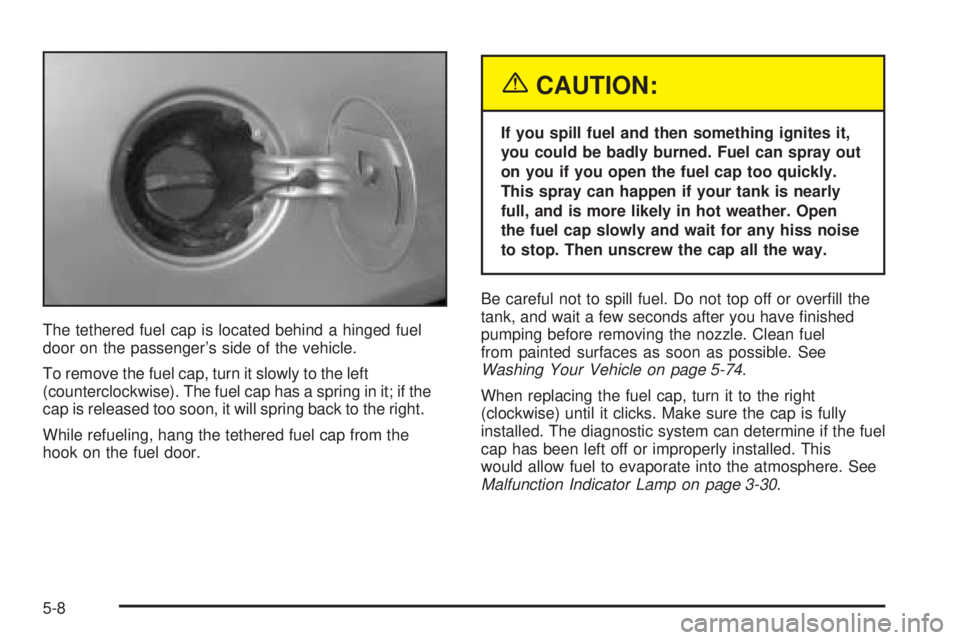
The tethered fuel cap is located behind a hinged fuel
door on the passenger’s side of the vehicle.
To remove the fuel cap, turn it slowly to the left
(counterclockwise). The fuel cap has a spring in it; if the
cap is released too soon, it will spring back to the right.
While refueling, hang the tethered fuel cap from the
hook on the fuel door.
{CAUTION:
If you spill fuel and then something ignites it,
you could be badly burned. Fuel can spray out
on you if you open the fuel cap too quickly.
This spray can happen if your tank is nearly
full, and is more likely in hot weather. Open
the fuel cap slowly and wait for any hiss noise
to stop. Then unscrew the cap all the way.
Be careful not to spill fuel. Do not top off or overfill the
tank, and wait a few seconds after you have finished
pumping before removing the nozzle. Clean fuel
from painted surfaces as soon as possible. See
Washing Your Vehicle on page 5-74.
When replacing the fuel cap, turn it to the right
(clockwise) until it clicks. Make sure the cap is fully
installed. The diagnostic system can determine if the fuel
cap has been left off or improperly installed. This
would allow fuel to evaporate into the atmosphere. See
Malfunction Indicator Lamp on page 3-30.
5-8
Page 221 of 334
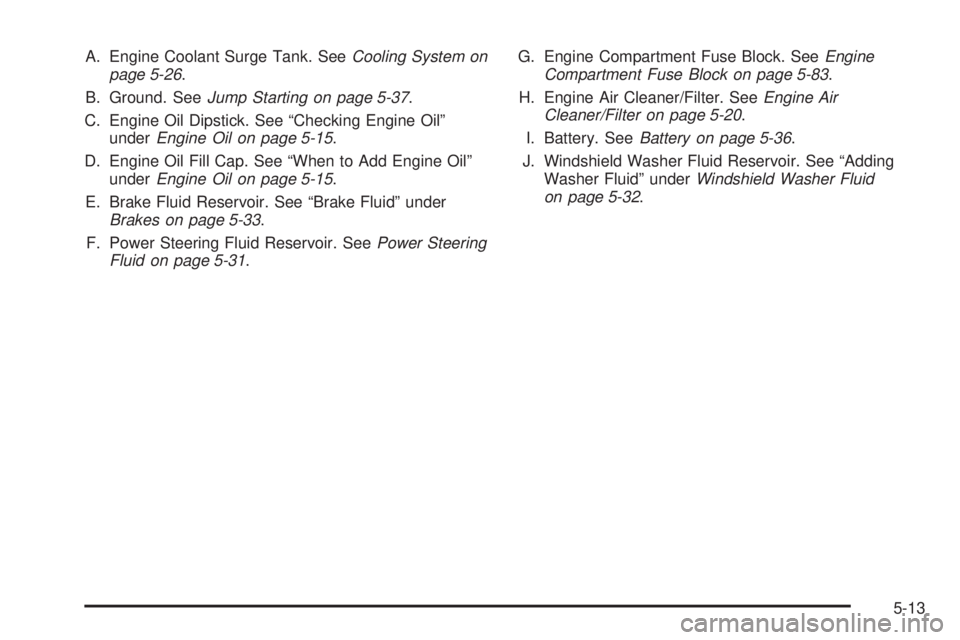
A. Engine Coolant Surge Tank. SeeCooling System on
page 5-26.
B. Ground. SeeJump Starting on page 5-37.
C. Engine Oil Dipstick. See “Checking Engine Oil”
underEngine Oil on page 5-15.
D. Engine Oil Fill Cap. See “When to Add Engine Oil”
underEngine Oil on page 5-15.
E. Brake Fluid Reservoir. See “Brake Fluid” under
Brakes on page 5-33.
F. Power Steering Fluid Reservoir. SeePower Steering
Fluid on page 5-31.G. Engine Compartment Fuse Block. SeeEngine
Compartment Fuse Block on page 5-83.
H. Engine Air Cleaner/Filter. SeeEngine Air
Cleaner/Filter on page 5-20.
I. Battery. SeeBattery on page 5-36.
J. Windshield Washer Fluid Reservoir. See “Adding
Washer Fluid” underWindshield Washer Fluid
on page 5-32.
5-13
Page 237 of 334
{CAUTION:
You can be burned if you spill coolant on hot
engine parts. Coolant contains ethylene glycol
and it will burn if the engine parts are hot
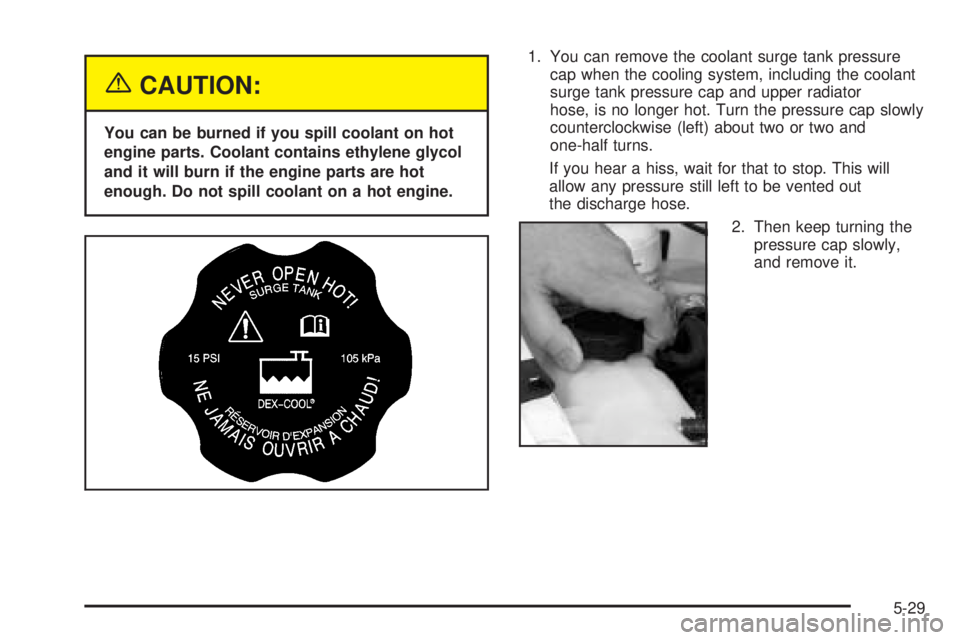
enough. Do not spill coolant on a hot engine.1. You can remove the coolant surge tank pressure
cap when the cooling system, including the coolant
surge tank pressure cap and upper radiator
hose, is no longer hot. Turn the pressure cap slowly
counterclockwise (left) about two or two and
one-half turns.
If you hear a hiss, wait for that to stop. This will
allow any pressure still left to be vented out
the discharge hose.
2. Then keep turning the
pressure cap slowly,
and remove it.
5-29
Page 251 of 334
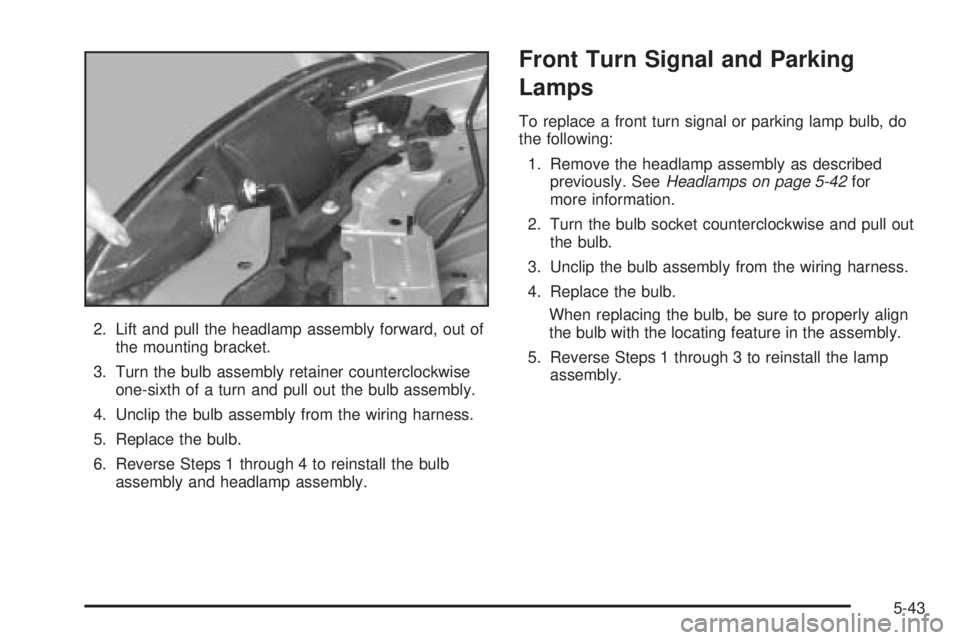
2. Lift and pull the headlamp assembly forward, out of
the mounting bracket.
3. Turn the bulb assembly retainer counterclockwise
one-sixth of a turn and pull out the bulb assembly.
4. Unclip the bulb assembly from the wiring harness.
5. Replace the bulb.
6. Reverse Steps 1 through 4 to reinstall the bulb
assembly and headlamp assembly.
Front Turn Signal and Parking
Lamps
To replace a front turn signal or parking lamp bulb, do
the following:
1. Remove the headlamp assembly as described
previously. SeeHeadlamps on page 5-42for
more information.
2. Turn the bulb socket counterclockwise and pull out
the bulb.
3. Unclip the bulb assembly from the wiring harness.
4. Replace the bulb.
When replacing the bulb, be sure to properly align
the bulb with the locating feature in the assembly.
5. Reverse Steps 1 through 3 to reinstall the lamp
assembly.
5-43
Page 269 of 334
Changing a Flat Tire
If a tire goes flat, avoid further tire and wheel damage
by driving slowly to a level place. Turn on your
hazard warning flashers.
{CAUTION:
Changing a tire can be dangerous. The vehicle
can slip off the jack and roll over or fall on you
or other people. You and they could be badly
injured or even killed. Find a level place to
change your tire. To help prevent the vehicle
from moving:
1. Set the parking brake rmly.
2. Put the shift lever in PARK (P).
CAUTION: (Continued)
CAUTION: (Continued)
3. Turn off the engine and do not restart
while the vehicle is raised.
4. Do not allow passengers to remain in the
vehicle.
To be even more certain the vehicle will not
move, you should put blocks at the front and
rear of the tire farthest away from the one
being changed. That would be the tire, on the
other side, at the opposite end of the vehicle.
5-61
Page 270 of 334
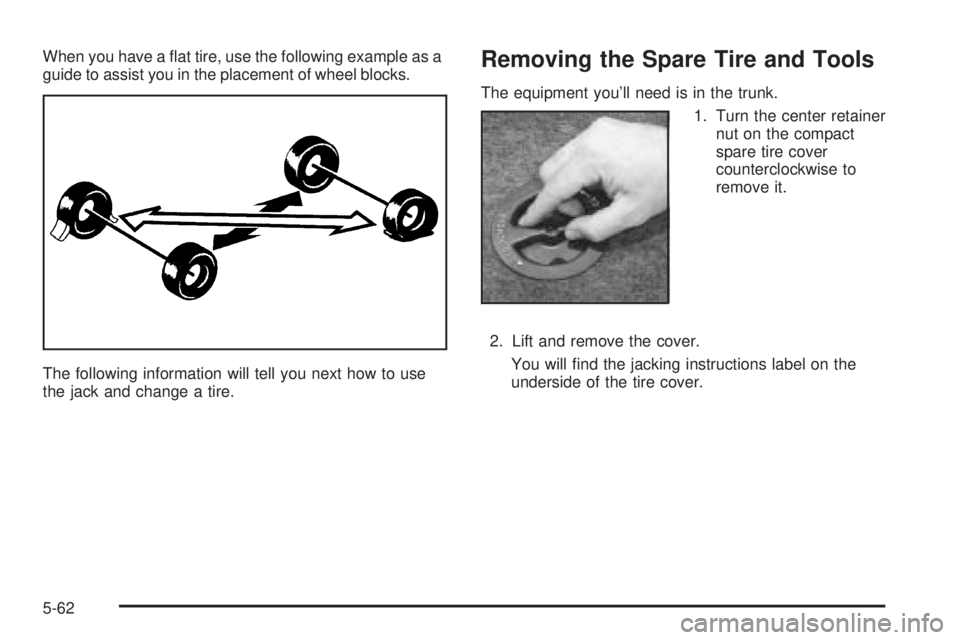
When you have a flat tire, use the following example as a
guide to assist you in the placement of wheel blocks.
The following information will tell you next how to use
the jack and change a tire.Removing the Spare Tire and Tools
The equipment you’ll need is in the trunk.
1. Turn the center retainer
nut on the compact
spare tire cover
counterclockwise to
remove it.
2. Lift and remove the cover.
You will find the jacking instructions label on the
underside of the tire cover.
5-62
Page 271 of 334
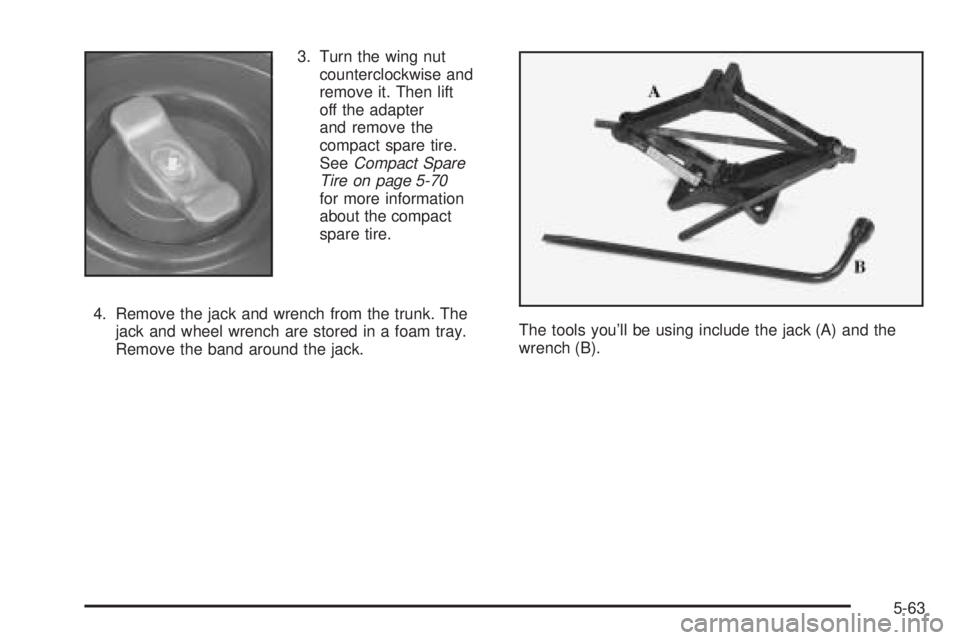
3. Turn the wing nut
counterclockwise and
remove it. Then lift
off the adapter
and remove the
compact spare tire.
SeeCompact Spare
Tire on page 5-70
for more information
about the compact
spare tire.
4. Remove the jack and wrench from the trunk. The
jack and wheel wrench are stored in a foam tray.
Remove the band around the jack.The tools you’ll be using include the jack (A) and the
wrench (B).
5-63
Page 274 of 334
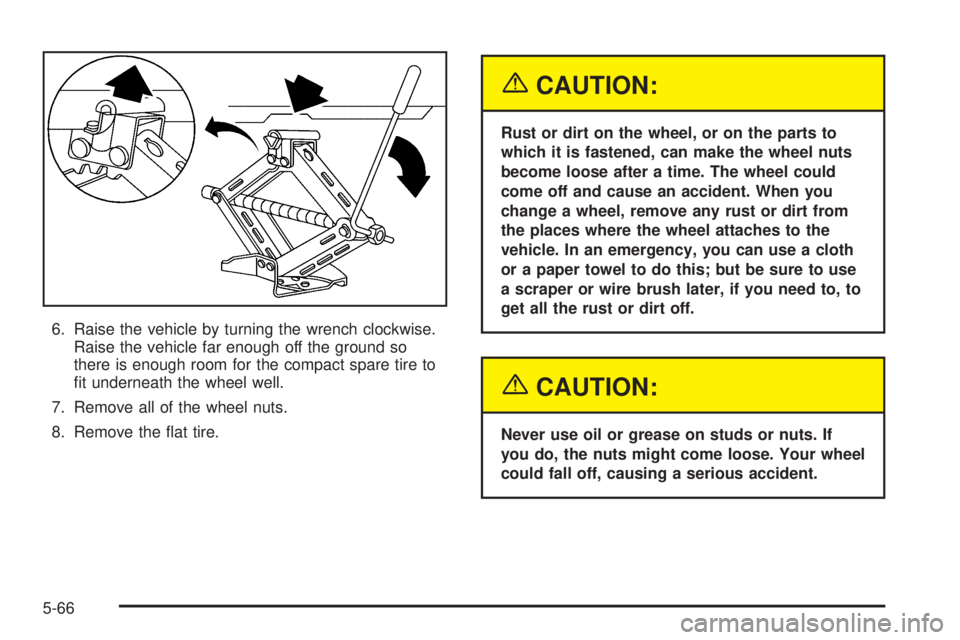
6. Raise the vehicle by turning the wrench clockwise.
Raise the vehicle far enough off the ground so
there is enough room for the compact spare tire to
fit underneath the wheel well.
7. Remove all of the wheel nuts.
8. Remove the flat tire.
{CAUTION:
Rust or dirt on the wheel, or on the parts to
which it is fastened, can make the wheel nuts
become loose after a time. The wheel could
come off and cause an accident. When you
change a wheel, remove any rust or dirt from
the places where the wheel attaches to the
vehicle. In an emergency, you can use a cloth
or a paper towel to do this; but be sure to use
a scraper or wire brush later, if you need to, to
get all the rust or dirt off.
{CAUTION:
Never use oil or grease on studs or nuts. If
you do, the nuts might come loose. Your wheel
could fall off, causing a serious accident.
5-66