light PONTIAC GRAND-PRIX 1993 Service Manual
[x] Cancel search | Manufacturer: PONTIAC, Model Year: 1993, Model line: GRAND-PRIX, Model: PONTIAC GRAND-PRIX 1993Pages: 338, PDF Size: 17.3 MB
Page 135 of 338
Comfort Controls & Audio Systems
Care of Your Cassette Tape
Player
(CONT.)
Clean your tape player with a wiping-
action, non-abrasive cleaning cassette,
and follow the directions provided with
it.
Cassettes are subject to wear and the
sound quality may degrade over time.
Always make sure that the cassette tape
is
in good condition before you have
your tape player serviced.
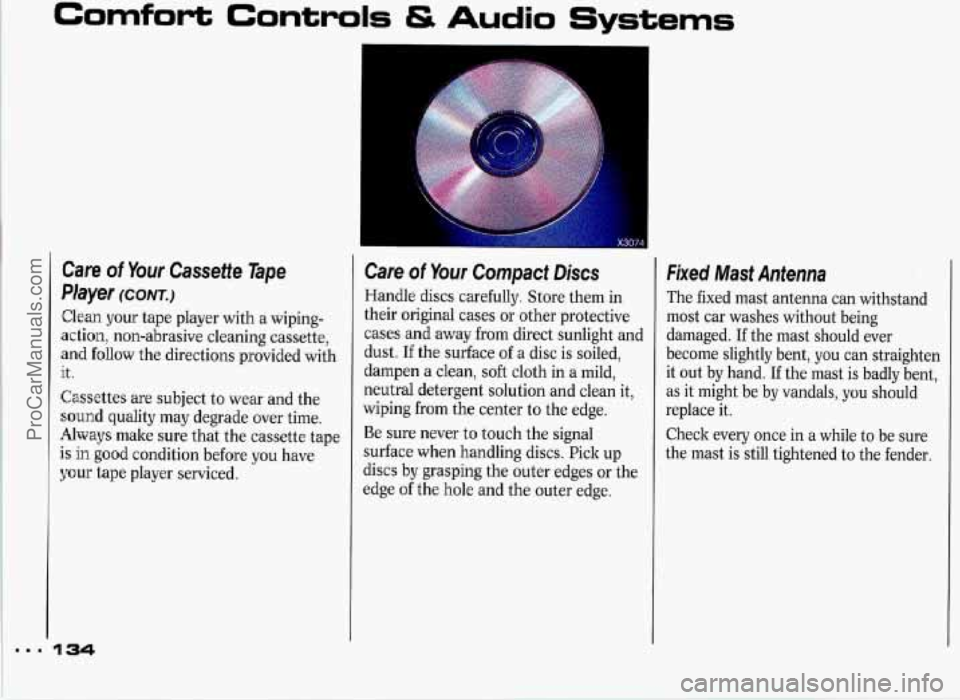
Care of Your Compact Discs
Handle discs carefully. Store them in
their original cases or other protective
cases and away from direct sunlight and
dust. If the surface of a disc is soiled,
dampen a clean, soft cloth in a mild,
neutral detergent solution and clean it,
wiping from the center to the edge.
Be sure never to touch the signal
surface when handling discs. Pick up
discs by grasping the outer edges or the
edge of the hole and the outer edge.
Fixed Mast Antenna
The fixed mast antenna can withstand
most car washes without being
damaged.
If the mast should ever
become slightly bent,
you can straighten
it
out by hand. If the mast is badly bent,
as it might be by vandals, you should
replace it.
Check every once in a while to be sure
the mast is still tightened to the fender.
ProCarManuals.com
Page 141 of 338
Your Driving and the Road
I X
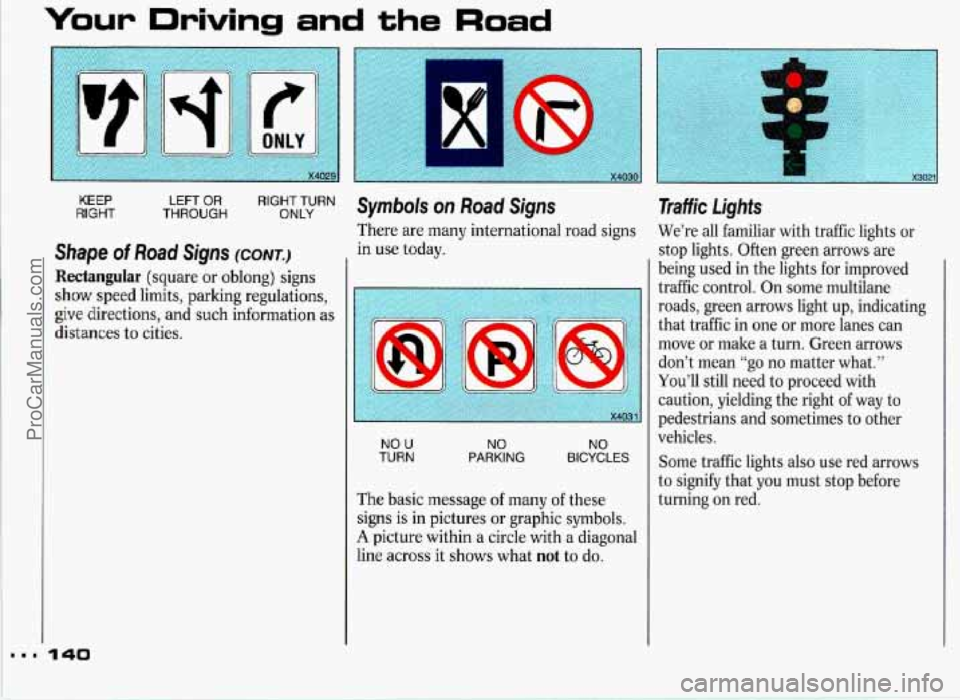
KEEP RIGHT LEFT OR THROUGH RIGHT TURN ONLY
Rectangular (square or oblong) signs
show speed limits, parking regulations,
give directions, and such information as
distances to cities.
Symbols on Road Signs
There are many international road signs
in use today.
NO u TURN NO PARKING NO
BICYCLES
The basic message of many of these
signs is in pictures or graphic symbols.
A picture within a circle with a diagonal
line across it shows what
not to do.
Traffic Lights
We’re all familiar with traffic lights or
stop lights. Often
green arrows are
being used in the lights for improved
traffic control. On some multilane
roads, green arrows light
up, indicating
that traffic in one
or more lanes can
move or make a turn. Green arrows
don’t mean
“go no matter what.”
You’ll still need to proceed with
caution, yielding the right
of way to
pedestrians and sometimes to other
vehicles.
Some traffic lights
also use red arrows
to signify that
you must stop before
turning on red.
ProCarManuals.com
Page 142 of 338
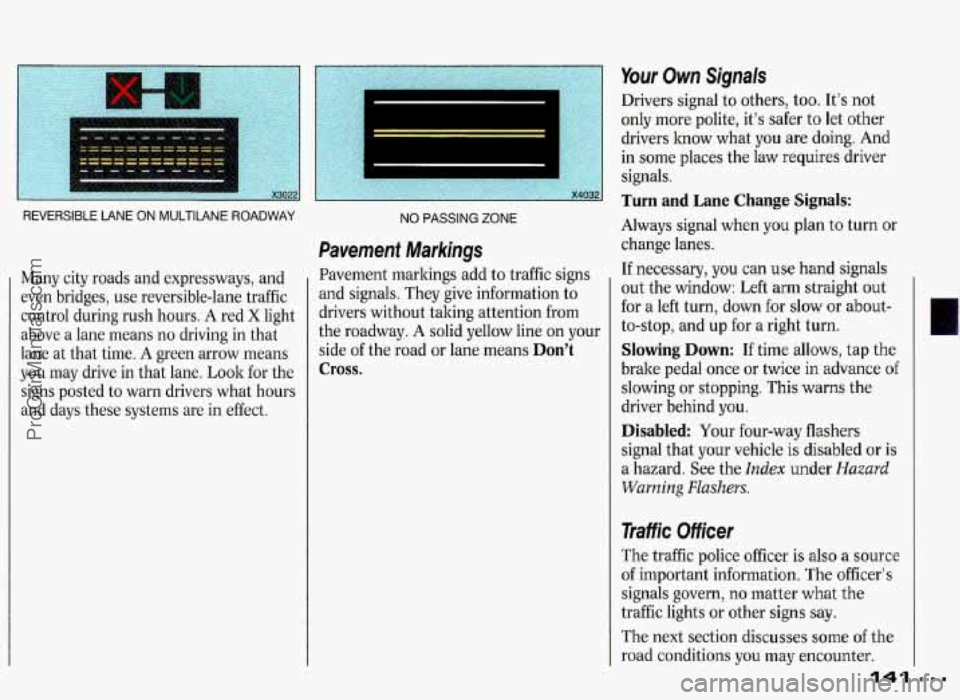
REVERSIBLE LANE ON MULTILANE ROADWAY
Many city roads and expressways, and
even bridges, use reversible-lane traffic
control during rush hours. A red
X light
above a lane means
no driving in that
lane at that time.
A green arrow means
you may drive in that lane. Look for the
signs posted to warn drivers what hours
and days these systems are in effect.
I
I
NO PASSING ZONE
Pavement Markings
Pavement markings add to traffic signs
and signals. They give information to
drivers without taking attention from
the roadway. A solid yellow line on your
side
of the road or lane means Don’t
Cross.
Your Own Signals
Drivers signal to others, too. It’s not
only more polite,
it’s safer to let other
drivers know what you are doing.
And
in some places the law requires driver
signals.
Turn and Lane Change Signals:
Always signal when you plan to turn or
change lanes.
If necessary, you can use hand signals
out the window: Left arm straight out
for a left turn,
down for slow or about-
to-stop, and up for a right turn.
Slowing Down: If time allows, tap the
brake pedal once or twice in advance
of
slowing or stopping. This warns the
driver behind you.
Disabled: Your four-way flashers
signal that your vehicle
is disabled or is
a hazard. See the
Index under Hazard
Warning Flashers.
Traffic Officer
The traffic police officer is also a source
of important information. The officer’s
signals govern, no matter what the
traffic lights
or other signs say.
The next section discusses some of the
road conditions you
may encounter.
141
ProCarManuals.com
Page 144 of 338
Drunken Driving
Death and injury associated with
drinking and driving is a national
tragedy. It’s the number one contributor
to the highway death toll, claiming
thousands of victims every
year.
Alcohol takes away three things that
anyone needs to drive a vehicle:
Judgment
Muscular Coordination
Vision
Police records show that half of all
motor vehicle-related deaths involve alcohol-a driver, a passenger or
someone else, such as a pedestrian, had
been drinking. In most cases, these
deaths are the result
of someone who
was drinking and driving. Over
25,000
motor vehicle-related deaths occur each
year because of alcohol, and thousands
of people are injured. Just
how much alcohol is too much
if a
~ person plans to drive? Ideally, no one
~ should drink alcohol and then drive.
But if one does, then what’s “too
much”? It can be
a lot less than many
might think. Although it depends on
each person and situation, here is
some
general information on the problem.
The Blood Alcohol Content (BAC)
of
someone who is drinking depends upon
four things:
How much alcohol is in the drink.
The drinker’s body weight.
The amount of food that is consumed
before and during drinlung.
The length of time it has taken the
drinker to consume the alcohol.
I
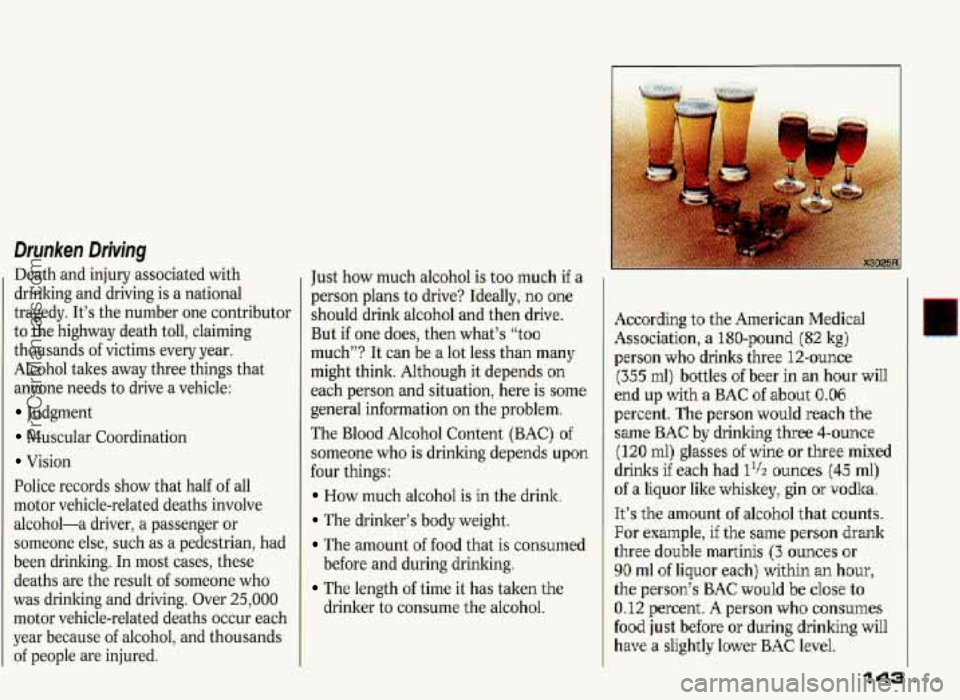
According to the American Medi’cal
Association,
a 180-pound [82 kg)
person who
drinks three 12-ounce
(355 mi) bottles of beer in an hour will
end up with a
BAC of about 0.06,
percent. The person would reach the
same BAC by drinking three 4-ounce
(120 ml) glasses of wine or three mixed
drinks
if each had ll/z ounces (45 ml)
of a liquor like whiskey, gin or vodka.
It’s the amount of alcohol that counts.
For example, if the same person drank
three double martinis (3 ounces or
90 rnl of liquor each) within an hour,
the person’s BAC would be close to
0.12 percent. A person who consumes
food just before or during drinking will
have a slightly lower BAC level.
ProCarManuals.com
Page 147 of 338
Your Driving and the Road
. .-
8raking
Braking action involves perception time
and reaction time.
First, you have to decide to push on the
brake pedal. That’s
perception time.
Then you have to bring up your foot
and do it. That’s
reaction time.
Average reaction time is about 3/4 of a
second. But that’s only an average.
It
might be less with one driver and as
long
as two or three seconds or more
with another. Age, physical condition,
alertness, coordination, and eyesight all
play a part.
So do alcohol, drugs and
frustration. But even in
3/4 of a second, a
vehicle moving at
60 mph (100 lun/h)
travels 66 feet (20 m). That could be a
lot
of distance in an emergency, so
keeping enough space between your
vehicle and others
is important.
146
~~ ~~ -
And, of course, actual stopping
distances vary greatly with the surface
of the road (whether it’s pavement or
gravel); the condition of the road (wet,
dry, icy); tire tread; and the condition of
your brakes.
Most drivers treat their brakes with
care. Some, however, overwork the
braking system with poor driving habits.
Avoid needless heavy braking. Some
people drive in spurts-heavy
acceleration followed by heavy
braking-rather than keeping pace
with traffic.
This is a mistake. Your
brakes may not have time to cool
between hard stops.
Your brakes will
wear out much faster if you do a lot of
heavy braking.
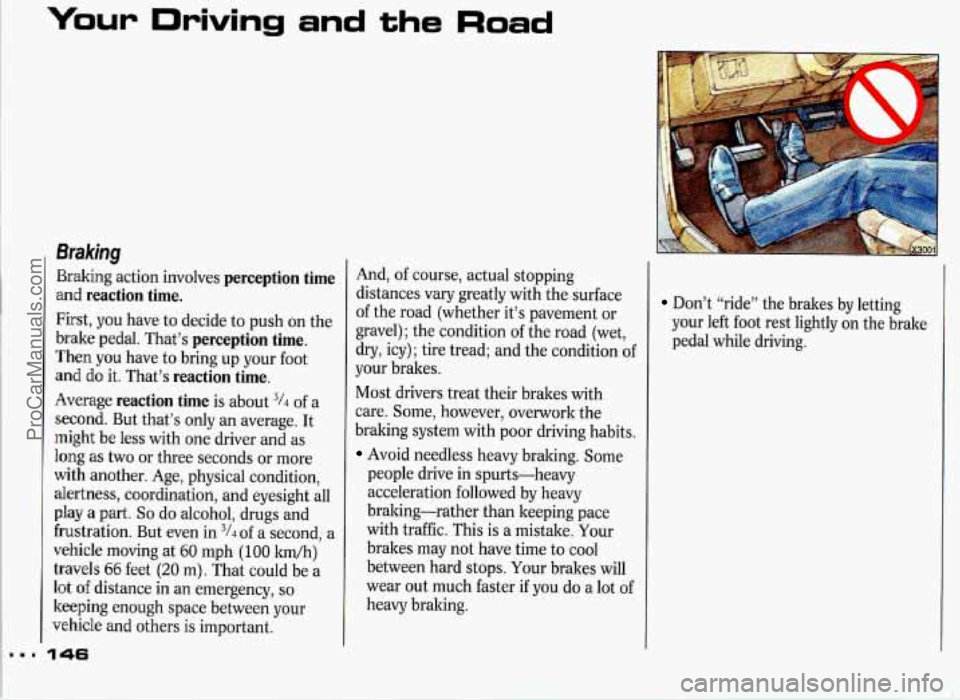
Don’t “ride” the brakes by letting
your left foot rest lightly on the brake
pedal while driving.
ProCarManuals.com
Page 149 of 338
ma.
Your Driving and the Road
Anti-lock Brakes (CONT.)
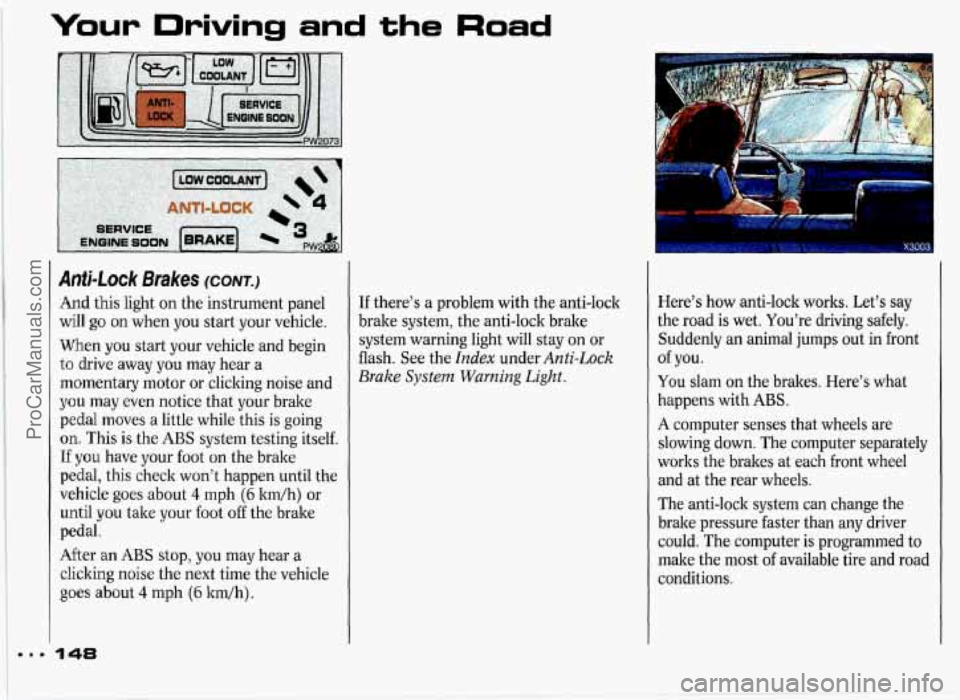
And this light on the instrument panel
will
go on when you start your vehicle.
When you start your vehicle and begin
to drive away you may hear a
momentary motor or clicking noise and
you may even notice that your brake
pedal moves a little while this is going
on. This is the ABS system testing itself.
If you have your foot on the brake
pedal, this check won't happen until the
vehicle goes about
4 mph (6 ltm/h) or
until you take your foot off the brake
pedal.
After
an ABS stop, you may hear a
clicking noise the next time the vehicle
goes about 4 mph (6 ltdh).
148
If there's a problem with the anti-lock
brake system, the anti-lock brake
system warning light will stay on or
flash. See the
Index under Anti-Lock
Brake
System Warning Light.
Here's how anti-lock works. Let's say
the road is wet. You're driving safely.
Suddenly an animal jumps out in front
You slam on the brakes. Here's what
happens with
ABS.
A computer senses that wheels are
slowing down. The computer separately
works the brakes at each front wheel
and at the rear wheels.
The anti-lock system can change the
brake pressure faster than any driver
could. The computer is programmed to
make the most
of available tire and road
conditions.
of you.
ProCarManuals.com
Page 151 of 338
Your Driving and the Road
Disc Brake Wear Indicators
(COWT.)
NOTICE
Continuing to drive with worn-out
brake pads could result in costly
brake repair.
Some driving conditions or climates
may cause a brake squeal when the
brakes are first applied or lightly
applied. This does not mean something
is wrong
with your brakes.
Brake linings should always be replaced
as complete axle sets.
Brake Pedal Travel
See your dealer if the brake pedal does
not return to normal height, or
if there
is a rapid increase in pedal travel. This
could be a sign
of brake trouble.
Brake Adjustment
Every time you make a moderate brake
stop, your disc brakes adjust for wear. If
you rarely make a moderate or heavier
stop, then your brakes might not adjust
correctly. If you drive in that way,
then-very carefully-make a few
moderate brake stops about every
1,000
miles (1 600 km) , so your brakes will
adjust properly.
ProCarManuals.com
Page 153 of 338
Your Driving and the Road
Steering Tips-Driving on Curves
It’s important to take curves at a
reasonable speed.
A lot of the “driver lost control”
accidents mentioned on the news
happen on curves. Here’s why:
Experienced driver or beginner, each of
us
is subject to the same laws of physics
when driving on curves. The traction of
the tires against the road surface makes
it possible for the vehicle to change its
path when you turn the front wheels. If
there’s
no traction, inertia will keep the
vehicle going in the same direction. If
you’ve ever tried to steer a vehicle
on
wet ice, you’ll understand this.
The traction you can get in a curve
depends on the condition
of your tires
and the road surface, the angle at which
the curve
is banked, and your speed.
While you’re in
a curve, speed is the one
factor you can control.
152
Suppose you’re steering through a
sharp curve. Then you suddenly apply
the brakes. Both control systems-
steering and braking-have to do their
work where the tires meet the road.
Unless you have four-wheel anti-lock
brakes, adding the hard braking can
demand too much at those places. You
can lose control.
The same thing can happen
if you’re
steering through a sharp curve and you
suddenly accelerate. Those two control
systems-steering and acceleration-
can overwhelm those places where the
tires meet the road and make you lose
control.
What should you do if this ever
happens? Let up on the brake or
accelerator pedal, steer the vehicle the
way you want it to go, and slow down. Speed limit signs near curves
warn that
you should adjust your speed. Of
course, the posted speeds are based on
good weather and road conditions.
Under less favorable conditions you’ll
want to
go slower.
If you need to reduce your speed
as you
approach a curve, do it before you enter
the curve, while your front wheels are
straight ahead.
Try to adjust your speed
so you can “drive” through the curve.
Maintain a reasonable, steady speed.
Wait to accelerate until you are out
of
the curve, and then accelerate gently
into the straightaway.
When you drive into a curve at night,
it’s harder to see the road ahead of you
because it bends away from the straight
beams
of your lights. This is one good
reason to drive slower.
ProCarManuals.com
Page 155 of 338
Your Driving and the Road
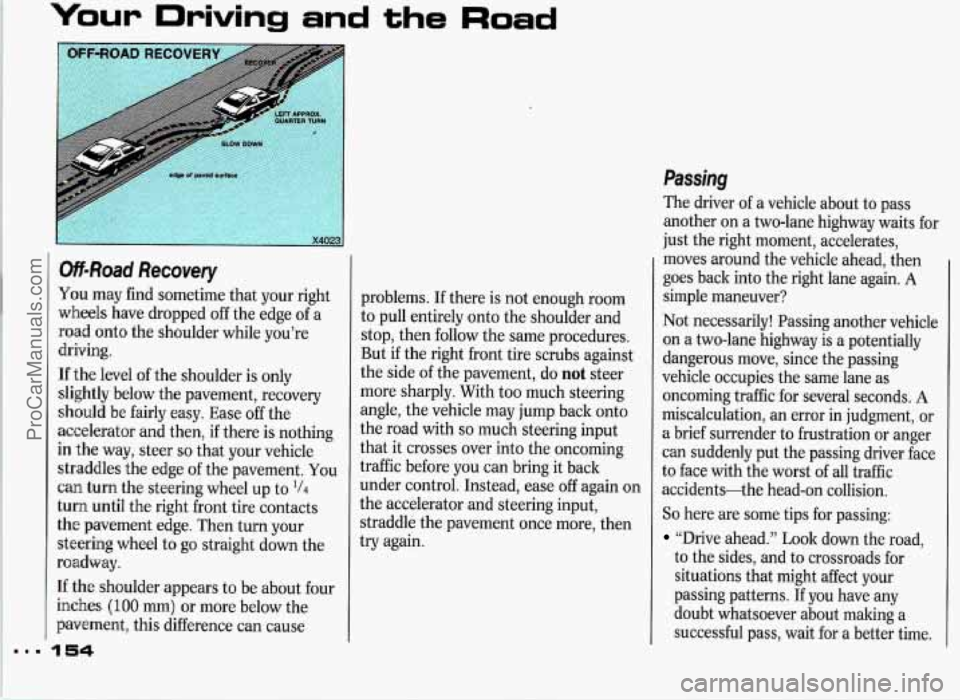
Off-Road Recovery
You may find sometime that your right
wheels have dropped
off the edge of a
road onto the shoulder while you’re
driving.
If the level of the shoulder is only
slightly below the pavement, recovery
should be fairly easy. Ease
off the
accelerator and then, if there is nothing
in the way, steer
so that your vehicle
straddles the edge of the pavement. You
can turn the steering wheel up to ‘/4
turn until the right front tire contacts
the pavement edge. Then turn your
steering wheel to go straight down the
roadway.
If the shoulder appears to be about four
inches (100 mm) or more below the
pavement, this difference can cause
154
problems. If there is not enough room
to pull entirely onto the shoulder and
stop, then follow the same procedures.
But
if the right front tire scrubs against
the side
of the pavement, do not steer
more sharply. With too much steering
angle, the vehicle may jump back onto
the road with
so much steering input
that it crosses over into the oncoming
traffic before you can bring it back
under control. Instead, ease
off again on
the accelerator and steering input,
straddle the pavement once more, then
try again.
Passing
The driver of a vehicle about to pass
another on a two-lane highway waits for
just the right moment, accelerates,
moves around the vehicle ahead, then
goes back into the right lane again.
A
simple maneuver?
Not necessarily! Passing another vehicle
on a two-lane highway is a potentially
dangerous move, since the passing
vehicle occupies the same lane as
oncoming traffic for several seconds.
A
miscalculation, an error in judgment, or
a brief surrender to frustration or anger
can suddenly put the passing driver face
to face with the worst of all traffic
accidents-the head-on collision.
So here are some tips for passing:
“Drive ahead.” Look down the road,
to the sides, and to crossroads for
situations that might affect your
passing patterns.
If you have any
doubt whatsoever about making a
successful pass, wait for a better time.
ProCarManuals.com
Page 156 of 338
Watch for traffic signs, pavement markings, and lines.
If you can see a
sign up ahead that might indicate a
turn or an intersection, delay your
pass. A broken center line usually
indicates it’s all right tdpass
(providing the road ahead is clear).
Never cross a solid line
on your side
of the lane or a double solid line, even
if the road seems empty of
approaching traffic.
If you suspect that the driver of the
vehicle you want to pass isn’t aware
of your presence, tap the horn a
couple of times before passing. Or,
you can use flash-to-pass. See the
Index under Flash-to-Pass.
Do not get too close to the vehicle you
want to pass while you’re awaiting an
opportunity. For one thing, following
too closely reduces your area of vision,
especially
if you’re following a larger
vehicle. Also, you won’t have adequate space if the vehicle ahead
suddenly slows or stops. Keep back a
reasonable distance.
When it looks like a chance to pass is
coming up, start to accelerate but stay
in the right lane and don’t get too
close. Time your move
so you will be
increasing speed as the time comes to
move into the other lane.
If the way is
clear to pass, you will have a “running
start” that more than makes up for
the distance
you would lose by
dropping back. And if something
happens to cause you to cancel your
pass, you need only slow down and
drop back again and wait for another
opportunity.
slow vehicle, wait your turn. But take
care that someone isn’t trying to pass
you as you pull out to pass the slow
vehicle. Remember to glance over
your shoulder and check the blind
spot.
If other cars are lined up to pass a
Check your mirrors, glance over your
shoulder, and start your left lane
change signal before moving out of
the right lane to pass. When you are
far enough ahead of the passed
vehicle to see its front in your inside
mirror, activate your right lane change
signal and move back into the right
lane. (Remember that your right
outside mirror is convex. The vehicle
you just passed may seem to be
farther away from you than
it really
is
.)
Try not to pass more than one vehicle
at a time on two-lane roads.
Reconsider before passing the next
vehicle.
vehicle too rapidly. Even though the
brake lights are not flashing, it may be
slowing down or starting
to turn.
If you’re being passed, make it easy
for the following driver
to get ahead of
you. Perhaps you can ease a little to
the right.
Don’t overtake a slowly moving
ProCarManuals.com