cooling PONTIAC GRAND-PRIX 1993 Owners Manual
[x] Cancel search | Manufacturer: PONTIAC, Model Year: 1993, Model line: GRAND-PRIX, Model: PONTIAC GRAND-PRIX 1993Pages: 338, PDF Size: 17.3 MB
Page 99 of 338
8..
Features & Controls
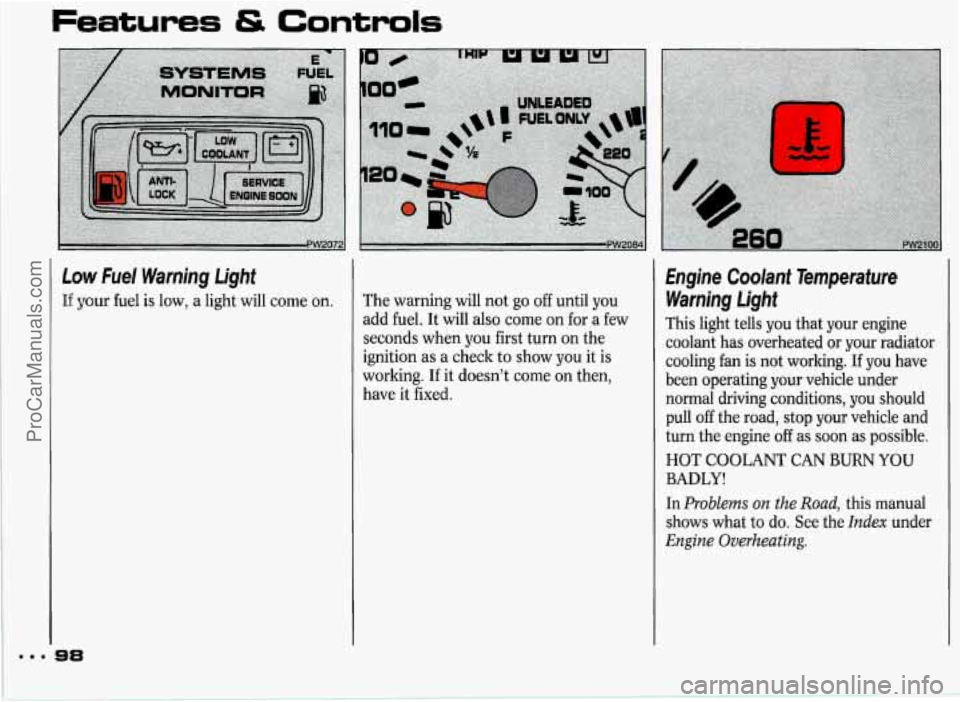
Low Fuel Warning Light
If your fuel is low, a light will come on.
98
The warning will not go off until you
add fuel. It will also come on for a few
seconds when
you first turn on the
ignition as a check to show you it is
working. If it doesn’t come on then,
have it fixed.
Engine Coolant Temperature Warning Light
This light tells you that your engine
coolant has overheated or your radiator
cooling fan is not working. If you have
been operating your vehicle under
normal driving conditions, you should
pull off the road, stop your vehicle and
turn the engine off
as soon as possible.
HOT
COOLANT CAN BURN YOU
BADLY!
In Problems on the Road, this manual
shows what to do.
See the Index under
Engine Overheating.
ProCarManuals.com
Page 117 of 338
Comfort Controls & Audio Systems
Climate Control
The air conditioner and heater work
best
if you keep your windows closed
while using them. Your vehicle also has
the flow-through ventilation system
described later in this section.
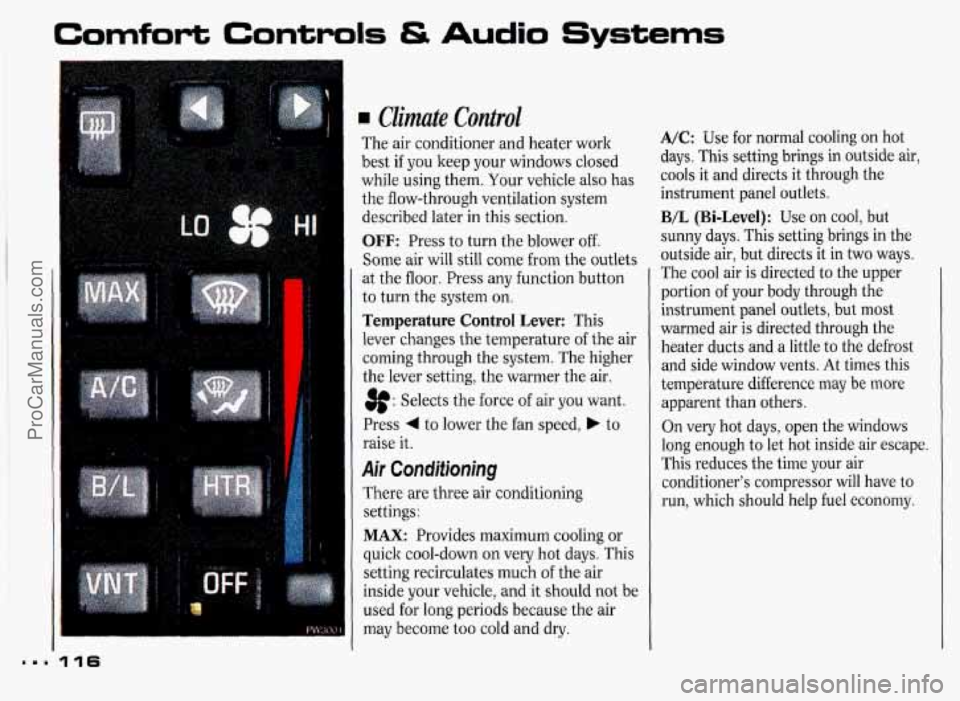
OFF: Press to turn the blower off.
Some air will still come from the outlets
at the floor. Press any function button
to turn the system on.
Temperature Control Lever: This
lever changes the temperature of the air
coming through the system. The higher
the lever setting, the warmer the air.
a: Selects the force of air you want.
Press
4 to lower the fan speed, b to
raise it.
Air Conditioning
There are three air conditioning
settings:
MAX: Provides maximum cooling or
quick cool-down on very hot days. This
setting recirculates much
of the air
inside your vehicle, and it should not be
used for long periods because the air
may become too cold and dry.
A/C: Use for normal cooling on hot
days. This setting brings in outside air,
cools it and directs it through the
instrument panel outlets.
B/L (Bi-Level): Use on cool, but
sunny days. This setting brings in the
outside air, but directs it in two ways.
The cool air
is directed to the upper
portion
of your body through the
instrument panel outlets, but most
warmed air is directed through the
heater ducts and
a little to the defrost
and side window vents. At times this
temperature difference may be more
apparent than others.
On very hot days, open the windows
long enough to let hot inside air escape.
This reduces the time your air
conditioner’s compressor will have to
run, which should help fuel economy.
ProCarManuals.com
Page 118 of 338
Heating and Ventilation
When you don’t need to cool the
outside air, use these next settings.
You
can leave the air as it is or heat it.
The air conditioner compressor doesn’t
run in the
VNT and HTR settings. This
reduces the engine load, resulting in
improved fuel economy (gas mileage).
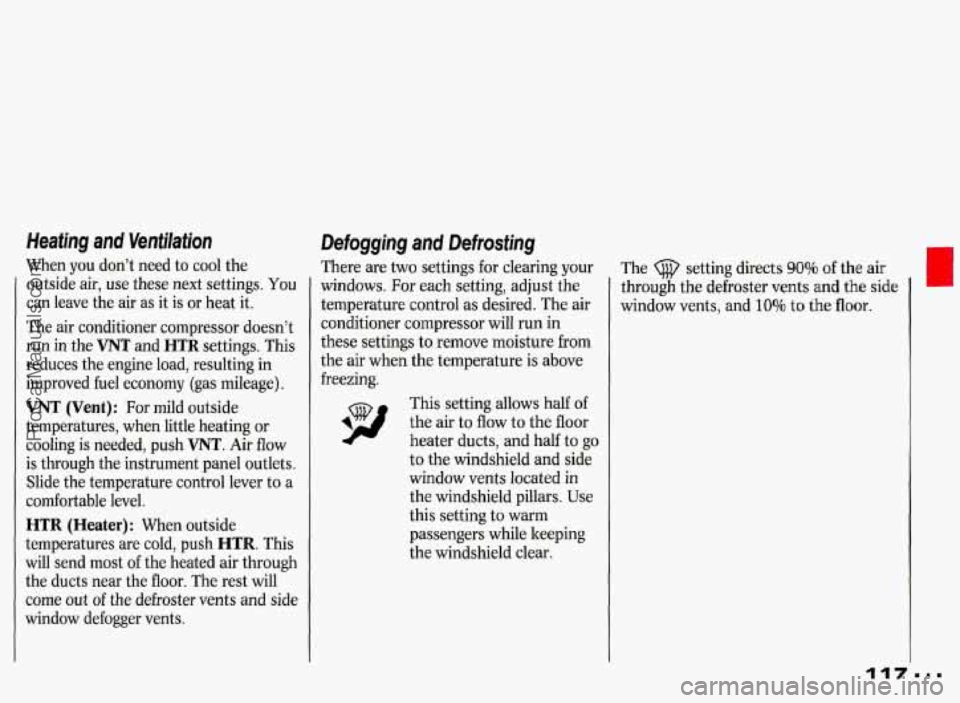
VNT (Vent): For mild outside
temperatures, when little heating or
cooling is needed, push
VNT. Air flow
is through the instrument panel outlets.
Slide the temperature control lever to a
comfortable level.
HTR (Heater): When outside
temperatures are cold, push
HTR. This
will send most of the heated air through
the ducts near the floor. The rest will
come out of the defroster vents and side
window defogger vents.
Defogging and Defrosting
There are two settings for clearing your
windows. For each setting, adjust the
temperature control
as desired. The air
conditioner compressor will run in
these settings to remove moisture from
the air when the temperature is above
freezing.
This setting allows half
of
\p the air to flow to the floor
heater ducts, and half to go
to the windshield and side
window vents located in
the windshield pillars. Use
this setting to warm
passengers while keeping
the windshield clear. The setting directs
90% of the air
through the defroster vents and the side
window vents, and
10% to the floor.
ProCarManuals.com
Page 182 of 338
Parking on Hills
You really should not park your vehicle,
with a trailer attached, on a hill.
If
something goes wrong, your rig could
start to move. People can be injured,
and both your vehicle and the trailer
can be damaged.
But if you ever have to park your rig on
a hill, here’s how to do it:
1. Apply your regular brakes, but don’t
shift into
P (Park) yet.
2. Have someone place chocks under
the trailer wheels.
3. When the wheel chocks are in place,
release the regular brakes until the
chocks absorb the load.
4. Reapply the regular brakes. Then
apply your parking brake, and then
shift to
P (Park).
5. Release the regular brakes.
When You Are Ready to Leave After
Parking
on a Hill
1. Apply your regular brakes and hold
the pedal down while you:
Start your engine;
Shift into a gear; and
Release the parking brake.
2. Let up on the brake pedal.
3. Drive slowly until the trailer is clear
4. Stop and have someone pick up and
of
the chocks.
store the choclts.
Maintenance When Trailer Towing
Your vehicle will need service more
often when you’re pulling a trailer. See
the Maintenance Schedule for more on
this. Things that are especially
important in trailer operation
are
automatic transaxle fluid (don’t
overfill), engine oil, belts, cooling
system, and brake adjustment. Each
of
these is covered in this manual, and the
Index will help you find them quickly. If
you’re trailering, it’s a good idea to
review these sections before you start
your trip.
Check periodically to see that all hitch
nuts and bolts are tight.
IBI ...
ProCarManuals.com
Page 195 of 338
Problems on the Road
Engine Overheafing ICONT.)
If you get the overheat warning with no
sign
of steam, try this for a minute or
1. Turn off your air conditioner.
2. Turn on your heater to full hot at the
SO:
highest fan speed and open the
window as necessary.
3. Try to keep your engine under load
(in a drive gear where the engine
runs slower).
If you no longer have the overheat
warning,
you can drive. Just to be safe,
drive slower for about ten minutes. If
the warning doesn’t come back
on, you
can drive normally.
If the warning continues, pull over, If
there’s still
no sign of steam, you can
idle
the engine for two or three minutes
while you’re parked, to
see if the
warning
stops. But then, if you still
have the warning,
TURN OFF THE
ENGINEANDGETEVERYONEOUT
OF THE IrEp3[1CLE until it cools down.
You may decide not to lift the hood but
to get servioe
help right away.
a
An electric fan under the
L L hood can start up even when
the engine
is not running and can
injure you. Keep hands, clothing
and tools away from any
underhood electric fan. I
stop, and park your vehicle right away. I I
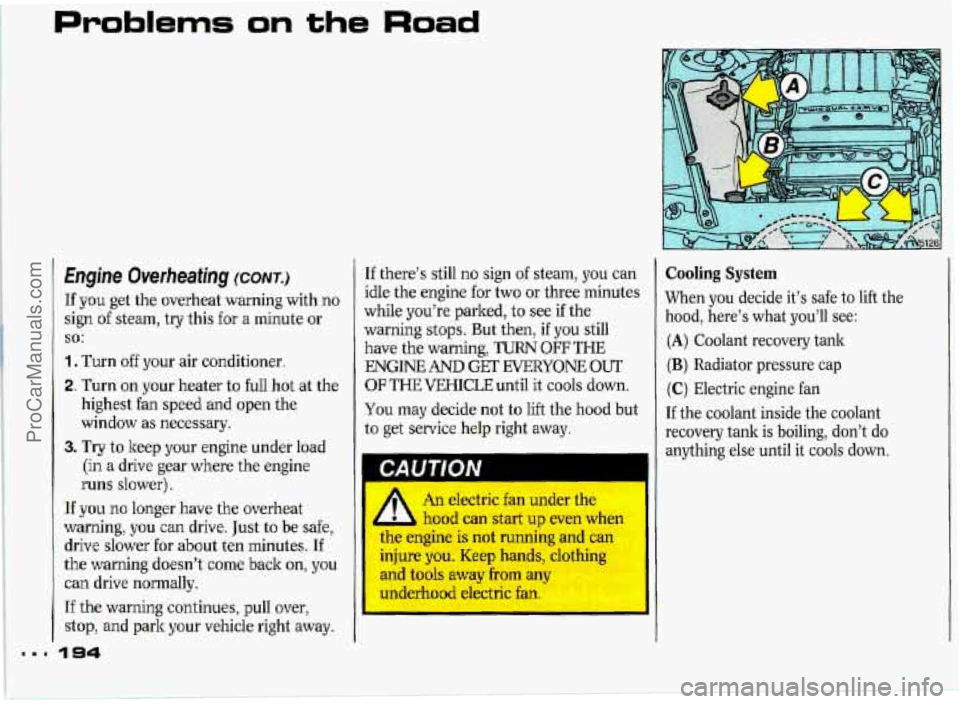
Cooling System
When you decide it’s safe to lift the
hood, here’s what you’ll see:
(A) Coolant recovery tank
(B) Radiator pressure cap
(C) Electric engine fan
If the coolant inside the coolant
recovery tank is boiling, don’t do
anything else until it cools down.
ProCarManuals.com
Page 196 of 338
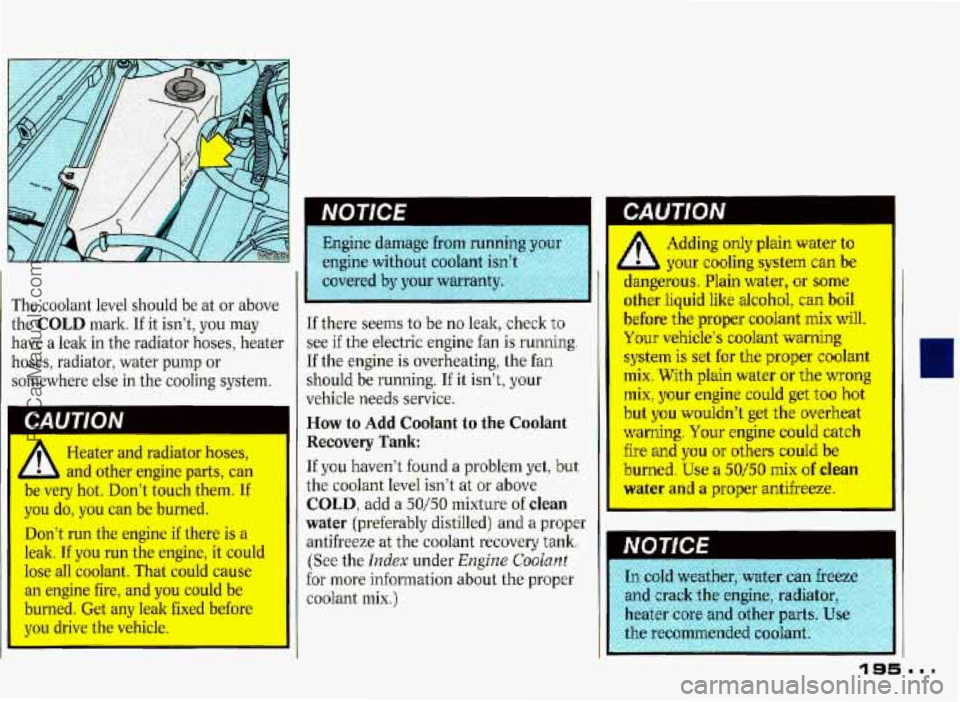
The coolant level should be at or above
the
COLD mark. If it isn’t, you may
have a leak in the radiator hoses, heater
hoses, radiator, water pump or
somewhere else in the cooling system.
~ CAUTION
A
Heater and radiator hoses,
and other
engine parts, can
be very hot. Don’t touch them. If
you do, you can be burned.
Don’$ run the engine if there is a
leak. If you run the engine, it could
lose all coolant. That could cause
an engine fire, and you could be
burned. Get any leak fixed before
I vou drive the vehicle.
If there seems to be no leak, check to
see if the electric engine fan is running.
If the engine is overheating, the fan
should be running. If it isn’t, your
vehicle needs service.
How to Add Coolant to the Coolant
Recovery Tank:
If you haven’t found a problem yet, but
the coolant level isn’t at or above
COLD, add a 50/50 mixture of clean
water (preferably distilled) and a proper
antifreeze at the coolant recovery tank.
(See the
Index under Engine Coolant
for more information about the proper
coolant mix.)
A
Adding only plain water to
your cooling system
can be
dangerous. Plain water,
or some I
other liquid like alcohol, can boil
before the proper coolant
mix will.
Your vehicle’s coolant warning
system
is set for the proper coolant
mix. With plain water or the wrong
mix, your engine could get too hot
but you wouldn’t get the overheat
warning. Your engine could catch
fire and
you or others could be
burned. Use a
50/50 mix of clean
water and a proper antifreeze.
cold weather, water can free-
d crack the engine, radiatnr
ater core and other parts.
ProCarManuals.com
Page 197 of 338
I
Problems on the Road
You can be burned ifp~
l spill coolant on hot engine
parts. Coolant contains ethylene
glycol
and it will bum if the engine
parts are hot enough. Don't spill
coolant on a hat engine.
When the coolant in the coolant
recovery tank
is at or above COLD,
start your vehicle.
If the overheat warning continues,
there's one more
thing you can try. You
can add the proper coolant mix directly
to
the radiator, but be sure the cooling
system is cool before you do it.
'I 96
A Steam and scalding liquids
L from a hot cooling system dm
b.,,v out and burn you badly. They
are under pressure, and if you turn
the radiator pressure cap-even a
little-they can come out at high
speed. Never turn the pressure cap
when the cooling system, including
the radiator pressure cap, is hot.
Wait for the cooling system and
radiator pressure cap tu cool if you
ever have to turn the pressure-cap.
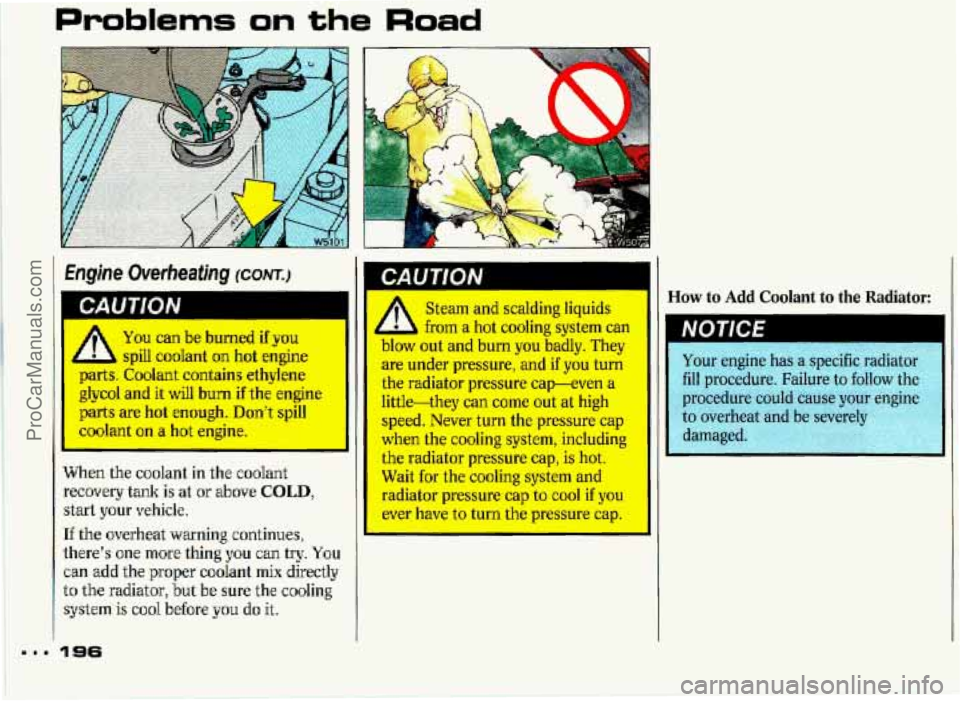
How to Add Coolant to the Radiator:
Your engine has a specific radiator
fill procedure. Failure
to follow the
procedure
could cause your engine
to overheat and be severely
damaged.
ProCarManuals.com
Page 198 of 338
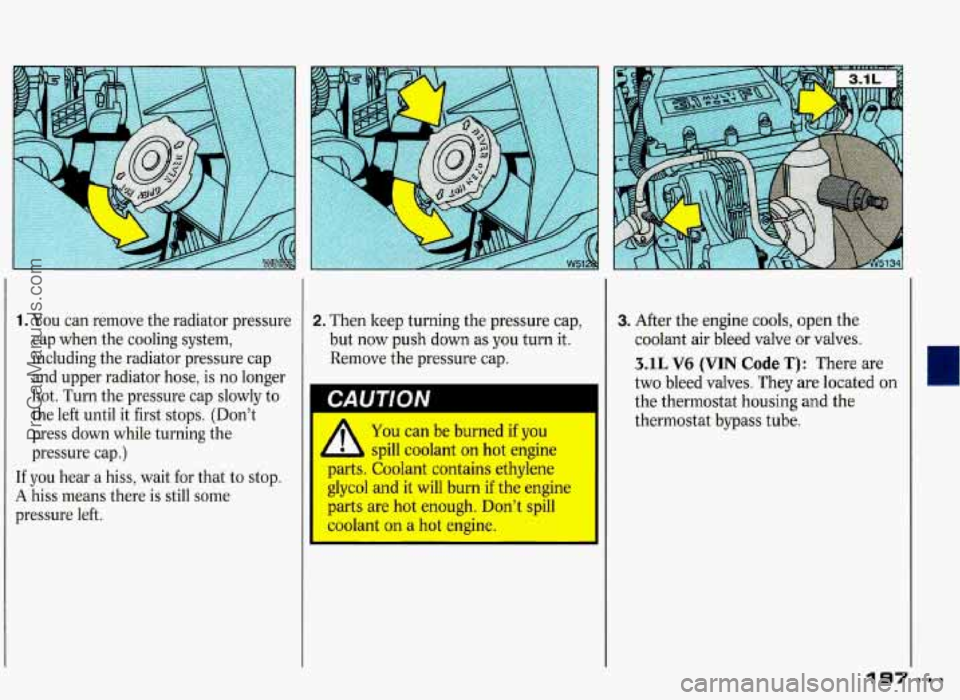
1. You can remove the radiator pressure
cap when the cooling system,
including the radiator pressure cap
and upper radiator hose, is
no longer
hot. Turn the pressure cap slowly to
the left until it first stops. (Don’t
press down while turning the
pressure cap.)
If you hear a hiss, wait for that to stop.
A hiss means there is still some
pressure left.
2. Then keep turning the pressure cap,
but now push down as you turn it.
Remove
the pressure cap.
I CAUTION
I A You can be burned if you
spill
coolant on hot engine
pa La. Coolant contains ethylene
glycol and it will burn if the engine
parts
are hot enough. Don’t spill
coolant on a hot engine.
3. After the engine cools, open the
coolant air bleed valve or valves.
3.1L V6 (VIN Code T): There are
two bleed valves. They
are located on
the thermostat housing and the
thermostat bypass tube.
ProCarManuals.com
Page 231 of 338
Service & Appearance Cam
Hydraulic Clutch Fluid (CONTJ
How to Check
The proper fluid should be added if the
level does not reach the bottom
of the
diaphragm when it’s in place in the
reservoir. See the instructions on the
reservoir cap.
230
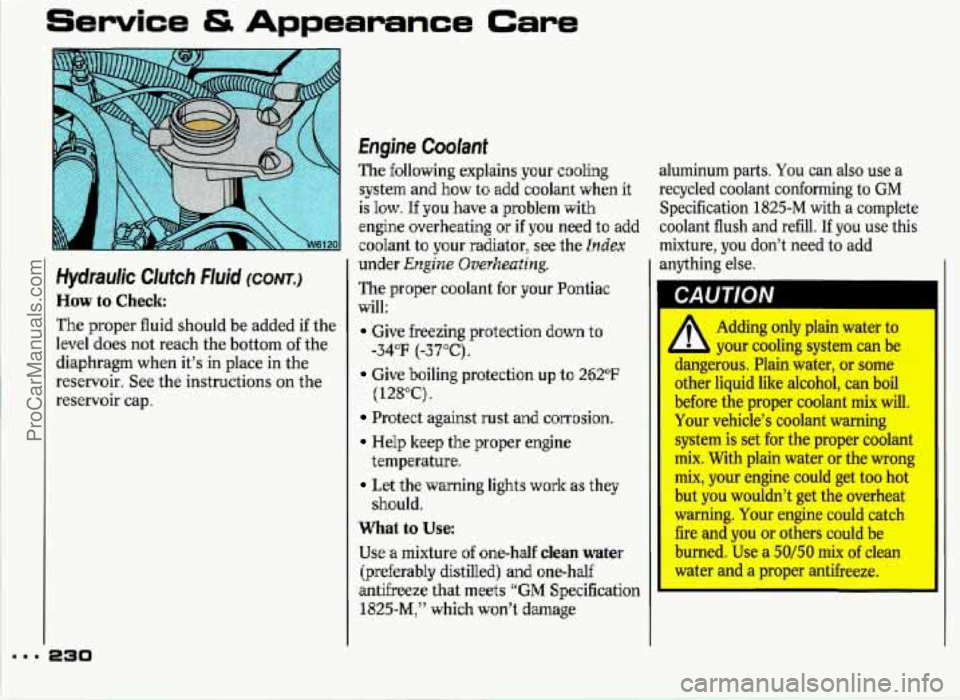
Engine Coolant
The following explains your cooling
system and
how to add coolant when it
is low. If you have a problem with
engine overheating or
if you need to add
coolant to your radiator, see the Index
under Engine Overheuling.
The proper coolant for your Pontia’c
will:
Give freezing protection do;wn to
Give boiling protection up to 262°F
Protect against rust and corrosion.
Help keep the proper engine
Let the warning lights work as they
What to Use:
Use a mixture of one-half dean water
(preferably distilled) and one-half
antifreeze that meets
“GM Specification
1825-M,” which won’t darnage
-34°F (-3 7 “C) .
(12S°C).
temperature.
should.
aluminum parts. You can also use a
recycled coolant conforming to
GM
Specification 1825-M with a complete
coolant flush and refill. If you use this
mixture, you don’t need to add
anything else.
Adding only plain water
to
your cooling system can be
dangerous. Plain water, or some
other liquid like alcohol, can boil
before the proper coolant mix will.
Your vehicle’s coolant warning
system is set for the proper coolant
mix. With plain water or the wrong
mix, your engine could get
too hot
but you wouldn’t get the overheat
warning. Your engine could catch
fire and you or others could be
burned. Use a
50/50 mix of clean
water and
a Droner antifreeze.
ProCarManuals.com
Page 261 of 338
Service 4S Appearance Care
Used Replacement Wheels Tire Chains
Using the wrong replacement I
1‘ I wheels, wheel bolts, or wheel
nuts on your vehicle can be
dangerous. It could affect the
braking md handling of you
vehicle, make your tires lose air and
make you lose control. You could
have a collision in which yau or
others could be injured. Always use
the correct wheel, wheel bolts, and
wheel nuts for replacement.
The wrong wheel can also cause
problems with bearing
life, brake
cooling, speedometer/odometer
calibration, headlight
aim, bumper
height, vehicle ground clearanr
and tire or tire chain clearancc
he body and chassis.
Putting a used wheel on your
1 b vehicle is dangerous, You
can’t how how it’s beerl used or
how rnany miles 8s been driven. It
could fail suddenly and muse an
accident. If you have to replace a
wheel use a new GM original
equipment wheel. I
If your Pontiac has P215/60R16,
P225/60R16 or P245/50ZR16 size
tires, don’t use tire chains; they
can damage your vehicle.
If you have other tires,
use
chains only when you must. I
only SAE Class “S” type chains
that are the proper size for your
tires. Install them on the front til
and tighten them as tightly as
possible with the ends securely
fastened. Drive slowly and
fnlh
the chain manufacturer’s
instructions. If you can hear
t
chains contacting your vehicle,
stop and retighten them.
If the
contact continues, slow
down until
it stops. Driving too fast with
chains on will damage your
vehicle.
ProCarManuals.com