heating PONTIAC GRAND-PRIX 1993 Owners Manual
[x] Cancel search | Manufacturer: PONTIAC, Model Year: 1993, Model line: GRAND-PRIX, Model: PONTIAC GRAND-PRIX 1993Pages: 338, PDF Size: 17.3 MB
Page 4 of 338
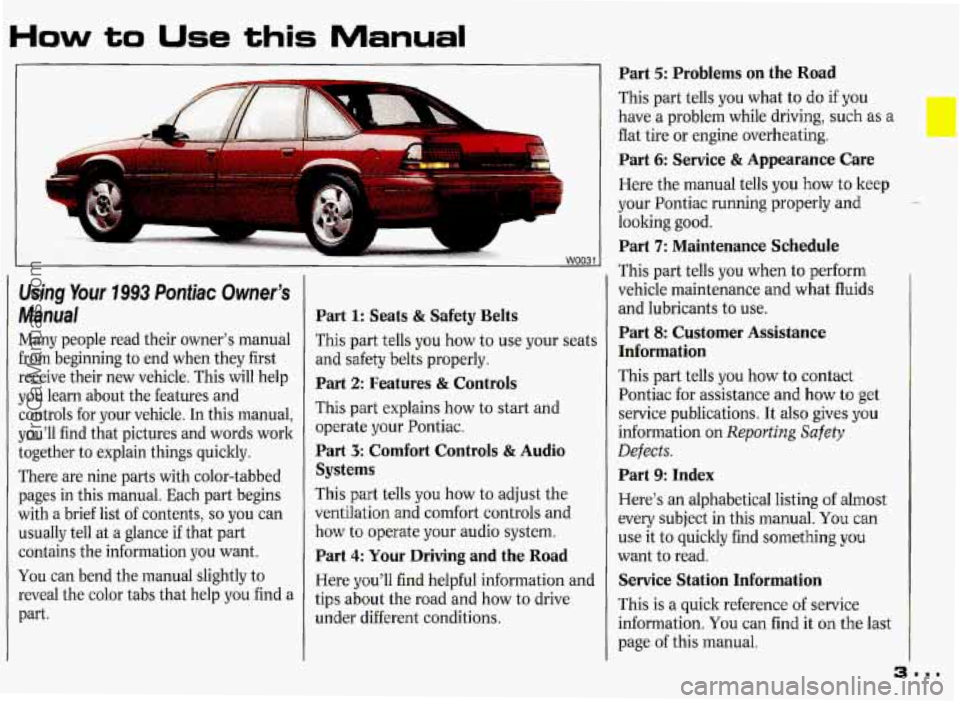
How to Use this Manual
b
Using Your 1993 Pontiac Owner’s
Manual
Many people read their owner’s manual
from beginning to end when they first
receive their new vehicle. This will help
you learn about the features and
controls for your vehicle. In this manual,
you’ll find that pictures and words work
together to explain things quicltly.
There are nine parts with color-tabbed pages in this manual. Each part begins
with a brief list of contents,
so you can
usually tell at a glance if that part
contains the information you want.
You can bend the manual slightly to
reveal the color tabs that help you find a
part.
Part 1: Seats & Safety Belts
This part tells you how to use your seat:
and safety belts properly.
Part 2: Features 8z Controls
This part explains how to start and
operate your Pontiac.
Part 3: Comfort Controls & Audio
Systems
This part tells you how to adjust the
ventilation
and comfort controls and
how to operate your audio system.
Part 4: Your Driving and the Road
Here you’ll find helpful information anc
tips about the road and how to drive
under different conditions.
Part 5: Problems on the Road
This part tells you what to do if you
have a problem while driving, such as a
flat tire or engine overheating.
Part 6: Service & Appearance Care
Here the manual tells you how to keep
your Pontiac running properly and
looking good.
Part 7: Maintenance Schedule
This part tells you when to perform
vehicle maintenance and what fluids
and lubricants to use.
Part 8: Customer Assistance
Information
This part tells you how to contact
Pontiac for assistance and how
to get
service publications. It also gives you
information on
Reporting Safety
Defects.
Part 9: Index
Here’s an alphabetical listing of almost
every subject in this manual.
You can
use it to quicltly find something
you
want to read.
Service Station Information
This is a quick reference of service
information.
You can find it on the last
page of this manual.
~~.
ProCarManuals.com
Page 89 of 338
Features & Controls
Ashfrays and Lighter (CONT.)
Don’t hold a cigarette lighter in
with your hand while it is heating.
If you do, it won’t be able to back
away from the heating element
when it’s readv. That can make it Don’t
put papers
and other things
that burn into your ashtrays.
If you
do, cigarettes or other smoking -1
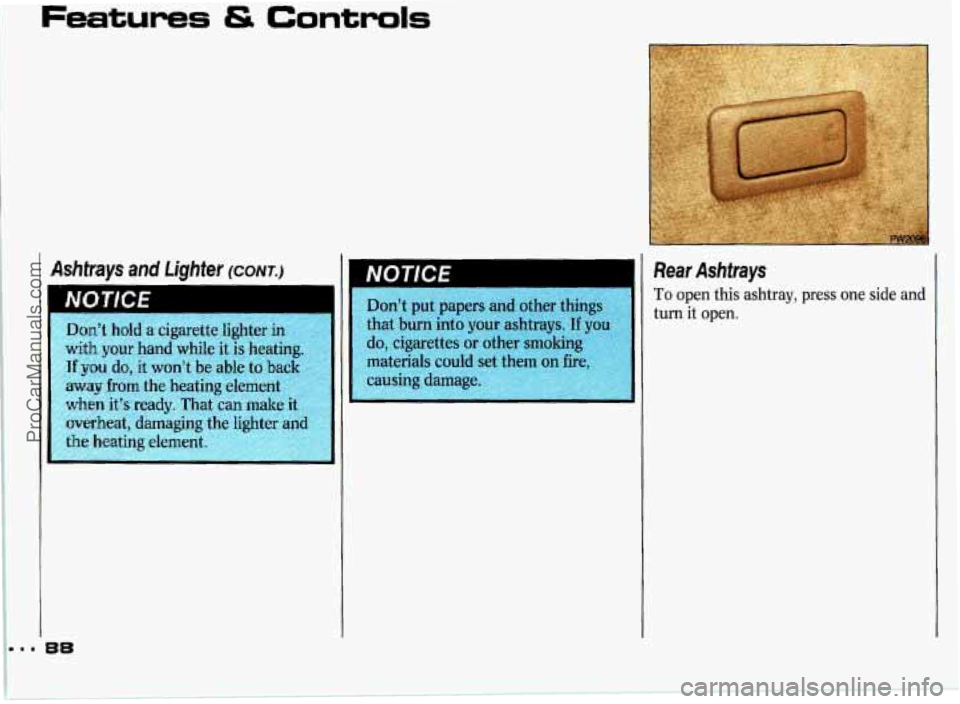
Rear Ashirays
To open this ashtray, press one side and
turn it open.
ProCarManuals.com
Page 99 of 338
8..
Features & Controls
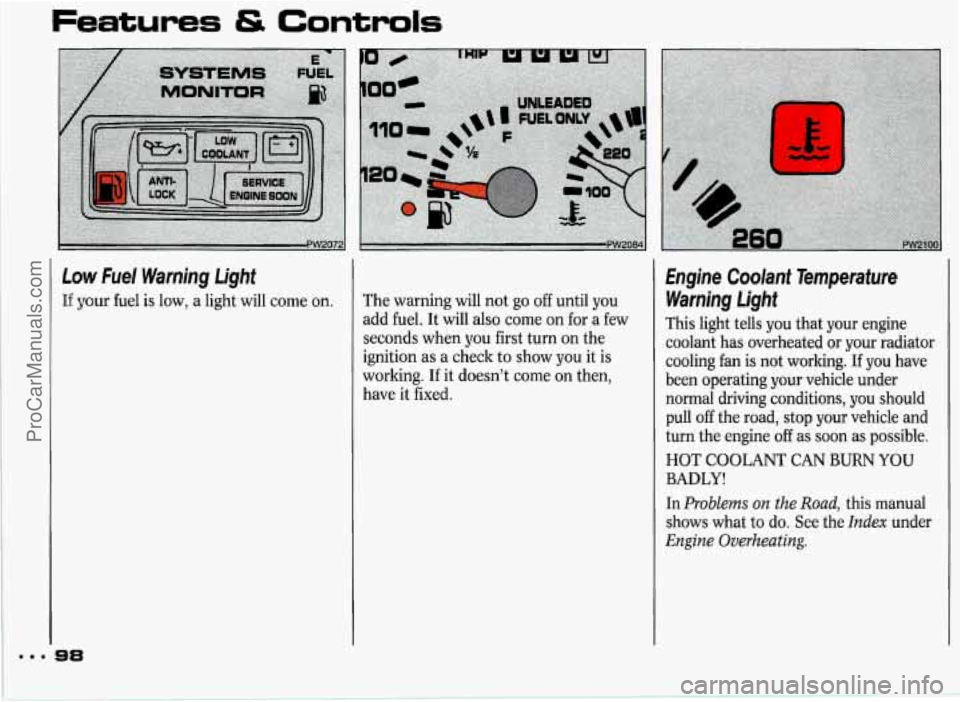
Low Fuel Warning Light
If your fuel is low, a light will come on.
98
The warning will not go off until you
add fuel. It will also come on for a few
seconds when
you first turn on the
ignition as a check to show you it is
working. If it doesn’t come on then,
have it fixed.
Engine Coolant Temperature Warning Light
This light tells you that your engine
coolant has overheated or your radiator
cooling fan is not working. If you have
been operating your vehicle under
normal driving conditions, you should
pull off the road, stop your vehicle and
turn the engine off
as soon as possible.
HOT
COOLANT CAN BURN YOU
BADLY!
In Problems on the Road, this manual
shows what to do.
See the Index under
Engine Overheating.
ProCarManuals.com
Page 100 of 338
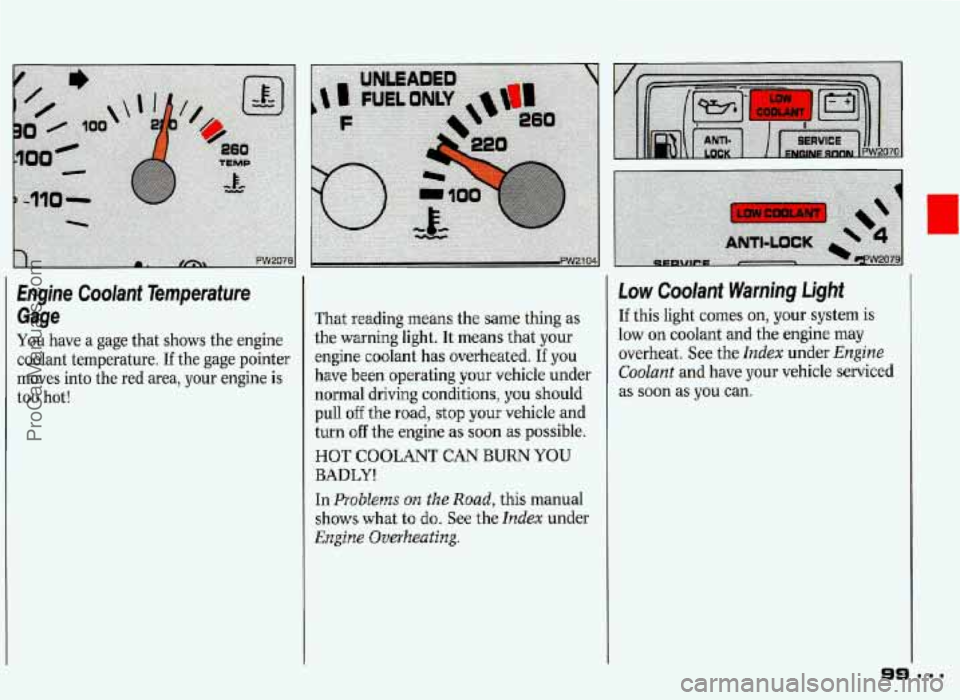
Engine Coolant Temperature Gage
You have a gage that shows the engine
coolant temperature.
If the gage pointer
moves into the red area, your engine
is
too hot! That
reading means the same thing as
the warning light.
It means that your
engine coolant
has overheated. If you
have
been operating your vehicle under
normal driving conditions, you should
pull
off the road, stop your vehicle and
turn
off the engine as soon as possible.
HOT COOLANT CAN BURN YOU
BADLY!
In Problems on the Road, this manual
shows what to
do. See the Index under
Engine Overheating.
Low Coolant Warning Light
If this light comes on, your system is
low on coolant and the engine may
overheat. See the
Index under Engine
Coolant and have your vehicle serviced
as soon as you can.
ProCarManuals.com
Page 118 of 338
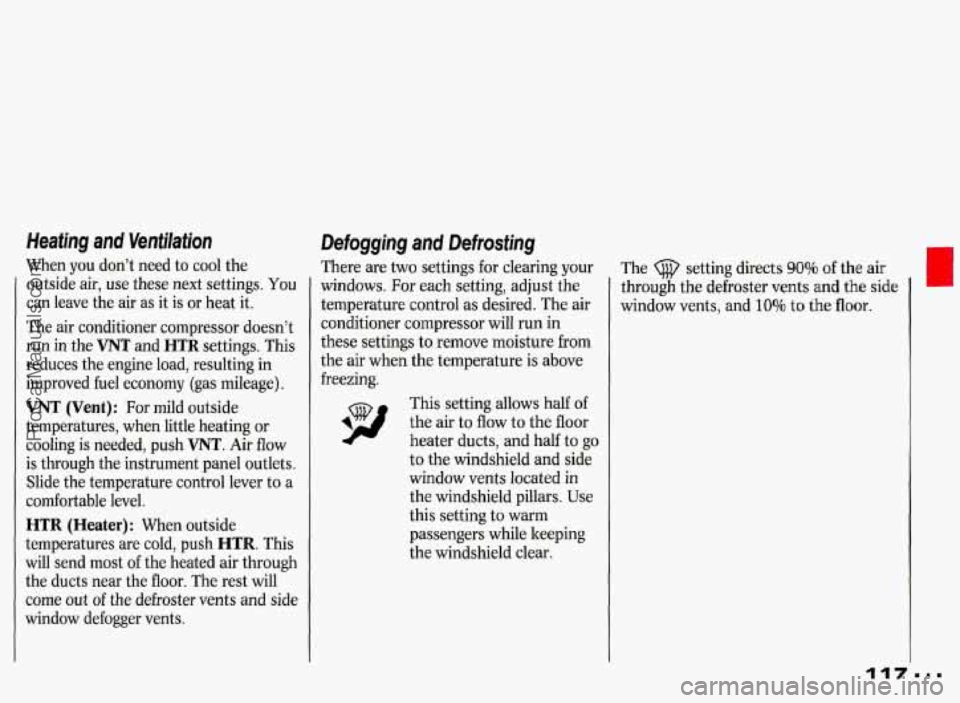
Heating and Ventilation
When you don’t need to cool the
outside air, use these next settings.
You
can leave the air as it is or heat it.
The air conditioner compressor doesn’t
run in the
VNT and HTR settings. This
reduces the engine load, resulting in
improved fuel economy (gas mileage).
VNT (Vent): For mild outside
temperatures, when little heating or
cooling is needed, push
VNT. Air flow
is through the instrument panel outlets.
Slide the temperature control lever to a
comfortable level.
HTR (Heater): When outside
temperatures are cold, push
HTR. This
will send most of the heated air through
the ducts near the floor. The rest will
come out of the defroster vents and side
window defogger vents.
Defogging and Defrosting
There are two settings for clearing your
windows. For each setting, adjust the
temperature control
as desired. The air
conditioner compressor will run in
these settings to remove moisture from
the air when the temperature is above
freezing.
This setting allows half
of
\p the air to flow to the floor
heater ducts, and half to go
to the windshield and side
window vents located in
the windshield pillars. Use
this setting to warm
passengers while keeping
the windshield clear. The setting directs
90% of the air
through the defroster vents and the side
window vents, and
10% to the floor.
ProCarManuals.com
Page 181 of 338
Your Driving and the Road
Driving with a Trailer (CONT.)
Making Turns
When you’re turning with a trailer,
make wider turns than normal. Do this
so your trailer won’t strike soft
sh’oulders, curbs, road signs, trees, or
other objects. Avoid jerky or sudden
maneuvers. Signal well in advance.
Turn Signals When Towing a Trailer
When you tow a trailer, your vehicle has
to have a different turn signal flasher
and extra wiring. The green arrows on
your instrument panel will flash
whenever you signal
a turn or lane
change. Properly hooked
up, the trailer
lights will also flash, telling other
drivers you’re about to turn, change
lanes or stop.
When towing a trailer, the green arrows
on your instrument panel will flash for
turns even if the bulbs on the trailer are
burned out. Thus, you may think
drivers behind you are seeing your
signal when they are not.
It’s important
to check occasionally
to be sure the
trailer bulbs are still working.
Your vehicle has bulb warning lights.
When you plug trailer lights into your
vehicle’s lighting system, its bulb
warning lights may not let you know if
one of your lights goes out.
So, when
you have trailer lights plugged in, be
sure
to check your vehicle and trailer
lights
from time to time to be sure
they’re all working. Once
you
disconnect the trailer lights, the bulb
warning lights again can tell you if one
of your vehicle lights is out.
Driving On Grades
Reduce speed and shift to a lower gear
before you start down a long or steep
downgrade.
If you don’t shift down, you
might have to use your brakes so much
that they would get hot and
no longer
work well.
On a long uphill grade, shift down and
reduce your speed to around
45 mph
(70 kwh) to reduce the possibility of
engine and transaxle overheating.
If you are towing a trailer and you have
an automatic transaxle with Overdrive,
it’s best to drive in
D instead of (or
as you need to, a lower gear). This will
minimize heat build-up and extend the
life of your transaxle.
ProCarManuals.com
Page 184 of 338
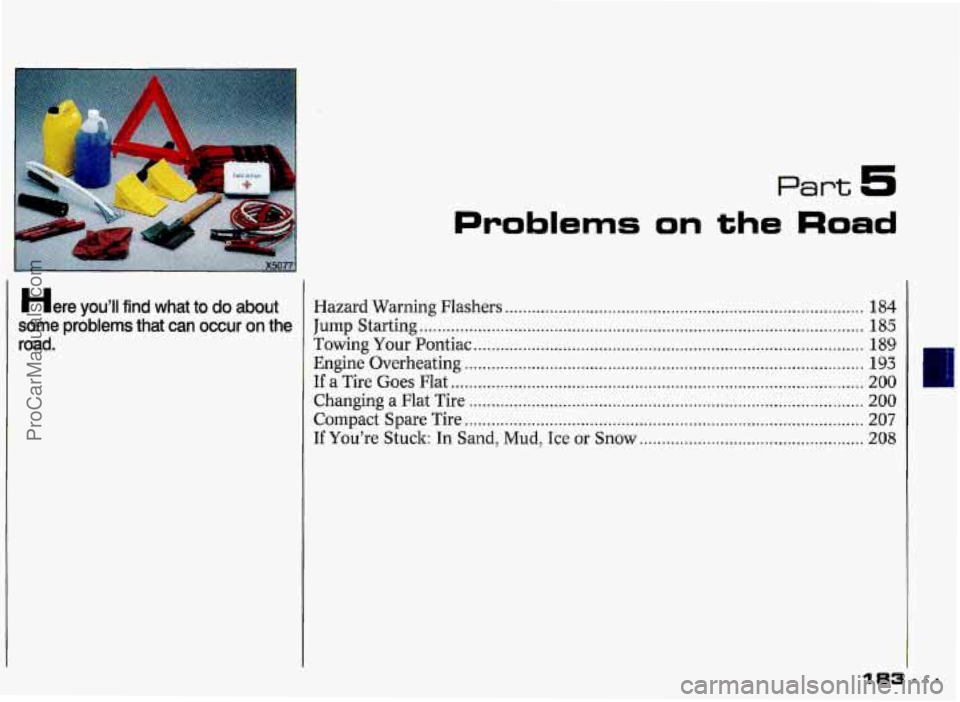
Here you’ll find what to do about
some problems that can occur on the
road
.
Part 5
Problems on the Road
Hazard Warning Flashers ........................................................................\
........ 184
Towing Your Pontiac ........................................................................\
............... 189
Engine Overheating ........................................................................\
................. 193
If a Tire Goes Flat ........................................................................\
.................... 200
Changing a Flat Tire ........................................................................\
................ 200
Compact Spare Tire ........................................................................\
................. 207
If You’re Stuck: In Sand, Mud. Ice or Snow .................................................. 208
Jump Starting ........................................................................\
........................... 185
ProCarManuals.com
Page 194 of 338
Engine Overheating
You will find a coolant temperature
gage or the warning light about
a hot
engine
on your Pontiac's instrument
panel.
You may also find a low coolant
warning light
on your Pontiac's
instrument panel.
r
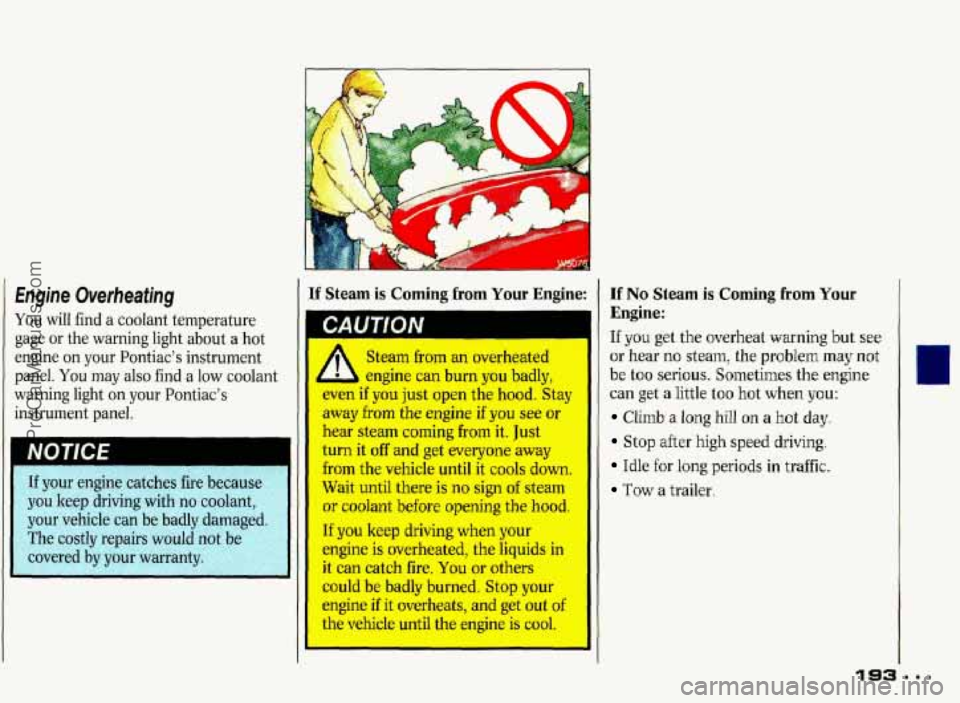
If Steam is Coming from Your Engine:
L Steam from an overheated
- b engine can burn you badly,
even if you just open the hood. Stay
away from the engine if you see or
hear steam coming from it. Just
turn it off and get everyone away
from the vehicle until it cools down.
Wait until there is no sign of steam
DP eoolant before opening the hood.
If you keep driving when your
engine is overheated, the liquids in
it can catch fire. YOU or others
could be badly burned. Stop your
engine if it overheats, and get out of
the vehicle until the engine is COOL
1
If No Steam is Coming from Your
Engine:
If you get the overheat warning but see
or hear no steam, the problem may not
be too serious. Sometimes the engine
can get a little too hot when you:
Climb a long hill on a hot day.
Stop after high speed driving.
Idle for long periods in traffic.
Tow a trailer.
-
!
ProCarManuals.com
Page 196 of 338
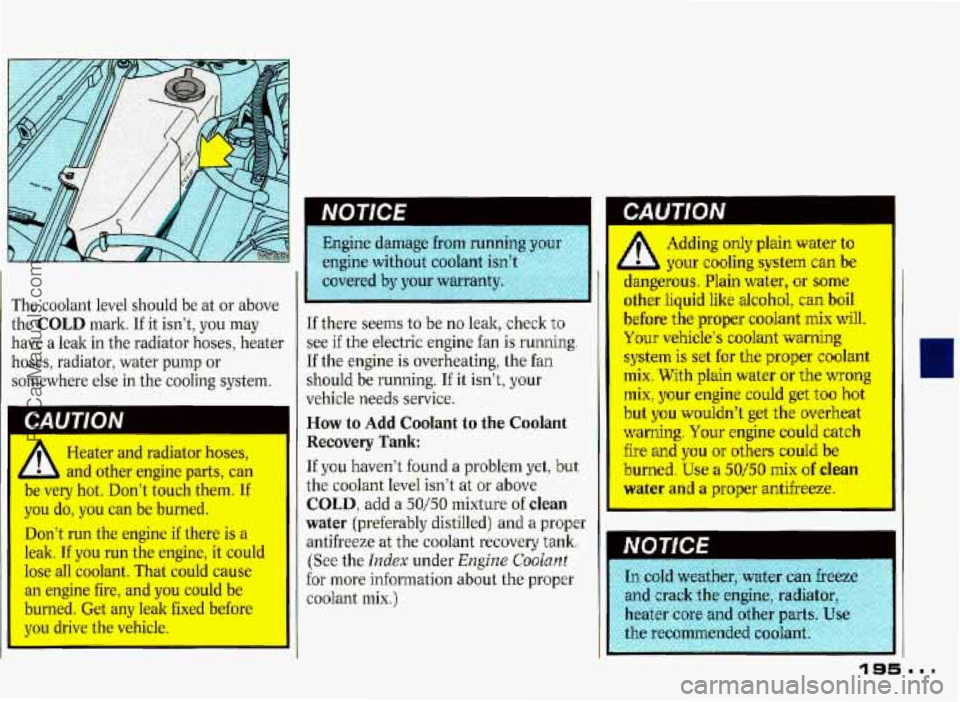
The coolant level should be at or above
the
COLD mark. If it isn’t, you may
have a leak in the radiator hoses, heater
hoses, radiator, water pump or
somewhere else in the cooling system.
~ CAUTION
A
Heater and radiator hoses,
and other
engine parts, can
be very hot. Don’t touch them. If
you do, you can be burned.
Don’$ run the engine if there is a
leak. If you run the engine, it could
lose all coolant. That could cause
an engine fire, and you could be
burned. Get any leak fixed before
I vou drive the vehicle.
If there seems to be no leak, check to
see if the electric engine fan is running.
If the engine is overheating, the fan
should be running. If it isn’t, your
vehicle needs service.
How to Add Coolant to the Coolant
Recovery Tank:
If you haven’t found a problem yet, but
the coolant level isn’t at or above
COLD, add a 50/50 mixture of clean
water (preferably distilled) and a proper
antifreeze at the coolant recovery tank.
(See the
Index under Engine Coolant
for more information about the proper
coolant mix.)
A
Adding only plain water to
your cooling system
can be
dangerous. Plain water,
or some I
other liquid like alcohol, can boil
before the proper coolant
mix will.
Your vehicle’s coolant warning
system
is set for the proper coolant
mix. With plain water or the wrong
mix, your engine could get too hot
but you wouldn’t get the overheat
warning. Your engine could catch
fire and
you or others could be
burned. Use a
50/50 mix of clean
water and a proper antifreeze.
cold weather, water can free-
d crack the engine, radiatnr
ater core and other parts.
ProCarManuals.com
Page 199 of 338
Problems on the Road
I I
~
I..
€ngh Overheating (cow.)
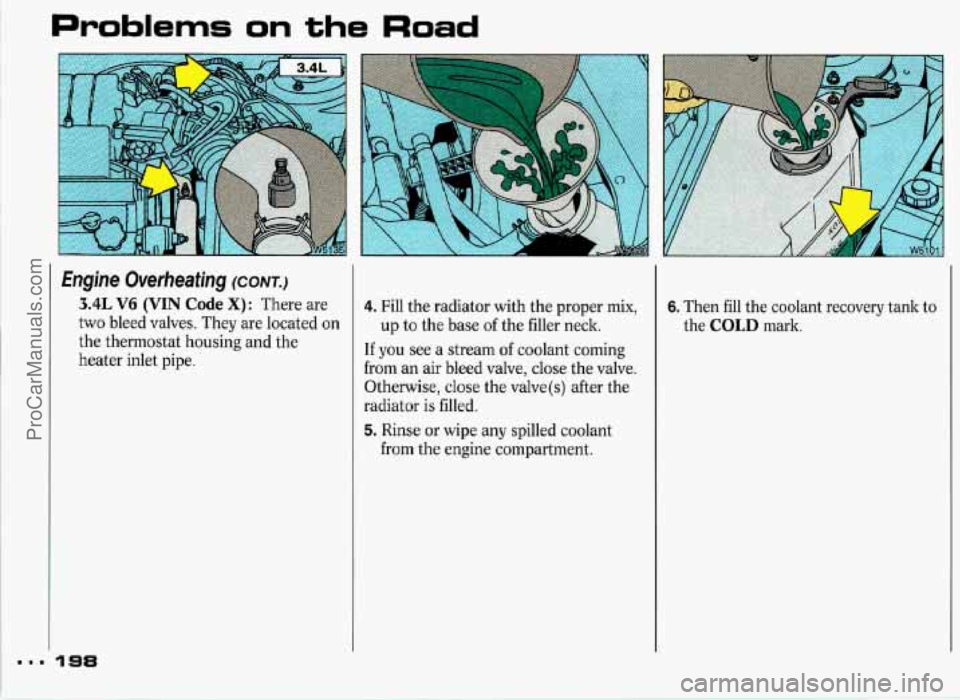
3.4L V6 (VIN Code X): There are
two bleed valves. They are located on
the thermostat housing and the
heater inlet pipe.
1 918
4. Fill the radiator with the proper mix,
up to the base of the filler neck.
If you see a stream of coolant coming
from an air bleed valve, close the valve.
Otherwise, close the valve(s) after the
radiator is filled.
5. Rinse or wipe any spilled coolant
from the engine compartment.
6. Then fill the coolant recovery tank to
the
COLD mark.
ProCarManuals.com