ESP PONTIAC GRAND PRIX 1998 Owners Manual
[x] Cancel search | Manufacturer: PONTIAC, Model Year: 1998, Model line: GRAND PRIX, Model: PONTIAC GRAND PRIX 1998Pages: 402, PDF Size: 17.96 MB
Page 19 of 402
”-
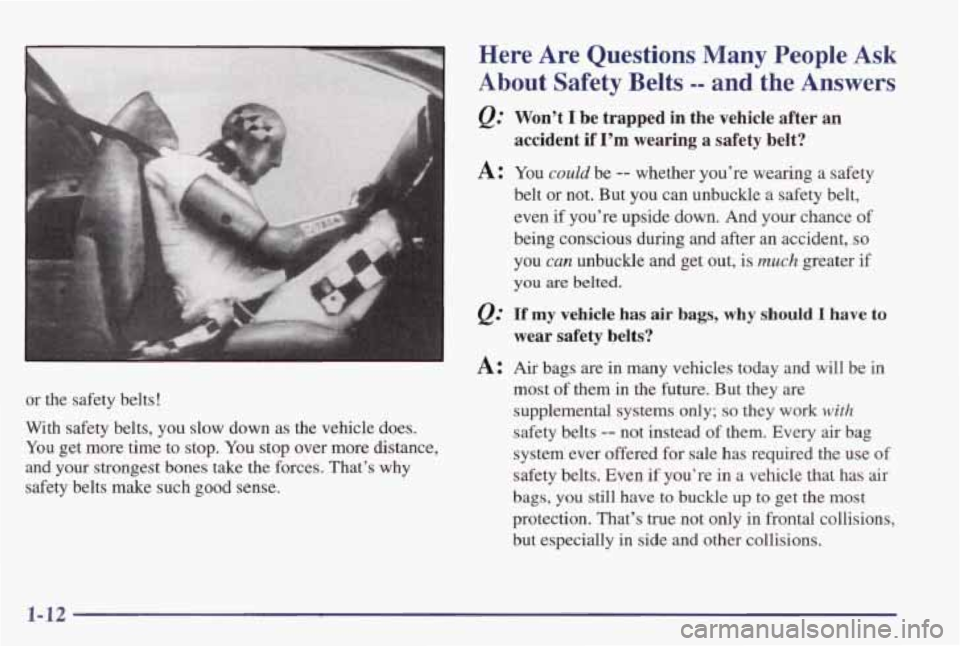
or the safety belts!
With safety belts, you slow down as the vehicle does.
You get more time to stop. You stop over more distance,
and your strongest bones take the forces. That’s why
safety belts make such good sense.
Here Are Questions Many People Ask
About Safety Belts -- and the Answers
@ Won’t I be trapped in the vehicle after an
accident if I’m wearing a safety belt?
A: You could be -- whether you’re wearing a safety
belt or not. But
you can unbuckle a safety belt,
even
if you’re upside down. And your chance of
being conscious during and after an accident,
so
you can unbuckle and get out, is much greater if
you are belted.
If my vehicle has air bags, why should I have to
wear safety belts?
A: Air bags are in many vehicles today and will be in
most
of them in the future. But they are
supplemental systems only;
so they work with
safety belts -- not instead of them. Every air bag
system ever offered for sale has required the use of
safety belts. Even if you’re in a vehicle that has
air
bags, you still have to buckle up to get the most
protection. That’s true not only in frontal collisions,
but especially in side and other collisions.
1-12
Page 79 of 402
Door Locks
1
I A CAUTION:
Unlocked doors can be dangerous.
Passengers
-- especially children -- can easily
open the doors and fall out. When
a door is
locked, the inside handle won’t open it.
Outsiders can easily enter through an unlocked
door
when you slow down or stop your vehicle.
This may not be so obvious: You increase the
chance of being thrown out of the vehicle in a
crash
if the doors aren’t locked. Wear safety belts
properly,
lock your doors, and you will be far
better off whenever you drive your vehicle.
There are several ways to lock and unlock your vehicle.
Front Door
To unlock either front door from outside the vehicle
with your key, insert it fully into the door key cylinder
and turn
it toward the front.
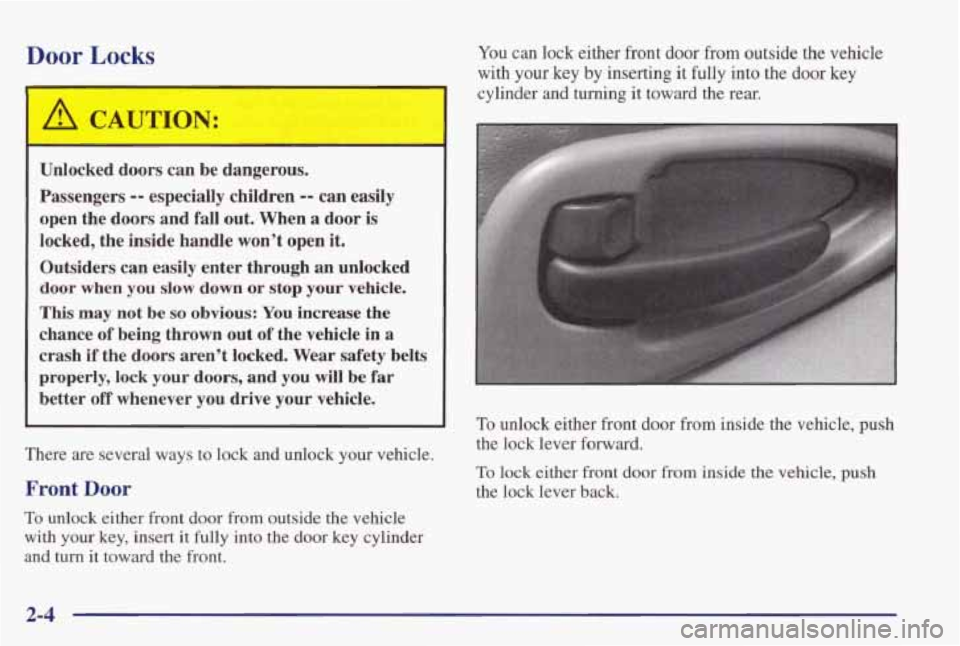
You can lock either front door from outside the vehicle
with your key
by inserting it fully into the door key
cylinder and
turning it toward the rear.
To unlock either front door from inside the vehicle, push
the lock lever forward.
To lock either front door from inside the vehicle, push
the lock lever back.
Page 88 of 402
Parking Lots Theft
Vehicle theft is big business, especially in some cities.
Although your vehicle has
a number of theft-deterrent
features, we know that nothing we put on it can make
it impossible to steal. However, there are ways you
can help.
Key in the Ignition
If you leave your vehicle with the keys inside, it’s an
easy target for joy riders or professional thieves -- so
don’t do it.
When you park your vehicle and open the driver’s door,
you’ll hear a chime reminding you to remove your key
from
the ignition and take it with you. Always do this.
Your steering wheel will be locked, and so will your
ignition and transaxle. And remember to lock the doors.
Parking at Night
Park in a lighted spot, close all windows and lock your
vehicle. Remember
to keep your valuables out of sight.
Put them in a storage area, or take them with you. If you park in
a lot where someone
will be watching
your vehicle, it’s best to
lock it up and take your keys.
But what if you have to leave your ignition key?
0
0
0
0
0
0
If possible, park in a busy, well lit area.
Put your valuables in a storage area, like your
trunk
or glove box. Be sure to close and lock the
storage area.
Close
all windows.
Lock
the glove box.
Lock all doors except
the driver’s.
Give the valet key to the valet. Then take the tnaster
key with you.
Page 116 of 402
Daytime Running Lamps
Daytime Running Lamps (DRL) can make it easier for
others to see the front
of your vehicle during the day.
DRL can be helpful in many different driving
conditions, but they can be especially helpful in the
short periods after dawn and before sunset.
A light sensor on top of the instrument panel makes the
DRL work, so be sure it isn’t covered.
The DRL system will make your low-beam headlamps
come on at a reduced brightness when:
0 The ignition is on,
The headlamp switch is off and
0 The parking brake is released.
When the DRL are on, only your low-beam headlamps
will be on. The taillamps, sidemarker and other
lamps won’t be on. Your instrument panel won’t be lit up either.
When it’s dark enough outside, your headlamps will
change to full brightness. The other lamps that come
on
with your headlamps will also come on.
When it’s bright enough outside,
the regular lamps will
go out, and your low-beam headlamps change to the
reduced brightness of DRL.
To idle your vehicle with the DRL off, set the parking
brake while the ignition is
in OFF or LOCK. Then start
your vehicle. The DRL will stay off until you release the
parking brake.
As with any vehicle, you should turn on the regular
headlamp system when you need it.
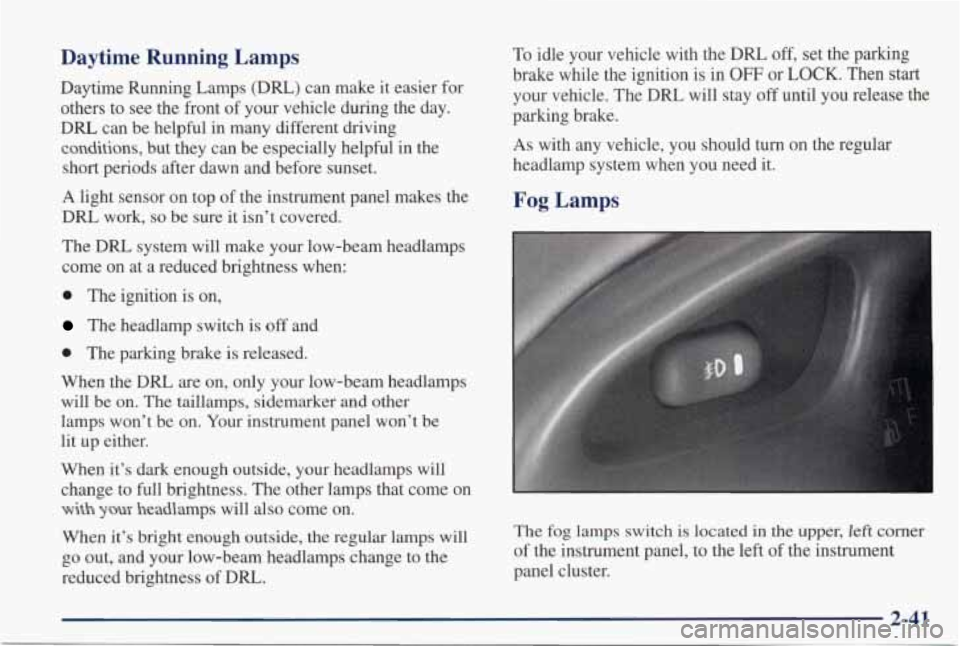
Fog Lamps
The fog lamps switch is located in the upper, left comer
of the instrument panel, to the left of the instrument
panel cluster.
Page 189 of 402
Understanding Radio Reception
AM
The range for most AM stations is greater than for FM,
especially at night. The longer range, however, can
cause stations to interfere with each other.
AM can pick
up noise from things like storms and power lines. Try
reducing the treble to reduce
this noise if you ever get it.
FM Stereo
FM stereo will give you the best sound, but FM signals
will reach only about 10 to 40 miles (16 to 65 km). Tall
buildings or hills can interfere with FM signals, causing
the sound to come and go.
Tips About Your Audio System
Hearing damage from loud noise is almost undetectable
until it is too late. Your hearing can adapt
to higher
volumes of sound. Sound that seems
normal can be loud
and harmful to
your hearing. Take precautions by
adjusting
the volume control on your radio to a safe
sound level before your hearing adapts to it.
To help avoid hearing loss or damage:
0 Adjust the volume control to the lowest setting.
0 Increase volume slowly until you hear comfortably
and clearly.
NOTICE:
Before you add any sound equipment to your
vehicle
-- like a tape player, CB radio, mobile
telephone or two-way radio
-- be sure you can
add what you want.
If you can, it's very
important to do it properly. Added sound
equipment may interfere with the operation
of
your vehicle's engine, Delco Electronics radio or
other systems, and even damage them. Your
vehicle's systems may interfere with the
operation
of sound equipment that has been
added improperly.
So, before adding sound equipment, check with
your dealer and be sure to check Federal rules
covering mobile radio and telephone units.
3-30
Page 198 of 402

The body takes about an hour to rid itself of the alcohol
in one drink.
No amount of coffee or number of cold
showers will speed that up. “I’ll be careful” isn’t \
the
right answer. What if there’s an emergency, a need to take sudden action, as when a child darts into the street?
A person with even a moderate BAC might not be able
to react quickly enough to avoid the collision.
There’s something else about drinking and driving that
many people don’t know. Medical research shows that
alcohol in a person’s system
can make crash injuries
worse, especially injuries to the brain, spinal cord or
heart. This means that when anyone who has been
drinking
-- driver or passenger -- is in a crash, that
person’s chance
of being killed or permanently disabled
is higher than if the person had not been drinking.
A CAUTION:
-
Drinking and then driving is very dangerous.
Your reflexes, perceptions, attentiveness
and
judgment can be affected by even a small amount
of alcohol. You can have a serious -- or even
fatal -- collision if you drive after drinking.
Please don’t drink and drive or ride with
a driver
who has been drinking. Ride home in a cab; or if
you’re with a group, designate a driver who will
not drink.
Page 202 of 402
Remember: Anti-lock doesn’t change the time you need
to get your foot up to the brake pedal or always decrease
stopping distance. If you get too close to the vehicle
in
front of you, you won’t have time to apply your brakes
if that vehicle suddenly slows or stops. Always leave
enough room up ahead to
stop, even though you have
anti-lock brakes.
Using Anti-Lock
Don’t pump the brakes. Just hold the brake pedal down
firmly and let anti-lock work for you. You may feel a
slight brake pedal pulsation or notice some noise, but
this is normal.
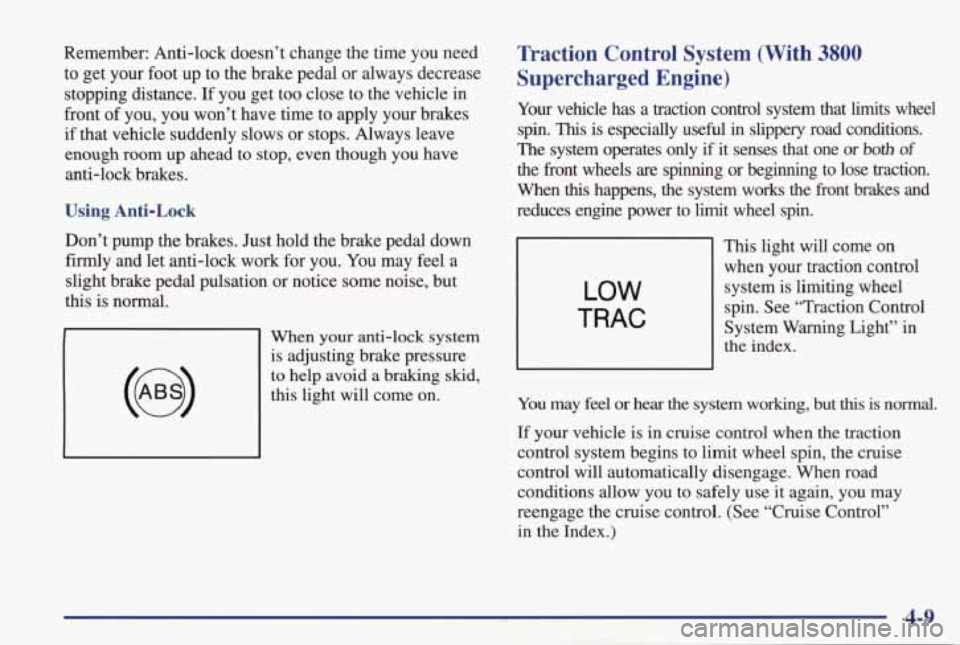
When your anti-lock system
is adjusting brake pressure
to help avoid a braking skid,
this light will come on.
Traction Control System (With 3800
Supercharged Engine)
Your vehicle has a traction control system that limits wheel
spin.
This is especially useful in slippery road conditions.
The system operates only if it senses that one or both of
the front wheels are spinning or beginning to lose traction.
When
this happens, the system works the front brakes and
reduces engine power to limit wheel spin.
LOW
TRAC
This light will come on
when your traction control system is limiting wheel
spin. See “Traction Control
System Warning Light” in
the index.
You may
feel or hear the system working, but this is normal.
If your vehicle is in cruise control when the traction
control system begins to limit wheel spin,
the cruise
control will automatically disengage. When road
conditions allow you to safely use it again, you may
reengage the cruise control. (See “Cruise Control” in the Index.)
Page 203 of 402
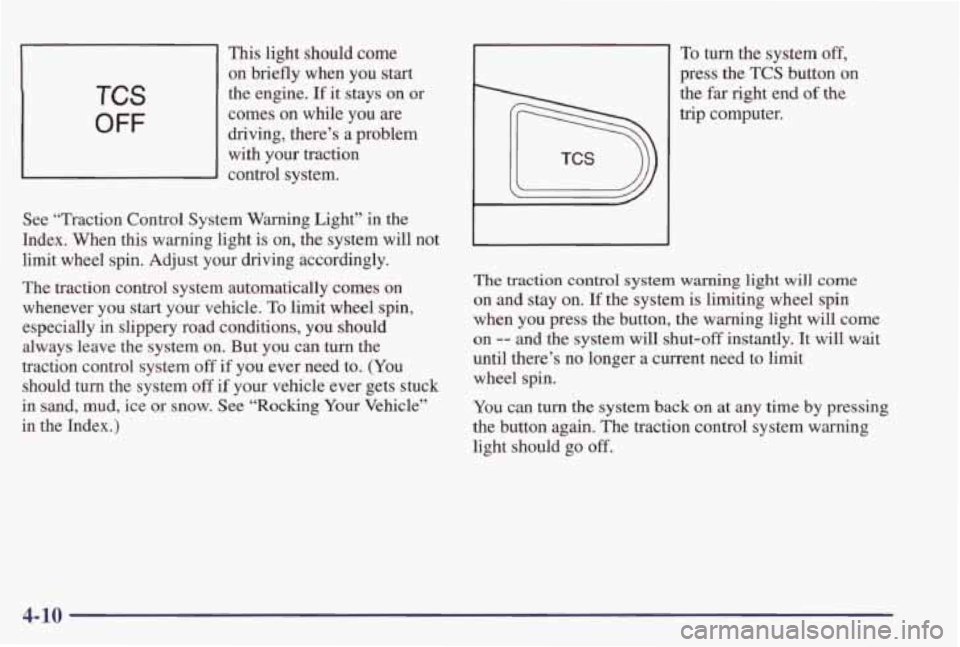
This light should come on briefly when you start
comes on while
you are
driving, there’s a problem with your traction
control system.
TCS
OFF
the engine. If it stays on or
See “Traction Control System Warning Light” in the
Index. When this warning light is on, the system will not
limit wheel spin. Adjust your driving accordingly.
The traction control system automatically comes on
whenever you start your vehicle.
To limit wheel spin,
especially in slippery road conditions, you should
always leave the system on. But you can
turn the
traction control system
off if you ever need to. (You
should
turn the system off if your vehicle ever gets stuck
in sand, mud, ice or snow. See “Rocking Your Vehicle”
in the Index.)
To turn the system off,
press the TCS button on
the far right end of the
trip computer.
The traction control system warning light will come
on and stay on. If the system is limiting wheel spin
when you press the button, the warning light will come
on -- and the system will shut-off instantly. It will wait
until there’s no longer
a current need to limit
wheel spin.
You can
turn the system back on at any time by pressing
the button again. The traction control system warning
light should go
off.
4-10
Page 204 of 402
Enhanced Traction System
(3100 or 3800 Engine)
Your vehicle may have an Enhanced Traction System (ETS) that limits wheel spin. This is especially useful
in
slippery road conditions. The system operates only if it
senses that one or both of the front wheels
are spinning
or beginning to lose traction. When
this happens, the
system reduces engine power and may
also upshift the
transaxle
to limit wheel spin.
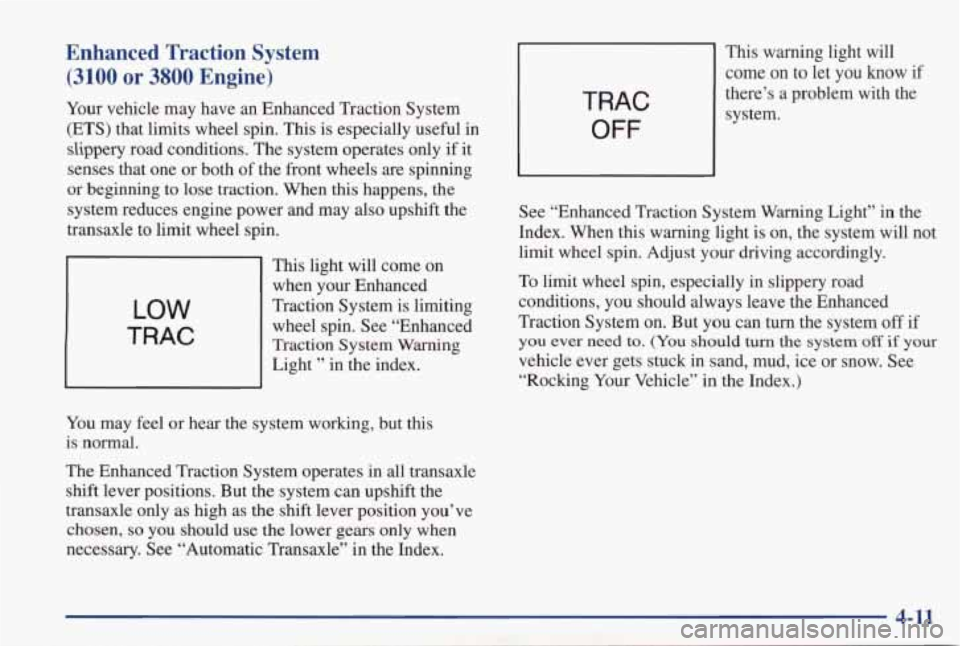
LOW
TRAC
This light will come on when your Enhanced
Traction System is limiting wheel spin. See “Enhanced
Traction
System Warning
Light
” in the index.
You may feel or hear the system working, but this
is normal.
The Enhanced Traction System operates in all transaxle
shift lever positions. But the system can upshift the
transaxle
only as high as the shift lever position you’ve
chosen,
so you should use the lower gears only when
necessary. See “Automatic Transaxle” in
the Index.
1
This warning light will
come
on to let you know if
there’s a problem with the TRAC
OFF
system.
See “Enhanced Traction System Warning Light” in the
Index. When this warning light is on, the system will not
limit wheel spin. Adjust your driving accordingly.
To limit wheel spin, especially in slippery road
conditions, you should always leave the Enhanced
Traction System on. But you can
turn the system off if
you ever need to. (You should turn the system off if your
vehicle ever gets stuck in sand, mud, ice or snow. See
“Rocking Your Vehicle” in the Index.)
Page 208 of 402
Passing
The driver of a vehicle about to pass another on a
two-lane highway waits for just the right moment,
accelerates, moves around the vehicle ahead, then goes
back into the right lane again. A simple maneuver?
Not necessarily! Passing another vehicle on a two-lane highway is a potentially dangerous move, since the
passing vehicle occupies the same lane as oncoming
traffic for several seconds.
A miscalculation, an error in
judgment, or a brief surrender to frustration or anger can
suddenly put the passing driver face to face with the
worst of
all traffic accidents -- the head-on collision.
So here are some tips for passing:
“Drive ahead.” Look down the road, to the sides and to
crossroads for situations that might affect your passing
patterns.
If you have any doubt whatsoever about
making a successful pass, wait for a better time.
Watch for traffic signs, pavement markings and
lines. If you can see a sign up ahead that might
indicate a
turn or an intersection, delay your pass.
A broken center line usually indicates it’s all right to
pass (providing the road ahead is clear). Never cross a solid line on your side
of the lane or a double
solid line, even if the road seems empty of
approaching traffic.
Do not get too close to the vehicle you want to
pass while you’re awaiting an opportunity.
For one
thing, following too closely reduces your area
of
vision, especially if you’re following a larger
vehicle. Also, you won’t have adequate space
if the
vehicle ahead suddenly slows or stops. Keep
back a
reasonable distance.
When it looks like a chance to pass is coming up, start to accelerate but stay in the right lane and don’t
get too close. Time your move
so you will be
increasing speed as the time comes to move
into the
other lane. If the way
is clear to pass, you will have a
“running start” that more than makes up for the
distance you would lose by dropping back. And if
something happens to cause you to cancel your pass,
you need only slow down and drop back again and
wait for another opportunity.
If other cars are lined up to pass a slow vehicle, wait
your turn. But take care that someone isn’t trying to
pass you as you pull out to pass the slow vehicle.
Remember to glance over your shoulder and check
the blind spot.
4-15