starting PONTIAC GRAND PRIX 2003 User Guide
[x] Cancel search | Manufacturer: PONTIAC, Model Year: 2003, Model line: GRAND PRIX, Model: PONTIAC GRAND PRIX 2003Pages: 378, PDF Size: 17.64 MB
Page 205 of 378
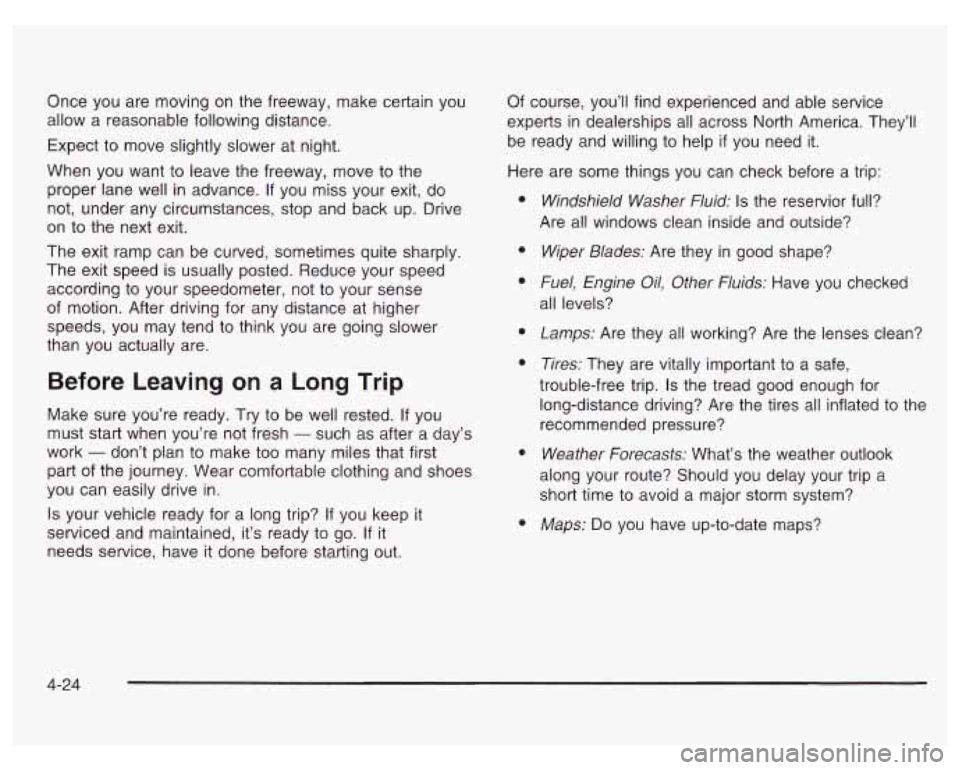
Once you are moving on the freeway, make certain you
allow a reasonable following distance.
Expect to move slightly slower at night.
When you want to leave the freeway, move to the
proper lane well in advance.
If you miss your exit, do
not, under any circumstances, stop and back up. Drive
on to the next exit.
The exit ramp can be curved, sometimes quite sharply.
The exit speed is usually posted. Reduce your speed
according to your speedometer, not to your sense
of motion. After driving for any distance at higher
speeds, you may tend to think you are going slower
than you actually are.
Before Leaving on a Long Trip
Make sure you’re ready. Try to be well rested. If you
must start when you’re not fresh
- such as after a day’s
work
- don’t plan to make too many miles that first
part of the journey. Wear comfortable clothing and shoes
you can easily drive in.
Is your vehicle ready for a long trip? If you keep it
serviced and maintained, it’s ready to
go. If it
needs service, have it done before starting out.
Of course, you’ll find experienced and able service
experts in dealerships all across North America. They’ll
be ready and willing to help
if you need it.
Here are some things you can check before a trip:
Windshield Washer Fluid:
Is the reservior full?
Are all windows clean inside and outside?
Wiper Blades: Are they in good shape?
Fuel, Engine Oil, Other Fluids: Have you checked
all levels?
Lamps: Are they all working? Are the lenses clean?
Tires: They are vitally important to a safe,
trouble-free trip.
Is the tread good enough for
long-distance driving? Are the tires all inflated to the
recommended pressure?
Weather Forecasts: What’s the weather outlook
along your route? Should you delay your trip a
short time to avoid a major storm system?
Maps:
Do you have up-to-date maps?
4-24
Page 226 of 378
Section 5 Service and Appearance Care
Service ............................................................ 5.3
Doing Your
Owr? Service Work ......................... 5-4
Adding Equipment to the Outside of
Your Vehicle
.............................................. 5-4
Fuel ................................................................ 5-5
Gasoline Octane
............................................ 5-5
Gasoline Specifications
.................................... 5-5
California Fuel
............................................... 5-6
Additives
....................................................... 5-6
Fuels in Foreign Countries
............................... 5-7
Filling Your Tank
............................................ 5-7
Filling a Portable Fuel Container
....................... 5-9
Checking Things Under the Hood .................... 5-10
Hood Release
.............................................. 5-10
Engine Compartment Overview
....................... 5-12
Engine Oil
................................................... 5-18
Supercharger Oil
.......................................... 5-24
Engine Air CleanedFilter
................................ 5-25
Automatic Transaxle Fluid
.............................. 5-27
Engine Coolant
............................................. 5-30
Radiator Pressure Cap
.................................. 5-33
Cooling System
........................................... -5-36
Power Steering Fluid
..................................... 5-46
Windshield Washer Fluid
................................ 5-48
Engine Overheating
....................................... 5-33 Brakes
........................................................ 5.49
Battery
........................................................ 5.52
Jump Starting
............................................... 5-53
Bulb Replacement .......................................... 5-60
Halogen Bulbs
.............................................. 5-60
Headlamps
.................................................. 5-60
Front Turn Signal and Sidemarker Lamps
........ 5-62
Center High-Mounted Stoplamp (CHMSL)
......... 5-63
Taillamps, Sidemarker and Back-up Lamps
...... 5-64
Replacement Bulbs
....................................... 5-66
Windshield Wiper Blade Replacement .............. 5-67
Tires ............................................................. -5-68
Inflation
-- Tire Pressure ................................ 5-68
Tire Inspection and Rotation
........................... 5-69
When It
Is Time for New Tires ....................... 5-70
Buying New Tires
......................................... 5-71
Uniform Tire Quality Grading
.......................... 5-72
Wheel Replacement
...................................... 5-73
Headlamp Aiming ........................................... 5-59
Wheel Alignment and Tire Balance
.................. 5-73
Tire Chains
.................................................. 5-75
If a Tire Goes Flat ........................................ 5-76
Changing a Flat Tire
..................................... 5-76
Compact Spare Tire
...................................... 5-87
5- 1
Page 247 of 378
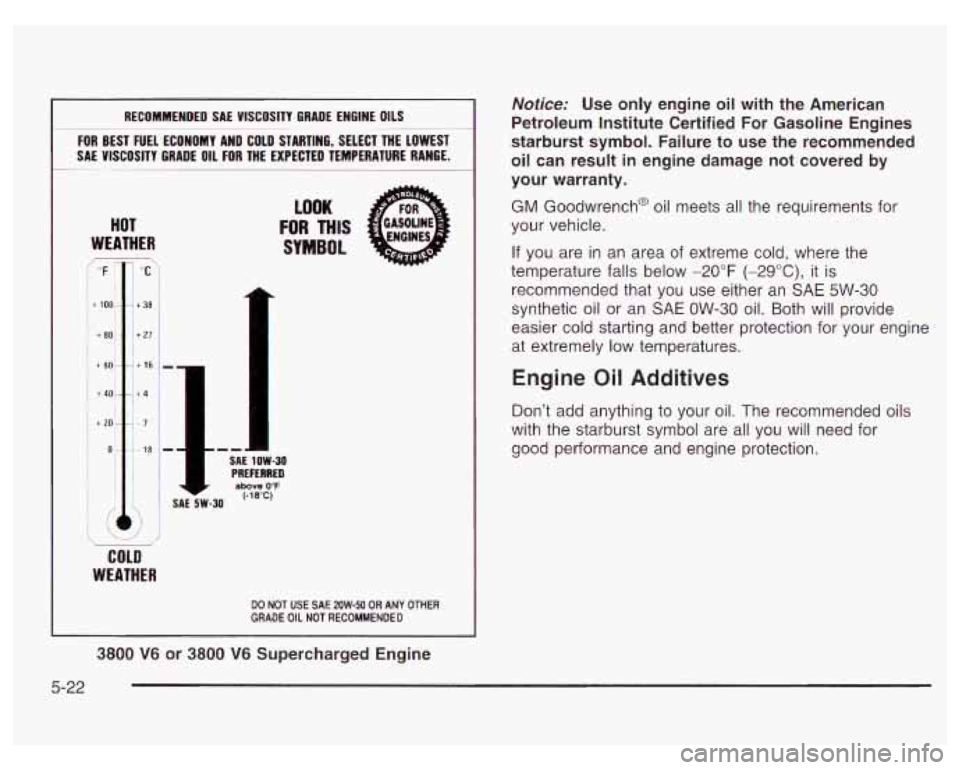
RECOMMENDED SAE VISCOSITY GRADE ENGINE OILS
FOR BEST FUEL ECONOMY AND COLD STARTING, SELECT THE LOWEST
SA€ VISCOSITY GRADE
OIL FOR THE EXPECTED TEMPERATURE RANGE.
~~~~ ~~~~~ ~~ -
HOT
WEATHER
SAE SW-30
LOOK
FOR THIS
SYMBOL
8- SAE I 1OW-30
PREFERRED above 0°F (-1 8°C)
Notice: Use only engine oil with the American
Petroleum Institute Certified For Gasoline Engines
starburst symbol. Failure to use the recommended
oil can result in engine damage not covered by
your warranty.
GM Goodwrench@ oil meets all the requirements for
your vehicle.
If you are in an area of extreme cold, where the
temperature falls below
-20°F (-29"C), it is
recommended that you use either an SAE
5W-30
synthetic oil or an SAE OW-30 oil. Both will provide
easier cold starting and better protection for your engine
at extremely low temperatures.
Engine Oil Additives
Don't add anything to your oil. The recommended oils
with the starburst symbol are
all you will need for
good performance and engine protection.
3800 V6 or 3800 V6 Supercharged Engine
5-22
Page 252 of 378
Automatic Transaxle Fluid
When to Check and Change
A good time to check your automatic transaxle fluid
level is when the engine oil is changed.
Change both the fluid and filter every 50,000 miles
(83
000 km) if the vehicle is mainly driven under one or
more of these conditions:
In heavy city traffic where the outside temperature
0 In hilly or mountainous terrain.
0 When doing frequent trailer towing.
0 Uses such as found in taxi, police or delivery service.
regularly reaches
90°F (32°C)
or higher.
If you do not use your vehicle under any of these
conditions, change the fluid and filter at
100,000 miles (166 000 km).
See Part
A: Scheduled Maintenance Services on
page
6-4.
How to Cheek
Because this operation can be a little difficult, you may
choose to have this done at the dealership service
department.
If you do it yourself, be sure to follow all the instructions
here, or you could get a false reading on the dipstick.
Nofice: Too much or too little fluid can damage
your transaxle.
Too much can mean that some of the
fluid could come out and fall on hot engine or
exhaust system parts, starting a fire.
Too little fluid
could cause the transaxle to overheat. Be sure
to get an accurate reading
if you check your
transaxle fluid.
Wait at least 30 minutes before checking the transaxle
fluid level
if you have been driving:
When outside temperatures are above
90°F (32°C).
At high speed for quite a while.
In heavy traffic
- especially in hot weather.
While pulling a trailer.
5-27
Page 278 of 378
Vehicle Storage Jump Starting
If you’re not going to drive your vehicle for 25 days or
more, remove the black, negative (-) cable from
the battery. This will help keep your battery from
running down.
If your battery has run down, you may want to use
another vehicle and some jumper cables to start your
vehicle. Be sure
to follow the steps listed below to
do it safely.
Batteries have acid that can burn you and gas
that can explode. You can be badly
hurt if you
aren’t careful. See “Jump Starting” next for
tips on working around a battery without getting hurt.
Contact your dealer to learn how to prepare your
vehicle for longer storage periods.
Also, for your audio system, see Theft-Deterrent
Feature
on page 3-54.
Batteries can hurt you. They can be dangerous
because:
They contain acid that can burn you.
They contain gas that can explode or ignite.
They contain enough electricity to
burn you.
If you don’t follow these steps exactly, some or
all of these things can hurt you.
Notice: Ignoring these steps could result in costly
damage to your vehicle that wouldn’t be covered
by your warranty.
Trying to start your vehicle by pushing or pulling
it
won’t work, and it could damage your vehicle.
5-53
Page 279 of 378
Notice: If the other system isn’t a 12-volt system
with a negative ground, both vehicles can be
damaged.
1. Check the other vehicle. It must have a 12-volt
battery with a negative ground system.
2. Get the vehicles close enough so the jumper cables
can reach, but be sure the vehicles aren’t touching
each other. If they are, it could cause a ground
connection you don’t want. You wouldn’t be able to
start your vehicle, and the bad grounding could
damage the electrical systems.
To avoid the possibility of the vehicles rolling, set
the parking brake firmly on both vehicles involved in
the jump start procedure. Put an automatic
transaxle in PARK
(P) or a manual transaxle in
NEUTRAL before setting the parking brake.
Notice: If you leave your radio on, it could be badly
damaged. The repairs wouldn’t be covered by
your warranty.
3. Turn off the ignition on both vehicles. Unplug
unnecessary accessories plugged into the cigarette
lighter or in the accessory power outlet. Turn
off
the radio and all lamps that aren’t needed. This will
avoid sparks and help save both batteries. And it
could save your radio!
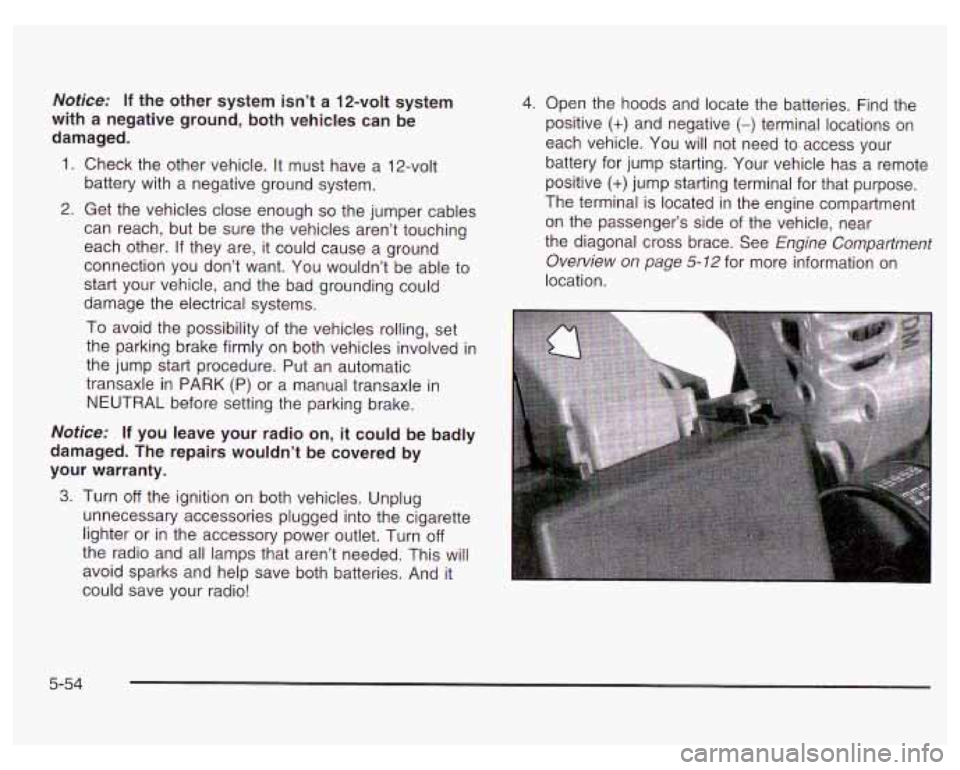
4. Open the hoods and locate the batteries. Find the
positive
(+) and negative (-) terminal locations on
each vehicle. You will not need to access your
battery for jump starting. Your vehicle has
a remote
positive
(+) jump starting terminal for that purpose.
The terminal is located in the engine compartment
on the passenger’s side of the vehicle, near
the diagonal cross brace. See Engine Compartment
Ovewiew
on page 5-72 for more information on
location.
5-54
Page 364 of 378
Emissions Inspection and Maintenance
Engine Programs
................................................... 3-34
Air Cleaner/Filter
......................................... 5-25
Battery
....................................................... 5-52
Check and Service Engine Soon Light ............ 3-32
Coolant
...................................................... 5-30
Coolant Heater
............................................ 2-23
Coolant Temperature Gage
........................... 3-31
Coolant Temperature Warning Light
................ 3-31
Cooling System Inspection
............................ 6-1 3
Engine Compartment Overview
...................... 5-1 2
Exhaust ..................................................... 2-31
Oil
............................................................. 5-18
Starting
...................................................... 2-20
Supercharger Oil
......................................... 5-24
Engine Coolant Level Check
.............................. 6-9
Engine Cooling When Trailer Towing
.................. 4-43
Engine Oil Additives
........................................ 5-22
Engine Oil Level Check
..................................... 6-9
Engine Oil Scheduled Maintenance
..................... 6-5
Warning Light
............................................. 3-30
Entering Programming Mode
......................... 2-44
Entry Lighting
........................ ...... 3-13
Exiting Programming Mode
.......... ...... 2-53
Extender, Safety Belt
.. ...................... 1-28
Exterior Lamps
............................................... 3-1 0
Overheating ................................................ 5-33
Enhanced Traction System (ETS)
...................... 4-1 1
Express-Down Window
................................. 2-1 4
F
, ........... FabridCarpet ........... ........... 5-88
Filter
Engine Air Cleaner ............................... :~~=:=~ 5-25
Finding a Station ............................ 3-45, 3-49, 3-52
Finish Care
.................................................... 5-92
Finish Damage
............................................... 5-93
Flash-to-Pass
................................................... 3-6
Flat Tire
........................................................ 5-76
Flat Tire, Changing
......................................... 5-76
Fluid Automatic Transaxle
..................................... 5-27
Power Steering
........................................... 5-46
Windshield Washer
...................................... 5-48
Fog Lamps
................................. , ........... 3-12
Following Distance
.......................................... 4-41
Footnotes
........................................................ 6-5
Front Reading Lamps
...................................... 3-14
Fuel
............................................................... 5-5
Additives ...................................................... 5-6
California Fuel
.............................................. 5-6
Filling a Portable Fuel Container
..................... 5-9
Filling Your Tank
........................................... 5-7
Fuels in Foreign Countries
.............................. 5-7
Gage
......................................................... 3-37
Gasoline Octane
........................................ 5-5
FM ............................................................... 3-57
5
Page 366 of 378
If No Steam is Coming From Your Engine .......... 5-35
If Steam
Is Coming From Your Engine ............... 5-34
If the HUD Image
Is Not Clear ......................... 3-18
If the Light
Is Flashing ..................................... 3-33
If the Light
Is On Steady ................................. 3-33
If You Are Stuck in Sand, Mud, Ice or Snow
....... 4-32
If You Can’t See the HUD Image When the
Ignition
Is On .............................................. 3-18
If You
Do Decide To Pull A Trailer ..................... 4-38
Ignition Positions
............................................. 2-1 9
Ignition Transaxle Lock Check
.......................... 6-12
Infants and Young Children, Restraints
............... 1-32
Inflation
-- Tire Pressure ............................... 5-68
Inspection Brake System
........................... ........... 6-14
Engine Cooling System
................................ 6-13
Exhaust System
.......................................... 6-13
Fuel System
............................................... 6-13
Part C
- Periodic Maintenance ....................... 6-13
Steering, Suspension and Front Drive Axle
Boot and Seal
......................................... 6-1 3
Throttle System
........................................... 6-14
Cluster
....................................................... 3-24
Overview
..................................................... 3-2
Instrument Panel Brightness
............................. 3-1 2
If
You’re Caught in a Blizzard
........................... 4-29
Instrument Panel Instrument Panel
Fuse Block
........................ 5-98
Interior Plastic Components .............................. 5-90
Interior
Lamps
................................................ 3-12
Jump Starting
................................................. 5-53
Key Lock Cylinders Service .............................. 6-10
Keyless Entry System
....................................... 2-4
Keys
............................................................... 2-3
L
Lamps Exterior
............................................... 3-10
Interior
....................................................... 3-12
Lap Belt
........................................................ 1-21
Lap-Shoulder Belt
................................... 1.12. 1-23
Last Door Closed Locking
.......................... 2.9. 2-47
LATCH System Child Restraints
........................................... 1-41
Securing a Child Restraint Designed for
the LATCH System
................................... 1-43
Leather
......................................................... 5-90
Leaving Your Vehicle
....................................... 2-11
7
Page 371 of 378
Safety Belts (cont.)
How to Wear Safety Belts Properly
................ 1-12
Rear Safety Belt Comfort Guides for
Children and Small Adults
......................... 1-26
Rear Seat Passengers
................................. 1-22
Right Front Passenger Position
...................... 1-20
Safety Belt Extender
.................................... 1-28
Safety Belt Use During Pregnancy
................. 1-20
Safety Belts Are for Everyone
......................... 1-7
Safety Chains
................................................. 4-40
Safety Warnings and Symbols
.............................. III
Scheduled Maintenance ..................................... 6-5
Seats Head Restraints
............................................ 1-6
Heated Seats
............................................... 1-4
Manual
........................................................ 1-2
Power Lumbar
.............................................. 1-3
Reclining Seatbacks
...................................... 1-4
Six-Way Power Driver
.................................... 1-3
Center Rear Seat Position
............................ 1-46
Designed for the LATCH System
................... 1-43
Rear Outside Seat Position
........................... 1-43
Right Front Seat Position
.............................. 1-48
Security Light
................................................. 3-36
Questions
and Answers About Safety Belts
..... 1-1 1
...
Securing a Child Restraint
Security While You Travel
.................................. 7-5 Service
....................................................... 5-3
Adding Equipment to the Outside of
Your Vehicle
.............................................. 5-4
Doing Your Own Work
................................... 5-4
Engine Soon Light
....................................... 3-32
Publications Ordering Information
................... 7-10
Service Bulletins
............................................. 7-10
Service Engine Soon Light in the United States
or Check Engine Light in Canada
.................. 3-32
Service Manuals
............................................. 7-10
Setting Preset Stations
.................... 3-45, 3-49, 3-52
Setting the Time
............................................. 3-44
Setting the Tone (BassTTreble)
.......... 3-46, 3-49, 3-52
Sheet Metal Damage
....................................... 5-93
Shift Lock Release
.......................................... 2-20
Shifting Into Park (P)
....................................... 2-28
Shifting Out of Park (P)
................................... 2-30
Shoulder Belt Height Adjuster
........................... 1-14
Skidding
........................................................ 4-17
Some Other Rainy Weather Tips
....................... 4-21
Special Fabric Cleaning Problems
..................... 5-89
Specifications, Capacities
............................... 5-1 02
Speedometer
.................................................. 3-25
Starter Switch Check
....................................... 6-11
Starting Your 3100
V6 Engine ........................... 2-21
Starting Your 3800 Series
II V6 Engine ................ 2-22
Starting Your Engine
....................................... 2-20
12