Battery PONTIAC GRAND PRIX 2003 Owner's Manual
[x] Cancel search | Manufacturer: PONTIAC, Model Year: 2003, Model line: GRAND PRIX, Model: PONTIAC GRAND PRIX 2003Pages: 378, PDF Size: 17.64 MB
Page 278 of 378
Vehicle Storage Jump Starting
If you’re not going to drive your vehicle for 25 days or
more, remove the black, negative (-) cable from
the battery. This will help keep your battery from
running down.
If your battery has run down, you may want to use
another vehicle and some jumper cables to start your
vehicle. Be sure
to follow the steps listed below to
do it safely.
Batteries have acid that can burn you and gas
that can explode. You can be badly
hurt if you
aren’t careful. See “Jump Starting” next for
tips on working around a battery without getting hurt.
Contact your dealer to learn how to prepare your
vehicle for longer storage periods.
Also, for your audio system, see Theft-Deterrent
Feature
on page 3-54.
Batteries can hurt you. They can be dangerous
because:
They contain acid that can burn you.
They contain gas that can explode or ignite.
They contain enough electricity to
burn you.
If you don’t follow these steps exactly, some or
all of these things can hurt you.
Notice: Ignoring these steps could result in costly
damage to your vehicle that wouldn’t be covered
by your warranty.
Trying to start your vehicle by pushing or pulling
it
won’t work, and it could damage your vehicle.
5-53
Page 279 of 378
Notice: If the other system isn’t a 12-volt system
with a negative ground, both vehicles can be
damaged.
1. Check the other vehicle. It must have a 12-volt
battery with a negative ground system.
2. Get the vehicles close enough so the jumper cables
can reach, but be sure the vehicles aren’t touching
each other. If they are, it could cause a ground
connection you don’t want. You wouldn’t be able to
start your vehicle, and the bad grounding could
damage the electrical systems.
To avoid the possibility of the vehicles rolling, set
the parking brake firmly on both vehicles involved in
the jump start procedure. Put an automatic
transaxle in PARK
(P) or a manual transaxle in
NEUTRAL before setting the parking brake.
Notice: If you leave your radio on, it could be badly
damaged. The repairs wouldn’t be covered by
your warranty.
3. Turn off the ignition on both vehicles. Unplug
unnecessary accessories plugged into the cigarette
lighter or in the accessory power outlet. Turn
off
the radio and all lamps that aren’t needed. This will
avoid sparks and help save both batteries. And it
could save your radio!
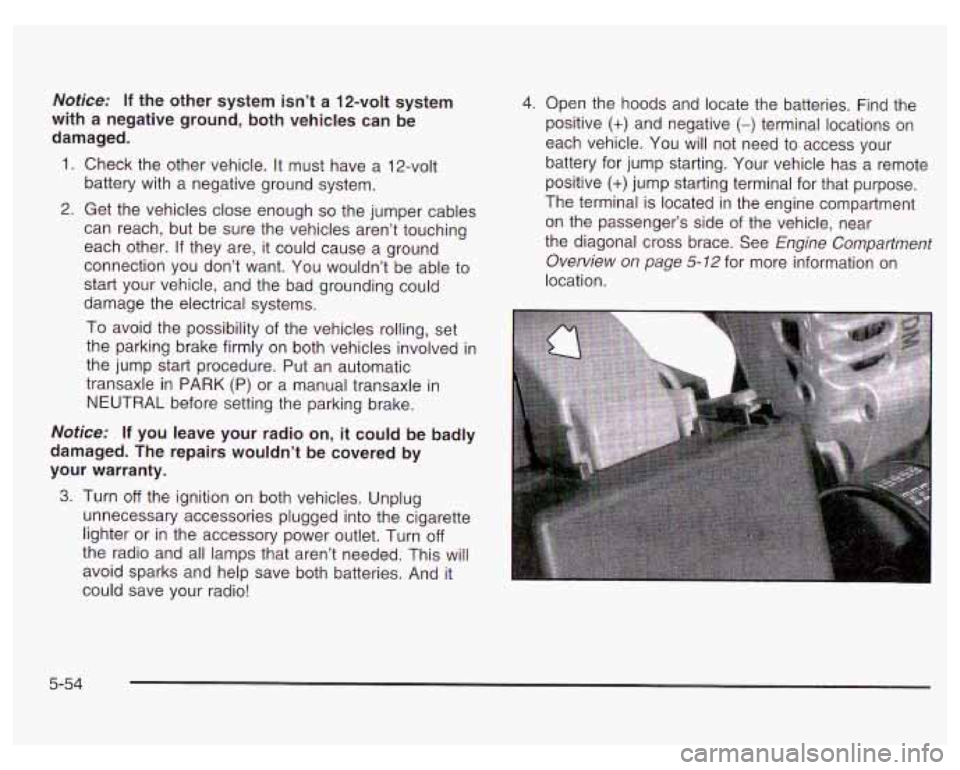
4. Open the hoods and locate the batteries. Find the
positive
(+) and negative (-) terminal locations on
each vehicle. You will not need to access your
battery for jump starting. Your vehicle has
a remote
positive
(+) jump starting terminal for that purpose.
The terminal is located in the engine compartment
on the passenger’s side of the vehicle, near
the diagonal cross brace. See Engine Compartment
Ovewiew
on page 5-72 for more information on
location.
5-54
Page 280 of 378
To uncover the remote positive (+) terminal, squeeze
the sides
of the plastic cap and slide the cap off.
You should always use the remote positive (+) terminal
instead
of the positive (+) terminal on the battery.
An electric fan can start up even when
rile
engine is not running and can injure you. Keep
hands, clothing and tools away from any
underhood electric fan.
Fans or other moving engine parts can injure
you badly. Keep your hands away from moving parts once the engine
is running.
I- -jng a ma I n r a battery can cause battery
gas to explode. People have been hurt doing
this, and some have been blinded. Use a
flashlight if you need more light.
Be sure the battery has enough water. You
don’t need to add water to the ACDelco@ battery installed in your new vehicle. But if a
battery has filler caps, be sure the right
amount of fluid is there. If
it is low, add water
to take care of that first. If you don’t, explosive gas could be present.
Battery fluid contains acid that can burn you.
Don’t get
it on you. If you accidentally get it in
your eyes or on your skin, flush the place with water and get medical help immediately.
5-55
Page 281 of 378
5. Check that the jumper cables don’t have loose or
missing insulation.
If they do, you could get a
shock. The vehicles could be damaged too. Don’t connect positive
(+) to
negative (-), or you’ll get a
short that would damage the battery and maybe
other parts, too. And don’t connect the negative
(-)
cable to the negative (-) terminal on the dead battery
because this can cause sparks.
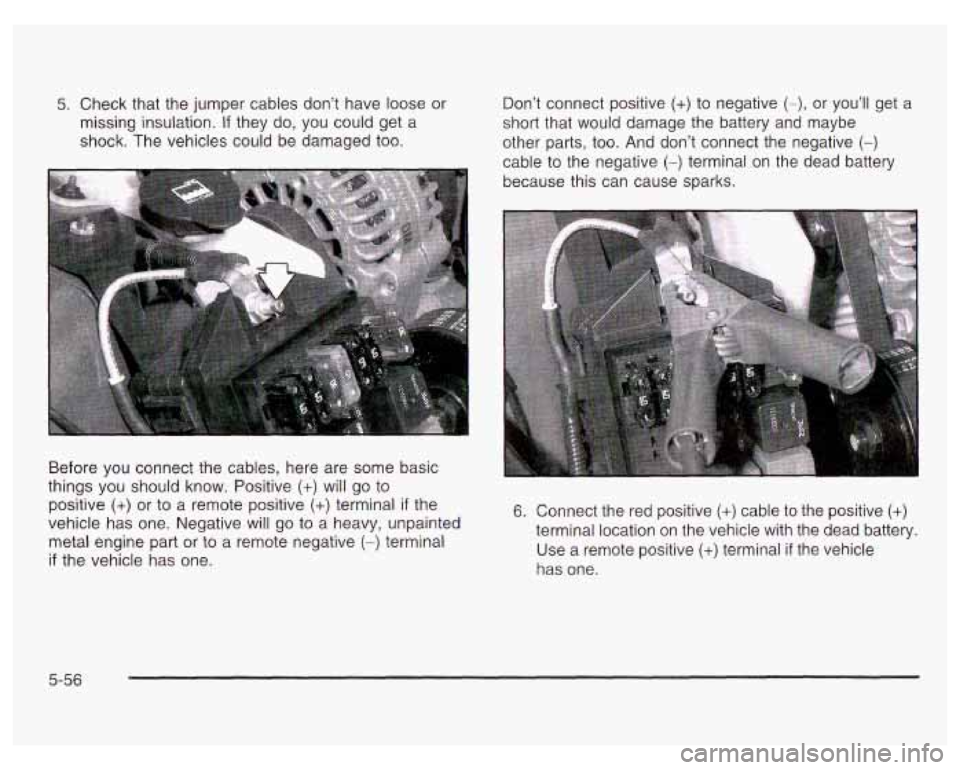
Before you connect the cables, here are some basic
things you should know. Positive
(+) will go to
positive
(+) or to a remote positive (+) terminal if the
vehicle has one. Negative will go to a heavy, unpainted
metal engine part or to a remote negative
(-) terminal
if the vehicle has one.
6. Connect the red positive (+) cable to the positive (+)
terminal location on the vehicle with the dead battery.
Use a remote positive
(+) terminal if the vehicle
has one.
5-56
Page 282 of 378

7. Don't let the other end
touch metal. Connect it
to the positive
(+)
terminal location on the
vehicle with the good
battery. Use a
remote positive
(+)
terminal if the vehicle
has one.
9. Don't let the other end touch anything until the next
step. The other end
of the negative (-) cable doesn't
go to the dead battery. It goes to a heavy, unpainted
metal part or to
a remote negative (c) terminal on the
vehicle with the dead battery.
8. Now connect the black
negative
(-) cable to
the negative
(-)
terminal location on the vehicle with the good
battery. Use a
remote negative
(-)
terminal if the vehicle
has one. 10. Connect the other end of the negative (-) cable at
least
18 inches (45 cm) away from the dead battery,
but not near engine parts that move. The electrical
connection is just
as good there, and the chance
of sparks getting back to the battery is much less.
5-57
Page 283 of 378
11. Now start the vehicle with the good battery and run
the engine for a while.
12. Try to start the vehicle that had the dead battery.
If
it won’t start after a few tries, it probably needs
service.
Notice: Damage to your vehicle may result from
electrical shorting
if jumper cables are removed
incorrectly. To prevent electrical shorting, take care
that the cables don’t touch each other or any
other metal. The repairs wouldn’t be covered by
your warranty.
I
w
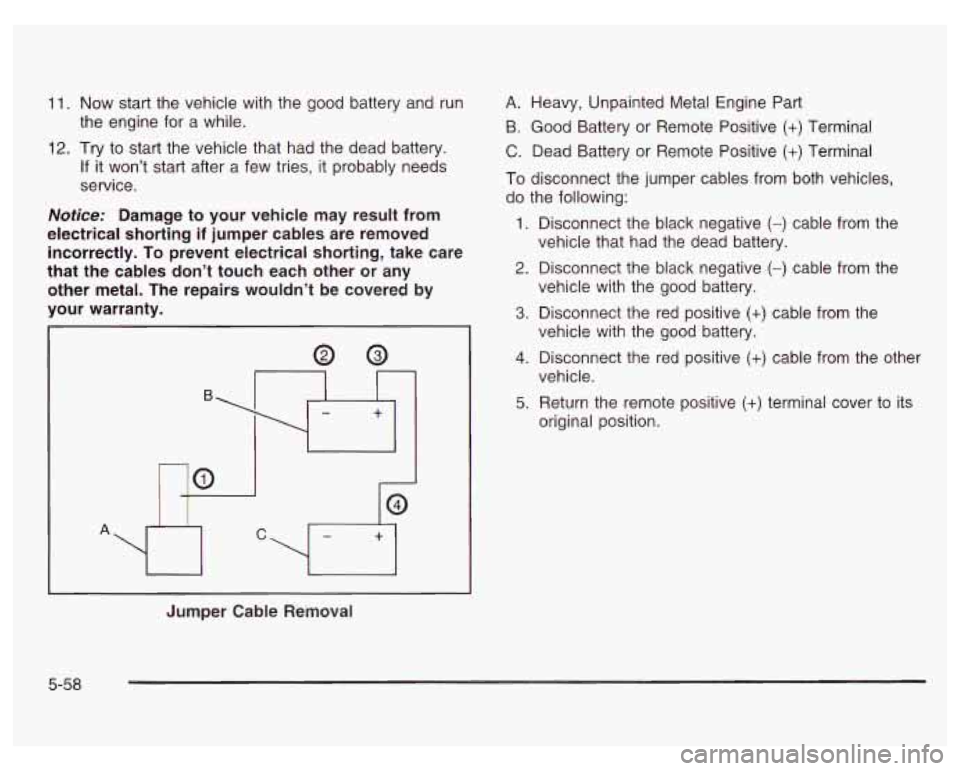
A. Heavy, Unpainted Metal Engine Part
B. Good Battery or Remote Positive
(+) Terminal
C. Dead Battery or Remote Positive (+) Terminal
To disconnect the jumper cables from both vehicles,
do the following:
1. Disconnect the black negative (-) cable from the
vehicle that had the dead battery.
2. Disconnect the black negative (-) cable from the
vehicle with the good battery.
3. Disconnect the red positive (+) cable from the
vehicle with the good battery.
4. Disconnect the red positive (+) cable from the other
vehicle.
5. Return the remote positive (+) terminal cover to its
original position.
Jumper Cable Removal
5-58
Page 325 of 378
Circuit Usage
Breakers
BLANK Blank - -. . . . . - . - . . . -
I PWR DROP I Power Droo lanition
CAN I
STE R
VENT
1- il
Canister Vent Solenoid
I DRL I Davtime Runnina Lamos I
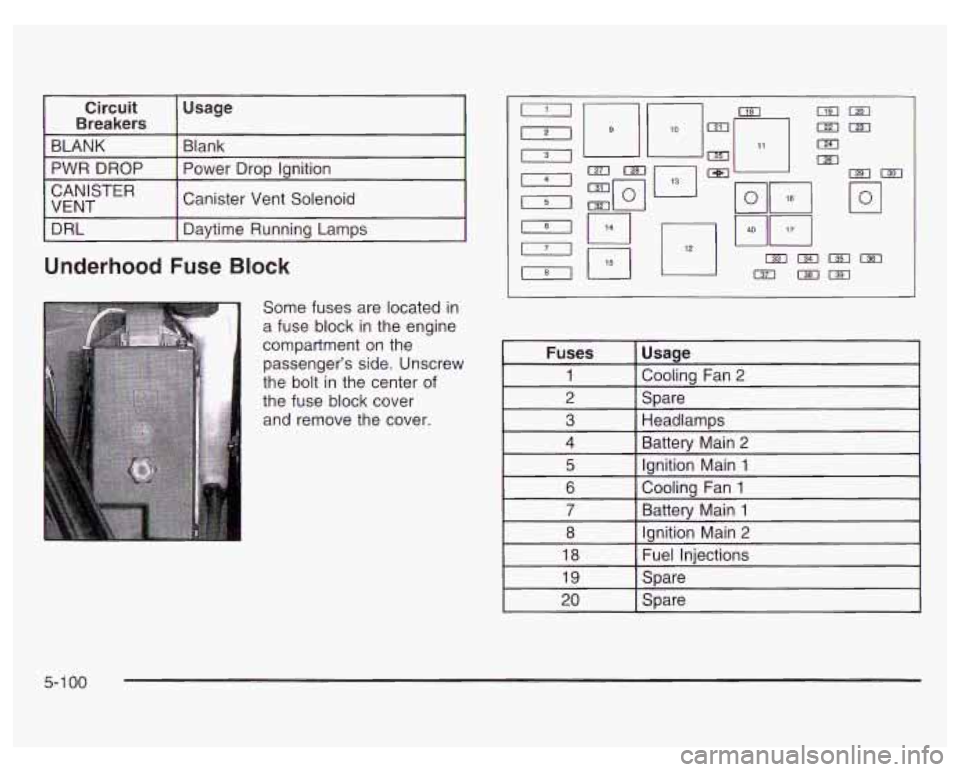
Underhood Fuse Block
Fuses Usage
Cooling Fan 2
Spare
Headlamps
4 Battery Main 2
5 Ignition Main 1
5-1 00
Page 361 of 378
Backglass Antenna .......................................... 3-59
Backing Up .................................................... 4-41
Battery .......................................................... 5-52
Battery Replacement ......................................... 2-6
Battery Run-Down Protection ............................ 3-1 5
Before Leaving on a Long Trip ......................... 4-24
Body Lubrication Service .......................... 6-10
Brake
Parking
...................................................... 2-27
System Inspection ....................................... 6-1 4
System Warning Light .................................. 3-28
Brake Fluid .................................................... 5-49
Brake Wear ................................................... 5-51
Brakes .......................................................... 5-49
Braking ........................................................... 4-6
Break-In, New Vehicle ..................................... 2-19
Bulb Replacement ........................................... 5-60
Center High-Mounted Stoplamp (CHMSL) ........ 5-63
Front Turn Signal and Sidemarker Lamps ....... 5-62
Halogen Bulbs ............................................ 5-60
Headlamp Aiming ........................................ 5-59
Headlamps ................................................. 5-60
Replacement Bulbs ...................................... 5-66
Taillamps, Sidemarker and Back-up Lamps ..... 5-64
Buying New Tires ........................................... 5-71
Braking in Emergencies ..................................... 4-9
C
California Fuel .................................................. 5-6
Canada ........................................................... 7-4
Canadian Owners ................................................ ii
Canadian Roadside Assistance ........................... 7-6
Capacities and Specifications .......................... 5-1 02
Carbon Monoxide ................... 4-27, 4-37, 2-1 1, 2-31
Care of
Safety Belts ................................................ 5-91
Care of the HUD ............................................ 3-17
Care of Your
Cassette Tape Player
................................... 3-58
CD Player .................................................. 3-59
Cassette Tape Messages ................................. 3-47
Cassette Tape Player Service ............................. 6-9
Center Console Storage Area ........................... 2-40
Center High-Mounted Stoplamp (CHMSL) ........... 5-63
Center Passenger Position, Safety Belts ............. 1-21
Chains, Tires .................................................. 5-75
Check
Checking Coolant
............................................ 5-31
Checking Things Under the Hood ...................... 5-10
Checking Your Restraint Systems ...................... 1-58
CDS .......................................................... 3-59
CD Adapter Kits ............................................. 3-48
Charging System Light .................................... 3-27
Engine Light ............................................... 3-32
Checking Engine Oil ........................................ 5-18
Chemical Paint Spotting ................................... 5-94
2
Page 364 of 378
Emissions Inspection and Maintenance
Engine Programs
................................................... 3-34
Air Cleaner/Filter
......................................... 5-25
Battery
....................................................... 5-52
Check and Service Engine Soon Light ............ 3-32
Coolant
...................................................... 5-30
Coolant Heater
............................................ 2-23
Coolant Temperature Gage
........................... 3-31
Coolant Temperature Warning Light
................ 3-31
Cooling System Inspection
............................ 6-1 3
Engine Compartment Overview
...................... 5-1 2
Exhaust ..................................................... 2-31
Oil
............................................................. 5-18
Starting
...................................................... 2-20
Supercharger Oil
......................................... 5-24
Engine Coolant Level Check
.............................. 6-9
Engine Cooling When Trailer Towing
.................. 4-43
Engine Oil Additives
........................................ 5-22
Engine Oil Level Check
..................................... 6-9
Engine Oil Scheduled Maintenance
..................... 6-5
Warning Light
............................................. 3-30
Entering Programming Mode
......................... 2-44
Entry Lighting
........................ ...... 3-13
Exiting Programming Mode
.......... ...... 2-53
Extender, Safety Belt
.. ...................... 1-28
Exterior Lamps
............................................... 3-1 0
Overheating ................................................ 5-33
Enhanced Traction System (ETS)
...................... 4-1 1
Express-Down Window
................................. 2-1 4
F
, ........... FabridCarpet ........... ........... 5-88
Filter
Engine Air Cleaner ............................... :~~=:=~ 5-25
Finding a Station ............................ 3-45, 3-49, 3-52
Finish Care
.................................................... 5-92
Finish Damage
............................................... 5-93
Flash-to-Pass
................................................... 3-6
Flat Tire
........................................................ 5-76
Flat Tire, Changing
......................................... 5-76
Fluid Automatic Transaxle
..................................... 5-27
Power Steering
........................................... 5-46
Windshield Washer
...................................... 5-48
Fog Lamps
................................. , ........... 3-12
Following Distance
.......................................... 4-41
Footnotes
........................................................ 6-5
Front Reading Lamps
...................................... 3-14
Fuel
............................................................... 5-5
Additives ...................................................... 5-6
California Fuel
.............................................. 5-6
Filling a Portable Fuel Container
..................... 5-9
Filling Your Tank
........................................... 5-7
Fuels in Foreign Countries
.............................. 5-7
Gage
......................................................... 3-37
Gasoline Octane
........................................ 5-5
FM ............................................................... 3-57
5