steering PONTIAC GRAND PRIX 2003 Owner's Guide
[x] Cancel search | Manufacturer: PONTIAC, Model Year: 2003, Model line: GRAND PRIX, Model: PONTIAC GRAND PRIX 2003Pages: 378, PDF Size: 17.64 MB
Page 240 of 378
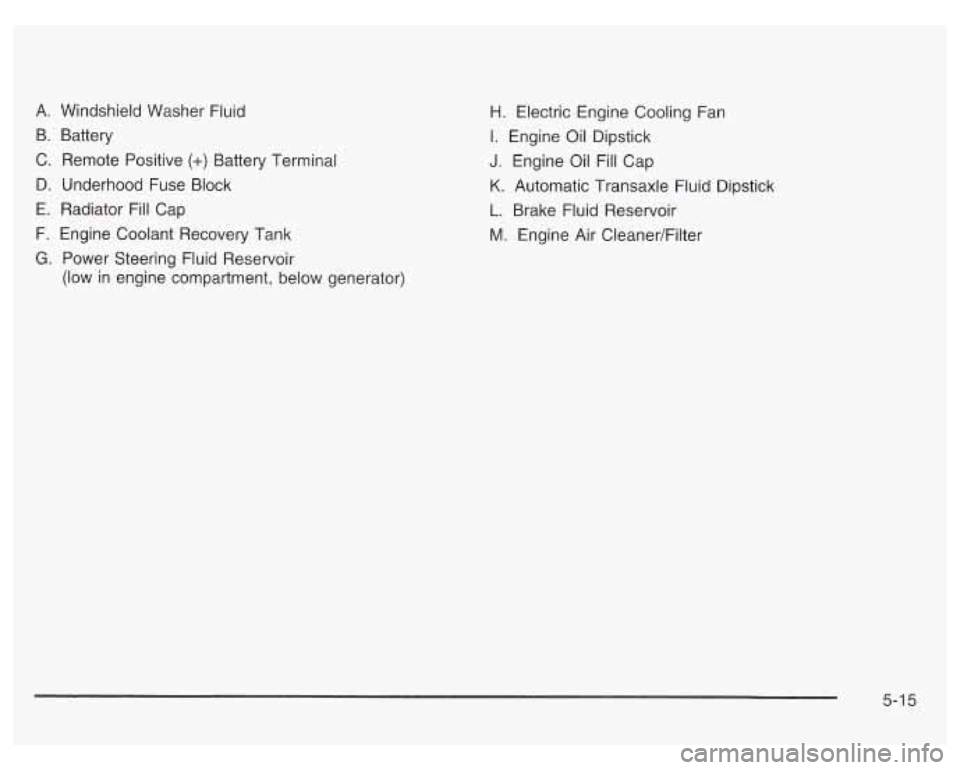
A. Windshield Washer Fluid
B. Battery
C. Remote Positive
(+) Battery Terminal
D. Underhood Fuse Block
E. Radiator Fill Cap
F. Engine Coolant Recovery Tank
G. Power Steering Fluid Reservoir
(low in engine compartment, below generator)
H. Electric Engine Cooling Fan
I. Engine Oil Dipstick
J. Engine Oil Fill Cap
K. Automatic Transaxle Fluid Dipstick
1. Brake Fluid Reservoir
M. Engine Air CleanedFilter
5-1 5
Page 242 of 378
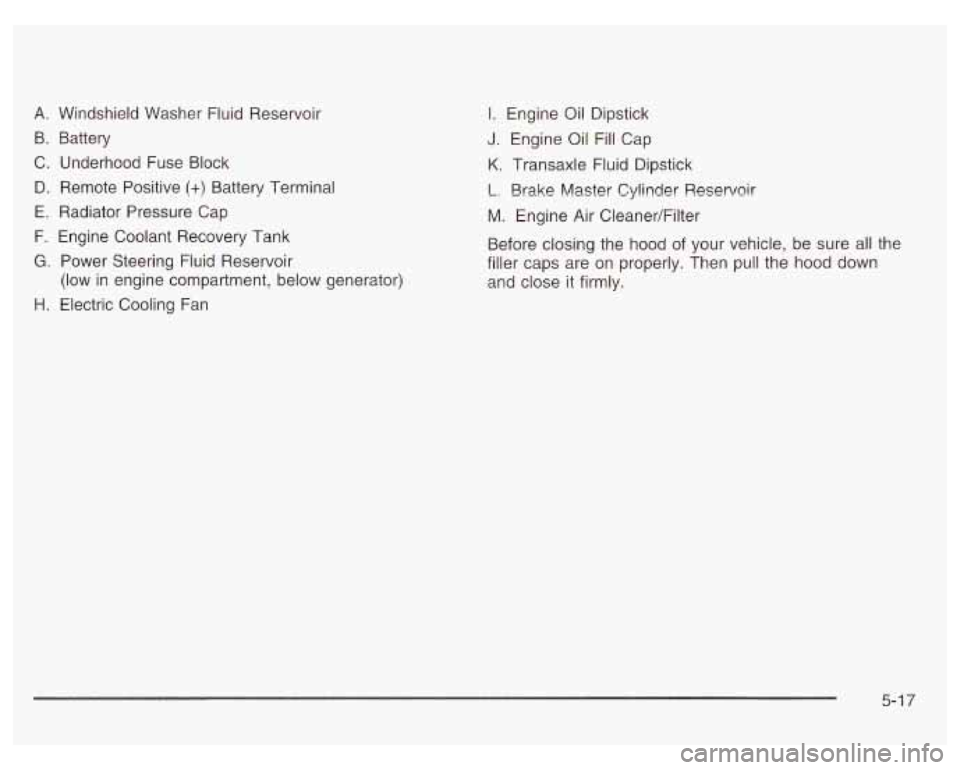
A. Windshield Washer Fluid Reservoir
B. Battery
C. Underhood Fuse Block D. Remote Positive
(+) Battery Terminal
E. Radiator Pressure Cap
F. Engine Coolant Recovery Tank
G. Power Steering Fluid Reservoir
H. Electric Cooling Fan
(low
in engine compartment, below generator)
I. Engine Oil Dipstick
J. Engine Oil Fill Cap
K. Transaxle Fluid Dipstick
L. Brake Master Cylinder Reservoir
M. Engine Air CleanedFilter
Before closing the hood
of your vehicle, be sure all the
filler caps are on properly. Then pull the
hood down
and close it firmly.
5-1 7
Page 271 of 378
Power Steering Fluid
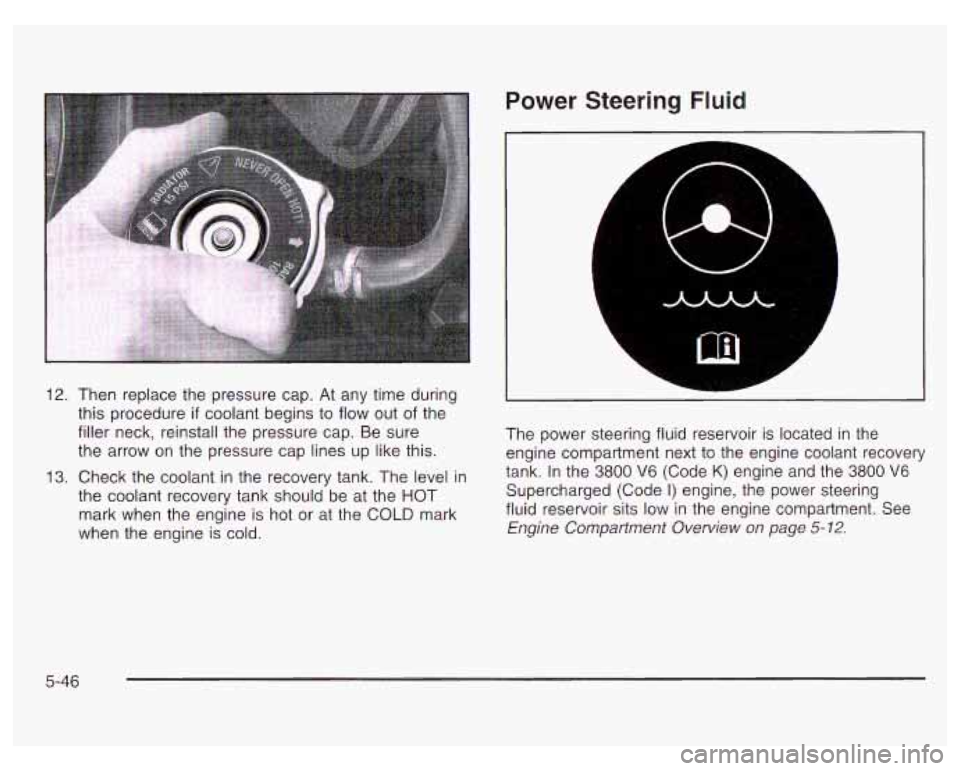
12. Then replace the pressure cap. At any time during
this procedure
if coolant begins to flow out of the
filler neck, reinstall the pressure cap. Be sure
the arrow on the pressure cap lines up like this.
13. Check the coolant in the recovery tank. The level in
the coolant recovery tank should be at the HOT
mark when the engine
is hot or at the COLD mark
when the engine is cold. The power
steering fluid reservoir is located in the
engine compartment next to the engine coolant recovery
tank. In the 3800 V6 (Code
K) engine and the 3800 V6
Supercharged (Code
I) engine, the power steering
fluid reservoir sits low in the engine compartment. See
Engine Compartment Overview on page
5- 12.
5-46
Page 272 of 378
When to Check Power Steering Fluid
It is not necessary to regularly check power steering fluid
unless you suspect there is a leak in the system or
you hear an unusual noise. A fluid loss in this system
couid indicate a problem. Have the system inspected
and repaired. See Engine Compartment Overview
on page
5-12 for reservoir location.
How to Check Power Steering Fluid
Turn the key off , let the engine compartment cool down,
wipe the cap and the top of the reservoir clean, then
unscrew the cap and wipe the dipstick with a clean rag.
Replace the cap and completely tighten it. Then remove
the cap again and look at the fluid level on the dipstick.
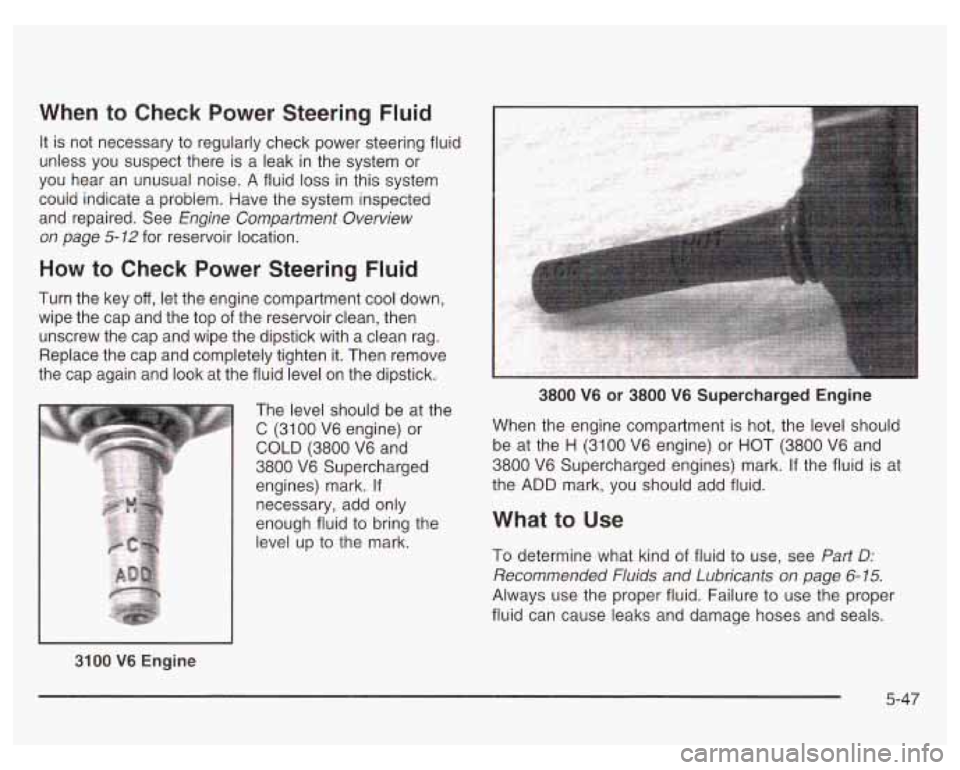
The level should be at the
C (3100 V6 engine)
or
COLD (3800 V6 and
3800 V6 Supercharged
engines) mark.
If
necessary, add only
enough fluid to bring the
level up to the mark.
3800 V6 or 3800 V6 Supercharged Engine
When the engine compartment is hot, the level should
be at the
H (3100 V6 engine) or HOT (3800 V6 and
3800 V6 Supercharged engines) mark.
If the fluid is at
the ADD mark, you should add fluid.
What to Use
To determine what kind of fluid to use, see Part D:
Recommended Fluids and Lubricants on page 6-15.
Always use the proper fluid. Failure to use the proper
fluid can cause leaks and damage hoses and seals.
3100 V6 Engine
5-47
Page 301 of 378
If a Tire Goes Flat
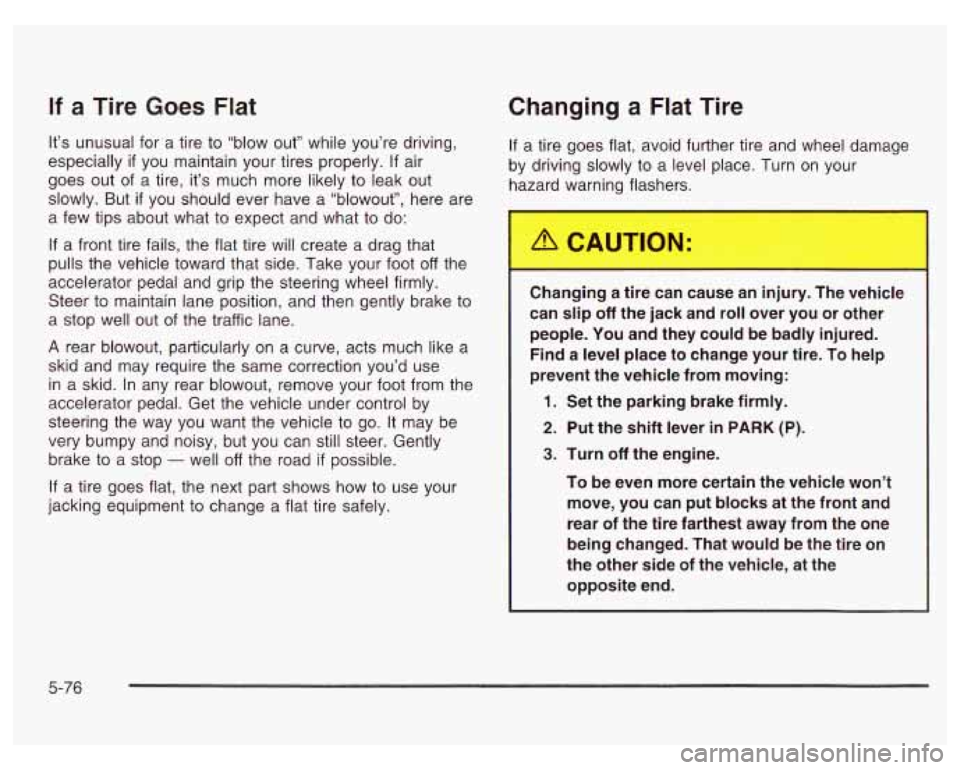
It’s unusual for a tire to “blow out” while you’re driving,
especially
if you maintain your tires properly. If air
goes out of a tire, it’s much more likely
to leak out
slowly. But
if you should ever have a “blowout”, here are
a few tips about what to expect and what to do:
If a front tire fails, the flat tire will create a drag that
pulls the vehicle toward that side. Take your foot
off the
accelerator pedal and grip the steering wheel firmly.
Steer to maintain lane position, and then gently brake to
a stop well out of the traffic lane.
A rear blowout, particularly on a curve, acts much like a
skid and may require the same correction you’d use
in a skid. In any rear blowout, remove your foot from the
accelerator pedal. Get the vehicle under control by
steering the way you want the vehicle to go.
It may be
very bumpy and noisy, but you can still steer. Gently
brake to a stop
- well off the road if possible.
If a tire goes flat, the next part shows how to use your
jacking equipment to change a flat tire safely.
Changing a Flat Tire
If a tire goes flat, avoid further tire and wheel damage
by driving slowly to a level place. Turn
on your
hazard warning flashers.
I
Chant_ g a tire can cause an injury. The v icle
can slip
off the jack and roll over you or other
people.
You and they could be badly injured.
Find a level place to change your tire. To help
prevent the vehicle from moving:
1. Set the parking brake firmly.
2. Put the shift lever in PARK (P).
3. Turn off the engine.
To be even more certain the vehicle won’t move, you can put blocks at the front and
rear of the tire farthest away from
the one
being changed. That would be the tire on
the other side of the vehicle, at the
opposite end.
5-76
Page 324 of 378
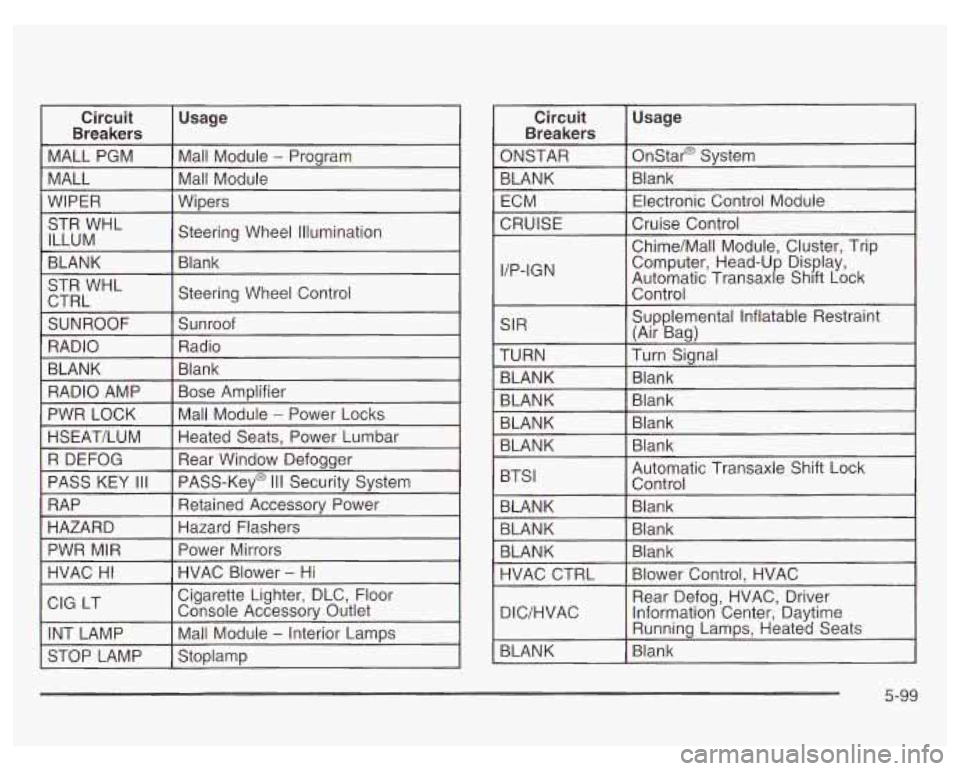
Circuit
Breakers
MALL PGM
MALL
WIPER STR WHL
ILLUM
BLANK
STR WHL
CTRL
SUNROOF RADIO
BLANK
RADIO AMP
PWR LOCK
HSEAT/LUM
I Usage
Mall Module - Program
Mall Module
~~ ~~
-
Wipers
Steering Wheel Illumination
Blank
Steering Wheel Control
Sunroof
Radio
R DEFOG Rear Window Defogger
PASS KEY
Ill PASS-Key@ I II Security System
~~ ~
lRAP I Retained Accessow Power I
ONSTAR Onstar@
System
BLANK Blank
SIR Supplemental
Inflatable Restraint
(Air Baa)
BTSl
I
Automatic Transaxle Shift Lock
Control
5-99
Page 330 of 378
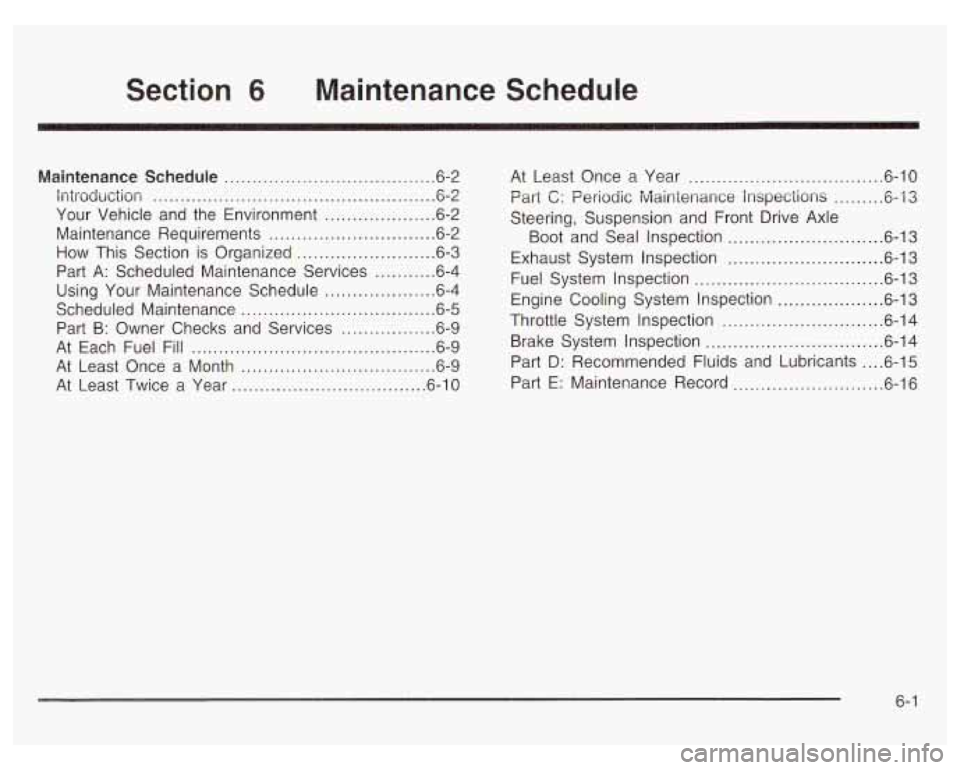
Section 6 Maintenance Schedule
Maintenance Schedule ...................................... 6-2
Introduction
................................................... 6-2
Your Vehicle and the Environment
.................... 6-2
Maintenance Requirements
.............................. 6-2
How This Section is Organized
......................... 6-3
Part A: Scheduled Maintenance Services
........... 6-4
Using Your Maintenance Schedule
.................... 6.4
Scheduled Maintenance
.................. ......... 6.5
Part B: Owner Checks and Services
.... ..... 6.9
At Each Fuel Fill
........................................ 6-9
At Least Once a Month
................................... 6.9
At Least Twice a Year
................................... 6.10 At
Least Once a Year
................................... 6.10
Pari C: Periodic
Maintenance inspections ......... 6.13
Steering, Suspension and Front Drive Axle
Boot and Seal Inspection
............................ 6-13
Exhaust System Inspection
............................ 6.13
Fuel System Inspection
.................................. 6.13
Engine Cooling System Inspection
................... 6.13
Throttle System Inspection
............................ -6-14
Brake System Inspection
................................ 6.14
Part D: Recommended Fluids and Lubricants
.... 6-15
Part
E: Maintenance Record ........................... 6.16
6- 1
Page 342 of 378
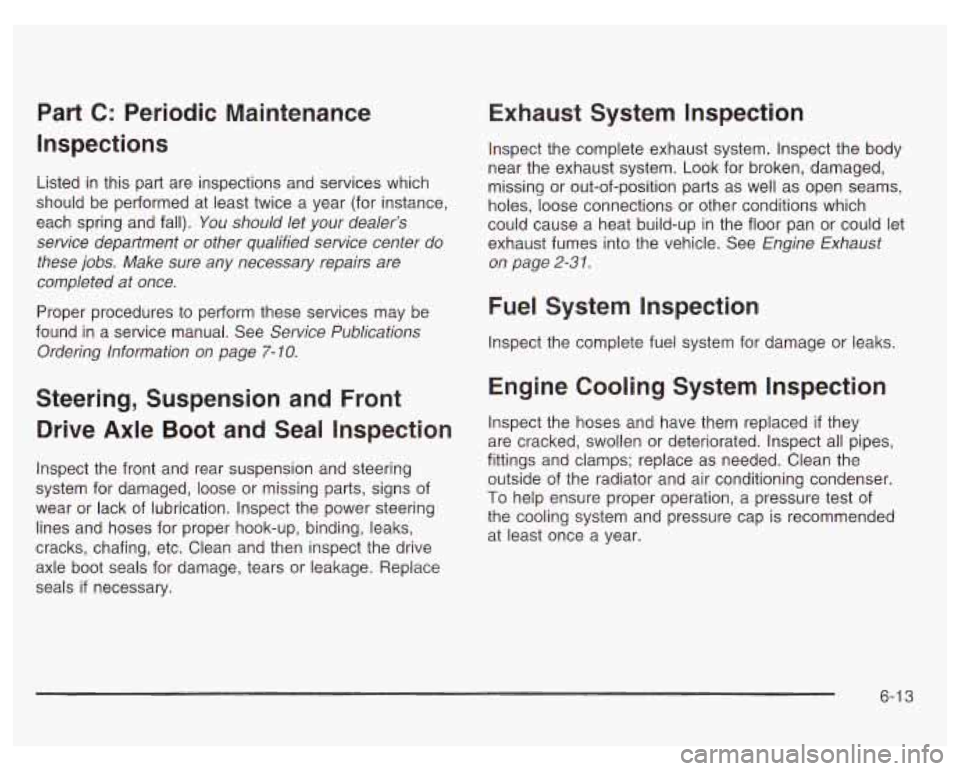
Part C: Periodic Maintenance
Inspections
Listed in this part are inspections and services which
should be performed at least twice a year (for instance,
each spring and fall).
You should let your dealer’s
service department
or other qualified service center do
these
jobs. Make sure any necessary repairs are
completed at once.
Proper procedures to perform these services may be
found in a service manual. See Service Publications
Ordering lnformation
on page 7- 10.
Steering, Suspension and Front
Drive Axle Boot and Seal Inspection
Inspect the front and rear suspension and steering
system for damaged, loose
or missing parts, signs of
wear or lack of lubrication. Inspect the power steering
lines and hoses for proper hook-up, binding, leaks,
cracks, chafing, etc. Clean and then inspect the drive
axle boot seals for damage, tears or leakage. Replace
seals
if necessary.
Exhaust System Inspection
Inspect the complete exhaust system. Inspect the body
near the exhaust system. Look for broken, damaged,
missing or out-of-position parts as well as open seams,
holes, loose connections or other conditions which
could cause a heat build-up in the floor pan or could let
exhaust fumes into the vehicle. See Engine Exhaust
on page
2-3 1.
Fuel System Inspection
Inspect the complete fuel system for damage or leaks.
Engine Cooling System Inspection
Inspect the hoses and have them replaced if they
are cracked, swollen or deteriorated. Inspect all pipes,
fittings and clamps; replace as needed. Clean the
outside of the radiator and air conditioning condenser.
To help ensure proper operation, a pressure test of
the cooling system and pressure cap is recommended
at least once a year.
6-1 3
Page 357 of 378
Service Publications Ordering
Information
Service Manuals
Service Manuals have the diagnosis and repair
information on engines, transmission, axle, suspension,
brakes, electrical, steering, body, etc.
RETAIL SELL PRICE: $120.00
Transmission, Transaxle, Transfer Case Unit Repair Manual
This manual provides information on unit repair service
procedures, adjustments, and specifications for GM
transmissions, transaxles, and transfer cases.
RETAIL SELL PRICE:
$50.00
Service Bulletins
Service Bulletins give technical service information
needed to knowledgeably service General Motors cars
and trucks. Each bulletin contains instructions to
assist in the diagnosis and service of your vehicle.
In Canada, information pertaining to Product Service
Bulletins can be obtained by contacting your General
Motors dealer or by calling 1-800-GM-DRIVE
(1 -800-463-7483).
Owner’s Information
Owner publications are written specifically for owners
and intended to provide basic operational information
about the vehicle. The owner’s manual will include
the Maintenance Schedule for all models.
In-Portfolio: Includes a Portfolio, Owner’s Manual, and
Warranty Booklet.
RETAIL SELL PRICE:
$35.00
Without Portfolio: Owner’s Manual only.
RETAIL SELL PRICE: $25.00
7-1 0
Page 360 of 378
A
Accessory Power Outlets ................................. 3-1 8
Activating the Theft-Deterrent Feature
................ 3-54
Adding Washer Fluid
....................................... 5-48
Additional Program Information
........................... 7-8
Additives, Fuel
................................................. 5-6
Add-on Electrical Equipment
............................ 5-97
Adjusting the Speakers
(Balance/Fade)
............................ 3-46, 3-49, 3-52
Air Bag Readiness Light
.................................... ~ ~ ~ ~ ~ ~ ~ 3-26
Air Bag System, Supplemental Restraint
System (SRS)
............................................. 1-51
Air Cleaner/Filter, Engine
................................. 5-25
All Overseas Locations ...................................... 7-4
Aluminum or Chrome Plated Wheels
............. 5-93
Antenna, Backglass
......................................... 3-59
Anti-lock Brake System (ABS)
............................ 4-7
Anti-Lock Brake, System Warning Light
.............. 3-29
Appearance Care
............................................ 5-88
Care of Safety Belts
.................................... 5-91
Cleaning the Inside of Your Vehicle
................ 5-88
Cleaning the Outside of Your Vehicle
.............. 5-91
Finish Damage
............................................ 5-93
GM Vehicle Care/Appearance Materials
.......... 5-94
Underbody Maintenance
............................... 5-93
AM
........................................................... 3-57
Chemical Paint Spotting
............................... 5-94
Sheet Metal Damage
................................... 5-93 Appearance
Care (cont.)
Weatherstrips
.......................................... 5-91
Arming and Disarming the Content
Theft-Deterrent System
................................. 2-52
Arming Confirmation
........................................ 2-16
Arming with the Power Lock Switch
................... 2-15
Arming with the Remote Keyless Entry
Transmitter
................................................. 2-16
Ashtrays
............. ............................... 3-19
Assist Handles
.... ................................... 2-41
Audio System(s)
......................................... 3-44
Audio Systems Audio Steering Wheel Controls
...... ........ 3-56
Backglass Antenna
...................................... 3-59
Care of Your Cassette Tape Player
................ 3-58
Care of Your CD Player
............................... 3-59
Care of Your CDs
........................................ 3-59
Radio with Cassette
..................................... 3-45
Radio with CD .................................... 3-48, 3-51
Setting the Time
.......................................... 3-44
Theft-Deterrent Feature
................................ 3-54
Understanding Radio Reception
..................... 3-57
Automatic Door Locks
..................................... 2-45
Automatic Transaxle
Fluid
.......................................................... 5-27
Operation
................................................... 2-24
Automatic Transaxle Check
.............................. 6-10
Automatic Transaxle Shift Lock Control
System Check
............................................. 6-11
Auxiliary Power Connection (Power Drop)
........... 3-19
1