engine PONTIAC GRAND PRIX 2005 Owners Manual
[x] Cancel search | Manufacturer: PONTIAC, Model Year: 2005, Model line: GRAND PRIX, Model: PONTIAC GRAND PRIX 2005Pages: 444, PDF Size: 2.6 MB
Page 335 of 444
{CAUTION:
Fans or other moving engine parts can injure
you badly. Keep your hands away from moving
parts once the engine is running.
{CAUTION:
Using a match near a battery can cause battery
gas to explode. People have been hurt doing
this, and some have been blinded. Use a
ashlight if you need more light.
Be sure the battery has enough water. You do
not need to add water to the battery installed
in your new vehicle. But if a battery has ller
caps, be sure the right amount of uid is there.
CAUTION: (Continued)
CAUTION: (Continued)
If it is low, add water to take care of that rst.
If you do not, explosive gas could be present.
Battery uid contains acid that can burn you.
Do not get it on you. If you accidentally get it
in your eyes or on your skin, ush the place
with water and get medical help immediately.
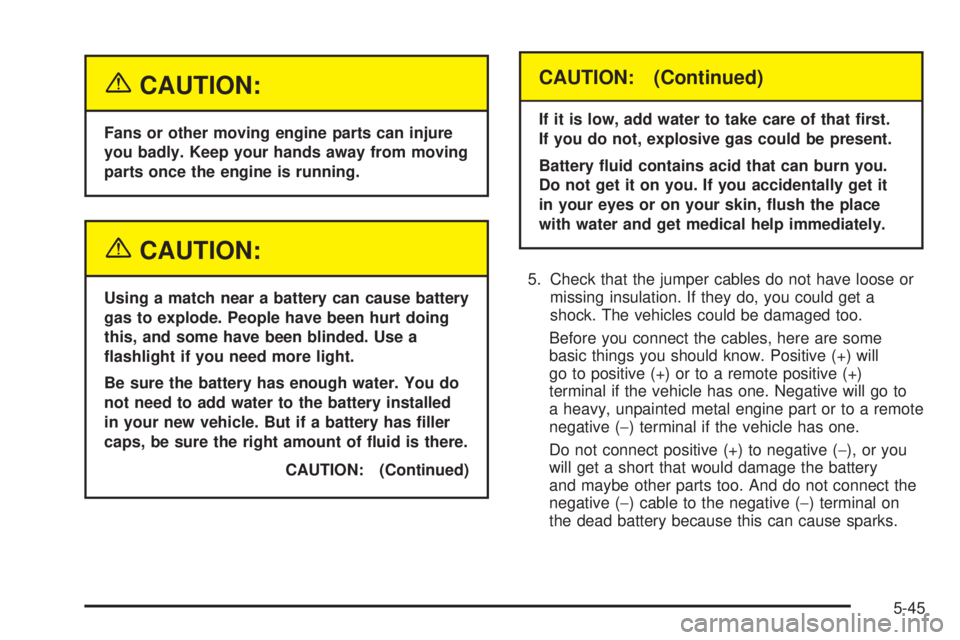
5. Check that the jumper cables do not have loose or
missing insulation. If they do, you could get a
shock. The vehicles could be damaged too.
Before you connect the cables, here are some
basic things you should know. Positive (+) will
go to positive (+) or to a remote positive (+)
terminal if the vehicle has one. Negative will go to
a heavy, unpainted metal engine part or to a remote
negative (−) terminal if the vehicle has one.
Do not connect positive (+) to negative (−), or you
will get a short that would damage the battery
and maybe other parts too. And do not connect the
negative (−) cable to the negative (−) terminal on
the dead battery because this can cause sparks.
5-45
Page 336 of 444
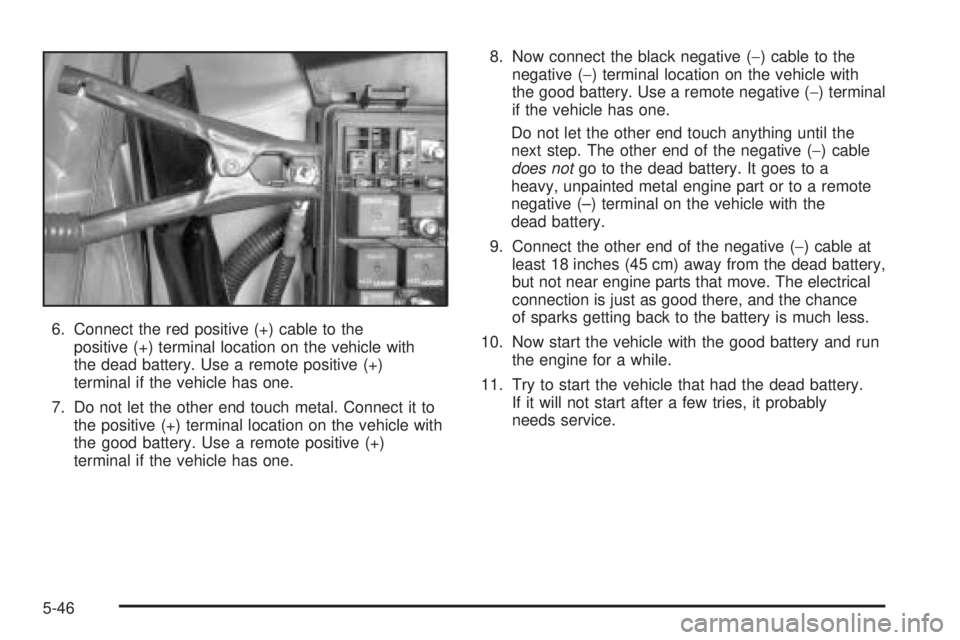
6. Connect the red positive (+) cable to the
positive (+) terminal location on the vehicle with
the dead battery. Use a remote positive (+)
terminal if the vehicle has one.
7. Do not let the other end touch metal. Connect it to
the positive (+) terminal location on the vehicle with
the good battery. Use a remote positive (+)
terminal if the vehicle has one.8. Now connect the black negative (−) cable to the
negative (−) terminal location on the vehicle with
the good battery. Use a remote negative (−) terminal
if the vehicle has one.
Do not let the other end touch anything until the
next step. The other end of the negative (−) cable
does notgo to the dead battery. It goes to a
heavy, unpainted metal engine part or to a remote
negative (–) terminal on the vehicle with the
dead battery.
9. Connect the other end of the negative (−) cable at
least 18 inches (45 cm) away from the dead battery,
but not near engine parts that move. The electrical
connection is just as good there, and the chance
of sparks getting back to the battery is much less.
10. Now start the vehicle with the good battery and run
the engine for a while.
11. Try to start the vehicle that had the dead battery.
If it will not start after a few tries, it probably
needs service.
5-46
Page 337 of 444
Notice:If the jumper cables are removed in the
wrong order, electrical shorting may occur and
damage the vehicle. The repairs would not be
covered by your warranty. Remove the jumper
cables in the correct order, making sure that the
cables do not touch each other or other metal.
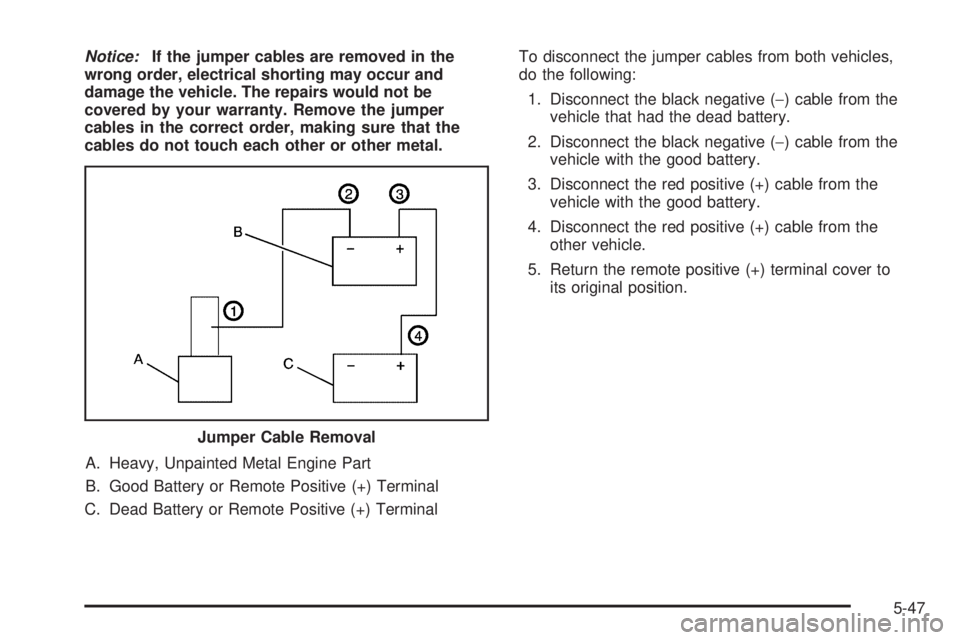
A. Heavy, Unpainted Metal Engine Part
B. Good Battery or Remote Positive (+) Terminal
C. Dead Battery or Remote Positive (+) TerminalTo disconnect the jumper cables from both vehicles,
do the following:
1. Disconnect the black negative (−) cable from the
vehicle that had the dead battery.
2. Disconnect the black negative (−) cable from the
vehicle with the good battery.
3. Disconnect the red positive (+) cable from the
vehicle with the good battery.
4. Disconnect the red positive (+) cable from the
other vehicle.
5. Return the remote positive (+) terminal cover to
its original position.
Jumper Cable Removal
5-47
Page 351 of 444
Tire Size
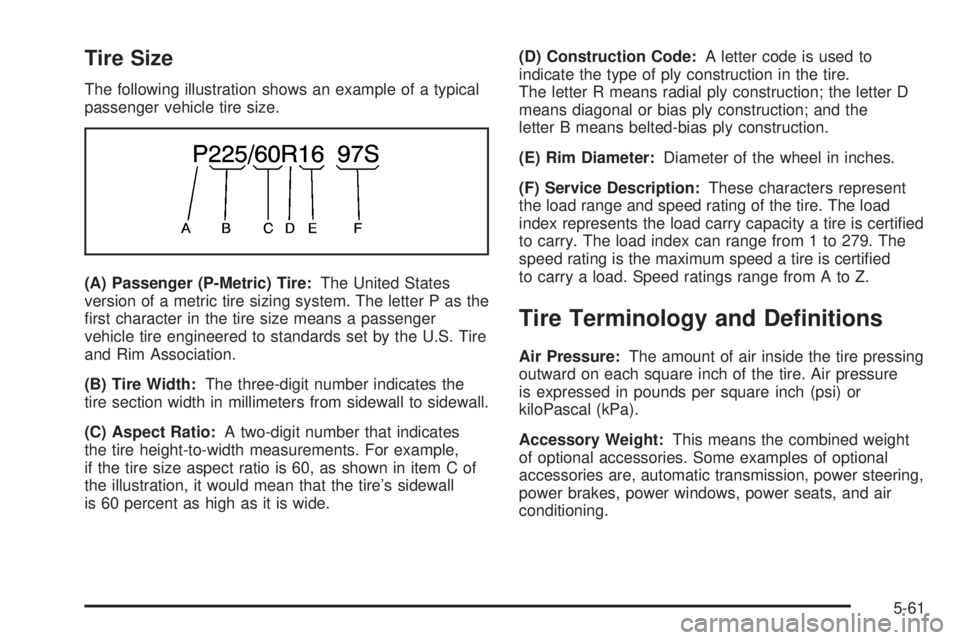
The following illustration shows an example of a typical
passenger vehicle tire size.
(A) Passenger (P-Metric) Tire:The United States
version of a metric tire sizing system. The letter P as the
rst character in the tire size means a passenger
vehicle tire engineered to standards set by the U.S. Tire
and Rim Association.
(B) Tire Width:The three-digit number indicates the
tire section width in millimeters from sidewall to sidewall.
(C) Aspect Ratio:A two-digit number that indicates
the tire height-to-width measurements. For example,
if the tire size aspect ratio is 60, as shown in item C of
the illustration, it would mean that the tire’s sidewall
is 60 percent as high as it is wide.(D) Construction Code:A letter code is used to
indicate the type of ply construction in the tire.
The letter R means radial ply construction; the letter D
means diagonal or bias ply construction; and the
letter B means belted-bias ply construction.
(E) Rim Diameter:Diameter of the wheel in inches.
(F) Service Description:These characters represent
the load range and speed rating of the tire. The load
index represents the load carry capacity a tire is certied
to carry. The load index can range from 1 to 279. The
speed rating is the maximum speed a tire is certied
to carry a load. Speed ratings range from A to Z.
Tire Terminology and Denitions
Air Pressure:The amount of air inside the tire pressing
outward on each square inch of the tire. Air pressure
is expressed in pounds per square inch (psi) or
kiloPascal (kPa).
Accessory Weight:This means the combined weight
of optional accessories. Some examples of optional
accessories are, automatic transmission, power steering,
power brakes, power windows, power seats, and air
conditioning.
5-61
Page 367 of 444
{CAUTION:
Idling the engine in a closed-in place or with
the climate control system off can cause
deadly carbon monoxide (CO). See “Engine
Exhaust” in the Index.
6. Start the vehicle. SeeStarting Your Engine on
page 2-23for more information. The vehicle
must be running while using the air compressor.
{CAUTION:
Inating something too much can make it
explode, and you or others could be injured.
Be sure to read the inator instructions, and
inate the tire to its recommended pressure.
Do not exceed 36 psi (248 kPa).Notice:If the air compressor runs for more than
six minutes, at a time, it may overheat. The
excessive heat could damage the compressor.
Always operate the compressor for six minutes or
less when inating a tire.
7. Move the inator kit switch to the ON position.
The inator kit will force sealant and air into the
tire. Sealant may leak from the valve stem while the
sealant is being forced into the tire.
8. Inate the tire up to the standard operating pressure
using the air pressure gauge on the top of the unit.
Notice:If 26 psi (179 kPa) tire pressure cannot be
reached after six minutes the vehicle should not
be driven further. Damage to the tire is severe and
the sealant will not be effective. Remove the air
compressor plug from the accessory power outlet
and unscrew the inating hose from the tire
valve. See “Roadside Assistance” in the Index.
9. Turn off the engine.
10. Move the inator kit switch to the OFF position
once the correct tire pressure is obtained.
11. Unplug the air compressor plug and store in the
housing of the compressor (A).
12. Disconnect the air compressor inator hose from
the tire valve stem and replace the valve stem cap.
5-77
Page 369 of 444
Using the Air Compressor
To use the air compressor by itself to inate a tire,
do the following:
1. Remove the air compressor accessory plug from
the air compressor.
2. Unlock the air compressor hose from the sealant
canister by pulling up on the lever.
3. Pull the air compressor inator hose from the
sealant canister.
4. Push the air compressor inator hose onto the tire
valve stem and push the lever down to secure in
place.
5. Plug the air compressor accessory plug (C) into
an accessory power outlet in the vehicle. See
Accessory Power Outlets on page 3-24for more
information.{CAUTION:
Idling the engine in a closed-in place or with
the climate control system off can cause
deadly carbon monoxide (CO). See “Engine
Exhaust” in the Index.
6. Start the vehicle. SeeStarting Your Engine on
page 2-23for more information. The vehicle
must be running while using the air compressor.
{CAUTION:
Inating something too much can make it
explode, and you or others could be injured.
Be sure to read the inator instructions, and
inate the tire to its recommended pressure.
Do not exceed 36 psi (248 kPa).
5-79
Page 372 of 444
Changing a Flat Tire
If a tire goes at, avoid further tire and wheel
damage by driving slowly to a level place.
Turn on your hazard warning ashers.{CAUTION:
Changing a tire can be dangerous. The vehicle
can slip off the jack and roll over or fall on you
or other people. You and they could be badly
injured or even killed. Find a level place to
change your tire. To help prevent the vehicle
from moving:
1. Set the parking brake rmly.
2. Put the shift lever in PARK (P).
3. Turn off the engine and do not restart
while the vehicle is raised.
4. Do not allow passengers to remain in
the vehicle.
To be even more certain the vehicle will not
move, you should put blocks at the front and
rear of the tire farthest away from the one
being changed. That would be the tire, on the
other side, at the opposite end of the vehicle.
5-82
Page 392 of 444
Vehicle Identication
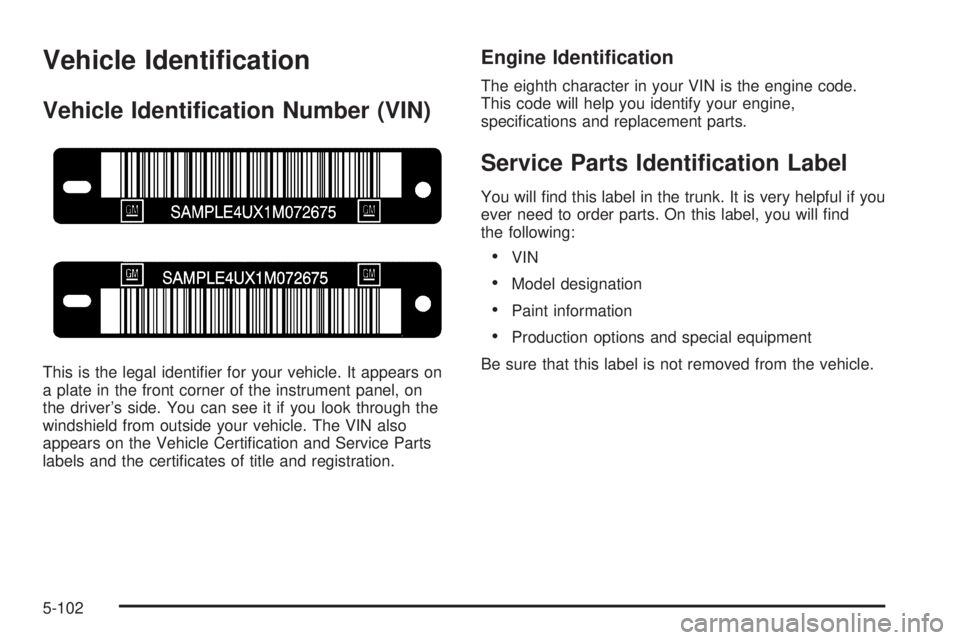
Vehicle Identication Number (VIN)
This is the legal identier for your vehicle. It appears on
a plate in the front corner of the instrument panel, on
the driver’s side. You can see it if you look through the
windshield from outside your vehicle. The VIN also
appears on the Vehicle Certication and Service Parts
labels and the certicates of title and registration.
Engine Identication
The eighth character in your VIN is the engine code.
This code will help you identify your engine,
specications and replacement parts.
Service Parts Identication Label
You will nd this label in the trunk. It is very helpful if you
ever need to order parts. On this label, you will nd
the following:
VIN
Model designation
Paint information
Production options and special equipment
Be sure that this label is not removed from the vehicle.
5-102
Page 395 of 444
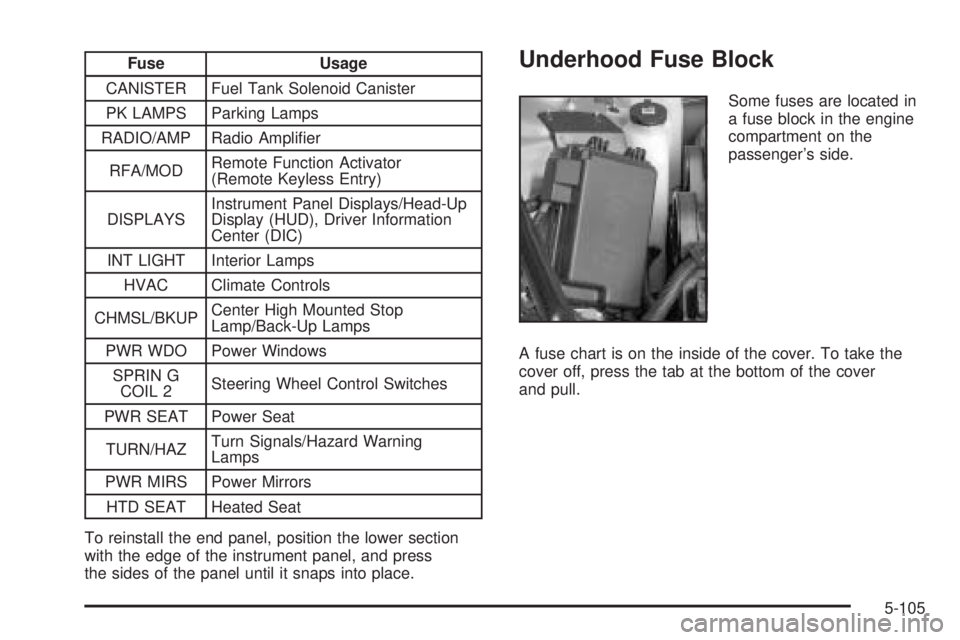
Fuse Usage
CANISTER Fuel Tank Solenoid Canister
PK LAMPS Parking Lamps
RADIO/AMP Radio Amplier
RFA/MODRemote Function Activator
(Remote Keyless Entry)
DISPLAYSInstrument Panel Displays/Head-Up
Display (HUD), Driver Information
Center (DIC)
INT LIGHT Interior Lamps
HVAC Climate Controls
CHMSL/BKUPCenter High Mounted Stop
Lamp/Back-Up Lamps
PWR WDO Power Windows
SPRIN G
COIL 2Steering Wheel Control Switches
PWR SEAT Power Seat
TURN/HAZTurn Signals/Hazard Warning
Lamps
PWR MIRS Power Mirrors
HTD SEAT Heated Seat
To reinstall the end panel, position the lower section
with the edge of the instrument panel, and press
the sides of the panel until it snaps into place.Underhood Fuse Block
Some fuses are located in
a fuse block in the engine
compartment on the
passenger’s side.
A fuse chart is on the inside of the cover. To take the
cover off, press the tab at the bottom of the cover
and pull.
5-105
Page 398 of 444
Capacities and Specications
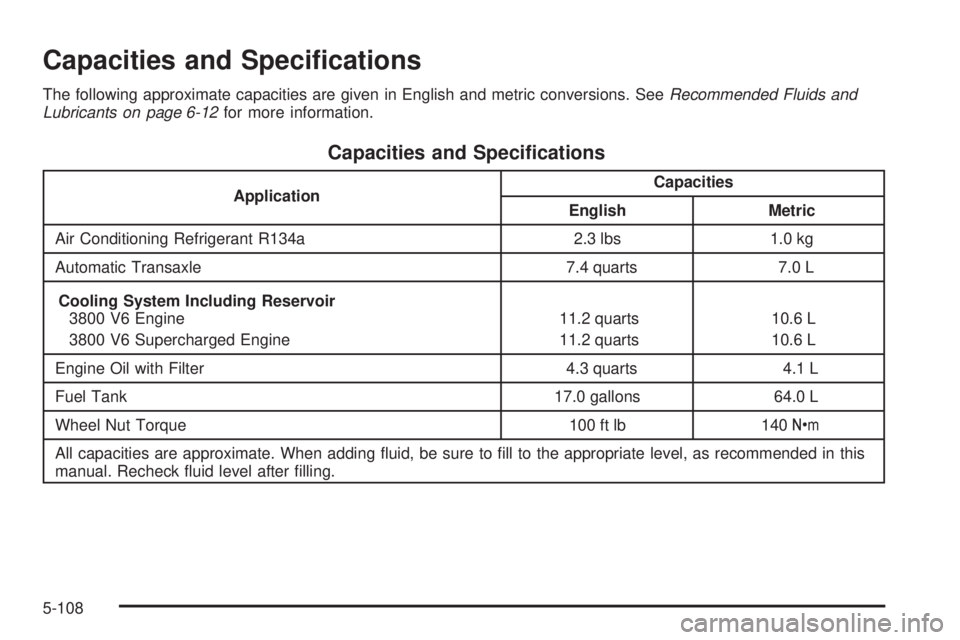
The following approximate capacities are given in English and metric conversions. SeeRecommended Fluids and
Lubricants on page 6-12for more information.
Capacities and Specications
ApplicationCapacities
English Metric
Air Conditioning Refrigerant R134a 2.3 lbs 1.0 kg
Automatic Transaxle 7.4 quarts 7.0 L
Cooling System Including Reservoir
3800 V6 Engine
3800 V6 Supercharged Engine11.2 quarts
11.2 quarts10.6 L
10.6 L
Engine Oil with Filter 4.3 quarts 4.1 L
Fuel Tank 17.0 gallons 64.0 L
Wheel Nut Torque 100 ft lb 140Y
All capacities are approximate. When adding uid, be sure to ll to the appropriate level, as recommended in this
manual. Recheck uid level after lling.
5-108