brakes PONTIAC GRAND PRIX 2005 Owners Manual
[x] Cancel search | Manufacturer: PONTIAC, Model Year: 2005, Model line: GRAND PRIX, Model: PONTIAC GRAND PRIX 2005Pages: 444, PDF Size: 2.6 MB
Page 89 of 444
Automatic Transaxle Operation
The shift lever for the automatic transaxle is located on
the console between the seats.
Maximum engine speed is limited when the vehicle is
in PARK (P) or NEUTRAL (N) to protect driveline
components from improper operation.
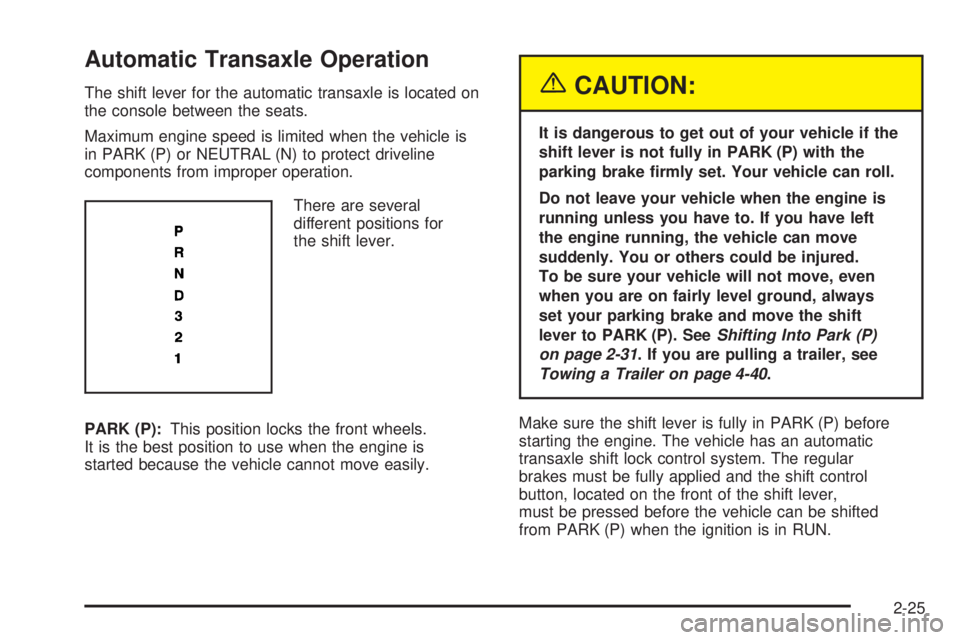
There are several
different positions for
the shift lever.
PARK (P):This position locks the front wheels.
It is the best position to use when the engine is
started because the vehicle cannot move easily.{CAUTION:
It is dangerous to get out of your vehicle if the
shift lever is not fully in PARK (P) with the
parking brake rmly set. Your vehicle can roll.
Do not leave your vehicle when the engine is
running unless you have to. If you have left
the engine running, the vehicle can move
suddenly. You or others could be injured.
To be sure your vehicle will not move, even
when you are on fairly level ground, always
set your parking brake and move the shift
lever to PARK (P). SeeShifting Into Park (P)
on page 2-31. If you are pulling a trailer, see
Towing a Trailer on page 4-40.
Make sure the shift lever is fully in PARK (P) before
starting the engine. The vehicle has an automatic
transaxle shift lock control system. The regular
brakes must be fully applied and the shift control
button, located on the front of the shift lever,
must be pressed before the vehicle can be shifted
from PARK (P) when the ignition is in RUN.
2-25
Page 91 of 444
The vehicle will shift down to the next gear and have
more power.
Notice:If your vehicle seems to start up rather
slowly or not shift gears when you go faster, and
you continue to drive your vehicle that way, you
could damage the transaxle. Have your vehicle
serviced right away. You can drive in SECOND (2)
when you are driving less than 35 mph (55 km/h)
and AUTOMATIC OVERDRIVE (D) for higher speeds
until then.
THIRD (3):This position is also used for normal driving,
but it offers more power and lower fuel economy than
AUTOMATIC OVERDRIVE (D).
Here are some times THIRD (3) could be used instead
of AUTOMATIC OVERDRIVE (D):
When driving on hilly, winding roads.
When towing a trailer, so there is less shifting
between gears.
When going down a steep hill.
When driving in non-highway scenarios
(i.e. city streets, etc.).SECOND (2):This position gives the vehicle more
power but lower fuel economy than THIRD (3).
SECOND (2) can be used on hills. It can help control
the vehicle’s speed as it goes down steep mountain
roads, but then you would also want to use the brakes
off and on.
Notice:Driving in SECOND (2) for more than
25 miles (40 km) or at speeds over 55 mph (90 km/h)
may damage the transaxle. Also, shifting into
SECOND (2) at speeds above 65 mph (105 km/h) can
cause damage. Drive in THIRD (3) or AUTOMATIC
OVERDRIVE (D) instead of SECOND (2).
FIRST (1):This position gives the vehicle even more
power but lower fuel economy than SECOND (2). It can
be used on very steep hills, or in deep snow or mud.
If the shift lever is moved to FIRST (1), the transaxle will
not shift into rst gear until the vehicle is going slowly
enough.
Notice:Spinning the tires or holding the vehicle
in one place on a hill using only the accelerator
pedal may damage the transaxle. If you are stuck,
do not spin the tires. When stopping on a hill,
use the brakes to hold the vehicle in place.
2-27
Page 96 of 444
Torque Lock
If you are parking on a hill and you do not shift your
transaxle into PARK (P) properly, the weight of the
vehicle may put too much force on the parking pawl in
the transaxle. You may nd it difficult to pull the shift
lever out of PARK (P). This is called “torque lock.”
To prevent torque lock, set the parking brake and then
shift into PARK (P) properly before you leave the
driver’s seat. To nd out how, seeShifting Into Park (P)
on page 2-31.
When you are ready to drive, move the shift lever out of
PARK (P)beforeyou release the parking brake.
If torque lock does occur, you may need to have another
vehicle push your vehicle a little uphill to take some of
the pressure from the parking pawl in the transaxle,
so you can pull the shift lever out of PARK (P).
Shifting Out of Park (P)
The vehicle has an automatic transaxle shift lock control
system which locks the shift lever in PARK (P) when
the ignition is in OFF. In addition, the regular brakes
must be fully applied before shifting from PARK (P) while
the ignition is in RUN. SeeAutomatic Transaxle
Operation on page 2-25.
If the vehicle cannot be shifted out of PARK (P), ease
pressure on the shift lever and push the shift lever
all the way up into PARK (P) as brake application
is maintained. Then move the shift lever into the
desired gear.
If the brake pedal is held down but the vehicle still
cannot be shifted out of PARK (P), try this:
1. Turn the key to ACC. There is no shift interlock in
this key position.
2. Apply and hold the brake until the end of Step 4.
3. Shift the transaxle to NEUTRAL (N).
4. Start the vehicle and then shift to the desired
transaxle gear.
5. Have the system xed as soon as possible.
2-32
Page 117 of 444
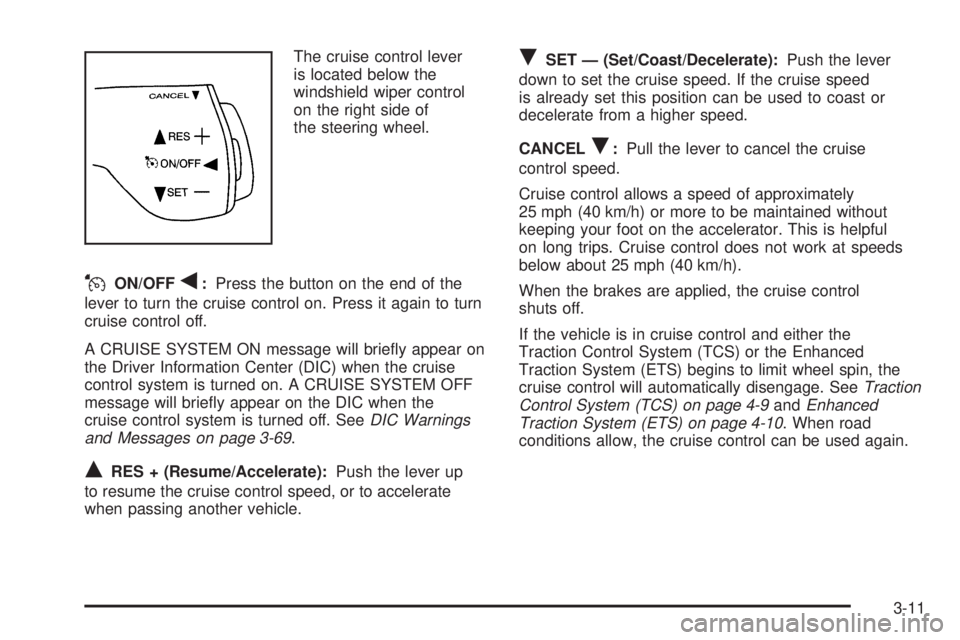
The cruise control lever
is located below the
windshield wiper control
on the right side of
the steering wheel.
JON/OFFq:Press the button on the end of the
lever to turn the cruise control on. Press it again to turn
cruise control off.
A CRUISE SYSTEM ON message will briey appear on
the Driver Information Center (DIC) when the cruise
control system is turned on. A CRUISE SYSTEM OFF
message will briey appear on the DIC when the
cruise control system is turned off. SeeDIC Warnings
and Messages on page 3-69.
QRES + (Resume/Accelerate):Push the lever up
to resume the cruise control speed, or to accelerate
when passing another vehicle.
RSET — (Set/Coast/Decelerate):Push the lever
down to set the cruise speed. If the cruise speed
is already set this position can be used to coast or
decelerate from a higher speed.
CANCEL
R:Pull the lever to cancel the cruise
control speed.
Cruise control allows a speed of approximately
25 mph (40 km/h) or more to be maintained without
keeping your foot on the accelerator. This is helpful
on long trips. Cruise control does not work at speeds
below about 25 mph (40 km/h).
When the brakes are applied, the cruise control
shuts off.
If the vehicle is in cruise control and either the
Traction Control System (TCS) or the Enhanced
Traction System (ETS) begins to limit wheel spin, the
cruise control will automatically disengage. SeeTraction
Control System (TCS) on page 4-9andEnhanced
Traction System (ETS) on page 4-10. When road
conditions allow, the cruise control can be used again.
3-11
Page 118 of 444
Setting Cruise Control
{CAUTION:
If you leave your cruise control on when you
are not using cruise, you might hit a button
and go into cruise when you do not want to.
You could be startled and even lose control.
Keep the cruise control switch off until you
want to use cruise control.
1. Push the button at the end of the cruise control
lever to turn the cruise control on.
2. Accelerate to the desired speed.
3. Push down on the cruise control lever and release
it. This will set the speed in cruise control.
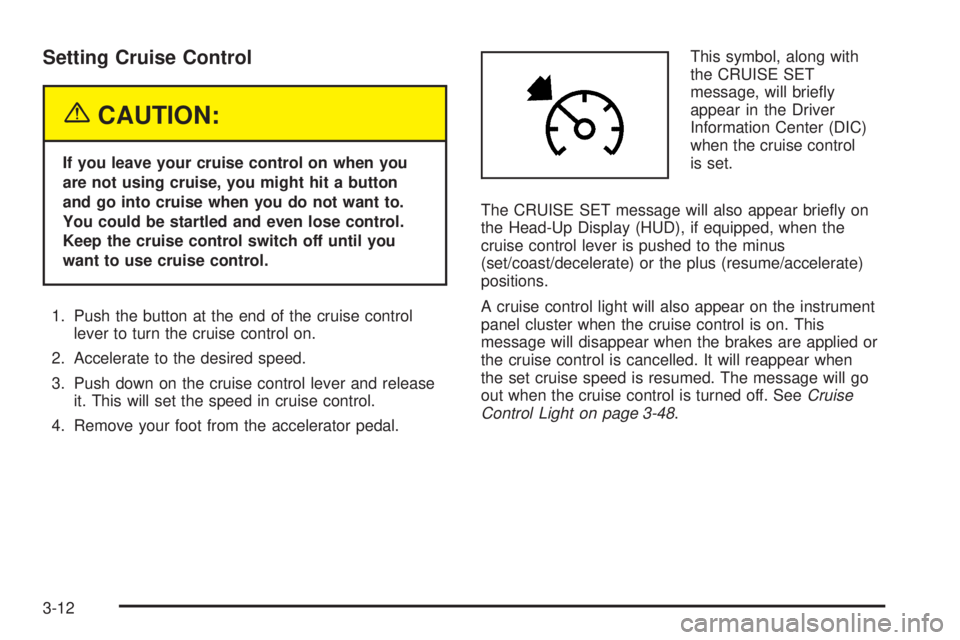
4. Remove your foot from the accelerator pedal.This symbol, along with
the CRUISE SET
message, will briey
appear in the Driver
Information Center (DIC)
when the cruise control
is set.
The CRUISE SET message will also appear briey on
the Head-Up Display (HUD), if equipped, when the
cruise control lever is pushed to the minus
(set/coast/decelerate) or the plus (resume/accelerate)
positions.
A cruise control light will also appear on the instrument
panel cluster when the cruise control is on. This
message will disappear when the brakes are applied or
the cruise control is cancelled. It will reappear when
the set cruise speed is resumed. The message will go
out when the cruise control is turned off. SeeCruise
Control Light on page 3-48.
3-12
Page 119 of 444
Resuming a Set Speed
If the cruise control is set at a desired speed and then
the brakes are applied, the cruise control shuts off.
But the cruise control does not need to be reset.
Once the vehicle is traveling approximately 25 mph
(40 km/h) or more, the cruise control lever can be
pushed upward toward the plus (resume/accelerate)
position to return to the preset cruise speed.
The vehicle will return to and stay at the preset cruise
speed. If the cruise control lever is pushed up and
held toward the plus (resume/accelerate) position, the
vehicle speed will increase until the lever is released or
the brakes are applied. Do not continue to hold the
lever in the plus (resume/accelerate) position, unless
a faster speed is desired.
Increasing Speed While Using
Cruise Control
There are two ways to go to a higher speed:
Use the accelerator pedal to get to the higher
speed. Push up on the cruise control lever toward
the plus (resume/accelerate) position, then
release the lever and take your foot off the
accelerator pedal. The vehicle will now cruise at
the higher speed.
Push up and hold the cruise control lever toward
the plus (resume/accelerate) position until the
vehicle reaches the desired speed. Then release
the cruise control lever. To increase the vehicle’s
speed in very small amounts, push up briey on the
cruise control lever and release it. Each time this
is done, the vehicle will speed up approximately
one mph (1.6 km/h).
The acceleration feature will only work after the cruise
control speed has been set by pushing the cruise control
lever down to the set position.
Reducing Speed While Using
Cruise Control
There are two ways to reduce the vehicle’s speed while
using cruise control:
Push the cruise control lever downward toward the
minus (set/coast/decelerate) position until a lower
speed is reached, then release it.
To slow down in very small amounts, push the
cruise control lever downward toward the minus
(set/coast/decelerate) position briey. Each time this
is done, the vehicle will slow down approximately
one mph (1.6 km/h).
3-13
Page 120 of 444
Passing Another Vehicle While Using
Cruise Control
Use the accelerator pedal to increase the vehicle’s
speed. When you take your foot off the pedal, the vehicle
will slow down to the cruise control speed set earlier.
Using Cruise Control on Hills
How well the cruise control will work on hills depends
upon the vehicle’s speed, its load, and the steepness of
the hills. When going up steep hills, the accelerator pedal
might have to be used in order to maintain the vehicle’s
speed. When going downhill, the brakes might have to be
applied, or the transaxle might have to be shifted to a
lower gear to keep the vehicle’s speed down. Doing
either of these things will take the vehicle out of cruise.
It may be better not to use the cruise control if the brakes
constantly have to be applied, or the vehicle continuously
needs to be shifted to a lower gear.
Cancelling Cruise Control
To cancel a cruise control session, pull the cruise
control lever forward, or step lightly on the brake pedal.
Doing either of these things will only end the current
cruise control session, but the set speed will be retained
in memory.
Push the button at the end of the cruise control lever to
turn the system off.
Erasing Speed Memory
When the cruise control or the ignition is turned off, the
cruise control set speed memory is erased.
Exterior Lamps
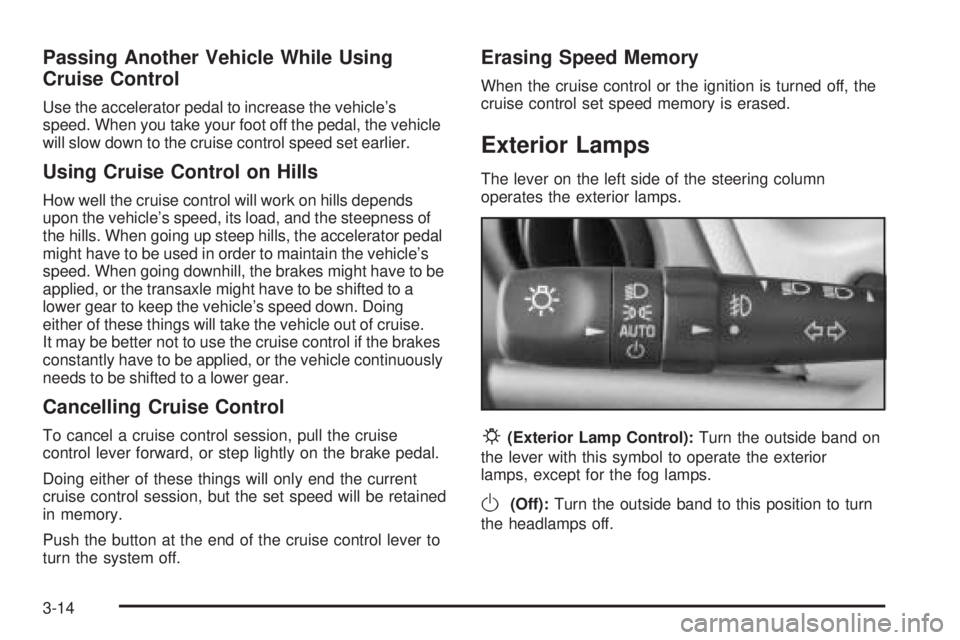
The lever on the left side of the steering column
operates the exterior lamps.
P(Exterior Lamp Control):Turn the outside band on
the lever with this symbol to operate the exterior
lamps, except for the fog lamps.
O(Off):Turn the outside band to this position to turn
the headlamps off.
3-14
Page 147 of 444
{CAUTION:
Your brake system may not be working properly
if the brake system warning light is on. Driving
with the brake system warning light on can lead
to an accident. If the light is still on after you
have pulled off the road and stopped carefully,
have the vehicle towed for service.
Anti-Lock Brake System
Warning Light
If the vehicle has the
Anti-lock Brake System
(ABS), this light will come
on when the engine is
started and may stay on
for several seconds.
That is normal.If the ABS warning light comes on and stays on, there
may be a problem with the anti-lock portion of the brake
system. If the brake system warning light is not on,
the vehicle still has brakes, but it does not have anti-lock
brakes. SeeBrake System Warning Light on page 3-40.
If the light stays on, the vehicle needs service. If the
light comes on while the vehicle is being driven, stop as
soon as possible and turn the ignition off. Then start
the vehicle again to reset the system. If the light
still stays on, or comes on again while driving, the
vehicle needs service. If the regular brake system
warning light is not on, the vehicle still has brakes, but it
does not have anti-lock brakes. If the brake system
warning light is also on, the vehicle does not have
anti-lock brakes and there is a problem with the regular
brakes. SeeBrake System Warning Light on page 3-40.
If both the brake system warning light and the anti-lock
brake system light is on, pull off the road and have
the vehicle towed for service.
The anti-lock brake system warning light will come on
briey when the ignition key is turned to RUN. This
is normal. If the light does not come on then, have it
xed so it will be ready to warn you if there is a problem.
3-41
Page 148 of 444
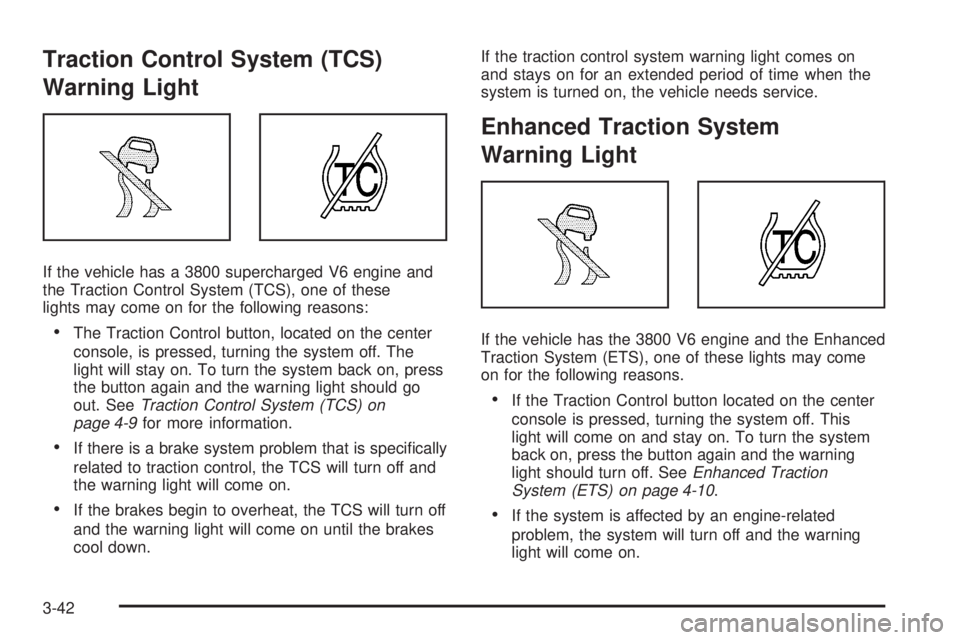
Traction Control System (TCS)
Warning Light
If the vehicle has a 3800 supercharged V6 engine and
the Traction Control System (TCS), one of these
lights may come on for the following reasons:
The Traction Control button, located on the center
console, is pressed, turning the system off. The
light will stay on. To turn the system back on, press
the button again and the warning light should go
out. SeeTraction Control System (TCS) on
page 4-9for more information.
If there is a brake system problem that is specically
related to traction control, the TCS will turn off and
the warning light will come on.
If the brakes begin to overheat, the TCS will turn off
and the warning light will come on until the brakes
cool down.If the traction control system warning light comes on
and stays on for an extended period of time when the
system is turned on, the vehicle needs service.
Enhanced Traction System
Warning Light
If the vehicle has the 3800 V6 engine and the Enhanced
Traction System (ETS), one of these lights may come
on for the following reasons.
If the Traction Control button located on the center
console is pressed, turning the system off. This
light will come on and stay on. To turn the system
back on, press the button again and the warning
light should turn off. SeeEnhanced Traction
System (ETS) on page 4-10.
If the system is affected by an engine-related
problem, the system will turn off and the warning
light will come on.
3-42
Page 153 of 444
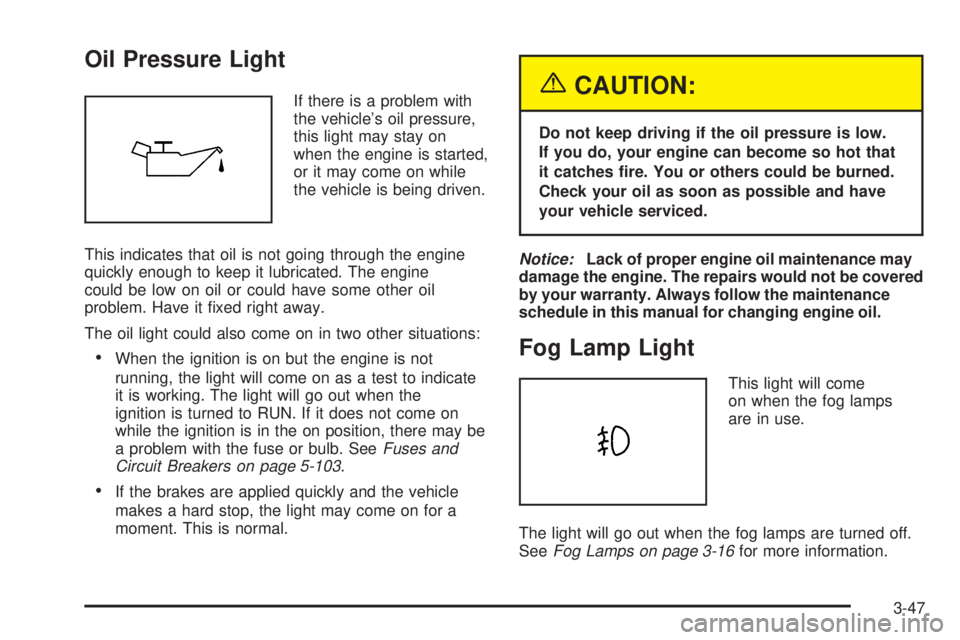
Oil Pressure Light
If there is a problem with
the vehicle’s oil pressure,
this light may stay on
when the engine is started,
or it may come on while
the vehicle is being driven.
This indicates that oil is not going through the engine
quickly enough to keep it lubricated. The engine
could be low on oil or could have some other oil
problem. Have it xed right away.
The oil light could also come on in two other situations:
When the ignition is on but the engine is not
running, the light will come on as a test to indicate
it is working. The light will go out when the
ignition is turned to RUN. If it does not come on
while the ignition is in the on position, there may be
a problem with the fuse or bulb. SeeFuses and
Circuit Breakers on page 5-103.
If the brakes are applied quickly and the vehicle
makes a hard stop, the light may come on for a
moment. This is normal.
{CAUTION:
Do not keep driving if the oil pressure is low.
If you do, your engine can become so hot that
it catches re. You or others could be burned.
Check your oil as soon as possible and have
your vehicle serviced.
Notice:Lack of proper engine oil maintenance may
damage the engine. The repairs would not be covered
by your warranty. Always follow the maintenance
schedule in this manual for changing engine oil.
Fog Lamp Light
This light will come
on when the fog lamps
are in use.
The light will go out when the fog lamps are turned off.
SeeFog Lamps on page 3-16for more information.
3-47