steering wheel adjustment PONTIAC GRAND PRIX 2006 Owners Manual
[x] Cancel search | Manufacturer: PONTIAC, Model Year: 2006, Model line: GRAND PRIX, Model: PONTIAC GRAND PRIX 2006Pages: 472, PDF Size: 2.82 MB
Page 120 of 472
Engine Coolant Temperature Warning Light......3-46
Engine Coolant Temperature Gage..................3-46
Malfunction Indicator Lamp.............................3-47
Oil Pressure Light.........................................3-50
Fog Lamp Light............................................3-50
Cruise Control Light......................................3-51
Highbeam On Light.......................................3-51
Fuel Gage...................................................3-51
Driver Information Center (DIC).......................3-52
DIC Controls and Displays (Base Level DIC). . . .3-52
DIC Controls and Displays (Uplevel DIC
with Trip Computer)...................................3-60
DIC Warnings and Messages.........................3-72Audio System(s).............................................3-94
Setting the Time...........................................3-96
Radio with CD (Base Level)...........................3-96
Radio with CD (MP3)..................................3-107
Radio with Six-Disc CD................................3-123
Navigation/Radio System..............................3-139
Theft-Deterrent Feature................................3-139
Audio Steering Wheel Controls......................3-139
Radio Reception.........................................3-140
Care of Your CDs.......................................3-141
Care of the CD Player.................................3-141
Backglass Antenna......................................3-141
XM™ Satellite Radio Antenna System............3-142
Chime Level Adjustment...............................3-142
Section 3 Instrument Panel
3-2
Page 123 of 472
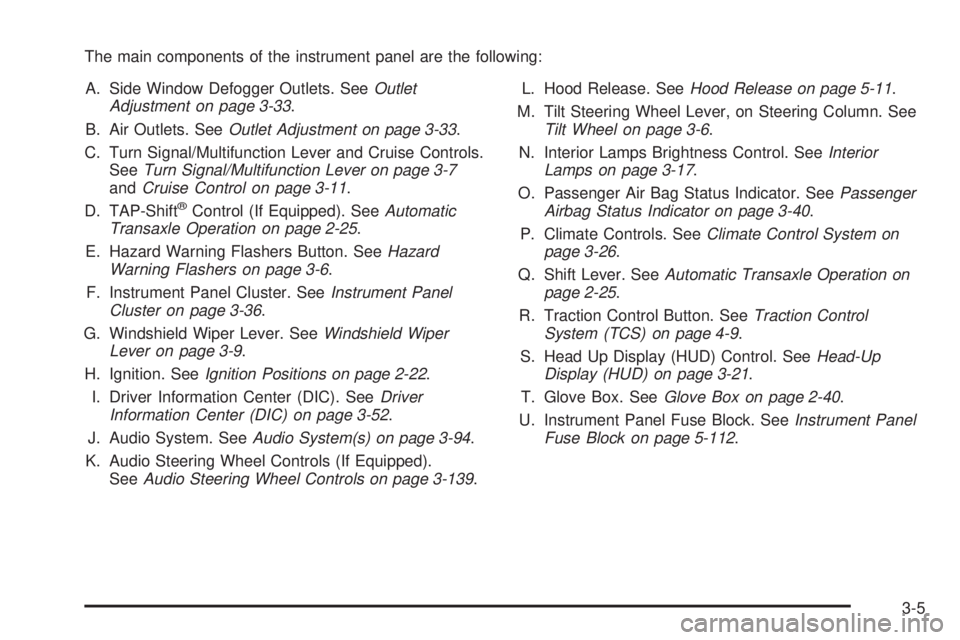
The main components of the instrument panel are the following:
A. Side Window Defogger Outlets. SeeOutlet
Adjustment on page 3-33.
B. Air Outlets. SeeOutlet Adjustment on page 3-33.
C. Turn Signal/Multifunction Lever and Cruise Controls.
SeeTurn Signal/Multifunction Lever on page 3-7
andCruise Control on page 3-11.
D. TAP-Shift
®Control (If Equipped). SeeAutomatic
Transaxle Operation on page 2-25.
E. Hazard Warning Flashers Button. SeeHazard
Warning Flashers on page 3-6.
F. Instrument Panel Cluster. SeeInstrument Panel
Cluster on page 3-36.
G. Windshield Wiper Lever. SeeWindshield Wiper
Lever on page 3-9.
H. Ignition. SeeIgnition Positions on page 2-22.
I. Driver Information Center (DIC). SeeDriver
Information Center (DIC) on page 3-52.
J. Audio System. SeeAudio System(s) on page 3-94.
K. Audio Steering Wheel Controls (If Equipped).
SeeAudio Steering Wheel Controls on page 3-139.L. Hood Release. SeeHood Release on page 5-11.
M. Tilt Steering Wheel Lever, on Steering Column. See
Tilt Wheel on page 3-6.
N. Interior Lamps Brightness Control. SeeInterior
Lamps on page 3-17.
O. Passenger Air Bag Status Indicator. SeePassenger
Airbag Status Indicator on page 3-40.
P. Climate Controls. SeeClimate Control System on
page 3-26.
Q. Shift Lever. SeeAutomatic Transaxle Operation on
page 2-25.
R. Traction Control Button. SeeTraction Control
System (TCS) on page 4-9.
S. Head Up Display (HUD) Control. SeeHead-Up
Display (HUD) on page 3-21.
T. Glove Box. SeeGlove Box on page 2-40.
U. Instrument Panel Fuse Block. SeeInstrument Panel
Fuse Block on page 5-112.
3-5
Page 304 of 472
Before starting, check the trailer hitch and platform (and
attachments), safety chains, electrical connector,
lamps, tires, and mirror adjustment. If the trailer has
electric brakes, start the vehicle and trailer moving and
then apply the trailer brake controller by hand to be
sure the brakes are working. This lets you check
the electrical connection at the same time.
During your trip, check occasionally to be sure that the
load is secure, and that the lamps and any trailer
brakes are still working.
Following Distance
Stay at least twice as far behind the vehicle ahead as
when driving the vehicle without a trailer. This can
prevent situations that require heavy braking and
sudden turns.
Passing
More passing distance is needed up ahead when
towing a trailer. And, because the vehicle and trailer are
a good deal longer, distances between any vehicles
that are passed must be greater, before returning to
the proper lane.
Backing Up
Hold the bottom of the steering wheel with one hand.
Then, to move the trailer to the left, move that hand
to the left. To move the trailer to the right, move that
hand to the right. Always back up slowly and, if possible,
have someone guide you.
Making Turns
Notice:Making very sharp turns while trailering
could cause the trailer to come in contact with the
vehicle. Your vehicle could be damaged. Avoid
making very sharp turns while trailering.
When turning with a trailer, make wider turns than
normal. Do this so the trailer will not strike soft
shoulders, curbs, road signs, trees, or other objects.
Avoid jerky or sudden maneuvers. Signal well
in advance.
Turn Signals When Towing a Trailer
When towing a trailer, the vehicle may need a different
turn signal asher and/or extra wiring. Check with
your dealer. The arrows on the instrument panel will
ash whenever signaling a turn or lane change. Properly
hooked up, the trailer lamps will also ash, telling
other drivers the vehicle and trailer are about to turn,
change lanes, or stop.
4-44
Page 459 of 472
A
Accessories and Modications............................ 5-3
Accessory Power Outlet(s)...............................3-24
Adding Equipment to Your Airbag-Equipped
Vehicle.......................................................1-66
Additives, Fuel................................................. 5-6
Add-On Electrical Equipment...........................5-111
Air Cleaner/Filter, Engine.................................5-21
Air Conditioning......................................3-26, 3-29
Airbag
Passenger Status Indicator...........................3-40
Readiness Light..........................................3-39
Airbag Sensing and Diagnostic Module (SDM)...... 7-9
Airbag System................................................1-52
Adding Equipment to Your Airbag-Equipped
Vehicle...................................................1-66
How Does an Airbag Restrain?......................1-59
Passenger Sensing System...........................1-61
Servicing Your Airbag-Equipped Vehicle..........1-65
What Makes an Airbag Inate?......................1-59
What Will You See After an Airbag Inates?....1-60
When Should an Airbag Inate?....................1-57
Where Are the Airbags?...............................1-55
Antenna, Backglass.......................................3-141
Antenna, XM™ Satellite Radio
Antenna System........................................3-142
Anti-Lock Brake System (ABS)........................... 4-7
Anti-Lock Brake, System Warning Light..............3-44Appearance Care
Aluminum Wheels......................................5-106
Care of Safety Belts...................................5-104
Chemical Paint Spotting..............................5-108
Cleaning Exterior Lamps/Lenses..................5-105
Cleaning the Inside of Your Vehicle................5-99
Fabric/Carpet............................................5-101
Finish Care...............................................5-105
Finish Damage..........................................5-107
Instrument Panel, Vinyl, and Other
Plastic Surfaces.....................................5-104
Leather....................................................5-103
Sheet Metal Damage..................................5-107
Tires........................................................5-107
Ultra Lux Suede........................................5-103
Underbody Maintenance.............................5-108
Vehicle Care/Appearance Materials...............5-109
Washing Your Vehicle.................................5-105
Weatherstrips............................................5-104
Windshield and Wiper Blades......................5-106
Ashtray(s)......................................................3-25
Assist Handles...............................................2-42
Audio System(s).............................................3-94
Audio Steering Wheel Controls....................3-139
Backglass Antenna.....................................3-141
Care of Your CD Player..............................3-141
Care of Your CDs......................................3-141
Chime Level Adjustment.............................3-142
1