heating PONTIAC GRAND PRIX 2007 Owners Manual
[x] Cancel search | Manufacturer: PONTIAC, Model Year: 2007, Model line: GRAND PRIX, Model: PONTIAC GRAND PRIX 2007Pages: 526, PDF Size: 2.92 MB
Page 90 of 526
3. Put the two halves back together. Make sure
the cover is on tight so water will not get
inside the transmitter.
4. Test the operation of the transmitter with the
vehicle.
Remote Vehicle Start
Your vehicle may have a remote start feature.
This feature allows you to start the engine
from outside the vehicle. It may also start the
vehicle’s heating or air conditioning systems and
rear window defogger. When the remote start
system is active, the climate control system will
heat or cool the inside of the vehicle based on the
outside temperature. The rear window defogger
will be turned on by the climate control system
when it is heating the inside of the vehicle. Normal
operation of the system will return after the key
is turned to RUN.
Laws in some communities may restrict the use of
remote starters. For example, some laws may
require a person using remote start to have
the vehicle in view when doing so. Check local
regulations for any requirements on remote starting
of vehicles.Do not use the remote start feature if your vehicle
is low on fuel. Your vehicle may run out of fuel.
The remote start feature provides two separate
starts per ignition cycle, each with 10 minutes of
engine running time.
The remote start system needs to be reset after
your vehicle’s engine is started two times using the
transmitter’s remote start button. The remote
start system is reset by inserting the vehicle’s key
into the ignition switch and turning to RUN.
SeeIgnition Positions on page 105for information
regarding the ignition positions on your vehicle.
Your remote keyless entry transmitter with
the remote start button provides an increased
range of operation. You can start your vehicle from
about 492 feet (150 m) away. However, the
range may be less while the vehicle is running,
and as a result you may need to be closer to your
vehicle to turn it off than you were to turn it on.
There are other conditions which can affect
the performance of the transmitter, seeRemote
Keyless Entry (RKE) System on page 86for
additional information.
90
Page 96 of 526
When you want to open a rear door when the
security lock is on, do the following:
1. Unlock the door using the remote keyless
entry transmitter, if equipped, the power
door lock switch, or by lifting the rear door
manual lock.
2. Open the door from the outside.
To cancel the rear door security lock, do the
following:
1. Unlock the door and open it from the outside.
2. Insert the key into the security lock slot
and turn it so the slot is in the vertical position.
Lockout Protection
The lockout protection feature makes it more
difficult to lock the key in the vehicle. If the driver’s
door is open while the key is in the ignition, the
door cannot be locked with the power door
lock switch.
This feature cannot guarantee that you will never be
locked out of the vehicle. If the key is not left in the
ignition, or, if the manual door lock pin is used, the
key could still be locked inside the vehicle. Always
remember to take the key with you.
Trunk
{CAUTION:
It can be dangerous to drive with the trunk
lid open because carbon monoxide (CO)
gas can come into your vehicle.
You cannot see or smell CO. It can cause
unconsciousness and even death. If you
must drive with the trunk lid open or if
electrical wiring or other cable connections
must pass through the seal between the
body and the trunk lid:
Make sure all other windows are shut.
Turn the fan on your heating or cooling
system to its highest speed and select
the control setting that will force
outside air into your vehicle. See
Climate Control System.
If you have air outlets on or under
the instrument panel, open them all
the way.
SeeEngine Exhaust on page 119.
96
Page 157 of 526
Ashtray(s) and Cigarette Lighter
Your vehicle may have a removable muffin
tin ashtray and cigarette lighter. The muffin tin
ashtray can be placed into the front center console
cupholder. To use the lighter, located on the
center console, push it in all the way and let go.
When it is ready, it will pop back out by itself.
Notice:Holding a cigarette lighter in while it
is heating will not allow the lighter to back
away from the heating element when it is hot.
Damage from overheating may occur to the
lighter or heating element, or a fuse could be
blown. Do not hold a cigarette lighter in
while it is heating.
Notice:If you put papers, pins, or other
ammable items in the ashtray, hot cigarettes
or other smoking materials could ignite
them and possibly damage your vehicle. Never
put ammable items in the ashtray.
Climate Controls
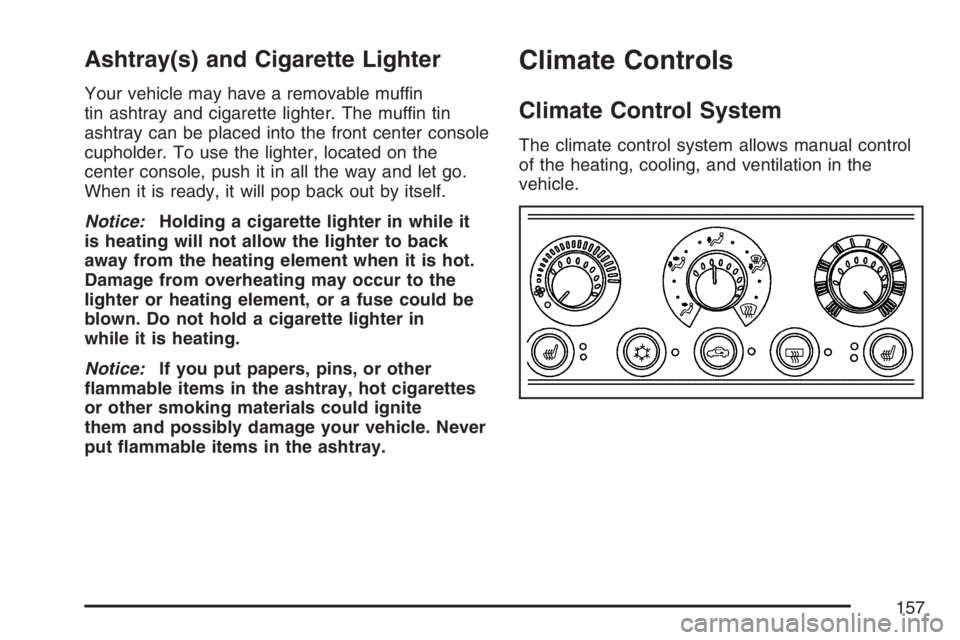
Climate Control System
The climate control system allows manual control
of the heating, cooling, and ventilation in the
vehicle.
157
Page 162 of 526
Dual Automatic Climate Control
System
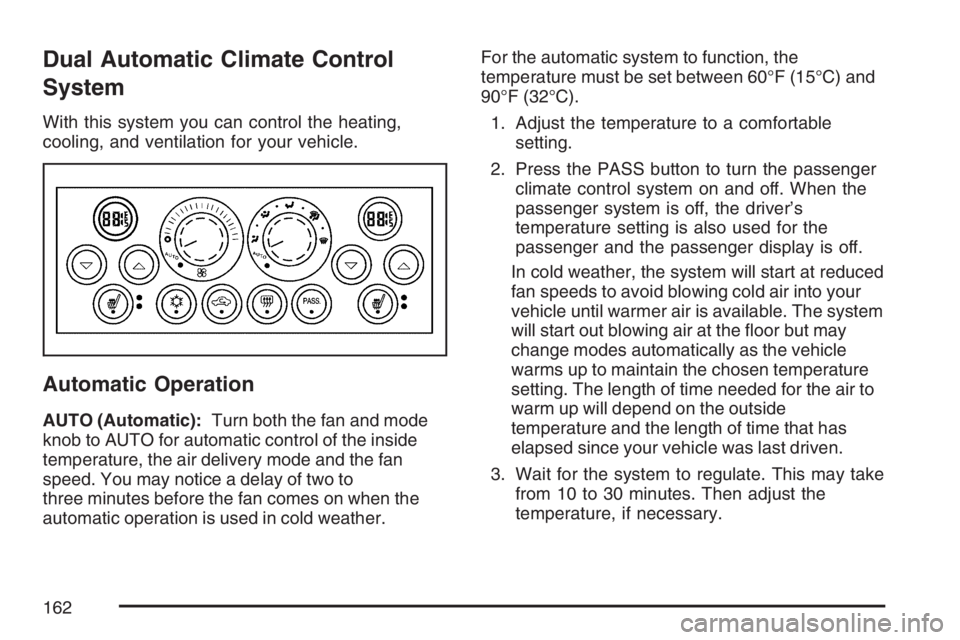
With this system you can control the heating,
cooling, and ventilation for your vehicle.
Automatic Operation
AUTO (Automatic):Turn both the fan and mode
knob to AUTO for automatic control of the inside
temperature, the air delivery mode and the fan
speed. You may notice a delay of two to
three minutes before the fan comes on when the
automatic operation is used in cold weather.For the automatic system to function, the
temperature must be set between 60°F (15°C) and
90°F (32°C).
1. Adjust the temperature to a comfortable
setting.
2. Press the PASS button to turn the passenger
climate control system on and off. When the
passenger system is off, the driver’s
temperature setting is also used for the
passenger and the passenger display is off.
In cold weather, the system will start at reduced
fan speeds to avoid blowing cold air into your
vehicle until warmer air is available. The system
will start out blowing air at the oor but may
change modes automatically as the vehicle
warms up to maintain the chosen temperature
setting. The length of time needed for the air to
warm up will depend on the outside
temperature and the length of time that has
elapsed since your vehicle was last driven.
3. Wait for the system to regulate. This may take
from 10 to 30 minutes. Then adjust the
temperature, if necessary.
162
Page 206 of 526
HOT COOLANT
Notice:If the HOT COOLANT warning message
appears on the DIC display, stop the vehicle as
soon as possible. Do not increase the engine
speed above normal idling speed. Severe
engine damage can result from driving a vehicle
with an overheated engine. SeeEngine
Overheating on page 364for more information.
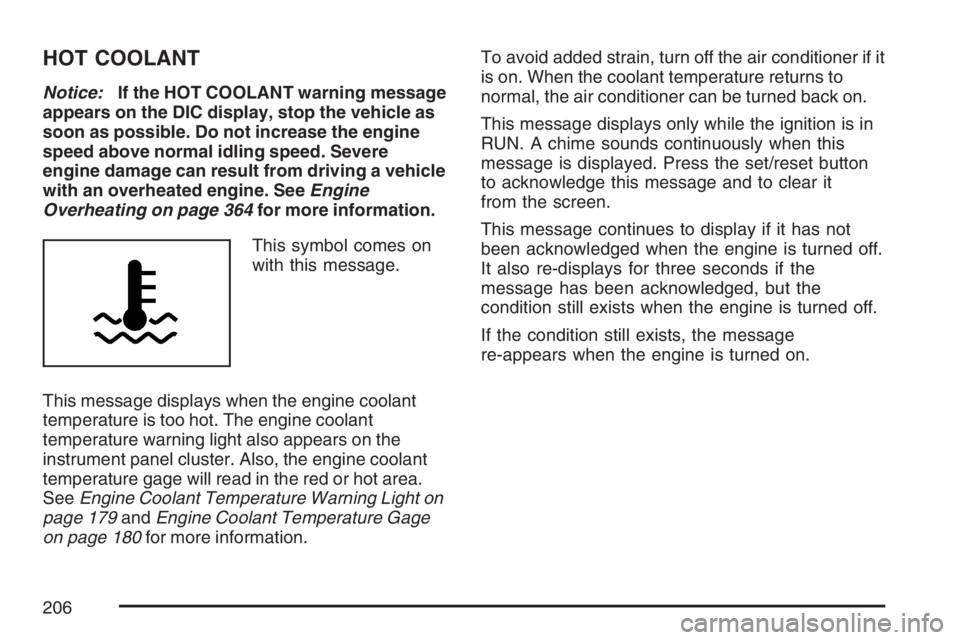
This symbol comes on
with this message.
This message displays when the engine coolant
temperature is too hot. The engine coolant
temperature warning light also appears on the
instrument panel cluster. Also, the engine coolant
temperature gage will read in the red or hot area.
SeeEngine Coolant Temperature Warning Light on
page 179andEngine Coolant Temperature Gage
on page 180for more information.To avoid added strain, turn off the air conditioner if it
is on. When the coolant temperature returns to
normal, the air conditioner can be turned back on.
This message displays only while the ignition is in
RUN. A chime sounds continuously when this
message is displayed. Press the set/reset button
to acknowledge this message and to clear it
from the screen.
This message continues to display if it has not
been acknowledged when the engine is turned off.
It also re-displays for three seconds if the
message has been acknowledged, but the
condition still exists when the engine is turned off.
If the condition still exists, the message
re-appears when the engine is turned on.
206
Page 330 of 526
Driving On Grades
Reduce speed and shift to a lower gear before
starting down a long or steep downgrade. If
the vehicle is not shifted down, the brakes may
have to be used so much that they would get hot
and no longer work well.
On a long uphill grade, shift down and reduce the
vehicle’s speed to around 45 mph (70 km/h) to
reduce the possibility of engine and transaxle
overheating.
If the vehicle has overdrive, it may be driven in
THIRD (3) instead of DRIVE (D).
Parking on Hills
{CAUTION:
You really should not park your vehicle,
with a trailer attached, on a hill. If
something goes wrong, your rig could
start to move. People can be injured, and
both your vehicle and the trailer can be
damaged.
But if the rig ever has to be parked on a hill, here
is how to do it:
1. Apply the regular brakes, but do not shift into
PARK (P) yet.
2. Have someone place chocks under the trailer
wheels.
3. When the wheel chocks are in place, release
the regular brakes until the chocks absorb
the load.
4. Reapply the regular brakes. Then apply the
parking brake, and then shift to PARK (P).
5. Release the regular brakes.
330
Page 331 of 526
When You Are Ready to Leave After
Parking on a Hill
1. Apply the regular brakes and hold the pedal
down while you:
Start the engine
Shift into a gear
Release the parking brake
2. Let up on the brake pedal.
3. Drive slowly until the trailer is clear of the
chocks.
4. Stop and have someone pick up and store the
chocks.
Maintenance When Trailer Towing
The vehicle will need service more often when it
pulls a trailer. SeeScheduled Maintenance
on page 473for more information. Things that are
especially important in trailer operation are
automatic transaxle uid, which should not be
overlled, engine oil, drive belts, cooling,
and brake systems. Each of these is covered in
this manual, and the Index will help locate
them quickly. If trailering, it is a good idea to
review this information before starting on a trip.
Check periodically to see that all hitch nuts
and bolts are tight.
Engine Cooling When Trailer Towing
The cooling system may temporarily overheat
during severe operating conditions. SeeEngine
Overheating on page 364.
331
Page 333 of 526
Service........................................................ 336
Accessories and Modications................... 336
California Proposition 65 Warning.............. 337
Doing Your Own Service Work.................. 337
Adding Equipment to the Outside of
Your Vehicle.......................................... 338
Fuel............................................................. 338
Gasoline Octane........................................ 338
Gasoline Specications.............................. 339
California Fuel........................................... 340
Additives................................................... 340
Fuels in Foreign Countries........................ 341
Filling the Tank......................................... 342
Filling a Portable Fuel Container............... 344
Checking Things Under the Hood.............. 344
Hood Release........................................... 345
Engine Compartment Overview.................. 346
Engine Oil................................................. 350
Engine Oil Life System.............................. 353
Supercharger Oil....................................... 355
Engine Air Cleaner/Filter............................ 355
Automatic Transaxle Fluid......................... 357Engine Coolant.......................................... 360
Pressure Cap............................................ 364
Engine Overheating................................... 364
Overheated Engine Protection
Operating Mode..................................... 366
Cooling System......................................... 366
Power Steering Fluid ................................. 376
Windshield Washer Fluid........................... 377
Brakes...................................................... 378
Battery...................................................... 381
Jump Starting............................................ 382
Headlamp Aiming........................................ 388
Bulb Replacement....................................... 391
Halogen Bulbs........................................... 391
Headlamps and Sidemarker Lamps........... 391
Front Turn Signal, Parking and
Fog Lamps............................................ 394
Taillamps, Turn Signal, and Stoplamps...... 395
Back-Up Lamps......................................... 397
License Plate Lamp................................... 398
Replacement Bulbs................................... 398
Windshield Replacement............................ 399
Section 5 Service and Appearance Care
333
Page 360 of 526
How to Add Automatic Transaxle Fluid
Refer to the Maintenance Schedule to determine
what kind of transaxle uid to use. See
Recommended Fluids and Lubricants on page 483.
If the uid level is low, add only enough of the
proper uid to bring the level into the crosshatched
area on the dipstick.
1. Pull out the dipstick.
2. Using a long-neck funnel, add enough uid at
the dipstick hole to bring it to the proper level.
It does not take much uid, generally less
than one pint (0.5 L). Do not overll.
Notice:Use of the incorrect automatic
transaxle uid may damage your vehicle, and
the damages may not be covered by your
warranty. Always use the automatic transaxle
uid listed inRecommended Fluids and
Lubricants on page 483.
3. After adding uid, recheck the uid level as
described under “How to Check Automatic
Transaxle Fluid,” earlier in this section.
4. When the correct uid level is obtained, push
the dipstick back in all the way.
Engine Coolant
The cooling system in the vehicle is lled with
DEX-COOL®engine coolant. This coolant
is designed to remain in the vehicle for ve years
or 150,000 miles (240 000 km), whichever
occurs rst, if only DEX-COOL
®extended life
coolant is added.
The following explains the cooling system and
how to add coolant when it is low. If there is
a problem with engine overheating or if coolant
needs to be added to the radiator, seeEngine
Overheating on page 364.
A 50/50 mixture of clean, drinkable water and
DEX-COOL
®engine coolant will:
Give freezing protection down to
−34°F (−37°C).
Give boiling protection up to 265°F (129°C).
Protect against rust and corrosion.
Help keep the proper engine temperature.
Let the warning lights and gages work as they
should.
360
Page 363 of 526
Adding Coolant
If more coolant is needed, add the proper
DEX-COOL®coolant mixture at the coolant
recovery tank, but be careful not to spill it.
If the coolant recovery tank is completely empty,
add coolant to the radiator. SeeEngine
Overheating on page 364.
{CAUTION:
Turning the pressure cap when the
engine and radiator are hot can allow
steam and scalding liquids to blow out
and burn you badly. With the coolant
recovery tank, you will almost never have
to add coolant at the radiator. Never turn
the pressure cap — even a little — when
the engine and radiator are hot.
{CAUTION:
You can be burned if you spill coolant on
hot engine parts. Coolant contains
ethylene glycol, and it will burn if the
engine parts are hot enough. Do not spill
coolant on a hot engine.
Occasionally check the coolant level in the
radiator. For information on how to add coolant to
the radiator, seeCooling System on page 366.
363