tow PONTIAC GRAND PRIX 2008 Owner's Guide
[x] Cancel search | Manufacturer: PONTIAC, Model Year: 2008, Model line: GRAND PRIX, Model: PONTIAC GRAND PRIX 2008Pages: 450, PDF Size: 2.64 MB
Page 268 of 450
Following Distance
Stay at least twice as far behind the vehicle ahead as
when driving the vehicle without a trailer. This can
prevent situations that require heavy braking and
sudden turns.
Passing
More passing distance is needed up ahead when
towing a trailer. And, because the vehicle and trailer are
a good deal longer, distances between any vehicles
that are passed must be greater, before returning to
the proper lane.
Backing Up
Hold the bottom of the steering wheel with one hand.
Then, to move the trailer to the left, move that hand
to the left. To move the trailer to the right, move
that hand to the right. Always back up slowly and,
if possible, have someone guide you.
Making Turns
Notice:Making very sharp turns while trailering
could cause the trailer to come in contact with the
vehicle. Your vehicle could be damaged. Avoid
making very sharp turns while trailering.
When turning with a trailer, make wider turns than
normal. Do this so the trailer will not strike soft
shoulders, curbs, road signs, trees, or other objects.
Avoid jerky or sudden maneuvers. Signal well in
advance.
Turn Signals When Towing a Trailer
When towing a trailer, the vehicle may need a different
turn signal asher and/or extra wiring. Check with
your dealer/retailer. The arrows on the instrument panel
will ash whenever signaling a turn or lane change.
Properly hooked up, the trailer lamps will also ash,
telling other drivers the vehicle and trailer are about to
turn, change lanes, or stop.
When towing a trailer, the arrows on the instrument
panel will ash for turns even if the bulbs on the trailer
are burned out. You may think drivers behind you
are seeing the turn signal when they are not. It is
important to check occasionally to be sure the trailer
bulbs are still working.
4-34
Page 270 of 450
When You Are Ready to Leave After
Parking on a Hill
1. Apply the regular brakes and hold the pedal
down while you:
Start the engine
Shift into a gear
Release the parking brake
2. Let up on the brake pedal.
3. Drive slowly until the trailer is clear of the chocks.
4. Stop and have someone pick up and store
the chocks.
Maintenance When Trailer Towing
The vehicle will need service more often when it
pulls a trailer. SeeScheduled Maintenance on page 6-4
for more information. Things that are especially
important in trailer operation are automatic transmission
uid, which should not be overlled, engine oil, drive
belts, cooling, and brake systems. Each of these
is covered in this manual, and the Index will help locate
them quickly. If trailering, it is a good idea to review
this information before starting on a trip.
Check periodically to see that all hitch nuts and bolts
are tight.
Engine Cooling When Trailer Towing
The cooling system may temporarily overheat during
severe operating conditions. SeeEngine Overheating
on page 5-27.
4-36
Page 285 of 450
A. Windshield Washer Fluid Reservoir. See “Adding
Washer Fluid” underWindshield Washer Fluid
on page 5-40.
B. Battery. SeeBattery on page 5-45.
C. Underhood Fuse Block. SeeUnderhood Fuse Block
on page 5-124.
D. Remote Positive (+) Terminal. SeeJump Starting on
page 5-46.
E. Pressure Cap. SeePressure Cap on page 5-27.
F. Power Steering Fluid Reservoir. SeePower Steering
Fluid on page 5-39.
G. Engine Oil Dipstick. See “Checking Engine Oil”
underEngine Oil on page 5-15.
H. Engine Oil Fill Cap. See “When to Add Engine Oil”
underEngine Oil on page 5-15.
I. Automatic Transmission Fluid Dipstick. See
“Checking the Fluid Level” underAutomatic
Transmission Fluid on page 5-22.
J. Brake Master Cylinder Reservoir. See “Brake Fluid”
underBrakes on page 5-41.
K. Engine Air Cleaner/Filter. SeeEngine Air
Cleaner/Filter on page 5-20.
L. Engine Coolant Recovery Tank. SeeCooling System
on page 5-30.Engine Oil
Checking Engine Oil
It is a good idea to check the engine oil every time you
get fuel. In order to get an accurate reading, the oil
must be warm and the vehicle must be on level ground.
The engine oil dipstick handle is a yellow loop. See
Engine Compartment Overview on page 5-12for
the location of the engine oil dipstick.
1. Turn off the engine and give the oil several minutes
to drain back into the oil pan. If you do not do this,
the oil dipstick might not show the actual level.
2. Pull out the dipstick and clean it with a paper towel
or cloth, then push it back in all the way. Remove it
again, keeping the tip down, and check the level.
5-15
Page 291 of 450
1. Lift the lter cover tabs on top of the engine air
cleaner/lter housing.
2. Push the lter cover housing toward the engine.
3. Pull out the lter.
4. Inspect or replace the engine air cleaner/lter.5. To reinstall the cover, position the tabs through the
slots on the housing. If your vehicle has one of the
3800 V6 engines, a notch on the sides of the lter
cover will indicate the correct engagement.
6. Push the cover tabs on top of the housing to lock
the cover in place.
{CAUTION:
Operating the engine with the air cleaner/lter
off can cause you or others to be burned.
The air cleaner not only cleans the air; it helps
to stop ames if the engine backres. If it is not
there and the engine backres, you could be
burned. Do not drive with it off, and be careful
working on the engine with the air
cleaner/lter off.
Notice:If the air cleaner/lter is off, a backre can
cause a damaging engine re. And, dirt can easily
get into your engine, which will damage it. Always
have the air cleaner/lter in place when you are
driving. 5.3L V8 Engine
5-21
Page 293 of 450
Checking the Fluid Level
Prepare the vehicle as follows:
1. Park the vehicle on a level place. Keep the engine
running.
2. With the parking brake applied, place the shift lever
in PARK (P).
3. With your foot on the brake pedal, move the shift
lever through each gear, pausing for about three
seconds in each one. Then, position the shift lever
in PARK (P).
4. Let the engine run at idle for three to ve minutes.
Then, without shutting off the engine, follow these steps:
The transmission uid
dipstick handle has this
symbol on it, and is located
near the rear of the
engine compartment.SeeEngine Compartment Overview on page 5-12for
more information on location.
1. Pull out the dipstick and wipe it with a clean rag or
paper towel.
2. Push it back in all the way, wait three seconds and
then pull it back out again.
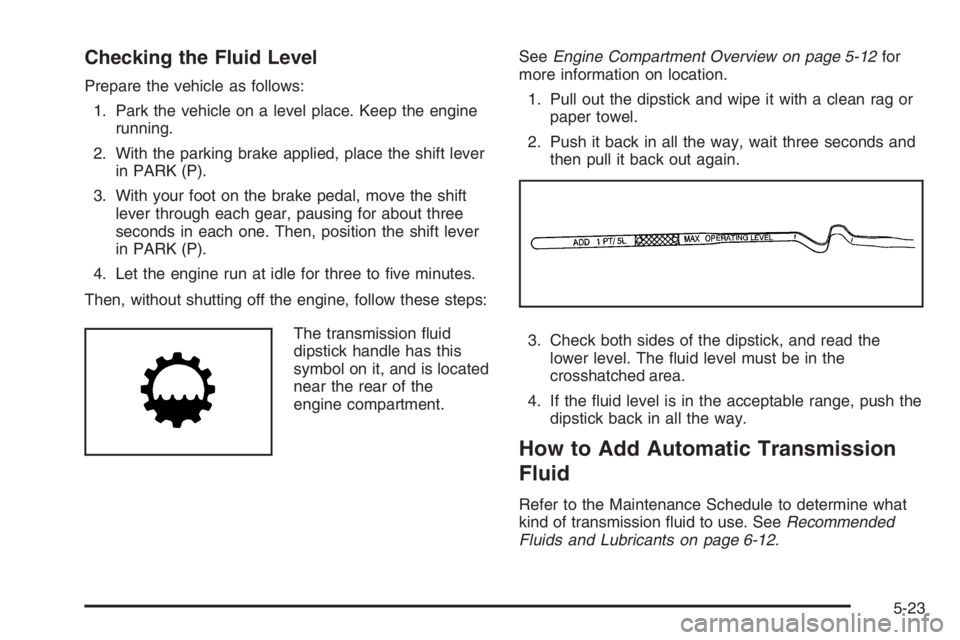
3. Check both sides of the dipstick, and read the
lower level. The uid level must be in the
crosshatched area.
4. If the uid level is in the acceptable range, push the
dipstick back in all the way.
How to Add Automatic Transmission
Fluid
Refer to the Maintenance Schedule to determine what
kind of transmission uid to use. SeeRecommended
Fluids and Lubricants on page 6-12.
5-23
Page 298 of 450
If Steam Is Coming From Your Engine
{CAUTION:
Steam from an overheated engine can burn you
badly, even if you just open the hood. Stay away
from the engine if you see or hear steam coming
from it. Turn it off and get everyone away from
the vehicle until it cools down. Wait until there
is no sign of steam or coolant before you open
the hood.
If you keep driving when the vehicles engine is
overheated, the liquids in it can catch re. You
or others could be badly burned. Stop your
engine if it overheats, and get out of the vehicle
until the engine is cool.
SeeOverheated Engine Protection Operating
Mode on page 5-29for information on driving to
a safe place in an emergency.Notice:If your engine catches re because you
keep driving with no coolant, your vehicle can be
badly damaged. The costly repairs would not be
covered by your warranty. SeeOverheated Engine
Protection Operating Mode on page 5-29for
information on driving to a safe place in an
emergency.
If No Steam is Coming From Your
Engine
An overheat warning can indicate a serious problem.
If you get an engine overheat warning but see or
hear no steam, the problem may not be too serious.
Sometimes the engine can get a little too hot when you:
Climb a long hill on a hot day.
Stop after high-speed driving.
Idle for long periods in traffic.
Tow a trailer.
5-28
Page 299 of 450
If an overheat warning occurs without any sign of
steam, try this for a minute or so:
1. In heavy traffic, let the engine idle in NEUTRAL (N)
while stopped. If it is safe to do so, pull off the road,
shift to PARK (P) or NEUTRAL (N) and let the
engine idle.
2. Set the heater at the highest setting and the fan at
the highest speed and open the windows as
necessary.
If the overheat warning no longer exists, the vehicle can
be driven. Just to be safe, drive slower for about
10 minutes. If the warning does not come back on, the
vehicle can be driven normally.
If the warning continues, and you have not stopped, pull
over, stop, and park the vehicle right away.
If there is still no sign of steam, idle the engine for three
minutes while parked. If the warning is still there, turn off
the engine and get everyone out of the vehicle until it
cools down. Also, see “Overheated Engine Protection
Operating Mode” later in this section.
You may decide not to lift the hood but to get service
help right away.Overheated Engine Protection
Operating Mode
The overheated engine protection operating mode
allows the vehicle to be driven to a safe place in an
emergency situation. If an overheated engine condition
exists, this protection mode alternates ring groups
of cylinders to help prevent engine damage. In this
mode, there will be a signicant loss in power and engine
performance. The engine coolant temperature gage
indicator will move to the shaded area, and the engine
coolant temperature warning light will come on, showing
that an overheated engine condition exists. Driving
extended miles (km) and/or towing a trailer in the
overheated engine protection mode should be avoided.
Notice:After driving in the overheated engine
protection operating mode, to avoid engine damage,
allow the engine to cool before attempting any
repair. The engine oil will be severely degraded.
Repair the cause of coolant loss, change the oil and
reset the oil life system. SeeEngine Oil on page 5-15.
5-29
Page 331 of 450
Windshield Replacement
If your vehicle is equipped with the Head-Up Display
(HUD) system, keep in mind that your windshield is part
of the HUD system. If you ever have to get your
windshield replaced, be sure to get one that is designed
for HUD or your HUD image may look blurred or out
of focus.
Windshield Wiper Blade
Replacement
Windshield wiper blades should be inspected for wear
or cracking. SeeScheduled Maintenance on page 6-4
for more information on wiper blade inspection.Replacement blades come in different types and are
removed in different ways. For the proper type and
length, seeMaintenance Replacement Parts on
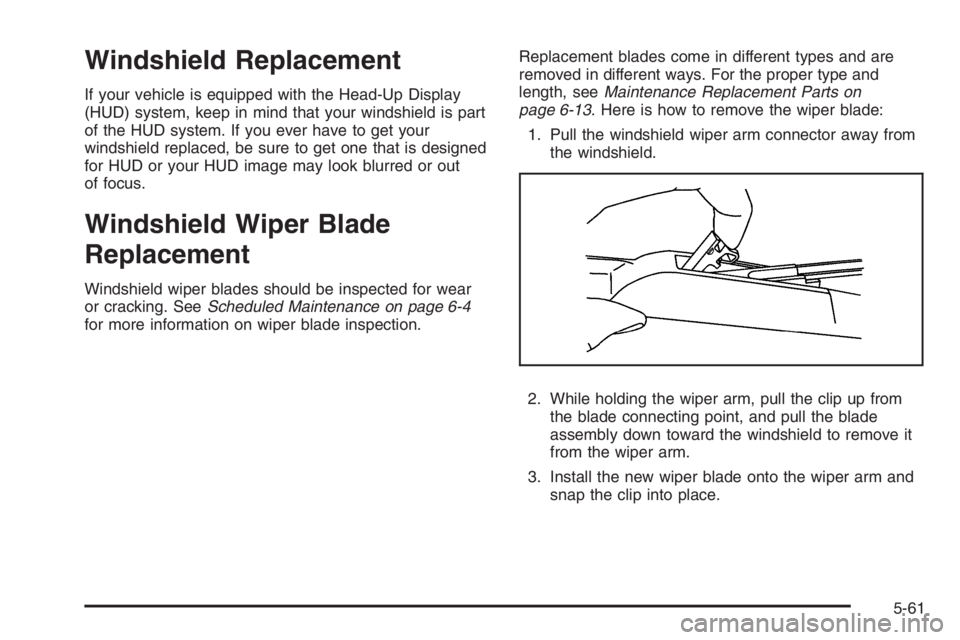
page 6-13. Here is how to remove the wiper blade:
1. Pull the windshield wiper arm connector away from
the windshield.
2. While holding the wiper arm, pull the clip up from
the blade connecting point, and pull the blade
assembly down toward the windshield to remove it
from the wiper arm.
3. Install the new wiper blade onto the wiper arm and
snap the clip into place.
5-61
Page 346 of 450
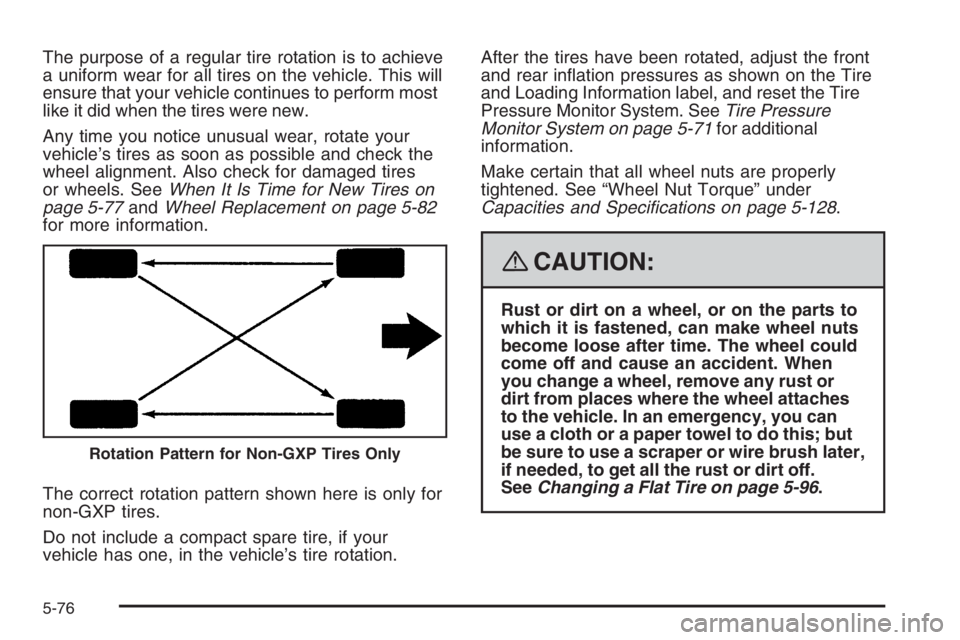
The purpose of a regular tire rotation is to achieve
a uniform wear for all tires on the vehicle. This will
ensure that your vehicle continues to perform most
like it did when the tires were new.
Any time you notice unusual wear, rotate your
vehicle’s tires as soon as possible and check the
wheel alignment. Also check for damaged tires
or wheels. SeeWhen It Is Time for New Tires on
page 5-77andWheel Replacement on page 5-82
for more information.
The correct rotation pattern shown here is only for
non-GXP tires.
Do not include a compact spare tire, if your
vehicle has one, in the vehicle’s tire rotation.After the tires have been rotated, adjust the front
and rear ination pressures as shown on the Tire
and Loading Information label, and reset the Tire
Pressure Monitor System. SeeTire Pressure
Monitor System on page 5-71for additional
information.
Make certain that all wheel nuts are properly
tightened. See “Wheel Nut Torque” under
Capacities and Specifications on page 5-128.
{CAUTION:
Rust or dirt on a wheel, or on the parts to
which it is fastened, can make wheel nuts
become loose after time. The wheel could
come off and cause an accident. When
you change a wheel, remove any rust or
dirt from places where the wheel attaches
to the vehicle. In an emergency, you can
use a cloth or a paper towel to do this; but
be sure to use a scraper or wire brush later,
if needed, to get all the rust or dirt off.
SeeChanging a Flat Tire on page 5-96.
Rotation Pattern for Non-GXP Tires Only
5-76
Page 355 of 450
If a Tire Goes Flat
It is unusual for a tire to blowout while you are driving,
especially if you maintain your tires properly. SeeTires
on page 5-62. If air goes out of a tire, it is much more
likely to leak out slowly. But if you should ever have a
blowout, here are a few tips about what to expect and
what to do:
If a front tire fails, the at tire will create a drag that
pulls the vehicle toward that side. Take your foot off the
accelerator pedal and grip the steering wheel rmly.
Steer to maintain lane position, and then gently brake to
a stop well out of the traffic lane.
A rear blowout, particularly on a curve, acts much like a
skid and may require the same correction you’d use in a
skid. In any rear blowout, remove your foot from the
accelerator pedal. Get the vehicle under control by
steering the way you want the vehicle to go. It may be
very bumpy and noisy, but you can still steer. Gently
brake to a stop, well off the road if possible.If a tire goes at, and your vehicle has a spare tire, see
Changing a Flat Tire on page 5-96. This information
shows you how to use your vehicle’s tire changing
equipment and how to change a at tire safely.
{CAUTION:
Lifting a vehicle and getting under it to do
maintenance or repairs is dangerous without
the appropriate safety equipment and training.
The jack provided with your vehicle is
designed only for changing a at tire. If it is
used for anything else, you or others could be
badly injured or killed if the vehicle slips off
the jack. Use the jack provided with your
vehicle only for changing a at tire.
5-85