spare tire PONTIAC GTO 2004 User Guide
[x] Cancel search | Manufacturer: PONTIAC, Model Year: 2004, Model line: GTO, Model: PONTIAC GTO 2004Pages: 326, PDF Size: 2.24 MB
Page 264 of 326

{CAUTION:
Getting under a vehicle when it is jacked up is
dangerous. If the vehicle slips off the jack you
could be badly injured or killed. Never get
under a vehicle when it is supported only by
a jack.
{CAUTION:
Raising your vehicle with the jack improperly
positioned can damage the vehicle and even
make the vehicle fall. To help avoid personal
injury and vehicle damage, be sure to t the
jack lift head into the proper location before
raising the vehicle.4. Raise the vehicle by turning the wheel wrench
clockwise. Raise the vehicle far enough off the
ground so there is enough room for the compact
spare tire to fit underneath the wheel well.
The jack handle must be unfolded to a right angle
before it is used.
5. Remove all of the wheel nuts.
6. Remove the flat tire.
5-74
Page 265 of 326
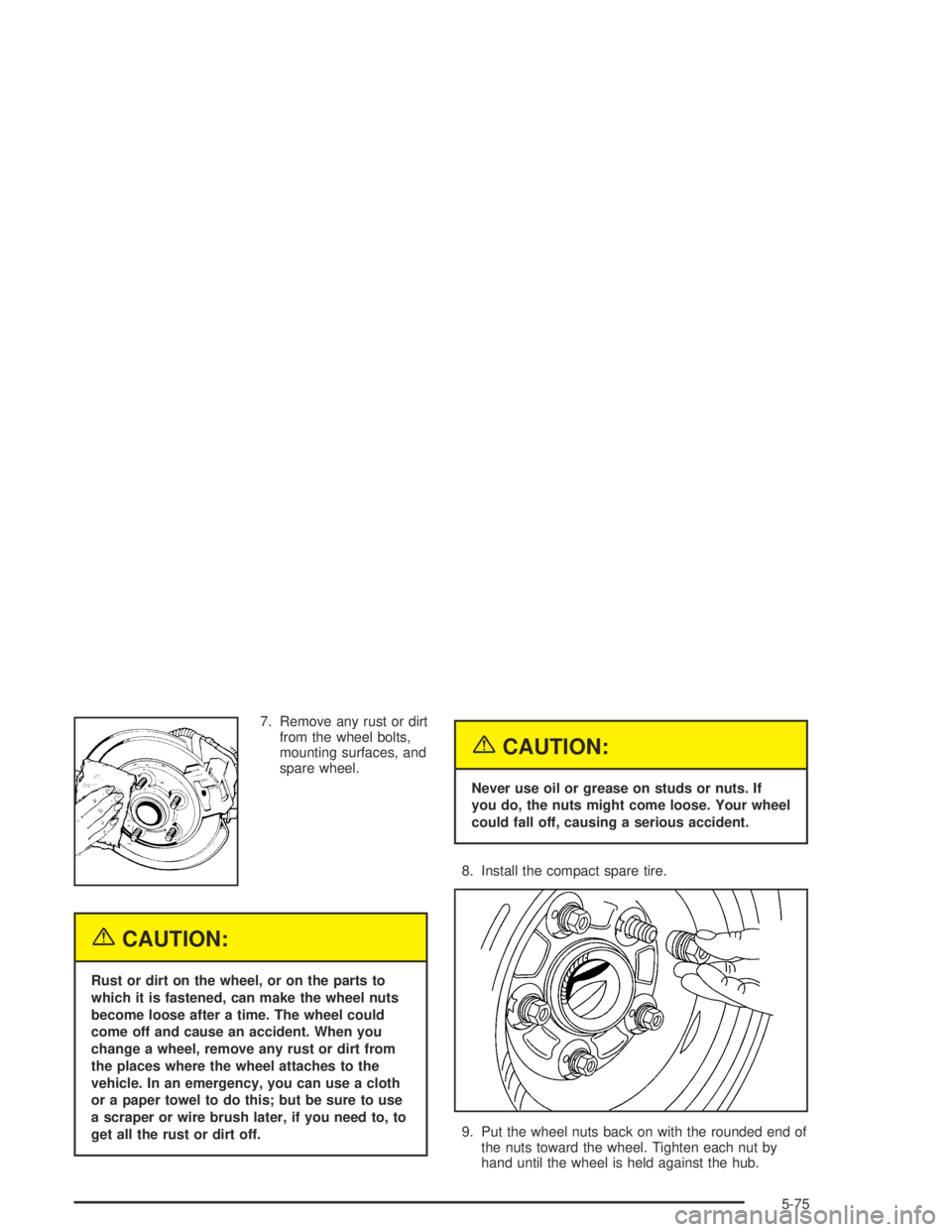
7. Remove any rust or dirt
from the wheel bolts,
mounting surfaces, and
spare wheel.
{CAUTION:
Rust or dirt on the wheel, or on the parts to
which it is fastened, can make the wheel nuts
become loose after a time. The wheel could
come off and cause an accident. When you
change a wheel, remove any rust or dirt from
the places where the wheel attaches to the
vehicle. In an emergency, you can use a cloth
or a paper towel to do this; but be sure to use
a scraper or wire brush later, if you need to, to
get all the rust or dirt off.
{CAUTION:
Never use oil or grease on studs or nuts. If
you do, the nuts might come loose. Your wheel
could fall off, causing a serious accident.
8. Install the compact spare tire.
9. Put the wheel nuts back on with the rounded end of
the nuts toward the wheel. Tighten each nut by
hand until the wheel is held against the hub.
5-75
Page 267 of 326

Storing the Flat Tire and Tools
{CAUTION:
Storing a jack, a tire, or other equipment in the
passenger compartment of the vehicle could
cause injury. In a sudden stop or collision,
loose equipment could strike someone. Store
all these in the proper place.
Store the tools in the same way that they were removed.
Place the flat tire in the temporary spare tire well in
the compartment under the trunk floor. Then place the
spare tire cover over the flat tire.
Storing the Spare Tire and Tools
The compact spare is for temporary use only. Replace
the compact spare tire with a full-size tire as soon
as you can. See “Compact Spare Tire” following in this
section. See the storage instructions label to replace
your compact spare into your trunk properly.
Compact Spare Tire
Although the compact spare tire was fully inflated when
your vehicle was new, it can lose air after a time.
Check the inflation pressure regularly. It should be
60 psi (420 kPa).
After installing the compact spare on your vehicle, you
should stop as soon as possible and make sure
your spare tire is correctly inflated. The compact spare
is made to perform well at speeds up to 65 mph
(105 km/h) for distances up to 3,000 miles (5 000 km),
so you can finish your trip and have your full-size
tire repaired or replaced where you want. Of course, it’s
best to replace your spare with a full-size tire as
soon as you can. Your spare will last longer and be in
good shape in case you need it again.
5-77
Page 268 of 326

Notice:When the compact spare is installed, don’t
take your vehicle through an automatic car wash
with guide rails. The compact spare can get caught
on the rails. That can damage the tire and wheel,
and maybe other parts of your vehicle.
Don’t use your compact spare on other vehicles.
And don’t mix your compact spare tire or wheel with
other wheels or tires. They won’t fit. Keep your compact
spare tire and its wheel together.
Notice:Tire chains won’t t your compact spare.
Using them can damage your vehicle and can
damage the chains too. Don’t use tire chains on
your compact spare.Appearance Care
Remember, cleaning products can be hazardous. Some
are toxic. Others can burst into flames if you strike a
match or get them on a hot part of the vehicle. Some are
dangerous if you breathe their fumes in a closed
space. When you use anything from a container to clean
your vehicle, be sure to follow the manufacturer’s
warnings and instructions. And always open your doors
or windows when you are cleaning the inside.
Never use these to clean your vehicle:
•Gasoline
•Benzene
•Naphtha
•Carbon Tetrachloride
•Acetone
•Paint Thinner
•Turpentine
•Lacquer Thinner
•Nail Polish Remover
They can all be hazardous — some more than
others — and they can all damage your vehicle, too.
5-78
Page 276 of 326

Vehicle Identication
Vehicle Identication Number (VIN)
This is the legal identifier for your vehicle. It appears on
a plate in the front corner of the instrument panel, on
the driver’s side. You can see it if you look through the
windshield from outside your vehicle. The VIN also
appears on the Vehicle Certification and Service Parts
labels and the certificates of title and registration.
Engine Identication
The 8th character in your VIN is the engine code. This
code will help you identify your engine, specifications
and replacement parts.
Service Parts Identication Label
You’ll find this label on your spare tire cover. It’s very
helpful if you ever need to order parts. On this label, you
will find the following:
•VIN
•Model designation
•Paint information
•A list of all production options and special
equipment.
Be sure that this label is not removed from the vehicle.
5-86
Page 292 of 326

Engine Coolant Level Check
Check the engine coolant level and add
DEX-COOL®coolant mixture if necessary. SeeEngine
Coolant on page 5-25for further details.
Windshield Washer Fluid Level Check
Check the windshield washer fluid level in the windshield
washer tank and add the proper fluid if necessary.
At Least Once a Month
Tire Ination Check
Visually inspect your tires and make sure tires are
inflated to the correct pressures. Do not forget to
check your spare tire. SeeTires on page 5-51for
further details.
At Least Once a Year
Starter Switch Check
{CAUTION:
When you are doing this inspection, the
vehicle could move suddenly. If the vehicle
moves, you or others could be injured.
1. Before you start, be sure you have enough room
around the vehicle.
2. Firmly apply both the parking brake and the regular
brake. SeeParking Brake on page 2-23if
necessary.
Do not use the accelerator pedal, and be ready to
turn off the engine immediately if it starts.
3. Try to start the engine in each gear. The starter
should work only in PARK (P) or NEUTRAL (N).
If the starter works in any other position, contact
your GM Goodwrench dealer for service.
6-10
Page 306 of 326

•Emergency Tow:Tow to the nearest dealership for
warranty service or in the event of a
vehicle-disabling accident. Assistance when the
vehicle is mired in sand, mud or snow.
•Flat Tire Change:Installation of a spare tire will be
covered at no charge. (The customer is responsible
for the repair or replacement of the tire if not
covered by a warrantable failure.)
•Jump Start:No-start occurrences which require a
battery jump start will be covered at no charge.
•Dealer Locator Service
In many instances, mechanical failures are covered
under Pontiac’s Bumper-to-Bumper warranty. However,
when other services are utilized, our Roadside
Assistance Representatives will explain any payment
obligations you might incur.
For prompt and efficient assistance when calling, please
provide the following to the Roadside Assistance
Representative:
•Your name, home address, and home telephone
number
•Telephone number of your location
•Location of the vehicle
•Model, year, color, and license plate number
•Mileage, Vehicle Identification Number and delivery
date of the vehicle
•Description of the problem
While we hope you never have the occasion to use our
service, it is added security while traveling for you
and your family. Remember, we are only a phone call
away. Pontiac Roadside Assistance: 1-800-ROADSIDE
(762-3743), text telephone (TTY) users, call
1-888-889-2438.
Pontiac reserves the right to limit services or
reimbursement to an owner or driver when, in Pontiac’s
judgement, the claims become excessive in frequency
or type of occurrence.
Roadside Assistance is not part of or included in the
coverage provided by the New Vehicle Limited Warranty.
Buick reserves the right to make any changes or
discontinue the Roadside Assistance program at any
time without notification.
7-6
Page 315 of 326

Check
Engine Light...............................................3-29
Check Engine Light.........................................3-29
Checking Coolant............................................5-27
Checking Engine Oil........................................5-13
Checking Things Under the Hood......................5-10
Chemical Paint Spotting...................................5-84
Child Restraints
Child Restraint Systems...............................1-32
Infants and Young Children...........................1-28
Lower Anchorages and Top Tethers for
Children (LATCH System)..........................1-38
Older Children.............................................1-26
Securing a Child Restraint Designed for the
LATCH System........................................1-40
Securing a Child Restraint in a Rear Seat
Position..................................................1-40
Securing a Child Restraint in the Right Front
Seat Position...........................................1-43
Top Strap...................................................1-36
Top Strap Anchor Location............................1-37
Where to Put the Restraint...........................1-35
Cigarette Lighter.............................................3-18
Cleaning
Inside of Your Vehicle..................................5-79
Outside of Your Vehicle................................5-82
Underbody Maintenance...............................5-84
Weatherstrips..............................................5-81Cleaning Aluminum Wheels..............................5-83
Cleaning Exterior Lamps/Lenses.......................5-82
Cleaning Fabric/Carpet....................................5-79
Cleaning Glass Surfaces..................................5-81
Cleaning Interior Plastic Components.................5-81
Cleaning Leather............................................5-80
Cleaning the Top of the Instrument Panel...........5-81
Cleaning Tires................................................5-84
Cleaning Vinyl................................................5-80
Cleaning Windshield and Wiper Blades..............5-83
Climate Control System...................................3-19
Outlet Adjustment........................................3-22
Clutch, Hydraulic.............................................5-24
Compact Spare Tire........................................5-77
CONFIRMATION BEEPS.................................2-35
Content Theft-Deferrent....................................2-14
Control of a Vehicle.......................................... 4-5
Coolant
Engine Temperature Gage............................3-28
Cooling System..............................................5-31
COURTESY LAMP TIMEOUT...........................2-36
Courtesy Lamps.............................................3-15
Cruise Control.................................................. 3-9
Cupholder(s)..................................................2-31
Current and Past Model Order Forms................7-12
3
Page 322 of 326

Q
Questions and Answers About Safety Belts.........1-10
R
Racing or Other Competitive Driving..................2-18
RADIO DISPLAY............................................2-35
Radios..........................................................3-42
Care of Your CD Player...............................3-54
Care of Your CDs........................................3-54
Radio with Six-Disc CD................................3-43
Setting the Time..........................................3-42
Theft-Deterrent............................................3-52
Understanding Reception..............................3-54
Rear Safety Belt Comfort Guides......................1-23
Rear Seat Passenger Positions.........................1-20
Rear Seat Passengers, Safety Belts..................1-20
Rear Turn Signal, Stoplamps and Back-Up
Lamps.......................................................5-49
Rear Window Defogger....................................3-21
Rearview Mirrors.............................................2-29
Reclining Seatbacks.......................................... 1-3
Recommended Fluids and Lubricants.................6-13
Recreational Vehicle Towing.............................4-30
Remote Keyless Entry System............................ 2-4
Remote Keyless Entry System, Operation............ 2-5Remote Trunk Release...................................... 2-9
Removing the Flat Tire and Installing the
Spare Tire..................................................5-73
Removing the Spare Tire and Tools...................5-72
Replacement Bulbs.........................................5-50
Replacing Brake System Parts..........................5-40
Reporting Safety Defects
General Motors...........................................7-10
United States Government............................7-10
REST REMINDER..........................................2-34
Rest Reminder...............................................3-39
RESTORE TO FACTORY SETTINGS................2-33
Restraint System Check
Checking Your Restraint Systems...................1-52
Replacing Restraint System Parts After
a Crash..................................................1-53
Restraint Systems
Checking....................................................1-52
Replacing Parts...........................................1-53
Retained Accessory Power (RAP)......................2-17
Right Front Passenger Position, Safety Belts......1-20
Roadside
Assistance Program....................................... 7-5
Rocking Your Vehicle To Get It Out...................4-29
Routing, Engine Drive Belt...............................6-16
Running Your Engine While You Are Parked.......2-28
10
Page 324 of 326
Some Other Rainy Weather Tips.......................4-18
Special Fabric Cleaning Problems.....................5-80
Specifications, Capacities.................................5-92
SPEED DEPENDENT VOLUME........................2-35
Speedometer..................................................3-25
Starting Your Engine.......................................2-17
Steering.......................................................... 4-9
Steering in Emergencies..................................4-10
Steering Tips................................................... 4-9
Steering Wheel Controls, Audio.........................3-53
Steering Wheel, Tilt Wheel................................. 3-5
STOP WATCH ................................................2-34
Stop Watch....................................................3-39
Storage Areas
Center Console Storage Area........................2-31
Cupholder(s)...............................................2-31
Front Storage Area......................................2-31
Glove Box..................................................2-30
Storing the Flat Tire and Tools..........................5-77
Storing the Spare Tire and Tools.......................5-77
Stuck in Sand, Mud, Ice or Snow......................4-28
Sun Visors.....................................................2-12
T
Tachometer....................................................3-25
Telescopic Steering Column............................... 3-5
Theft-Deterrent, Radio.....................................3-52
Theft-Deterrent System....................................2-12Theft-Deterrent Systems
Content Theft-Deterrent................................2-14
Immobilizer.................................................2-12
Immobilizer Operation...................................2-13
Tilt Wheel........................................................ 3-5
TIME TO ARRIVAL.........................................3-37
Tire Inflation Check.........................................6-10
Tire Sidewall Labeling......................................5-52
Tire Size.......................................................5-55
Tire Terminology and Definitions........................5-56
Tires.............................................................5-51
Buying New Tires........................................5-65
Chains.......................................................5-69
Changing a Flat Tire....................................5-71
Compact Spare Tire.....................................5-77
If a Tire Goes Flat.......................................5-70
Inflation - Tire Pressure................................5-58
Inspection and Rotation................................5-62
Uniform Tire Quality Grading.........................5-66
Wheel Alignment and Tire Balance.................5-67
Wheel Replacement.....................................5-68
When It Is Time for New Tires......................5-64
Top Strap......................................................1-36
Top Strap Anchor Location...............................1-37
Torque Lock...................................................2-25
Towing
Recreational Vehicle.....................................4-30
Towing a Trailer..........................................4-35
Your Vehicle...............................................4-29
12