ECU PONTIAC GTO 2006 User Guide
[x] Cancel search | Manufacturer: PONTIAC, Model Year: 2006, Model line: GTO, Model: PONTIAC GTO 2006Pages: 326, PDF Size: 1.62 MB
Page 43 of 326
Lower Anchors and Tethers for
Children (LATCH)
Your vehicle has the LATCH system. The LATCH
system holds a child restraint during driving or in a
crash. This system is designed to make installation of a
child restraint easier. The LATCH system uses
anchors in the vehicle and attachments on the child
restraint that are made for use with the LATCH system
Make sure that a LATCH-compatible child restraint
is properly installed using the anchors, or use the
vehicle's safety belts to secure the restraint, following
the instructions that came with that restraint, and
also the instructions in this manual. When installing a
child restraint with a top tether, you must also use either
the lower anchors or the safety belts to properly
secure the child restraint. A child restraint must never
be installed using only the top tether and anchor.
In order to use the LATCH system in your vehicle, you
need a child restraint equipped with LATCH attachments.
The child restraint manufacturer will provide you with
instructions on how to use the child restraint and its
attachments. The following explains how to attach a child
restraint with these attachments in your vehicle.Your vehicle has lower anchors and top tether anchors.
Your child restraint may have lower attachments and
a top tether.
Not all vehicle seating positions or child restraints have
lower anchors and attachments or top tether anchors
and attachments.
Lower Anchors
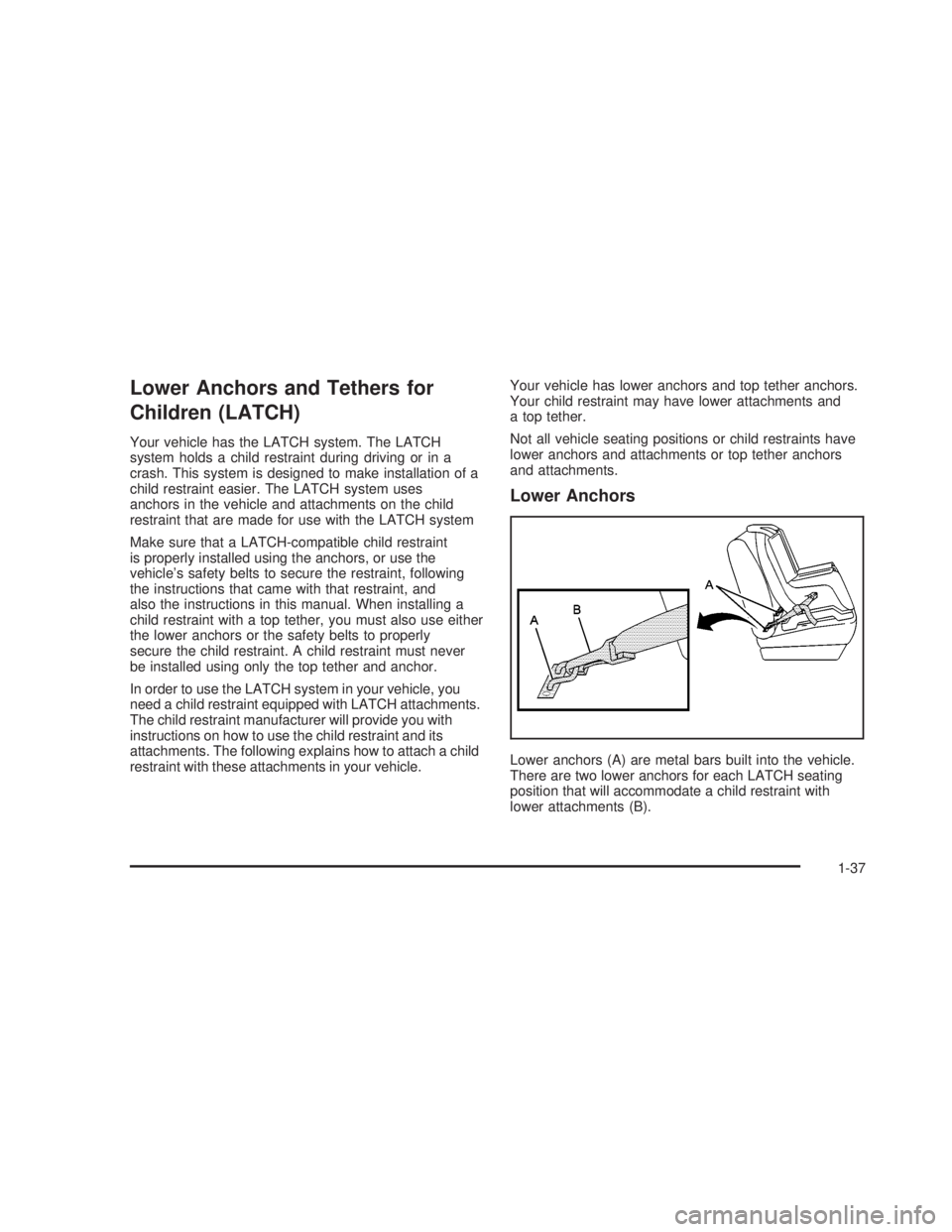
Lower anchors (A) are metal bars built into the vehicle.
There are two lower anchors for each LATCH seating
position that will accommodate a child restraint with
lower attachments (B).
1-37
2006 - Pontiac GTO Owner Manual
Page 44 of 326
Top Tether Anchor
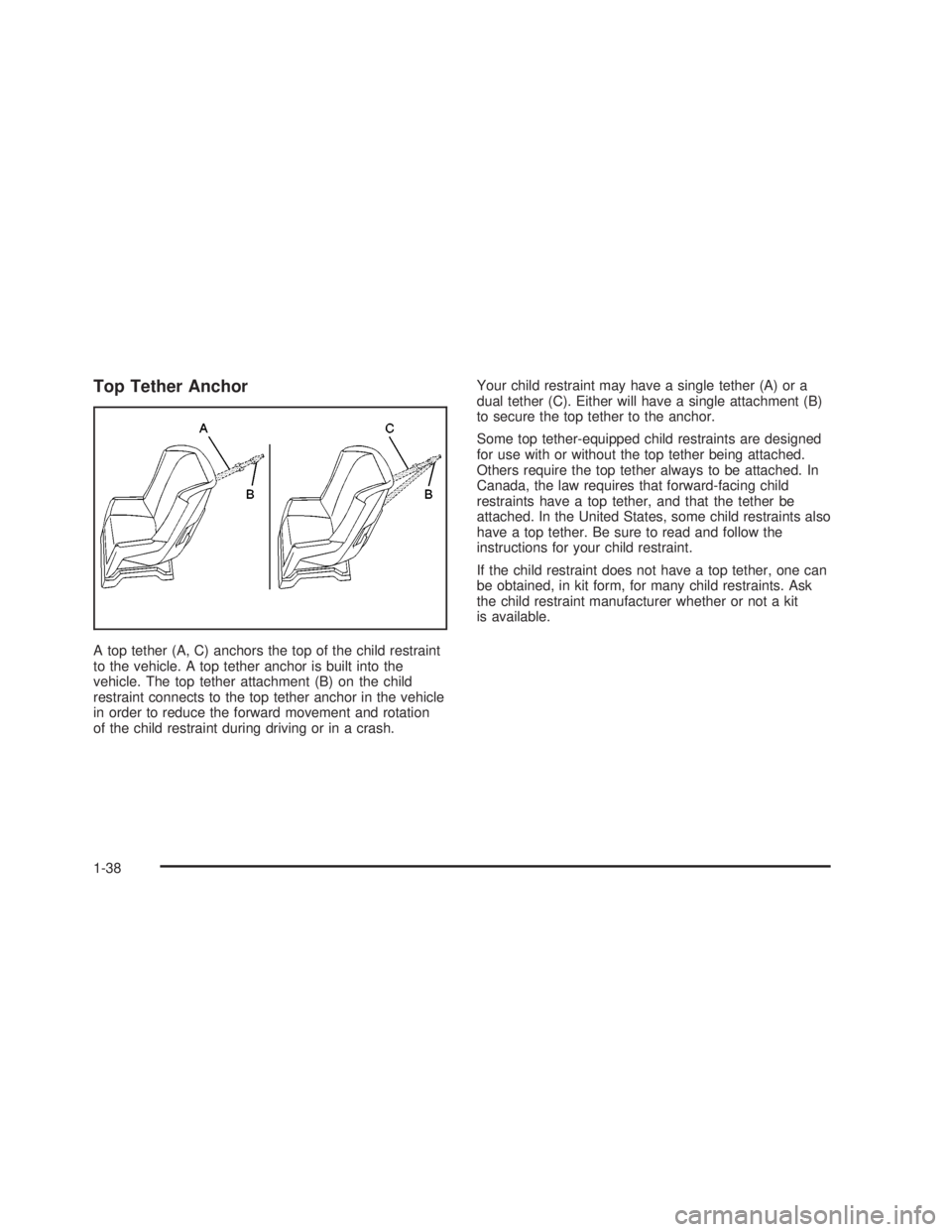
A top tether (A, C) anchors the top of the child restraint
to the vehicle. A top tether anchor is built into the
vehicle. The top tether attachment (B) on the child
restraint connects to the top tether anchor in the vehicle
in order to reduce the forward movement and rotation
of the child restraint during driving or in a crash.Your child restraint may have a single tether (A) or a
dual tether (C). Either will have a single attachment (B)
to secure the top tether to the anchor.
Some top tether-equipped child restraints are designed
for use with or without the top tether being attached.
Others require the top tether always to be attached. In
Canada, the law requires that forward-facing child
restraints have a top tether, and that the tether be
attached. In the United States, some child restraints also
have a top tether. Be sure to read and follow the
instructions for your child restraint.
If the child restraint does not have a top tether, one can
be obtained, in kit form, for many child restraints. Ask
the child restraint manufacturer whether or not a kit
is available.
1-38
2006 - Pontiac GTO Owner Manual
Page 46 of 326
Do not secure a child restraint in the right front
passenger's position if a national or local law requires
that the top tether be attached, or if the instructions that
come with the child restraint say that the top tether
must be attached. There is no place to attach the top
tether in this position.
Accident statistics show that children are safer if they
are restrained in the rear rather than the front seat. See
Where to Put the Restraint on page 1-36for additional
information.
Securing a Child Restraint Designed for
the LATCH System
{CAUTION:
If a LATCH-type child restraint is not attached
to anchors, the restraint will not be able to
protect the child correctly. In a crash, the child
could be seriously injured or killed. Make sure
that a LATCH-type child restraint is properly
installed using the anchors, or use the
vehicle's safety belts to secure the restraint,
following the instructions that came with that
restraint, and also the instructions in this
manual.
{CAUTION:
Each top tether anchor and lower anchor in the
vehicle is designed to hold only one child
restraint. Attaching more than one child
restraint to a single anchor could cause the
anchor or attachment to come loose or even
break during a crash. A child or others could
be injured if this happens. To help prevent
injury to people and damage to your vehicle,
attach only one child restraint per anchor.
1. Attach the lower attachments to the lower anchors.
If the child restraint does not have lower
attachments or the desired seating position does
not have lower anchors, secure the child restraint
with the top tether and the safety belts. Refer
to your child restraint manufacturer instructions and
the instructions in this manual.
1.1. Find the lower anchors for the desired
seating position.
1.2. Put the child restraint on the seat.
1.3. Attach the lower attachments on the child
restraint to the lower anchors.
1-40
2006 - Pontiac GTO Owner Manual
Page 47 of 326
2. If the child restraint manufacturer recommends that
the top tether be attached, attach the top tether to
the top tether anchor, if equipped. Refer to the
child restraint instructions and the following steps:
2.1. Find the top tether anchor.
2.2. Pull up on the head restraint to access the
anchors.
2.3. Route and attach the top tether according to
your child restraint instructions and the
following instructions:
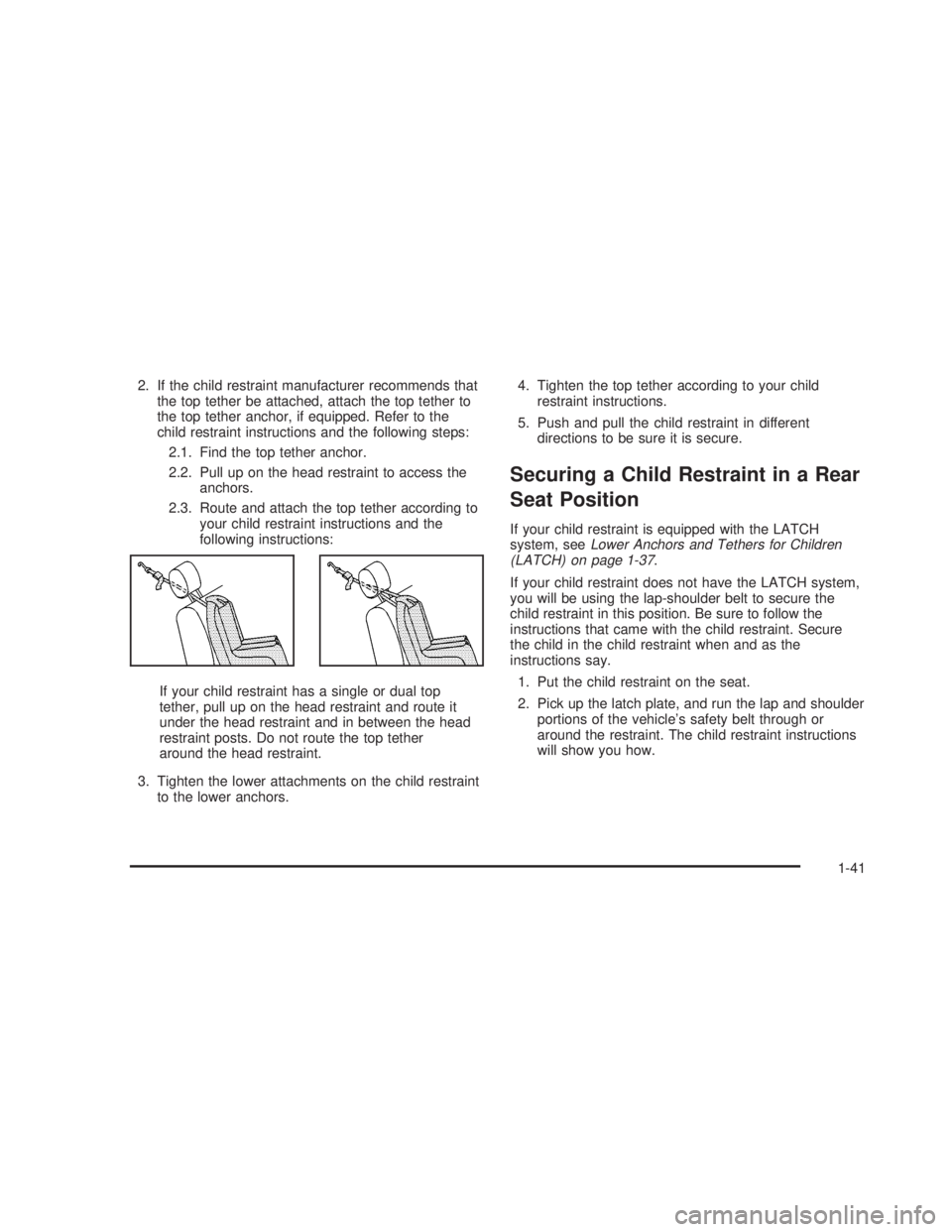
If your child restraint has a single or dual top
tether, pull up on the head restraint and route it
under the head restraint and in between the head
restraint posts. Do not route the top tether
around the head restraint.
3. Tighten the lower attachments on the child restraint
to the lower anchors.4. Tighten the top tether according to your child
restraint instructions.
5. Push and pull the child restraint in different
directions to be sure it is secure.
Securing a Child Restraint in a Rear
Seat Position
If your child restraint is equipped with the LATCH
system, seeLower Anchors and Tethers for Children
(LATCH) on page 1-37.
If your child restraint does not have the LATCH system,
you will be using the lap-shoulder belt to secure the
child restraint in this position. Be sure to follow the
instructions that came with the child restraint. Secure
the child in the child restraint when and as the
instructions say.
1. Put the child restraint on the seat.
2. Pick up the latch plate, and run the lap and shoulder
portions of the vehicle's safety belt through or
around the restraint. The child restraint instructions
will show you how.
1-41
2006 - Pontiac GTO Owner Manual
Page 49 of 326
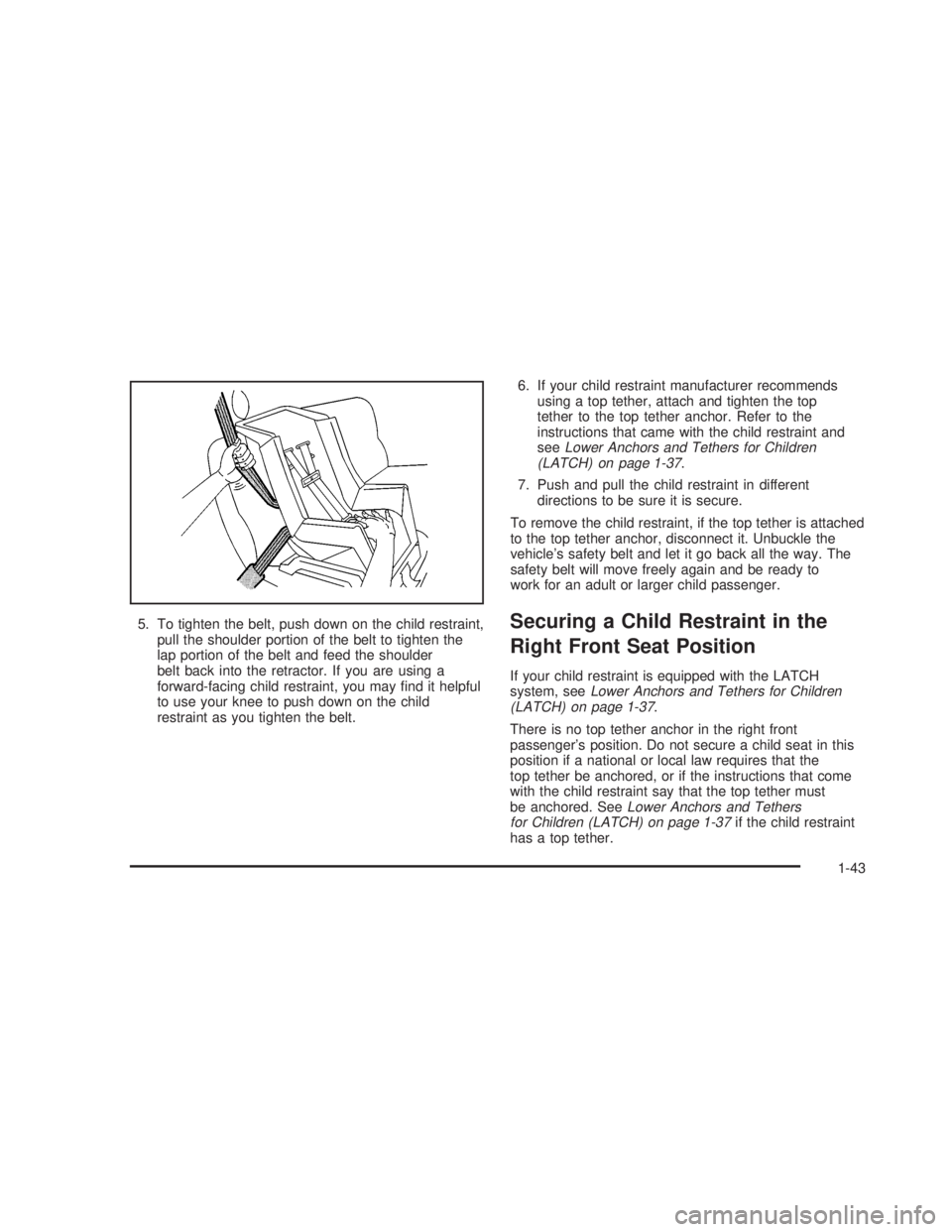
5. To tighten the belt, push down on the child restraint,
pull the shoulder portion of the belt to tighten the
lap portion of the belt and feed the shoulder
belt back into the retractor. If you are using a
forward-facing child restraint, you may ®nd it helpful
to use your knee to push down on the child
restraint as you tighten the belt.6. If your child restraint manufacturer recommends
using a top tether, attach and tighten the top
tether to the top tether anchor. Refer to the
instructions that came with the child restraint and
see
Lower Anchors and Tethers for Children
(LATCH) on page 1-37.
7. Push and pull the child restraint in different
directions to be sure it is secure.
To remove the child restraint, if the top tether is attached
to the top tether anchor, disconnect it. Unbuckle the
vehicle's safety belt and let it go back all the way. The
safety belt will move freely again and be ready to
work for an adult or larger child passenger.
Securing a Child Restraint in the
Right Front Seat Position
If your child restraint is equipped with the LATCH
system, seeLower Anchors and Tethers for Children
(LATCH) on page 1-37.
There is no top tether anchor in the right front
passenger's position. Do not secure a child seat in this
position if a national or local law requires that the
top tether be anchored, or if the instructions that come
with the child restraint say that the top tether must
be anchored. See
Lower Anchors and Tethers
for Children (LATCH) on page 1-37if the child restraint
has a top tether.
1-43
2006 - Pontiac GTO Owner Manual
Page 50 of 326
Your vehicle has a right front passenger's airbag.Neverput a rear-facing child restraint in this seat. Here is why:
{CAUTION:
A child in a rear-facing child restraint can be
seriously injured or killed if the right front
passenger's airbag in¯ates. This is because
the back of the rear-facing child restraint
would be very close to the in¯ating airbag.
Always secure a rear-facing child restraint in a
rear seat.
A rear seat is a safer place to secure a forward-facing
child restraint. If you need to secure a forward-facing
child restraint in the right front seat, you will be using the
lap-shoulder belt to secure the child restraint in this
position. Be sure to follow the instructions that came with
the child restraint. Secure the child in the child restraint
when and as the instructions say.
1. Because your vehicle has a right front passenger's
airbag, always move the seat as far back as it will
go before securing a forward-facing child restraint.
See
Power Seats on page 1-2.
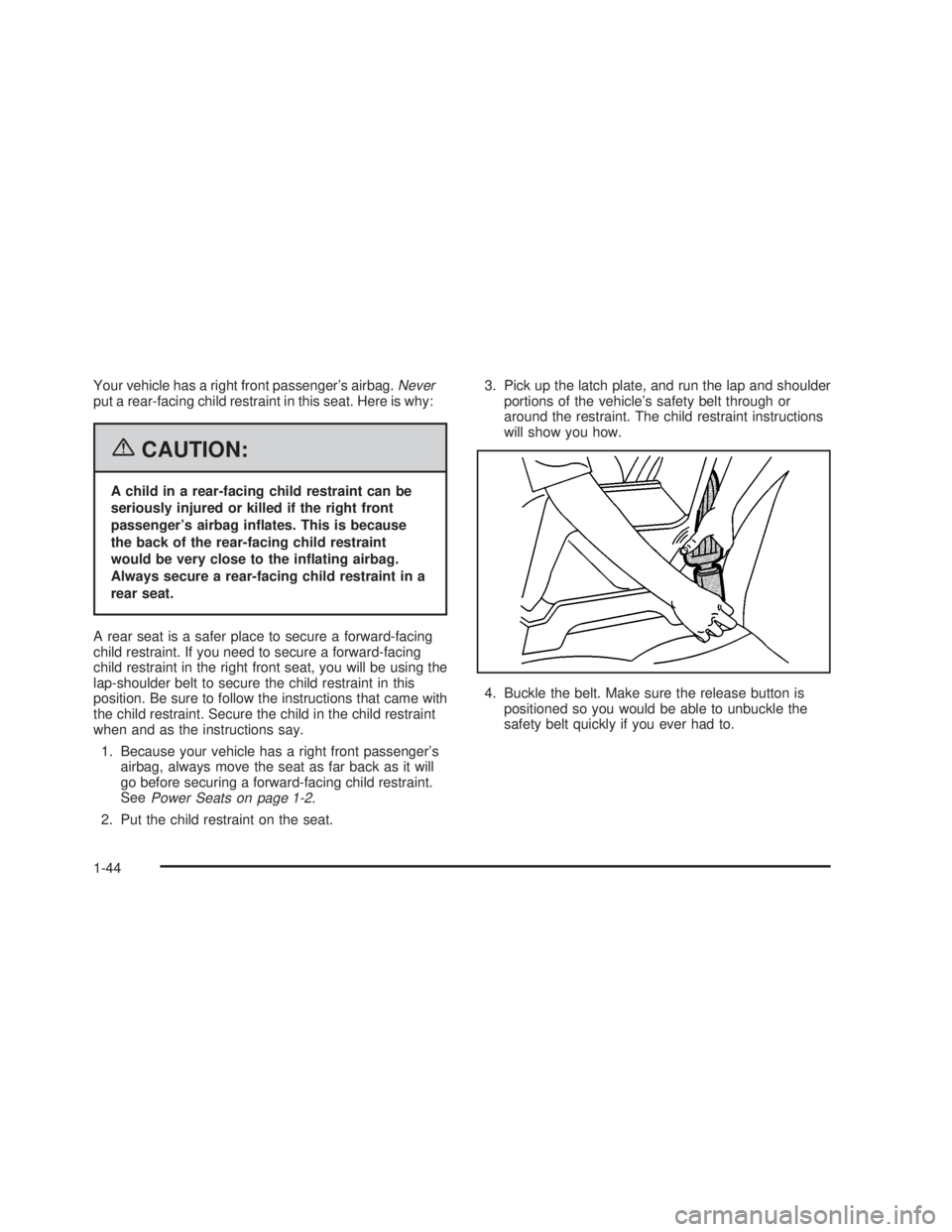
2. Put the child restraint on the seat.3. Pick up the latch plate, and run the lap and shoulder
portions of the vehicle's safety belt through or
around the restraint. The child restraint instructions
will show you how.
4. Buckle the belt. Make sure the release button is
positioned so you would be able to unbuckle the
safety belt quickly if you ever had to.
1-44
2006 - Pontiac GTO Owner Manual
Page 51 of 326
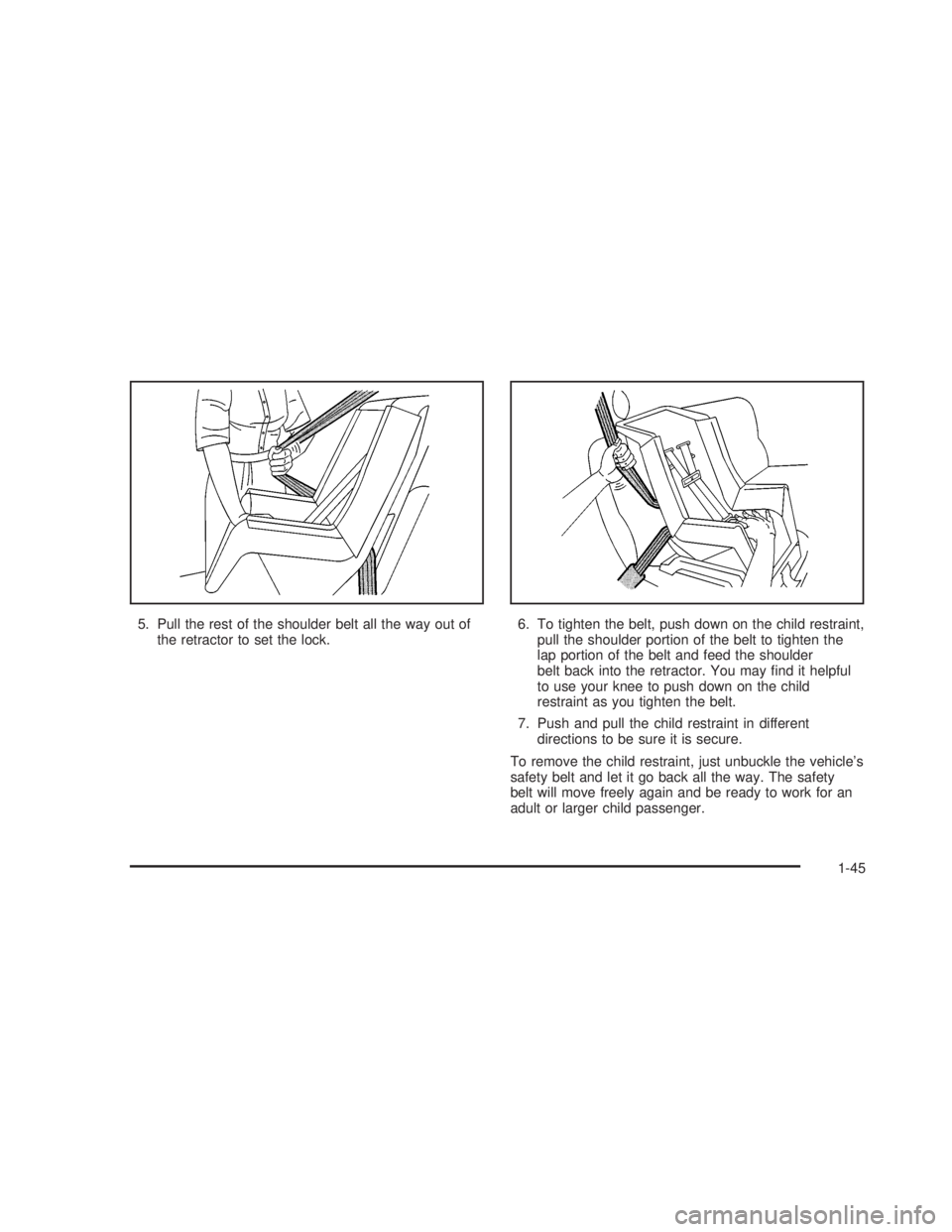
5. Pull the rest of the shoulder belt all the way out of
the retractor to set the lock.6. To tighten the belt, push down on the child restraint,
pull the shoulder portion of the belt to tighten the
lap portion of the belt and feed the shoulder
belt back into the retractor. You may ®nd it helpful
to use your knee to push down on the child
restraint as you tighten the belt.
7. Push and pull the child restraint in different
directions to be sure it is secure.
To remove the child restraint, just unbuckle the vehicle's
safety belt and let it go back all the way. The safety
belt will move freely again and be ready to work for an
adult or larger child passenger.
1-45
2006 - Pontiac GTO Owner Manual
Page 53 of 326
{CAUTION:
Airbags in¯ate with great force, faster than the
blink of an eye. If you are too close to an
in¯ating airbag, as you would be if you were
leaning forward, it could seriously injure you.
Safety belts help keep you in position before
and during a crash. Always wear your safety
belt, even with airbags. The driver should sit
as far back as possible while still maintaining
control of the vehicle.
{CAUTION:
Anyone who is up against, or very close to,
any airbag when it in¯ates can be seriously
injured or killed. Airbags plus lap-shoulder
belts offer the best protection for adults, but
not for young children and infants. Neither the
CAUTION: (Continued)
CAUTION: (Continued)
vehicle's safety belt system nor its airbag
system is designed for them. Young children
and infants need the protection that a child
restraint system can provide. Always secure
children properly in your vehicle. To read how,
see
Older Children on page 1-25andInfants
and Young Children on page 1-28
.
There is an airbag
readiness light on the
instrument panel cluster,
which shows the airbag
symbol.
The system checks the airbag electrical system for
malfunctions. The light tells you if there is an electrical
problem. See
Airbag Readiness Light on page 3-25for more information.
1-47
2006 - Pontiac GTO Owner Manual
Page 63 of 326

The main key can be used
for the ignition and the
driver's door lock.
There is another key that
locks and unlocks the
glove box.This key can usually be kept in the unlocked glove box.
Then, when leaving your vehicle and main key with a
parking attendant, you can lock valuables in the
glove box and take the glove box key with you.
The vehicle comes with a security card that lists various
security numbers for your vehicle, including key
numbers, and the radio PIN. Please keep the card in a
safe place, away from your vehicle.
If a replacement key is needed, you will have to go to
the dealership to purchase one.
In an emergency, contact Pontiac Roadside Assistance.
See
Roadside Assistance Program on page 7-6for
more information.
Notice:If you ever lock your keys in your vehicle,
you may have to damage the vehicle to get in.
Be sure you have spare keys.
2-3
2006 - Pontiac GTO Owner Manual
Page 70 of 326
Trunk Lock
To unlock the trunk, press and hold the button with the
trunk symbol on the key. The vehicle must be moving
at less than 12 mph (20 km/h) for the trunk to open. See
Remote Keyless Entry System Operation on page 2-5.
The trunk locks automatically when closed, so be careful
not to leave your key in the trunk.
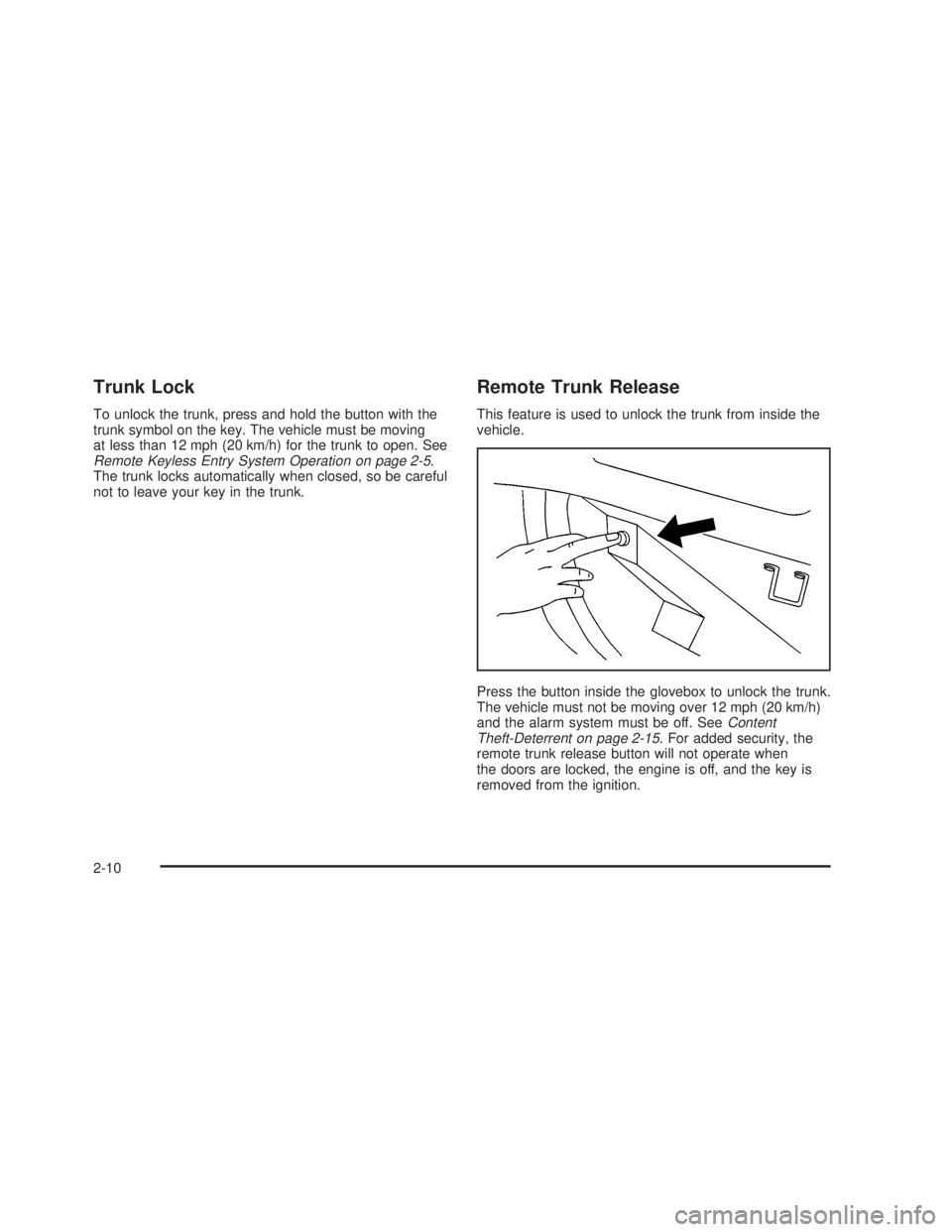
Remote Trunk Release
This feature is used to unlock the trunk from inside the
vehicle.
Press the button inside the glovebox to unlock the trunk.
The vehicle must not be moving over 12 mph (20 km/h)
and the alarm system must be off. See
Content
Theft-Deterrent on page 2-15. For added security, the
remote trunk release button will not operate when
the doors are locked, the engine is off, and the key is
removed from the ignition.
2-10
2006 - Pontiac GTO Owner Manual