child seat PONTIAC GTO 2006 User Guide
[x] Cancel search | Manufacturer: PONTIAC, Model Year: 2006, Model line: GTO, Model: PONTIAC GTO 2006Pages: 326, PDF Size: 1.62 MB
Page 40 of 326
Securing an Add-on Child Restraint in
the Vehicle
{CAUTION:
A child can be seriously injured or killed in a
crash if the child restraint is not properly
secured in the vehicle. Make sure the child
restraint is properly installed in the vehicle
using the vehicle's safety belt or LATCH
system, following the instructions that came
with that restraint, and also the instructions in
this manual.To help reduce the chance of injury, the child restraint
must be secured in the vehicle. Child restraint systems
must be secured in vehicle seats by lap belts or the
lap belt portion of a lap-shoulder belt, or by the LATCH
system. See
Lower Anchors and Tethers for Children
(LATCH) on page 1-37for more information. A child can
be endangered in a crash if the child restraint is not
properly secured in the vehicle.
When securing an add-on child restraint, refer to the
instructions that come with the restraint which may be on
the restraint itself or in a booklet, or both, and to this
manual. The child restraint instructions are important, so
if they are not available, obtain a replacement copy
from the manufacturer.
Keep in mind that an unsecured child restraint can
move around in a collision or sudden stop and injure
people in the vehicle. Be sure to properly secure
any child restraint in your vehicle Ð even when no child
is in it.
1-34
2006 - Pontiac GTO Owner Manual
Page 42 of 326
Where to Put the Restraint
Accident statistics show that children are safer if they are
restrained in the rear rather than the front seat. We,
therefore, recommend that child restraints be secured in
a rear seat, including an infant riding in a rear-facing
infant seat, a child riding in a forward-facing child seat
and an older child riding in a booster seat.
Neverput a
rear-facing child restraint in the front passenger seat.
Here is why:
{CAUTION:
A child in a rear-facing child restraint can be
seriously injured or killed if the right front
passenger's airbag in¯ates. This is because
the back of the rear-facing child restraint
would be very close to the in¯ating airbag.
Always secure a rear-facing child restraint in a
rear seat.
CAUTION: (Continued)
CAUTION: (Continued)
If you need to secure a forward-facing child
restraint in the right front seat, always move
the front passenger seat as far back as it will
go. It is better to secure the child restraint in a
rear seat.
Wherever you install a child restraint, be sure to secure
the child restraint properly.
Keep in mind that an unsecured child restraint can move
around in a collision or sudden stop and injure people in
the vehicle. Be sure to properly secure any child restraint
in your vehicle Ð even when no child is in it.
1-36
2006 - Pontiac GTO Owner Manual
Page 43 of 326
Lower Anchors and Tethers for
Children (LATCH)
Your vehicle has the LATCH system. The LATCH
system holds a child restraint during driving or in a
crash. This system is designed to make installation of a
child restraint easier. The LATCH system uses
anchors in the vehicle and attachments on the child
restraint that are made for use with the LATCH system
Make sure that a LATCH-compatible child restraint
is properly installed using the anchors, or use the
vehicle's safety belts to secure the restraint, following
the instructions that came with that restraint, and
also the instructions in this manual. When installing a
child restraint with a top tether, you must also use either
the lower anchors or the safety belts to properly
secure the child restraint. A child restraint must never
be installed using only the top tether and anchor.
In order to use the LATCH system in your vehicle, you
need a child restraint equipped with LATCH attachments.
The child restraint manufacturer will provide you with
instructions on how to use the child restraint and its
attachments. The following explains how to attach a child
restraint with these attachments in your vehicle.Your vehicle has lower anchors and top tether anchors.
Your child restraint may have lower attachments and
a top tether.
Not all vehicle seating positions or child restraints have
lower anchors and attachments or top tether anchors
and attachments.
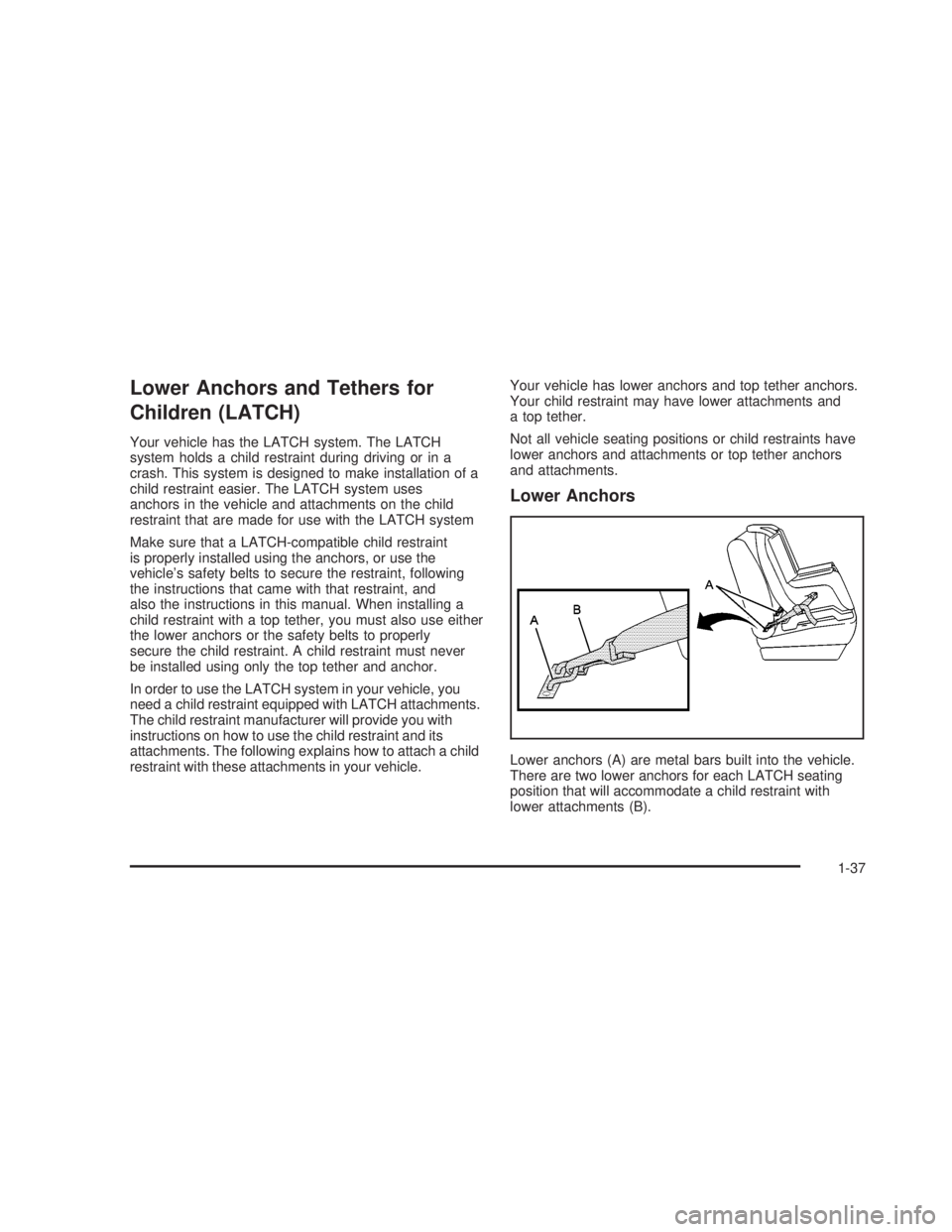
Lower Anchors
Lower anchors (A) are metal bars built into the vehicle.
There are two lower anchors for each LATCH seating
position that will accommodate a child restraint with
lower attachments (B).
1-37
2006 - Pontiac GTO Owner Manual
Page 45 of 326
Lower Anchor and Top Tether Anchor
Locations
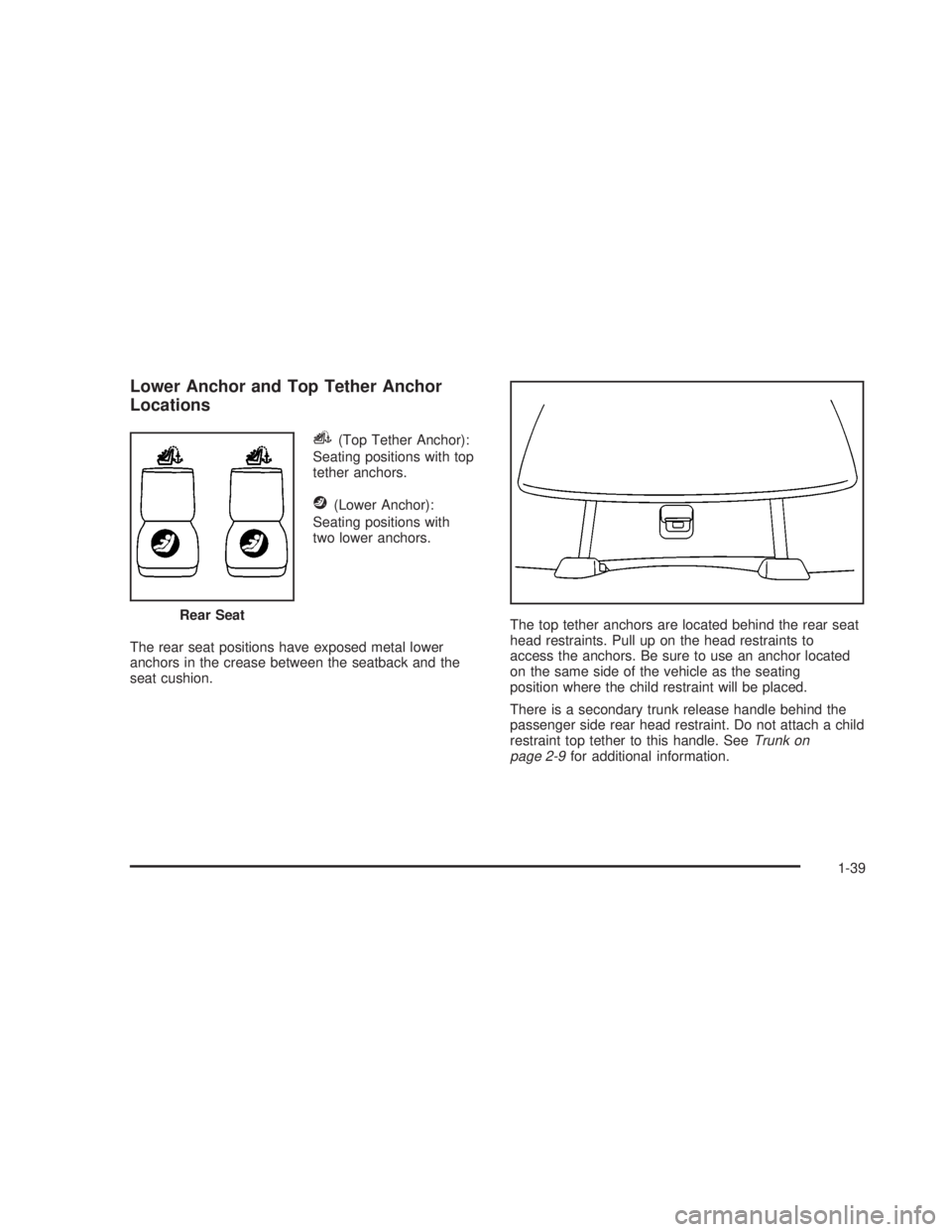
i(Top Tether Anchor):
Seating positions with top
tether anchors.
j(Lower Anchor):
Seating positions with
two lower anchors.
The rear seat positions have exposed metal lower
anchors in the crease between the seatback and the
seat cushion.The top tether anchors are located behind the rear seat
head restraints. Pull up on the head restraints to
access the anchors. Be sure to use an anchor located
on the same side of the vehicle as the seating
position where the child restraint will be placed.
There is a secondary trunk release handle behind the
passenger side rear head restraint. Do not attach a child
restraint top tether to this handle. See
Trunk on
page 2-9for additional information. Rear Seat
1-39
2006 - Pontiac GTO Owner Manual
Page 46 of 326
Do not secure a child restraint in the right front
passenger's position if a national or local law requires
that the top tether be attached, or if the instructions that
come with the child restraint say that the top tether
must be attached. There is no place to attach the top
tether in this position.
Accident statistics show that children are safer if they
are restrained in the rear rather than the front seat. See
Where to Put the Restraint on page 1-36for additional
information.
Securing a Child Restraint Designed for
the LATCH System
{CAUTION:
If a LATCH-type child restraint is not attached
to anchors, the restraint will not be able to
protect the child correctly. In a crash, the child
could be seriously injured or killed. Make sure
that a LATCH-type child restraint is properly
installed using the anchors, or use the
vehicle's safety belts to secure the restraint,
following the instructions that came with that
restraint, and also the instructions in this
manual.
{CAUTION:
Each top tether anchor and lower anchor in the
vehicle is designed to hold only one child
restraint. Attaching more than one child
restraint to a single anchor could cause the
anchor or attachment to come loose or even
break during a crash. A child or others could
be injured if this happens. To help prevent
injury to people and damage to your vehicle,
attach only one child restraint per anchor.
1. Attach the lower attachments to the lower anchors.
If the child restraint does not have lower
attachments or the desired seating position does
not have lower anchors, secure the child restraint
with the top tether and the safety belts. Refer
to your child restraint manufacturer instructions and
the instructions in this manual.
1.1. Find the lower anchors for the desired
seating position.
1.2. Put the child restraint on the seat.
1.3. Attach the lower attachments on the child
restraint to the lower anchors.
1-40
2006 - Pontiac GTO Owner Manual
Page 47 of 326
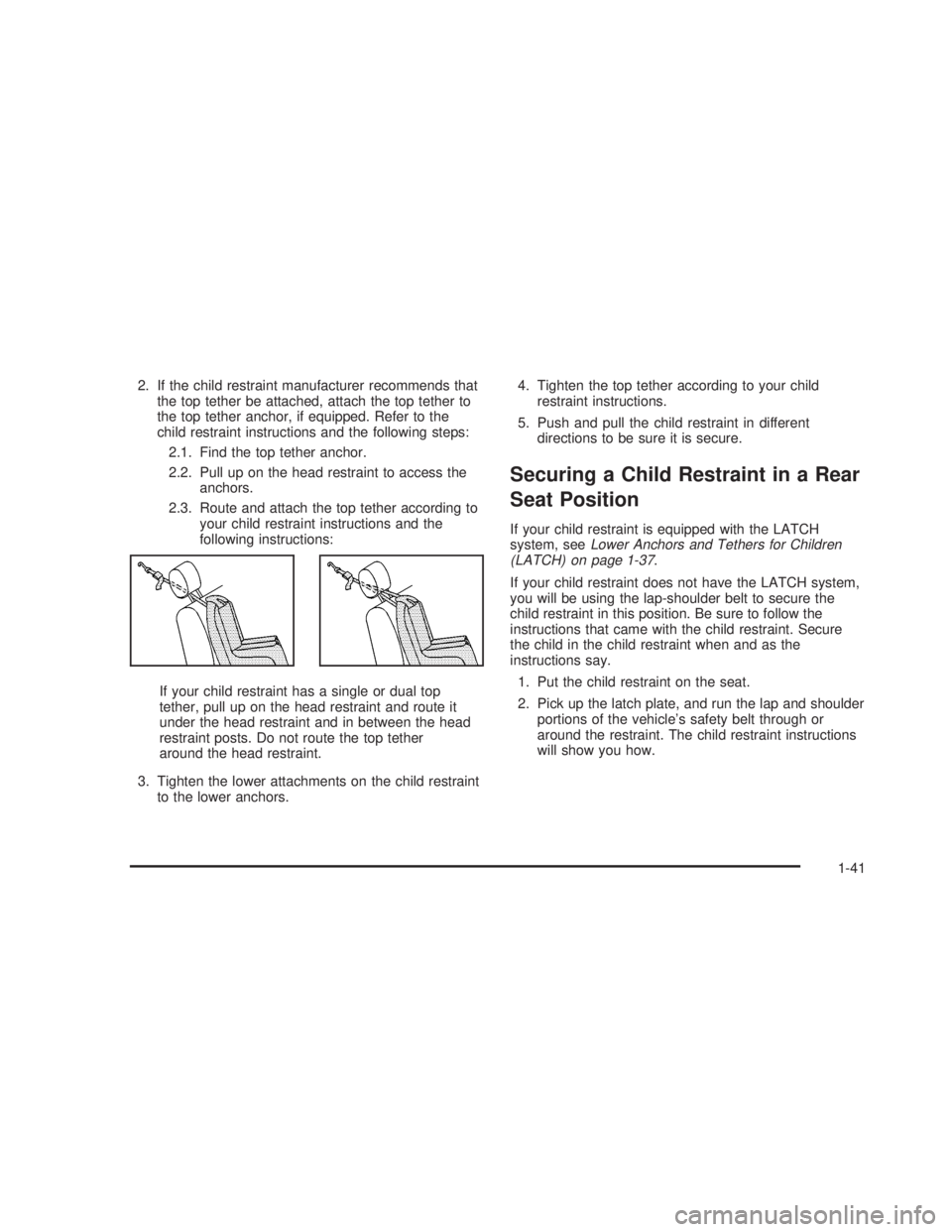
2. If the child restraint manufacturer recommends that
the top tether be attached, attach the top tether to
the top tether anchor, if equipped. Refer to the
child restraint instructions and the following steps:
2.1. Find the top tether anchor.
2.2. Pull up on the head restraint to access the
anchors.
2.3. Route and attach the top tether according to
your child restraint instructions and the
following instructions:
If your child restraint has a single or dual top
tether, pull up on the head restraint and route it
under the head restraint and in between the head
restraint posts. Do not route the top tether
around the head restraint.
3. Tighten the lower attachments on the child restraint
to the lower anchors.4. Tighten the top tether according to your child
restraint instructions.
5. Push and pull the child restraint in different
directions to be sure it is secure.
Securing a Child Restraint in a Rear
Seat Position
If your child restraint is equipped with the LATCH
system, seeLower Anchors and Tethers for Children
(LATCH) on page 1-37.
If your child restraint does not have the LATCH system,
you will be using the lap-shoulder belt to secure the
child restraint in this position. Be sure to follow the
instructions that came with the child restraint. Secure
the child in the child restraint when and as the
instructions say.
1. Put the child restraint on the seat.
2. Pick up the latch plate, and run the lap and shoulder
portions of the vehicle's safety belt through or
around the restraint. The child restraint instructions
will show you how.
1-41
2006 - Pontiac GTO Owner Manual
Page 49 of 326
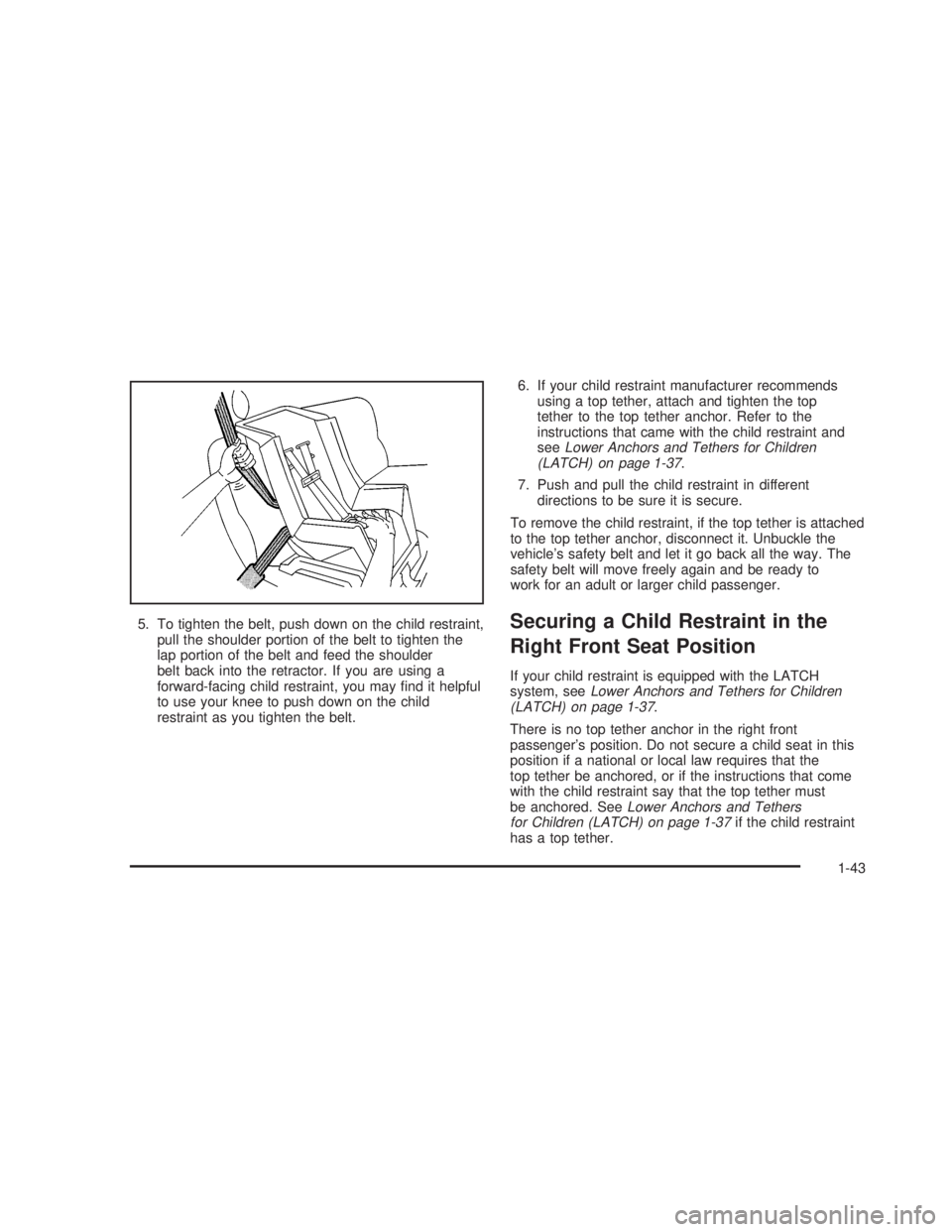
5. To tighten the belt, push down on the child restraint,
pull the shoulder portion of the belt to tighten the
lap portion of the belt and feed the shoulder
belt back into the retractor. If you are using a
forward-facing child restraint, you may ®nd it helpful
to use your knee to push down on the child
restraint as you tighten the belt.6. If your child restraint manufacturer recommends
using a top tether, attach and tighten the top
tether to the top tether anchor. Refer to the
instructions that came with the child restraint and
see
Lower Anchors and Tethers for Children
(LATCH) on page 1-37.
7. Push and pull the child restraint in different
directions to be sure it is secure.
To remove the child restraint, if the top tether is attached
to the top tether anchor, disconnect it. Unbuckle the
vehicle's safety belt and let it go back all the way. The
safety belt will move freely again and be ready to
work for an adult or larger child passenger.
Securing a Child Restraint in the
Right Front Seat Position
If your child restraint is equipped with the LATCH
system, seeLower Anchors and Tethers for Children
(LATCH) on page 1-37.
There is no top tether anchor in the right front
passenger's position. Do not secure a child seat in this
position if a national or local law requires that the
top tether be anchored, or if the instructions that come
with the child restraint say that the top tether must
be anchored. See
Lower Anchors and Tethers
for Children (LATCH) on page 1-37if the child restraint
has a top tether.
1-43
2006 - Pontiac GTO Owner Manual
Page 50 of 326
Your vehicle has a right front passenger's airbag.Neverput a rear-facing child restraint in this seat. Here is why:
{CAUTION:
A child in a rear-facing child restraint can be
seriously injured or killed if the right front
passenger's airbag in¯ates. This is because
the back of the rear-facing child restraint
would be very close to the in¯ating airbag.
Always secure a rear-facing child restraint in a
rear seat.
A rear seat is a safer place to secure a forward-facing
child restraint. If you need to secure a forward-facing
child restraint in the right front seat, you will be using the
lap-shoulder belt to secure the child restraint in this
position. Be sure to follow the instructions that came with
the child restraint. Secure the child in the child restraint
when and as the instructions say.
1. Because your vehicle has a right front passenger's
airbag, always move the seat as far back as it will
go before securing a forward-facing child restraint.
See
Power Seats on page 1-2.
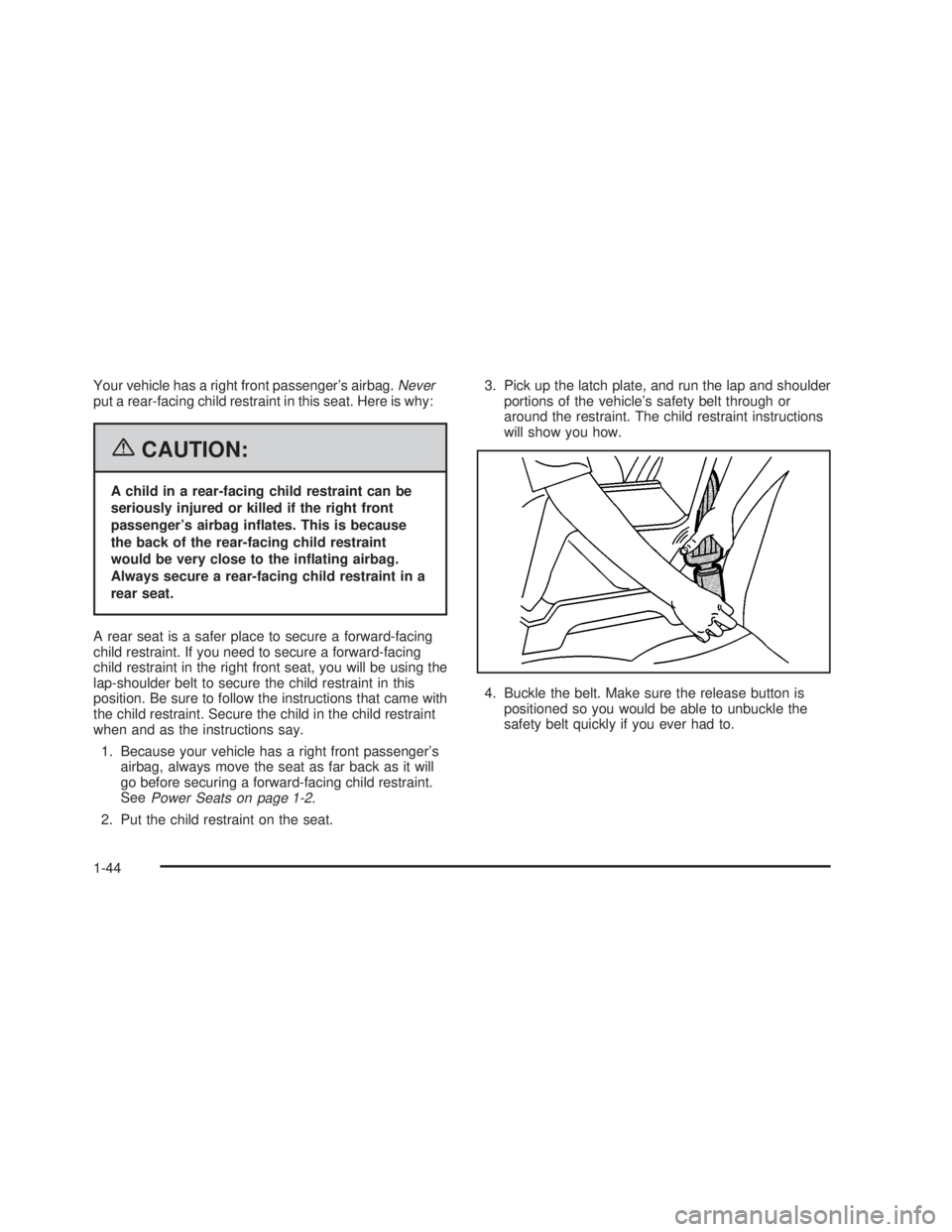
2. Put the child restraint on the seat.3. Pick up the latch plate, and run the lap and shoulder
portions of the vehicle's safety belt through or
around the restraint. The child restraint instructions
will show you how.
4. Buckle the belt. Make sure the release button is
positioned so you would be able to unbuckle the
safety belt quickly if you ever had to.
1-44
2006 - Pontiac GTO Owner Manual
Page 189 of 326
And, if you do have a heavy load, you should spread
it out.
{CAUTION:
Do not load your vehicle any heavier than the
Gross Vehicle Weight Rating (GVWR), or either
the maximum front or rear Gross Axle Weight
Rating (GAWR). If you do, parts on your
vehicle can break, and it can change the way
your vehicle handles. These could cause you
to lose control and crash. Also, overloading
can shorten the life of your vehicle.
If you put things inside your vehicle Ð like suitcases,
tools, packages, or anything else Ð they will go as fast
as the vehicle goes. If you have to stop or turn
quickly, or if there is a crash, they will keep going.
{CAUTION:
Things you put inside your vehicle can strike
and injure people in a sudden stop or turn, or
in a crash.
·Put things in the rear area of your vehicle.
Try to spread the weight evenly. If you
have fold-down rear seats, you will ®nd
four anchors on the back wall of your
trunk. You can use these anchors to tie
down lighter loads. They are not strong
enough for heavy things, however, so put
them as far forward as you can in the
trunk or rear area.
·Never stack heavier things, like suitcases,
inside the vehicle so that some of them
are above the tops of the seats.
·Do not leave an unsecured child restraint
in your vehicle.
·When you carry something inside the
vehicle, secure it whenever you can.
·Do not leave a seat folded down unless
you need to.
4-33
2006 - Pontiac GTO Owner Manual
Page 316 of 326
B
Backglass Antenna..........................................3-58
Battery..........................................................5-37
Run-Down Protection...................................3-16
Before Leaving on a Long Trip.........................4-21
Brake
Anti-Lock Brake System (ABS)........................ 4-7
Emergencies................................................ 4-9
Parking......................................................2-24
System Warning Light..................................3-27
Brakes..........................................................5-35
Braking........................................................... 4-6
Braking in Emergencies..................................... 4-9
Break-In, New Vehicle.....................................2-16
Bulb Replacement...........................................5-45
Front Turn Signal and Parking Lamps.............5-47
Halogen Bulbs............................................5-45
Headlamp Aiming........................................5-43
Headlamps.................................................5-45
Replacement Bulbs......................................5-49
Taillamps, Turn Signal, Stoplamps and
Back-up Lamps........................................5-48
Buying New Tires...........................................5-63
C
California Fuel.................................................. 5-6
California Proposition 65 Warning....................... 5-3
Capacities and Speci®cations............................5-90
Carbon Monoxide.....................2-9, 2-27, 4-24, 4-34
Care of
Safety Belts................................................5-79
Your CD Player...........................................3-57
Your CDs ...................................................3-57
Center Console Storage Area...........................2-30
Chains, Tire...................................................5-67
Charging System Light....................................3-26
Check
Engine Light...............................................3-28
Checking Things Under the Hood......................5-10
Chemical Paint Spotting...................................5-83
Child Restraints
Child Restraint Systems...............................1-31
Infants and Young Children...........................1-28
Lower Anchors and Tethers for Children..........1-37
Older Children.............................................1-25
Securing a Child Restraint in a Rear Seat
Position..................................................1-41
2
2006 - Pontiac GTO Owner Manual