radiator cap PONTIAC GTO 2006 Owners Manual
[x] Cancel search | Manufacturer: PONTIAC, Model Year: 2006, Model line: GTO, Model: PONTIAC GTO 2006Pages: 326, PDF Size: 1.62 MB
Page 191 of 326
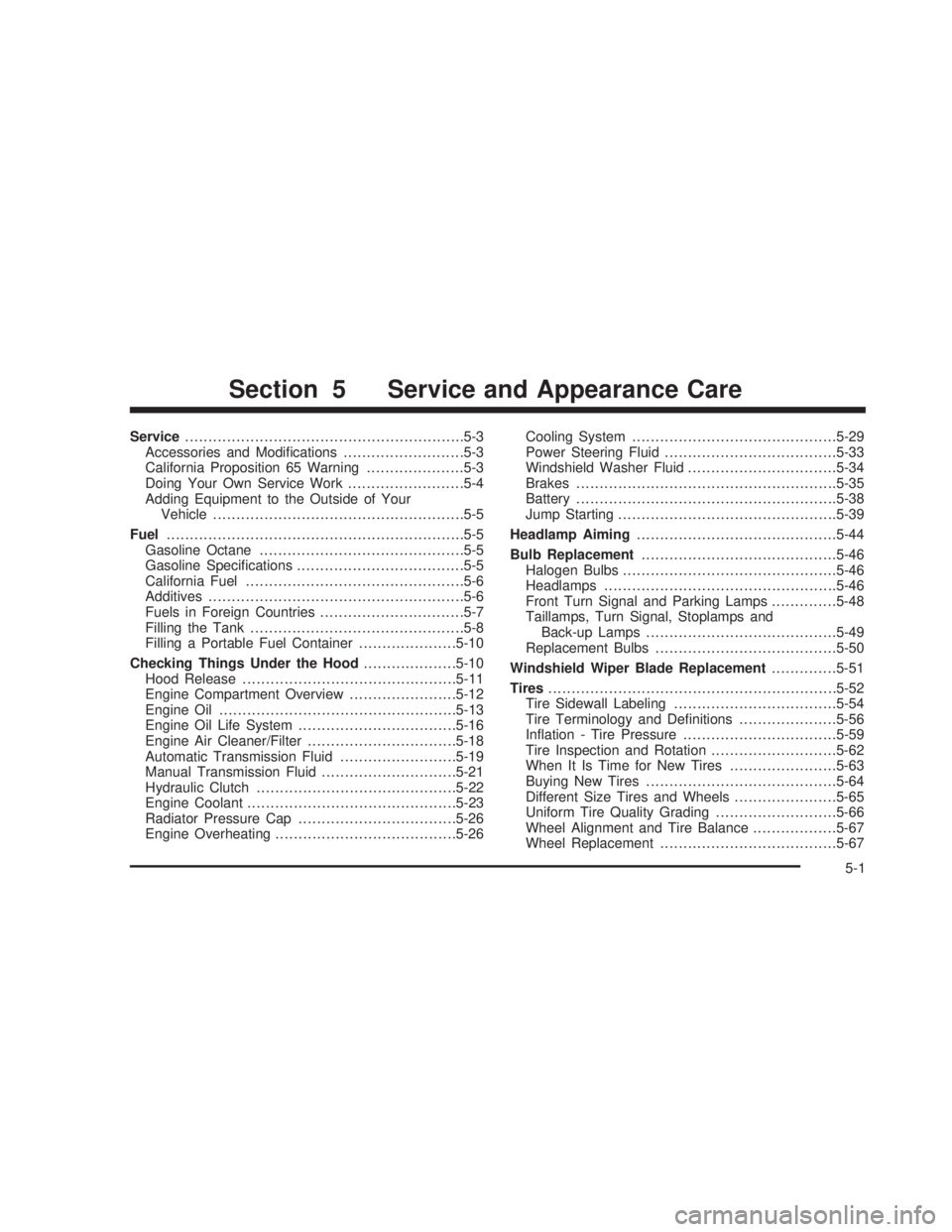
Service............................................................5-3
Accessories and Modi®cations..........................5-3
California Proposition 65 Warning.....................5-3
Doing Your Own Service Work.........................5-4
Adding Equipment to the Outside of Your
Vehicle......................................................5-5
Fuel................................................................5-5
Gasoline Octane............................................5-5
Gasoline Speci®cations....................................5-5
California Fuel...............................................5-6
Additives.......................................................5-6
Fuels in Foreign Countries...............................5-7
Filling the Tank..............................................5-8
Filling a Portable Fuel Container.....................5-10
Checking Things Under the Hood....................5-10
Hood Release..............................................5-11
Engine Compartment Overview.......................5-12
Engine Oil...................................................5-13
Engine Oil Life System..................................5-16
Engine Air Cleaner/Filter................................5-18
Automatic Transmission Fluid.........................5-19
Manual Transmission Fluid.............................5-21
Hydraulic Clutch...........................................5-22
Engine Coolant.............................................5-23
Radiator Pressure Cap..................................5-26
Engine Overheating.......................................5-26Cooling System............................................5-29
Power Steering Fluid.....................................5-33
Windshield Washer Fluid................................5-34
Brakes........................................................5-35
Battery........................................................5-38
Jump Starting...............................................5-39
Headlamp Aiming...........................................5-44
Bulb Replacement..........................................5-46
Halogen Bulbs..............................................5-46
Headlamps..................................................5-46
Front Turn Signal and Parking Lamps..............5-48
Taillamps, Turn Signal, Stoplamps and
Back-up Lamps.........................................5-49
Replacement Bulbs.......................................5-50
Windshield Wiper Blade Replacement..............5-51
Tires..............................................................5-52
Tire Sidewall Labeling...................................5-54
Tire Terminology and De®nitions.....................5-56
In¯ation - Tire Pressure.................................5-59
Tire Inspection and Rotation...........................5-62
When It Is Time for New Tires.......................5-63
Buying New Tires.........................................5-64
Different Size Tires and Wheels......................5-65
Uniform Tire Quality Grading..........................5-66
Wheel Alignment and Tire Balance..................5-67
Wheel Replacement......................................5-67
Section 5 Service and Appearance Care
5-1
2006 - Pontiac GTO Owner Manual
Page 203 of 326

A. Engine Compartment Fuse Block. SeeEngine
Compartment Fuse Block on page 5-88.
B. Windshield Washer Fluid Reservoir. See ªAdding
Washer Fluidº under
Windshield Washer Fluid
on page 5-34.
C. Battery. See
Battery on page 5-37.
D. Radiator Pressure Cap (Out of View). See
Radiator
Pressure Cap on page 5-26.
E. Engine Oil Dipstick. See ªChecking Engine Oilº
under
Engine Oil on page 5-13.
F. Engine Oil Fill Cap. See ªWhen to Add Engine Oilº
under
Engine Oil on page 5-13.
G. Automatic Transmission Dipstick (If Equipped). See
ªChecking the Fluid Levelº under
Automatic
Transmission Fluid on page 5-19.
H. Power Steering Fluid Reservoir. See
Power Steering
Fluid on page 5-33.
I. Brake Fluid Reservoir. See ªBrake Fluidº under
Brakes on page 5-35.
J. Hydraulic Clutch Fluid Reservoir (If Equipped). See
Hydraulic Clutch on page 5-22.
K. Engine Air Cleaner/Filter. See
Engine Air
Cleaner/Filter on page 5-18.
L. Engine Coolant Over¯ow Reservoir. See
Engine
Coolant on page 5-23.
Engine Oil
If the Service Engine Oil message appears on the trip
computer display, it means you need to check your
engine oil level right away. For more information, see
Trip Computer on page 3-33. You should check
your engine oil level regularly; this is an added reminder.
Checking Engine Oil
It is a good idea to check your engine oil every time you
get fuel. In order to get an accurate reading, the oil
must be warm and the vehicle must be on level ground.
The engine oil dipstick handle is a yellow loop. See
Engine Compartment Overview on page 5-12for
the location of the engine oil dipstick.
1. Turn off the engine and give the oil several minutes
to drain back into the oil pan. If you do not do this,
the oil dipstick might not show the actual level.
2. Pull out the dipstick and clean it with a paper towel
or cloth, then push it back in all the way. Remove it
again, keeping the tip down, and check the level.
5-13
2006 - Pontiac GTO Owner Manual
Page 213 of 326
How to Check and Add Fluid
To check the ¯uid level, look at the markings on the
reservoir. If the ¯uid level is between the MIN and the
MAX line, the ¯uid level is correct. If the ¯uid level
is between these marks do not remove the cap, as the
¯uid will quickly absorb moisture. See
Engine
Compartment Overview on page 5-12for more
information on reservoir location.
If ¯uid does need to be added, ®rst turn the vehicle off.
Remove the cap and add the proper ¯uid. Remember
to replace the cap and clean up any spilled ¯uid.
Engine Coolant
The cooling system in your vehicle is ®lled with
DEX-COOLžengine coolant. This coolant is designed
to remain in the vehicle for ®ve years or 150,000 miles
(240 000 km), whichever occurs ®rst, if only
DEX-COOL
žextended life coolant is added.The following explains the cooling system and how to
add coolant when it is low. If there is a problem
with engine overheating or if coolant needs to be added
to the radiator, see
Engine Overheating on page 5-26.
A 50/50 mixture of clean, drinkable water and
DEX-COOL
žcoolant will:
·Give freezing protection down to-34ÉF (-37ÉC).
·Give boiling protection up to 265ÉF (129ÉC).
·Protect against rust and corrosion.
·Help keep the proper engine temperature.
·Let the warning lights and gages work as
they should.
Notice:Using coolant other than DEX-COOLžmay
cause premature engine, heater core, or radiator
corrosion. In addition, the engine coolant may
require changing sooner, at the ®rst maintenance
service after each 30,000 miles (50 000 km) or
24 months, whichever occurs ®rst. Any repairs
would not be covered by your warranty. Always use
DEX-COOL
ž(silicate-free) coolant in your vehicle.
5-23
2006 - Pontiac GTO Owner Manual
Page 216 of 326

If the coolant over¯ow reservoir is completely empty,
add coolant to the radiator. SeeEngine Overheating on
page 5-26.
{CAUTION:
Turning the radiator pressure cap when the
engine and radiator are hot can allow steam
and scalding liquids to blow out and burn you
badly. With the coolant recovery tank, you will
almost never have to add coolant at the
radiator. Never turn the radiator pressure
cap Ð even a little Ð when the engine and
radiator are hot.
Occasionally check the coolant in the radiator. For
information on how to add coolant to the radiator, see
Cooling System on page 5-29.
Radiator Pressure Cap
Notice:If the pressure cap is not tightly installed,
coolant loss and possible engine damage may
occur. Be sure the cap is properly and tightly
secured.
See
Engine Compartment Overview on page 5-12for
information on location.
Engine Overheating
Immediate action is required if your engine overheats.
This is indicated by the coolant temperature gage
and the Engine Temp Hot message on the trip computer
display. See
Engine Coolant Temperature Gage on
page 3-28andTrip Computer on page 3-33for more
information.
5-26
2006 - Pontiac GTO Owner Manual
Page 219 of 326
Cooling System
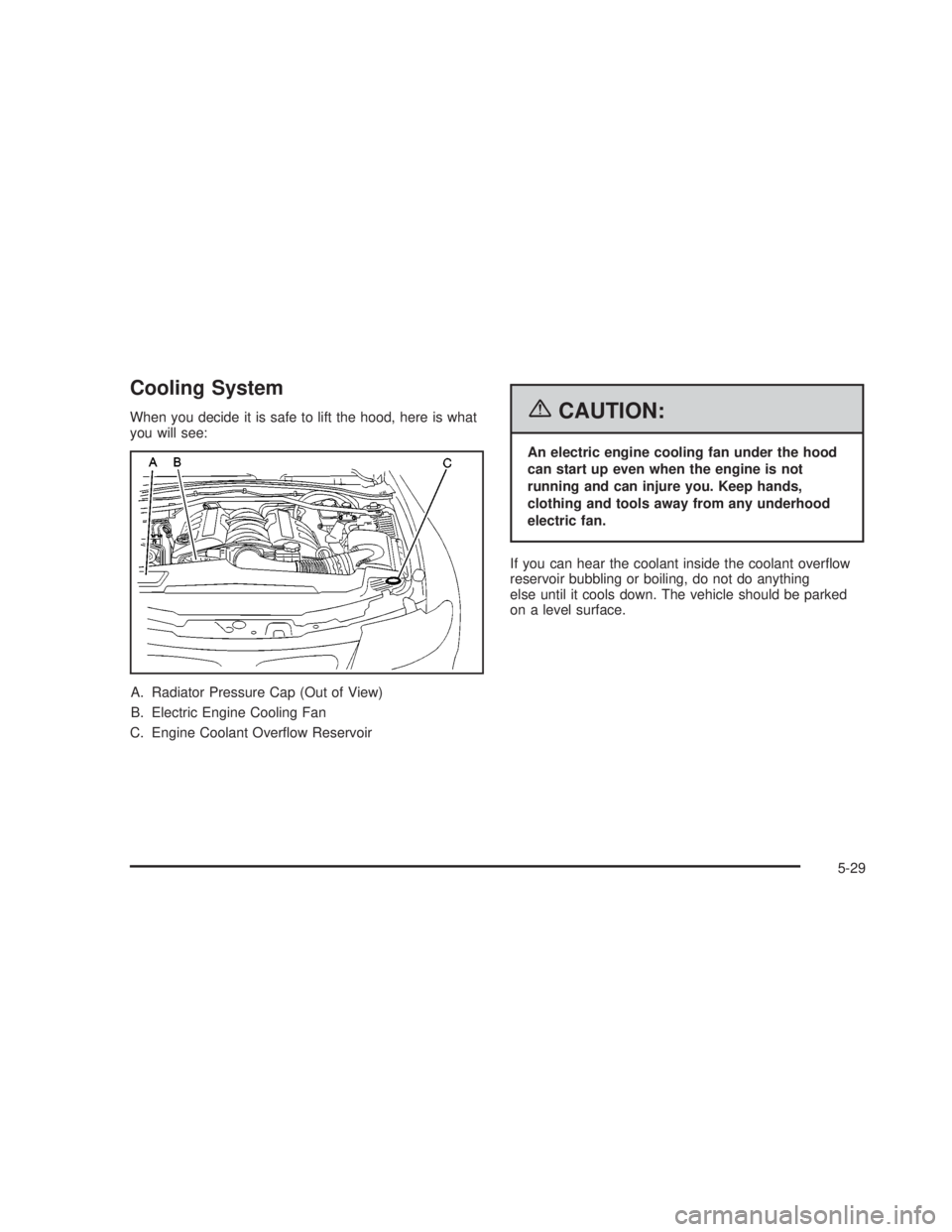
When you decide it is safe to lift the hood, here is what
you will see:
A. Radiator Pressure Cap (Out of View)
B. Electric Engine Cooling Fan
C. Engine Coolant Over¯ow Reservoir{CAUTION:
An electric engine cooling fan under the hood
can start up even when the engine is not
running and can injure you. Keep hands,
clothing and tools away from any underhood
electric fan.
If you can hear the coolant inside the coolant over¯ow
reservoir bubbling or boiling, do not do anything
else until it cools down. The vehicle should be parked
on a level surface.
5-29
2006 - Pontiac GTO Owner Manual
Page 220 of 326

The coolant level should be at or above the bottom
arrow on the dipstick. If it is not, you may have a leak at
the pressure cap or in the radiator hoses, heater
hoses, radiator, water pump, or somewhere else in the
cooling system.
{CAUTION:
Heater and radiator hoses, and other engine
parts, can be very hot. Do not touch them. If
you do, you can be burned.
Do not run the engine if there is a leak. If you
run the engine, it could lose all coolant. That
could cause an engine ®re, and you could be
burned. Get any leak ®xed before you drive
the vehicle.If there seems to be no leak, with the engine on, check
to see if the electric engine cooling fan is running. If
the engine is overheating, the fan should be running. If
it is not, your vehicle needs service.
Notice:If you operate the engine without coolant
or fail to maintain the cooling system properly,
you could damage the engine. The repairs would not
be covered by your warranty. Always follow the
maintenance schedule in this manual for
maintaining your cooling system. See
Cooling
System on page 5-29for more information.
Notice:Using coolant other than DEX-COOLžmay
cause premature engine, heater core or radiator
corrosion. In addition, the engine coolant may
require changing sooner, at 30,000 miles (50 000 km)
or 24 months, whichever occurs ®rst. Any repairs
would not be covered by your warranty. Always use
DEX-COOL
ž(silicate-free) coolant in your vehicle.
5-30
2006 - Pontiac GTO Owner Manual
Page 222 of 326

To add coolant to the over¯ow reservoir, do the
following:
1. Remove the coolant over¯ow reservoir cap when
the cooling system is no longer hot.
2. Fill the coolant over¯ow reservoir with the proper
mixture, until it reaches the bottom arrow on the
dipstick.
3. Replace the dipstick, then press down on the
coolant reservoir cap while turning it clockwise until
it stops, to lock it into position.
{CAUTION:
Steam and scalding liquids from a hot cooling
system can blow out and burn you badly. They
are under pressure, and if you turn the radiator
pressure cap Ð even a little Ð they can come
out at high speed. Never turn the cap when the
cooling system, including the radiator pressure
cap, is hot. Wait for the cooling system and
radiator pressure cap to cool if you ever have
to turn the pressure cap.
See your dealer, if necessary.
5-32
2006 - Pontiac GTO Owner Manual
Page 236 of 326
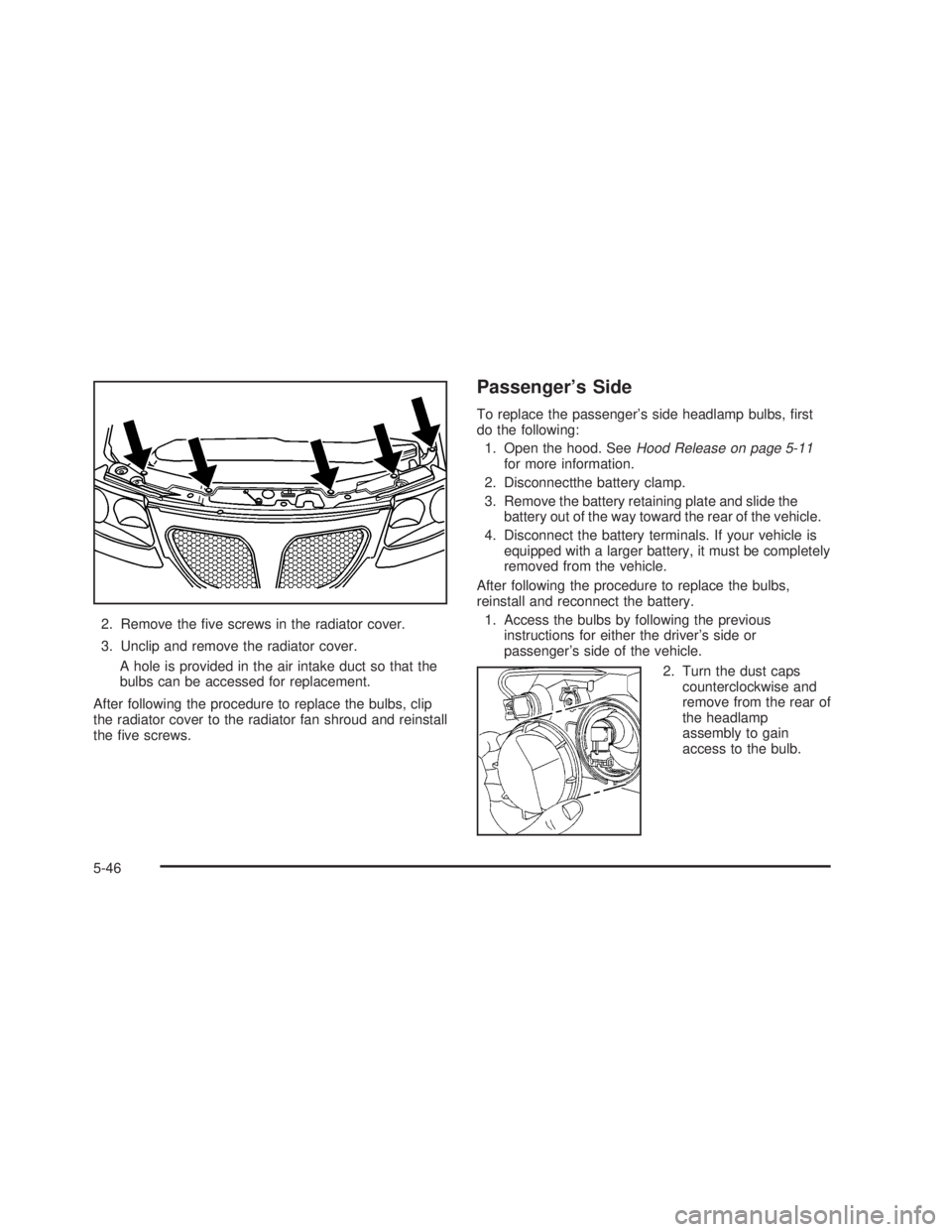
2. Remove the ®ve screws in the radiator cover.
3. Unclip and remove the radiator cover.
A hole is provided in the air intake duct so that the
bulbs can be accessed for replacement.
After following the procedure to replace the bulbs, clip
the radiator cover to the radiator fan shroud and reinstall
the ®ve screws.
Passenger's Side
To replace the passenger's side headlamp bulbs, ®rst
do the following:
1. Open the hood. See
Hood Release on page 5-11for more information.
2. Disconnectthe battery clamp.
3. Remove the battery retaining plate and slide the
battery out of the way toward the rear of the vehicle.
4. Disconnect the battery terminals. If your vehicle is
equipped with a larger battery, it must be completely
removed from the vehicle.
After following the procedure to replace the bulbs,
reinstall and reconnect the battery.
1. Access the bulbs by following the previous
instructions for either the driver's side or
passenger's side of the vehicle.
2. Turn the dust caps
counterclockwise and
remove from the rear of
the headlamp
assembly to gain
access to the bulb.
5-46
2006 - Pontiac GTO Owner Manual
Page 287 of 326
Maintenance Footnotes
(a)Visually inspect brake lines and hoses for proper
hook-up, binding, leaks, cracks, cha®ng, etc. Inspect
disc brake pads for wear and rotors for surface
condition. Inspect other brake parts, including calipers,
parking brake, etc.
(b)Visually inspect front and rear suspension and
steering system for damaged, loose, or missing parts or
signs of wear. Inspect power steering lines and hoses
for proper hook-up, binding, leaks, cracks, cha®ng, etc.
(c)Visually inspect hoses and have them replaced if
they are cracked, swollen, or deteriorated. Inspect
all pipes, ®ttings and clamps; replace with genuine GM
parts as needed. To help ensure proper operation, a
pressure test of the cooling system and pressure
cap and cleaning the outside of the radiator and air
conditioning condenser is recommended at least once
a year.
(d)Visually inspect wiper blades for wear or cracking.
Replace wiper blades that appear worn or damaged
or that streak or miss areas of the windshield.
(e)Make sure the safety belt reminder light and all your
belts, buckles, latch plates, retractors, and anchorages
are working properly. Look for any other loose or
damaged safety belt system parts. If you see anything
that might keep a safety belt system from doing its
job, have it repaired. Have any torn or frayed safety belts
replaced. Also look for any opened or broken airbag
coverings, and have them repaired or replaced.
The airbag system does not need regular maintenance.
(f)Lubricate all key lock cylinders, door hinges and
latches, hood hinges and latches, and trunk lid hinges
and latches. More frequent lubrication may be required
when exposed to a corrosive environment. Applying
silicone grease on weatherstrips with a clean cloth will
make them last longer, seal better, and not stick or
squeak.
6-7
2006 - Pontiac GTO Owner Manual
Page 288 of 326

(g)Change automatic transmission ¯uid and ®lter if the
vehicle is mainly driven under one or more of these
conditions:
þIn heavy city traffic where the outside temperature
regularly reaches 90ÉF (32ÉC) or higher.
þIn hilly or mountainous terrain.
þWhen doing frequent trailer towing.
þUses such as found in taxi, police, or delivery
service.
þUses such as high performance operation.
(h)Drain, ¯ush, and re®ll cooling system. This service
can be complex; you should have your dealer perform
this service. See Engine Coolant on page 5-23 for
what to use. Inspect hoses. Clean radiator, condenser,
pressure cap, and ®ller neck. Pressure test the
cooling system and pressure cap.
(i)A ¯uid loss in any vehicle system could indicate a
problem. Have the system inspected and repaired and
the ¯uid level checked. Add ¯uid if needed.
(j)Visually inspect belt for fraying, excessive cracks, or
obvious damage. Replace belt if necessary.
(k)Drain, ¯ush, and re®ll brake hydraulic system (or
every two years, whichever occurs ®rst). This service
can be complex; you should have your dealer perform
this service. See Brakes on page 5-35
andRecommended Fluids and Lubricants on page 6-12.
Owner Checks and Services
These owner checks and services should be performed
at the intervals speci®ed to help ensure the safety,
dependability, and emission control performance of your
vehicle. Your GM Goodwrench
ždealer can assist you
with these checks and services.
Be sure any necessary repairs are completed at once.
Whenever any ¯uids or lubricants are added to your
vehicle, make sure they are the proper ones, as shown
in
Recommended Fluids and Lubricants on page 6-12.
At Each Fuel Fill
It is important to perform these underhood checks at
each fuel ®ll.
Engine Oil Level Check
Check the engine oil level and add the proper oil if
necessary. SeeEngine Oil on page 5-13for further
details.
Notice:It is important to check your oil regularly
and keep it at the proper level. Failure to keep your
engine oil at the proper level can cause damage
to your engine not covered by your warranty.
6-8
2006 - Pontiac GTO Owner Manual