engine PONTIAC PONTIAC 1995 Owner's Manual
[x] Cancel search | Manufacturer: PONTIAC, Model Year: 1995, Model line: PONTIAC, Model: PONTIAC PONTIAC 1995Pages: 354, PDF Size: 17.27 MB
Page 119 of 354
Low Oil Level Light Security Light
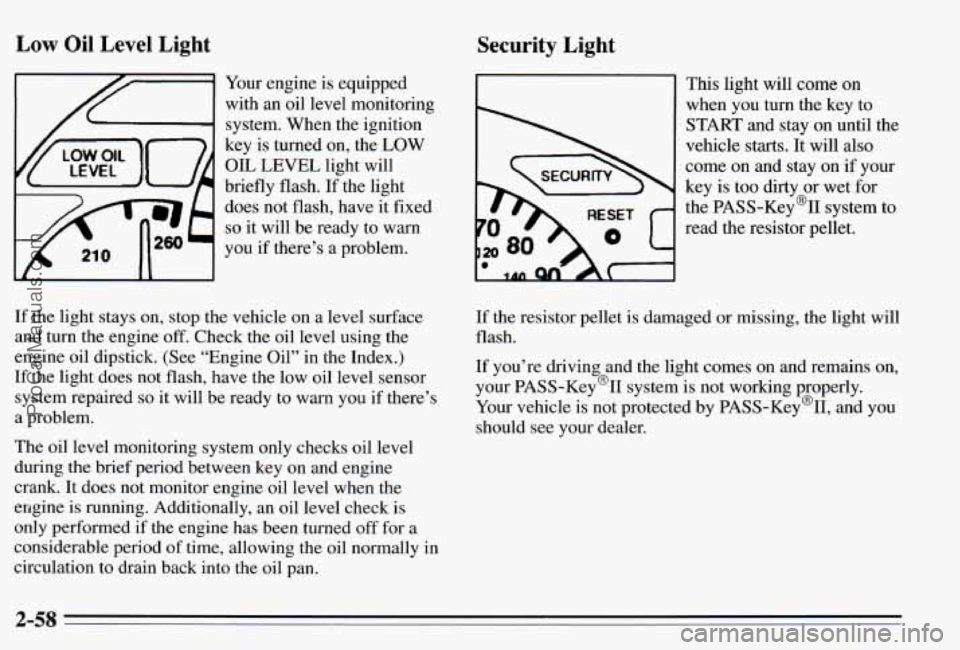
Your engine is equipped
with an oil level monitoring
system. When the ignition
key is turned on, the LOW
OIL LEVEL light will
briefly flash. If the light
does not flash, have it fixed
so it will be ready to warn
you if there’s
a problem.
If the light stays on, stop the vehicle on a level surface
and
turn the engine off. Check the oil level using the
This light will come on
when you turn the key to
START and stay on until the
vehicle starts. It will also
come on and stay on if your
key is too
dirty or wet for
the PASS-Key@II system to
read the resistor pellet.
If the resistor pellet is damaged or missing, the light will
flash.
engine oil dipstick. (See “Engine Oil” in the Index.) If you’re driving and the light comes on and remains on,
If‘ the light does not flash, have the low oil level sensor your PASS,Key~II system is not working properly.
a problem. and you system repaired SO it will be ready to warn you if there’s Your vehicle is not protected by
should see your dealer.
The
oil level monitoring system only checks oil level
during the brief period between key on and engine
crank.
It does not monitor engine oil level when the
engine is running. Additionally, an oil level check is
only performed
if the engine has been turned off for a
considerable period of time, allowing the oil normally
in
circulation to drain back into the oil pan.
2-58
ProCarManuals.com
Page 120 of 354
Trip Calculator (Option)
L
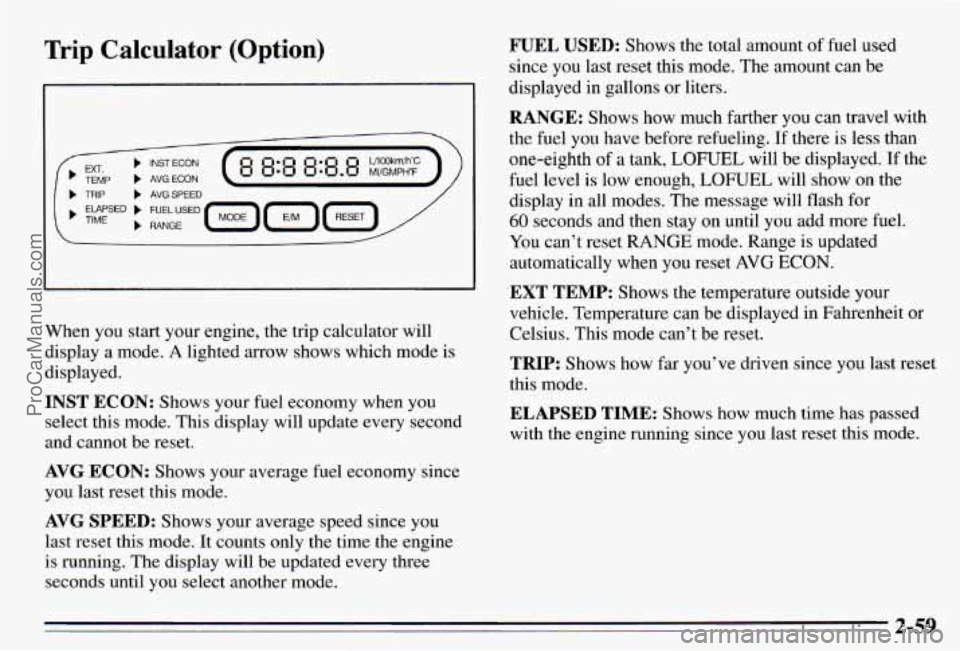
When you start your engine, the trip calculator will
display a mode.
A lighted arrow shows which mode is
displayed.
INST ECON: Shows your fuel economy when you
select
this mode. This display will update every second
and cannot be reset.
AVG ECON: Shows your average fuel economy since
you last reset this mode.
AVG SPEED: Shows your average speed since you
last reset this mode.
It counts only the time the engine
is running.
The disp1.a~ will be updated every three
seconds until you select another mode.
WEL USED: Shows the total amount of fuel used
since you last reset
this mode. The amount can be
displayed in gallons or liters.
RANGE: Shows how much farther you can travel with
the
fuel you have before refueling. If there is less than
one-eighth
of a tank, LOF’UEL will be displayed. If the
fuel level is
low enough, LOFUEL will show on the
display in all modes. The message
will flash for
60 seconds and then stay on until you add more fuel.
You can’t reset
RANGE mode. Range is updated
automatically when you reset
AVG ECON.
‘EXT TEMP: Shows the temperature outside your
vehicle. Temperature can be displayed in Fahrenheit or
Celsius. This mode can’t be reset.
TRIP: Shows how far you’ve driven since you last reset
this mode.
ELAPSED TIME: Shows how much time has passed
with the engine running since you last reset this mode.
2-59
ProCarManuals.com
Page 122 of 354
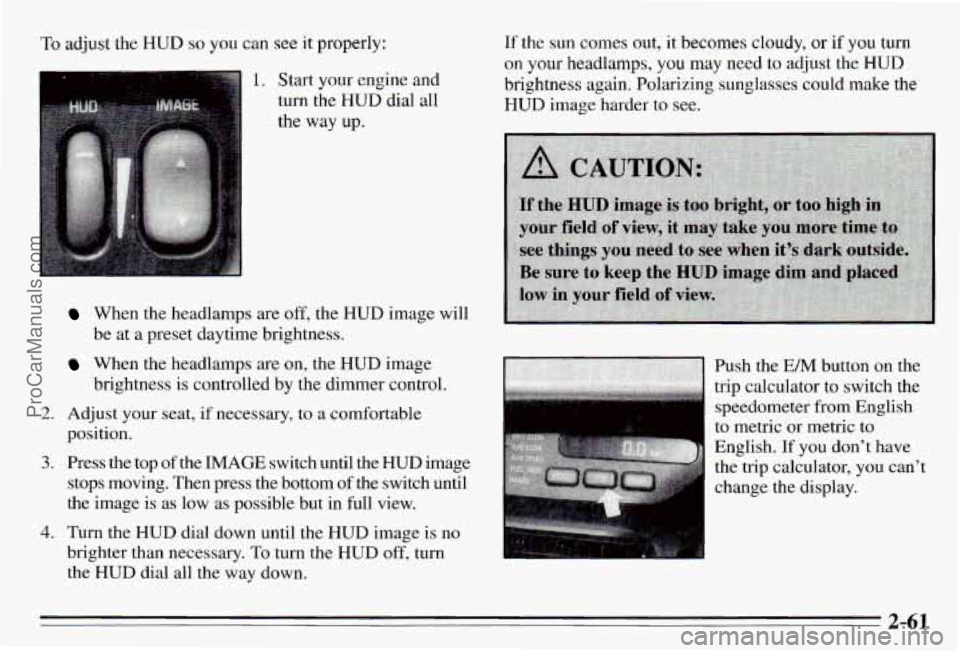
‘To adjust the HUD so you can see it properly:
1. Start your engine and
turn the HUD dial all
the way up.
2.
3.
4.
When the headlamps are off, the HUD image will
be at a preset daytime brightness.
brightness is controlled by the dimer control.
When the headlamps are on, the HUD image
Adjust your seat, if necessary, to
a comfortable
position.
Press the top of
the IMAGE switch until the HUD image
stops moving. Then press the bottom of the switch until
the image is as low as possible but in full view.
Turn the HUD dial down until the HUD image is
no
brighter than necessary. To turn the HUD off, turn
the HUD dial all
the way down.
If the sun comes out, it becomes cloudy, or if you turn
on
your headlamps, you may need to adjust the HUD
brightness again, Polarizing sunglasses could make the
HUD image harder to see.
speedometer from English
to metric or metric to
English. If you don’t have
the trip calculator, you can’t
1 change the display.
2-61
ProCarManuals.com
Page 128 of 354
Air Conditioning Heating
On very hot days, open the
windows long enough to
let hot inside air escape. This reduces the time the
compressor has
to run, which should help fuel economy.
For quick cool-down on very hot days,
use MAX with
the temperature knob all the way in the blue area.
If this
setting is used for long periods
of time, the air in your
vehicle may become too dry.
For normal cooling on hot days, use
VENT with the
temperature hob in the blue area and the
A/C button
pushed
in. The system will bring in outside air and cool it.
On cool but sunny days, the sun may warm your upper
body, but your lower body may not be warm enough.
You can use BI-LEVEL with the temperature knob in
the middle and the
A/C button pushed in. The system
will bring in outside air and direct it to your upper body,
while sending slightly warmed air to your lower body.
You may notice this temperature difference more at
some times than others. On
cold days use
FLOOR with the temperature knob all
the way in the red area. The system will bring in outside
air, heat
it and send it to the floor ducts.
If your vehicle has an engine coolant heater, you can use
it to help your system provide warm
air faster when it’s
cold outside (0°F (-lS0C) or lower).
An engine coolant
heater warms the coolant your engine and heating
system use to provide heat. See “Engine Coolant
Heater” in the Index.
Ventilation
For mild outside temperatures when little heating or
cooling is needed, use VENT
to direct outside air
through your vehicle. Your vehicle also has the
flow-through ventilation system described later in this
section.
Defogging and Defrosting Windows
Your system has two settings for clearing the front and
side windows. To defrost the windows quickly, use
DEFROST with the temperature knob all the way in the
red area. To warm passengers while keeping the
windows clean, use DEFOG.
3-3
ProCarManuals.com
Page 130 of 354
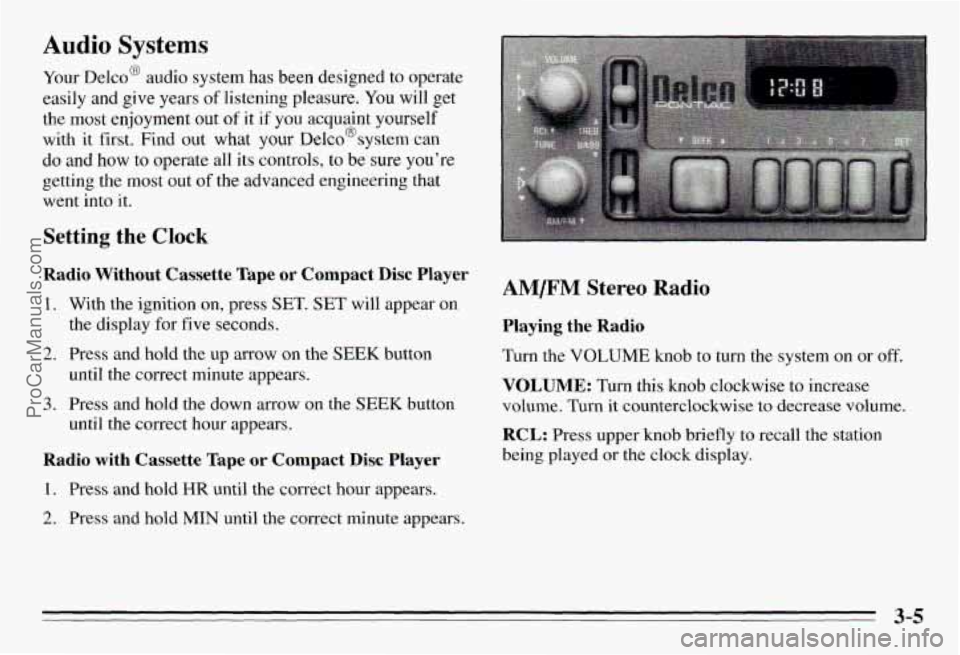
Audio Systems
Your Delco@ audio system has been designed to operate
easily and give years
of listening pleasure. You will get
the
most enjoyment out of it if you acquaint yourself
with
it first. Find out what your Delco@system can
do and how to operate all its controls, to be sure you’re
getting the
most out of the advanced engineering that
went into it.
Setting the Clock
Radio Without Cassette Tape or Compact Disc Player
1. With the ignition on, press SET. SET will appear on
2.
3.
the display for five seconds.
Press and hold the up arrow on the
SEEK button
until the correct minute appears.
Press and hold the down arrow on the
SEEK button
until the correct hour appears.
Radio with Cassette Tape or Compact Disc Player
1. Press and hold HR until the correct hour appears.
2. Press and hold MIN until the correct minute appears.
AM/FM Stereo Radio
Playing the Radio
Turn the VOLUME knob to turn the system on or off.
VOLUME: Turn this knob clockwise to increase
volume. Turn it counterclockwise to decrease volume.
RCL: Press upper knob briefly to recall the station
being played
or the clock display.
3-5
ProCarManuals.com
Page 139 of 354
Tips About Your Audio System
Hearing damage from loud noise is almost undetectable
until
it is too late. Your hearing can adapt to higher
volumes
df sound. Sound that seems normal can be loud
and hannful to your hearing. Take precautions by
adjusting the volume control
on your radio to a safe
sound level before your hearing
adapts to it.
To help avoid hearing loss or damage:
Adjust the volume control to the lowest setting.
Increase volume slowly until you hear comfortably
and clearly.
I NOTICE:
Before you add any sound equipment to your
vehicle
-- like a tape player, CB radio, mobile
telephone or two-way radio
- be sure you can
add what
you want. If you can, it’s very
important to do it properly. Added sound
equipment may interfere with the operation
of
your vehicle’s engine, Delco@ radio or other
systems, and even damage them. And, your
vehicle’s systems
may interfere with the
operation
of sound equipment that has been
added improperly.
So, before adding sound equipment, check with
your retailer and be sure
to check Federal rules
covering mobile radio and telephone units.
ProCarManuals.com
Page 149 of 354
Avoid needless heavy braking. Some people drive
in spurts
-- heavy acceleration followed by heavy
braking
-- rather than keeping pace with traffic. This
is a mistake. Your brakes may not have time to cool
between hard stops. Your brakes will
wear out much
faster if you do a lot of heavy braking.
If you keep pace
with the traffic and allow realistic following distances,
you will eliminate a lot of unnecessary braking. That
means better braking and longer brake life.
If your engine ever stops while you’re driving, brake
normally but don’t pump your brakes. If you do, the
pedal may get harder to push down. If your engine
stops, you will still have some power brake assist. But
you will use it when you brake. Once the power assist is
used up, it may take longer to stop and the brake pedal
will be harder to push.
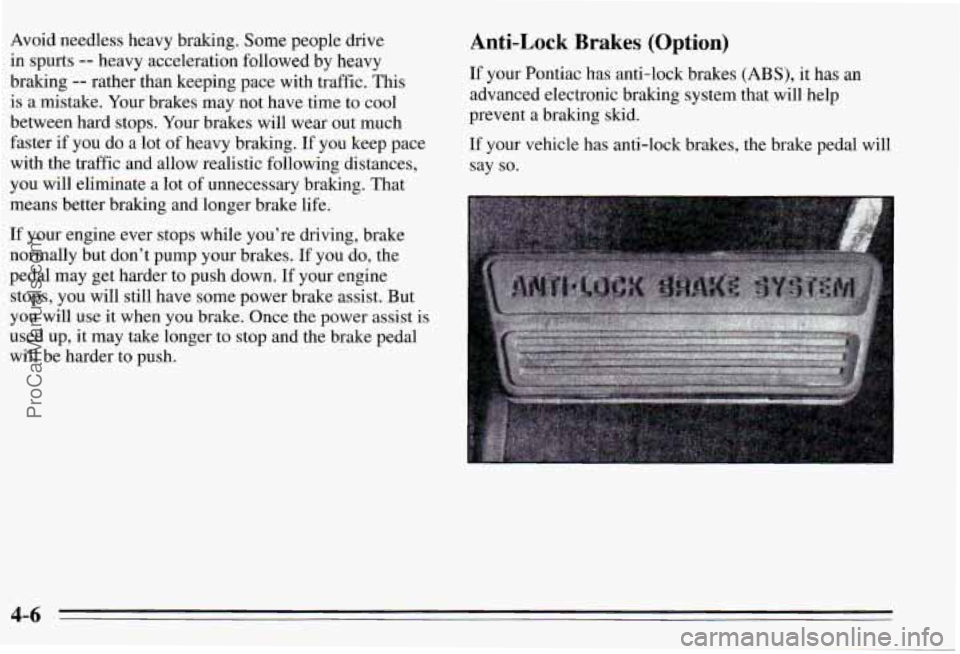
Bnti-Lock Brakes (Option)
:f your Pontiac has anti-lock brakes (ABS), it has an
dvanced electronic braking system that will help
Irevent a braking skid.
If your vehicle has anti-lock brakes, the brake pedal will
;ay
so.
4-6
ProCarManuals.com
Page 152 of 354
Braking in Emergencies
At some time, nearly every driver gets into a situation
that requires hard braking.
If you have anti-lock, you can steer and brake at the
same time. However,
if you don’t have anti-lock, your
first reaction
-- to hit the brake pedal hard and hold it
down
-- may be the wrong thing to do. Your wheels can
stop rolling. Once they do, the vehicle can’t respond to
your steering. Momentum will carry it in whatever
direction it was headed when the wheels stopped rolling.
That could be off the road, into the very thing you were
trying to avoid, or into traffic.
If you don’t have anti-lock, use a “squeeze” braking
technique. This will give you maximum braking while
maintaining steering control. You do this by pushing on
the brake pedal with steadily increasing pressure.
In an emergency you will probably want to “squeeze”
the brakes hard without locking the wheels. If you hear
or feel the wheels sliding, ease off the brake pedal. This
will help you retain steering control.
(If you do have
anti-lock, it’s different: see “Anti-Lock Brakes’’ in the
Index.)
In many emergencies, steering can help you more than
even the very best braking.
Steering
Power Steering
If you lose power steering assist because the engine
stops or the system is not functioning, you can steer but
it will take much more effort.
Steering Tips
Driving on Curves
It’s important to take curves at a reasonable speed.
A lot of the “driver lost control” accidents mentioned on
the news happen on curves. Here’s why:
Experienced driver or beginner, each of us is subject to
the same laws of physics when driving on curves. The
traction of the tires against the road surface makes it
possible for the vehicle to change its path when you turn
the front wheels. If there’s no traction, inertia will keep
the vehicle going in the same direction. If you’ve ever
tried to steer a vehicle on
wet ice, you’ll understand this.
The traction you can get in a curve depends on the
condition of your tires and the road surface, the angle
at which the curve is banked, and your speed. While
you’re in a curve, speed is the one factor you can
control.
4-9
ProCarManuals.com
Page 157 of 354
If your vehicle starts to slide, ease your foot off the
accelerator pedal and quickly steer the way you want
the vehicle to go.
If you start steering quickly enough,
your vehicle may straighten out. Always be ready for a
second skid if it occurs. control. Push the brake pedal down steadily when you
have
to stop suddenly.
As long as the wheels are rolling,
you will have steering control.
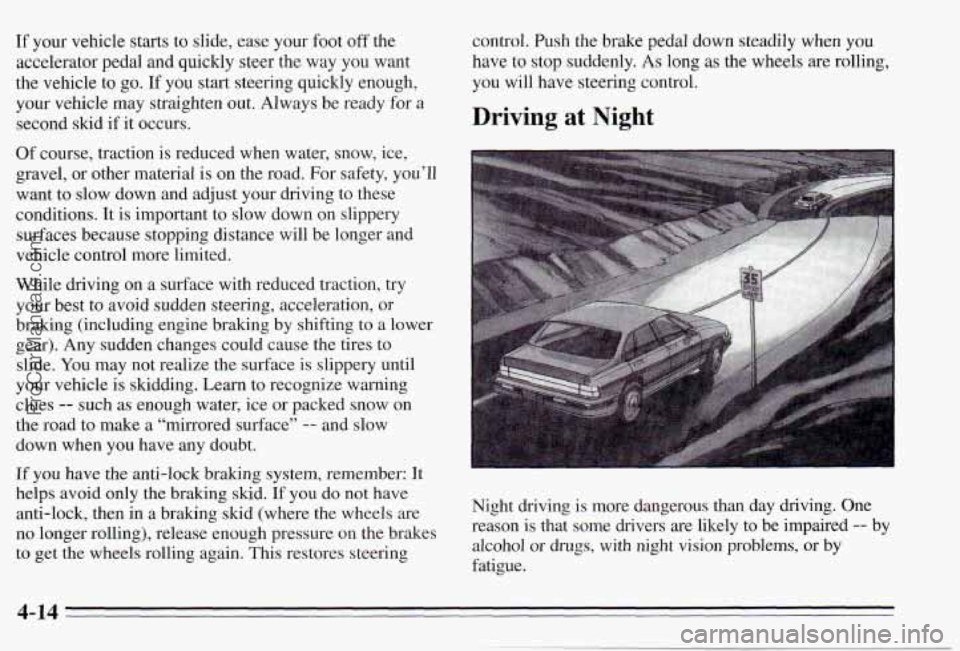
Driving at Night
Of course, traction is reduced when water, snow, ice,
gravel, or other material
is on the road. For safety, you’ll
want to slow down and adjust your driving to these
conditions. It is important
to slow down on slippery
surfaces because stopping distance will be longer and
vehicle control more limited.
While driving on a surface with reduced traction, try your best
to avoid sudden steering, acceleration, or
braking (including engine braking by shifting to
a lower
gear). Any sudden changes could cause the tires to
slide. You may not realize the surface is slippery until
your vehicle
is skidding. Learn to recognize warning
clues
-- such as enough water, ice or packed snow on
the road to
make a “mirrored surface” -- and slow
down when you have any doubt.
Lf you have the anti-lock braking system, remember: It
helps avoid only the braking skid. If you do not have
anti-lock, then in a braking
skid (where the wheels are
no longer rolling), release enough pressure on the brakes
to get the wheels rolling again. This restores steering Night driving is more dangerous than day driving. One
reason is that some drivers
are likely to be impaired -- by
alcohol or drugs, with night vision problems, or by
fatigue.
4-14
ProCarManuals.com
Page 163 of 354
Once you are moving on the freeway, make certain you
allow
a reasonable following distance, Expect to move
slightly slower at
night.
When you want to leave the freeway, move to the proper
lane well in advance.
If you miss your exit do not, under
any circumstances, stop and back up. Drive on to the
next exit.
The exit ramp can be curved, sometimes quite sharply.
The exit speed is usually posted.
Reduce
your speed according to your speedometer, not
to your sense of motion. After driving
for any distance
at higher speeds, you may tend to think you are going
slower than you actually are.
Before Leaving on a Long Trip
Make sure you’re ready. Try to be well rested. If you
must start when you’re not fresh
-- such as after a day’s
work
-- don’t plan to make too many miles that first part
of the journey. Wear comfortable clothing and shoes you
can easily drive in.
Is your vehicle ready for a long trip? If you keep it
serviced and maintained, it’s ready to go. If it needs
service,
have it done before starting out. Of course,
you’ll find experienced and able service experts in
Pontiac dealers
all across North America. They’ll..be
ready and willing
to help if you need it.
Here are some things you can check before a trip:
e
0
0
0
0
e
0
Windshield Washer Fluid: Is the reservoir full? Are
all windows clean inside and outside?
Wiper Blades: Are they in good shape?
Fuel, Engine Oil, Other Fluids: Have you checked
all levels?
Lamps: Are they all working? Are the lenses clean?
Tires: They are vitally important to a safe,
trouble-free trip.
Is the tread good enough for
long-distance driving? Are the tires all inflated to the
recommended pressure?
Weather Forecasts: What’s the weather outlook
along your route? Should you delay your
trip a short
time to avoid a major storm system?
Maps: Do you have up-to-date maps?
4-20
ProCarManuals.com