tire size PONTIAC PONTIAC 1995 Owners Manual
[x] Cancel search | Manufacturer: PONTIAC, Model Year: 1995, Model line: PONTIAC, Model: PONTIAC PONTIAC 1995Pages: 354, PDF Size: 17.27 MB
Page 170 of 354
Then, shut the engine off and close the window almost
all the
way to preserve the heat, Start the engine again
and repeat this only when
you feel really uncomfortable
from the cold. But do
it as little as possible. Preserve the
he1 as long as you can. To help keep warm, you can get
out
of the vehicle and do sume fairly vigorous exercises
every half hour
or so until help comes.
Loading Your Vehicle
/bI OCCUPANTS
VEHICLE CAP. WT.
TIRE-LOADING INFORMATION
FRT.
CTR. RR. TOTAL LBS. KG
MAX. LOADING & GVWR SAME AS VEHICLE I
CAPACITY WEIGHT XXX COLD TIRE
TIRE
SIZE SPEED PRESSURE
RTG PSI/KPa
FRT.
RR.
SPA.
IF TIRES ARE HOT, ADD 4PS1/28KPa
SEE OWNER’S MANUAL
FOR ADDITIONAL
INFORMATiON
/
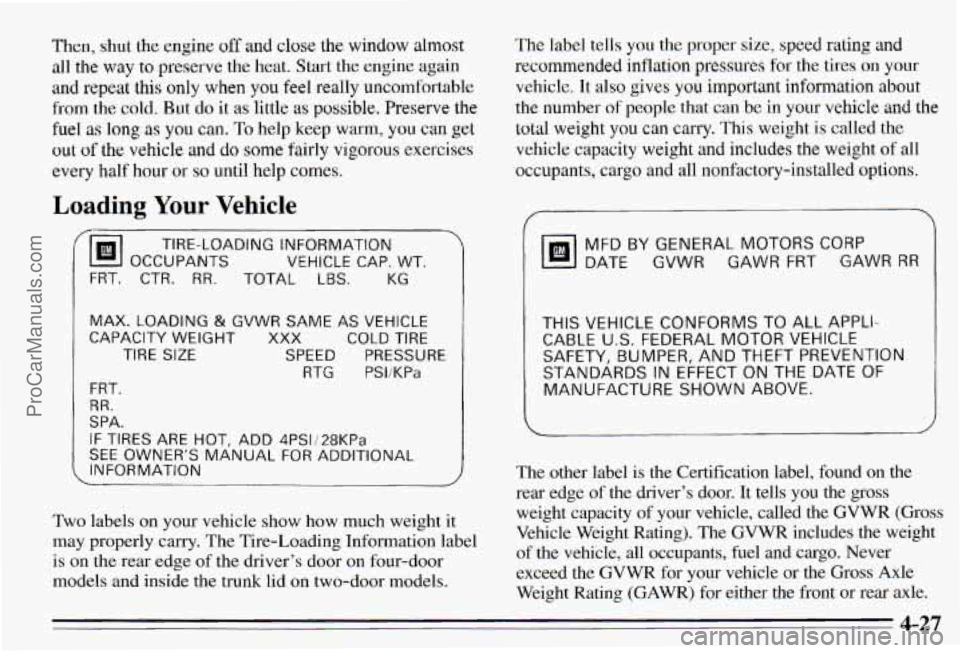
Two labels on your vehicle show how much weight it
may properly carry. The Tire-Loading Information label
is on
the rear edge of the driver’s door on four-door
models and inside the trunk lid on two-door models. The label tells you the proper
size, speed rating and
recommended inflation pressures
for the tires on your
vehicle.
It also gives you important information about
the number of people that can be in your vehicle and the
total weight
you can carry. This weight is called the
vehicle capacity weight and includes the weight
of all
occupants, cargo and all nonfactory-installed options.
MFD BY GENERAL MOTORS CORP
DATE GVWR GAWR FRT GAWR RR
THIS VEHICLE CONFORMS TO ALL APPLI-
CABLE
U.S. FEDERAL MOTOR VEHICLE
SAFETY, BUMPER, AND THEFT PREVENTION
STANDARDS IN EFFECT ON
THE DATE OF
MANUFACTURE SHOWN ABOVE.
The other label is the Certification label, found on the
rear edge of the driver’s door. It tells you the
gross
weight capacity of your vehicle, called the GVWR (Gross
Vehicle Weight Rating). The GVWR includes the weight of
the vehicle, all occupants, fuel and cargo. Never
exceed the GVWR for your vehicle or the Gross
Axle
Weight Rating (GAWR) for either the front or rear axle.
4-27
ProCarManuals.com
Page 209 of 354
Don’t try to put the wheel cover on your compact spare
tire. It won‘t fit. Store the wheel cover in the trunk until
you have the flat tire repaired or replaced.
I NOTICE:
Wheel covers won’t fit on your compact spare. If
you try to put a wheel cover on your compact
spare, you could damage the cover or the spare.
After you’ve put the compact spare tire on your vehicle,
you’ll need
to store the flat tire in your trunk. Use the
following procedure to secure the flat tire in the trunk.
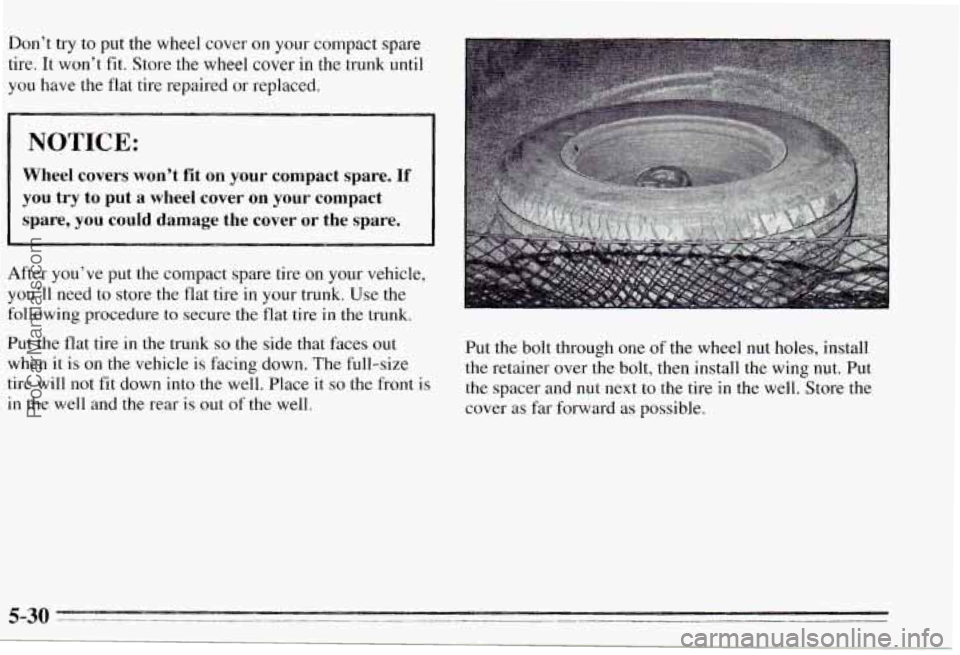
Put the flat tire in the trunk
so the side that faces out
Put the bolt through one of the wheel nut holes, install
when it
is on the vehicle is facing down. The full-size
the retainer over the bolt, then install the wing nut. Put
tire will not
fit down into the well. Place it SO the front is the spacer and nut next to the tire in the well. Store the
in the well and the rear is out of the well.
cover as far forward as possible.
ProCarManuals.com
Page 210 of 354

The compact spare is for temporary use only. Replace
the compact spare tire with a full-size tire as
soon as you
can. See “Compact Spare Tire” in the Index. See the
storage instructions label to replace your compact spare
into your trunk properly.
1. Nut
2. Cover
3. Wing Nut
4. Spacer
5. Tire
6. Wrench
7. Nut
8. Retainer
9. Jack
1.0. Bolt
5-31
ProCarManuals.com
Page 211 of 354

Compact Spare Tire
Although the compact spare was fully inflated when
your vehicle was new, it can lose air after a time. Check
the inflation pressure regularly. It should be
60 psi
(420 kPa). After installing the compact spare on your
vehicle,
you should stop as soon as possible and make
sure your spare tire is correctly inflated. The compact
spare is made to perform well at posted speed limits for
distances up to
3,000 miles (5-000 km), so you can
finish your trip and have your full-size tire repaired
or
replaced where you want. Of course, it’s best to replace
your spare with a full-size tire as soon as you can.
Your
spare will last longer and be in good shape in case you
need it again.
NOTICE:
Don’t take your compact spare through an
automatic car wash with guide rails. The
compact spare can get caught on the rails. That
can damage the tire and wheel, and maybe other
parts
of your vehicle.
Don’t use your compact spare on some other vehicle.
And don’t mix your compact spare
or wh.ee1 with other
wheels or tires. They won’t fit. Keep your spare and its
wheel together.
NOTICE:
Tire chains won’t fit your compact spare. Using
them will damage your vehicle and destroy the
chains too. Don’t use tire chains on your compact
spare.
5-32
ProCarManuals.com
Page 262 of 354

When rotating your tires, always use the correct rotation
pattern shown here.
Don’t include the compact spare tire in
your tire rotation.
After the tires have been rotated, adjust the front
and
rear inflation pressures as shown on the Tire-Loading
Information label. Make
certain that all wheel nuts are
properly tightened. See “Wheel Nut Torque” in the
Index.
When It’s Time for New Tires
.. .
One way to tell when it’s
time for new tires
is to
check the treadwear
indicators, which will
appear when your tires have
only 1/16 inch (1.6 mm) or
less
of tread remaining.
You need a new tire if
You can see the indicators at three or more places
around the tire.
You can see cord or fabric showing through the tire’s
rubber.
The tread or sidewall is cracked, cut or snagged deep
enough to show cord or fabric.
The tire has a bump, bulge or split.
0 The tire has a puncture, cut, or other damage that
can’t be repaired well because of the size
or location
of the damage.
6-49 ProCarManuals.com
Page 263 of 354

Buying New Tires
To find out what kind and size of tires you need, look at
the Tire-Loading Information label.
The tires installed on your vehicle when it was new had
a Tire Performance Criteria Specification (TPC Spec)
number on each tire’s sidewall. When you get new tires,
get ones with that same
TPC Spec number. That way,
your vehicle will continue to have tires that are designed
to give proper endurance, handling, speed rating,
traction, ride and other things during normal service
on your vehicle.
If your tires have an all-season tread
design, the
TPC number will be followed by an “MS”
(for mud and snow).
If you ever replace your tires with those not having
a
TPC Spec number, make sure they are the same size,
load range, speed rating and construction type (bias,
bias-belted or radial) as your original tires.
Uniform Tire Quality Grading
The following information relates to the system
developed by the United States National Highway
Traffic Safety Administration which grades tires
by
treadwear, traction and temperature performance. (This applies only to vehicles sold in the United States.)
6-50 ProCarManuals.com
Page 267 of 354
!
i Tire Chains
NOTICE:
If your Pontiac has P215/60R16 or P225/60R16
size tires, don’t use tire chains; they can damage
your vehicle.
If you have other tires, use tire chains only where
legal and only when
you must. Use only SAE
Class “S” type chains that are the proper size for
your
tires. Install them on the front tires and
tighten them
as tightly as possible with the ends
securely fastened. Drive slowly and follow the
chain manufacturer’s instructions. If you can
hear the chains contacting your vehicle, stop and
retighten them. If the contact continues, slow
down until
it stops. Driving too fast or spinning
the wheels with chains on will damage your
vehicle.
Appearance Care
Remember, cleaning products can be haza )us, Some
are toxic. Others can burst into flame if you strike a
match or get them on a hot part of the vehicle. Some are
dangerous if you breathe their fumes
in a closed space.
When you use anything from a container to clean your
Pontiac, be sure to follow the manufacturer’s warnings
and instructions. And always open your doors or
windows when you’re cleaning the inside.
Never use these to clean your vehicle:
Gasoline
Benzene
Naphtha
0 Carbon Tetrachloride
0 Acetone
0 Paint Thinner
0 Turpentine
0 Lacquer Thinner
0 Nail Polish Remover
They can all be hazardous
-- some more than
others
-- and they can all damage your vehicle, too.
ProCarManuals.com