engine oil PONTIAC PONTIAC 1996 Owners Manual
[x] Cancel search | Manufacturer: PONTIAC, Model Year: 1996, Model line: PONTIAC, Model: PONTIAC PONTIAC 1996Pages: 370, PDF Size: 17.69 MB
Page 6 of 370
1
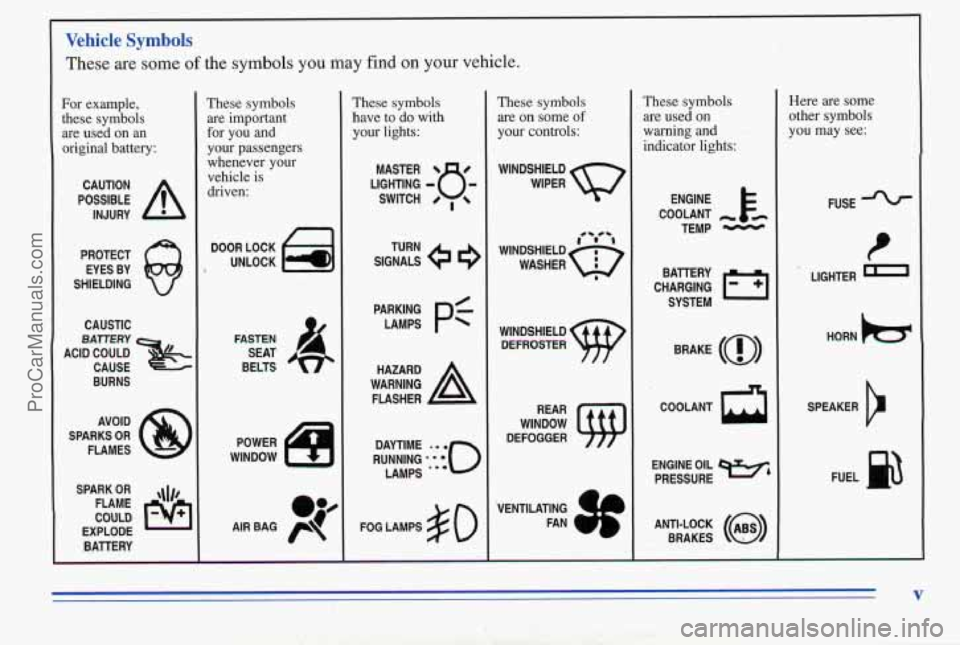
Vehicle Symbols
These are some of the symbols you may find on your vehicle.
For example,
these symbols are used on an
original battery:
POSSIBLE A
CAUTION
INJURY
PROTECT EYES BY
SHIELDING
CAUSTIC
ACIEEZ CAUSE
BURNS
AVOID
SPARKS
OR
FLAMES
SPARK
OR ,\I/,
COULD FLAME
EXPLODE BATTERY
These symbols
are important
for you and
your passengers
whenever your
vehicle is driven:
DOOR LOCK
UNLOCK
FASTEN SEAT
BELTS
POWER
WINDOW
c
These symbols
have to do with
your lights:
SIGNALS e 9
TURN
PARKING
PC
LAMPS
FOG LAMPS $0
These symbols
are
on some of
your controls:
WINDSHIELD
WIPER
'VENTILATING
FAN
These symbols
are used on
warning and
indicator lights:
COOLANT -
TEMP -
CHARGING 1-1
BATTERY
SYSTEM
BRAKE
(0)
COOLANT a
ENGINE OIL w,
PRESSURE
ANTI-LOCK
(@)
BRAKES
Here are some
other symbols
you may see:
FUSE
P
LIGHTER m
HORN )cr
SPEAKER
b
FUEL e3
V
ProCarManuals.com
Page 82 of 370
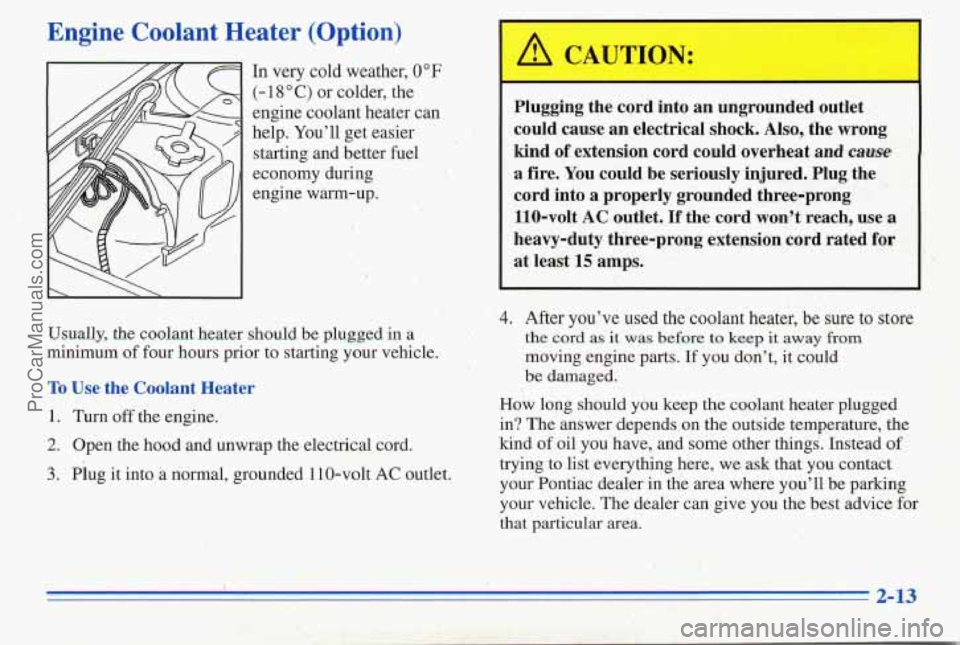
Engine Coolant Heater (Option)
In very cold weather, 0" F
(- 18 O C) or colder, the
engine coolant heater can
help. You'll get easier
starting and better fuel
economy during
engine warm-up.
A I
I A CAUTION: I
Plugging the cord into an ungrounded outlet
could cause an electrical shock. Also, the wrong
kind
of extension cord could overheat and cause
a fire. You could be seriously injured. Plug the
cord into a properly grounded three-prong 110-volt AC outlet.
If the cord won't reach, use a
heavy-duty three-prong extension cord rated for
I at least 15 amps.
4. After you've used the coolant heater, be sure to store
Usually, the coolant heater should be plugged in a the cord as it was before to keep it away from
minimum of four hours prior to starting your vehicle. moving engine parts. If you don't, it could
' - be damaged. To Use the- Coolant Heater
How long should you keep the coolant heater plugged
1. Turn off the engine.
in? The answer depends on the outside temperature, the
2. Open the hood and unwrap the electrical cord. kind of oil you have, and some other things. Instead of
.. - .. ' . ':. 1 :\'. . . .. .
~ ~
3. Plug it into a normal, grounded 110-volt AC outlet. trying to list
everything here, we ask that you contact
your Pontiac dealer in tlie area where you'll be parking
your vehicle. The dealer can give you-the best advice for
that particular area,
ProCarManuals.com
Page 123 of 370

Have you recently changed,brands of fuel?
If
so, be sure to fuel’ your vehicle with quality fuel (see
“Fuel” in the Index). Poor fuel quality will cause your
engine not to run as efficiently as designed.
You may
notice
this as stalling after start-up, stalling when you
put the vehicle into gear, misfiring, hesitation on
acceleration or stumbling on acceleration. (These
conditions may
go away once the engine is warmed up.)
This will be detected by the system and cause the light
to
turn on.
If you experience this condition, change the
fuel brand
you use. It will require at least one full tank of the
proper fuel to turn the light
off.
If none of the above steps have made the light turn off,
have your dealer or qualified service center check the
vehicle. Your dealer has the proper test equipment
and
diagnostic tools to fix any mechanical or electrical
problems that may have developed.
Oil Warnine Light
If you have a problem with
your oil, this light my stay
on after you start your
engine, or come on when
you are driving.
This indicates that oil is not going through your engine
quickly enough to keep
it lubricated. The engine could
be low on oil
or could have some other oil problem.
Have it fixed right away.
The oil light could also come
on in two other situations:
When the ignition is on but the engine is not running,
the light will come on as
a test to show you it is
working, but the light will go out when you turn the
ignition to START. If it doesn’t come on with the
ignition
on, you may have a problem with the fuse or
bulb. Have
it fixed right away,
2-54 5
ProCarManuals.com
Page 124 of 370

0 If you make a hard stop, the light may come on for a
moment. This is normal.
A CAUTION:
-
Don’t keep driving if the oil pressure is low. If
you do, your engine can become so hot that it
catches fire. You or others could be burned.
Check your
oil as soon as possible and have your
vehicle serviced.
I NOTICE: I
Damage to your engine from neglected oil
problems can be costly and
is not covered by
your warranty.
Low Oil Level Light
LOW OIL
LEVEL
Your engine is equipped
with an oil level monitoring
system. When the ignition
key is turned on, the LOW
‘OIL LEVEL light will
briefly flash. If the light
does not, flash, have it fixed
so it will be ready to warn
you if there’s a problem.
If the light stays on, stop the vehicle on a level surface
and turn the engine
off. Check the oil level using the
engine oil dipstick. (See “Engine Oil” in the Index.)
If the light does not flash, have the low oil level sensor
system repaired
so it will be ready to warn you if there’s
a problem.
,
The oil level monitoring system only checks oil level
during the brief period between key on and engine
crank. It does not monitor engine oil level when the “ .
engine is running. Additionally, an oil level check is
only performed if the engine has been turned off for a
considerable period of time, allowing the oil normally in
circulation to drain back into the
oil pan.
ProCarManuals.com
Page 127 of 370
EXT. TEMP: Shows the temperature outside your
vehicle. Temperature can be displayed in Fahrenheit or
Celsius. This mode can’t be reset.
TRIP: Shows how far you’ve driv’en since you last reset
this mode.
ELAPSED TIME: Shows how much time has passed
with the engine running since you last reset this mode.
Control Buttons
The trip calculator has three buttons that control
its functions.
MODE: Press this button to change the mode
being displayed.
EM: Press this button to change the display from
English to metric units or metric to English.
RESET: Press this button for one second to reset the
mode displayed.
If you push and hold RESET for more
than five seconds, all the modes will reset. You can’t
reset
INST ECON, RANGE or EXT. TEMP.
Head-Up Display (Option)
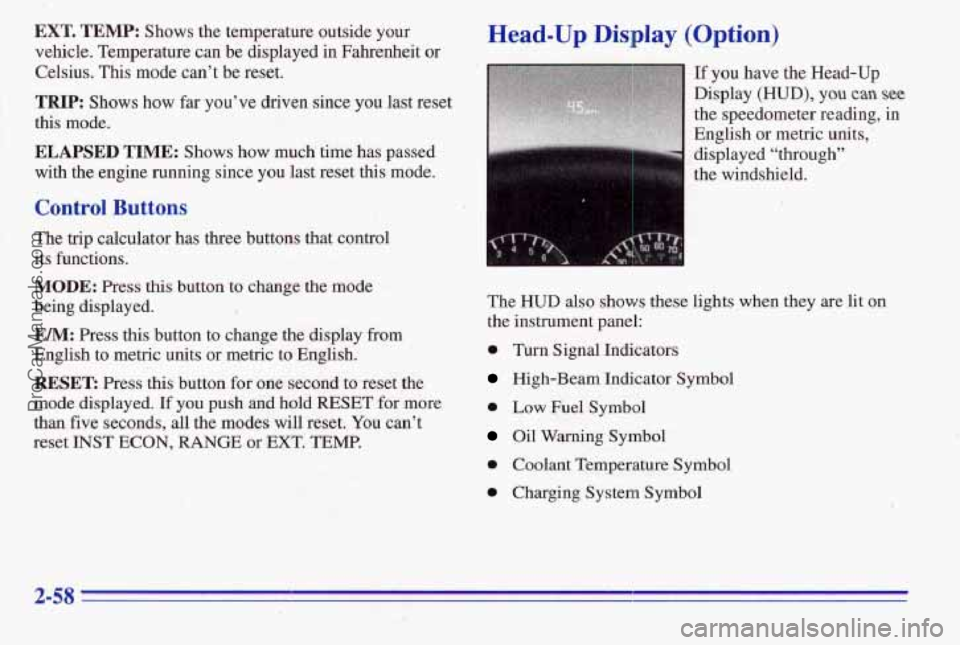
If you have the Head-Up
Display
(HUD), you can see
the speedometer reading, in
English or metric units,
’
displayed “through”
the windshield.
The
HUD also shows these lights when they are lit on
the instrument panel:
0 Turn Signal Indicators
High-Beam Indicator Symbol
0 Low Fuel Symbol
Oil Warning Symbol
0 Coolant Temperature Symbol
0 Charging System Symbol
ProCarManuals.com
Page 176 of 370
The exit speed is usually posted.
Reduce your speed according to your speedometer, not
to your sense of motion. After driving for any distance
at higher speeds, you may tend to think you are going
slower than you actually
are.
Before Leaving on a Long Trip
Make sure you're ready. Try to be well rested. If you
must
start when you're not fresh -- such as after a day's
work
-- .don't plan to make too many miles that first part
of the journey. Wear comfortable clothing and shoes you
can easily drive in.
Is your vehicle ready for a long trip? If you keep it
serviced and maintained, it's ready to go. If it needs
service, have it done before starting out. Of course,
you'll.find experienced and able service experts in
Pontiac dealerships all across
North America. They'll be
ready and willing to help if you need it. Here are some things
you can check before a trip:
0
0
0
a
a
0
a
Windshield Washer Fluid: Is the reservoir full? Are
all windows clean inside and outside?
Wiper Blades:
Are they'in good shape?
Fuel, Engine Oil, Other Fluids: Have you checked
all levels?
Lamps: Are they all working? Are the lenses clean?
Tires: They are vitally important to a safe,
trouble-free trip.
Is the tread good enough for
long-distance driving?
Are the tires all inflated to the
recommended pressure?
Weather Forecasts: What's the weather outlook
along your route? Should you delay your trip a
short
time to avoid a major storm system?
Maps:
Do you have up-to-date maps?
4-21
ProCarManuals.com
Page 192 of 370
Parking on Hills
You really should not park your vehicle, with a trailer
attached, on
a hill. If something goes wrong, your rig
could
start to move. People can be injured, and both
your vehicle and the trailer can be damaged.
But if you ever have to park your rig on a hill, here’s
how to do it:
1.
2.
3.
4.
5.
Apply your regular brakes, but don’t shift into
PARK (P) yet.
Have someone place chocks under
the trailer wheels.
When the wheel chocks are in place, release the
regular brakes until the chocks absorb the load.
Reapply the regular brakes. Then apply your parking
brake,
and then shift to PARK (P).
Release the regular brakes.
When You Are Ready to Leave After
Parking on a Hill
1. Apply your regular brakes and hold the pedal down
while you:
Start your engine;
Shift into a gear; and
Release the parking brake.
2. Let up on the brake pedal.
3. Drive slowly until the trailer is clear of the chocks.
4. Stop and have someone pick up and store the chocks.
Maintenance When Trailer Towing
Your vehicle will need service more oken when you’re
pulling a trailer. See the Maintenance Schedule for -more
on this. Things that are especially important in trailer
operation
are automatic transaxle fluid (don’t overfill),
engine oil, belt, cooling system and brake adjustment.
Each
of these is covered in this manual, and the Index
will help you find them quickly. If you’re trailering, it’s
a good idea to review these sections before you start
your trip.
Check periodically to see that all hitch nuts and bolts
are tight. ’
4-37
ProCarManuals.com
Page 208 of 370
An electric fan under the hood can start up even
when
the engine is not running and can injure
you. Keep hands, clothing and tools away from
any underhood electric fan.
If the coolant inside the coolant recovery tank is boiling,
don’t do anything else until
it cools down.
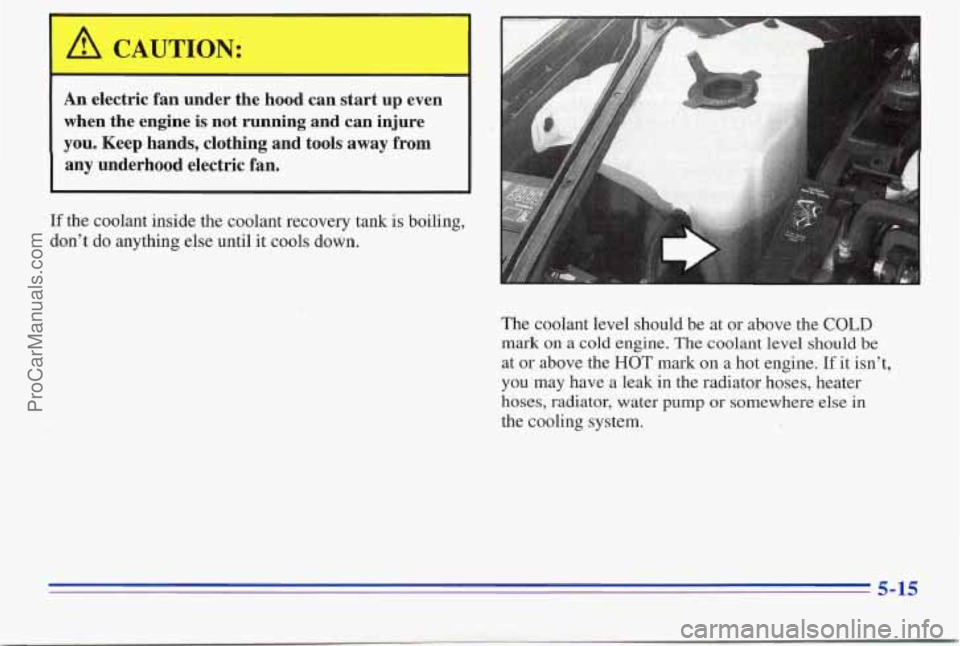
The coolant level should be
at or above the COLD
mark on a cold engine. The coolant level should be
at or above the HOT mark on a hot engine. If it isn’t,
you may have a leak
in the radiator hoses, heater
hoses, radiator, water pump or somewhere else in
the cooling system.
5-15
ProCarManuals.com
Page 209 of 370
A CAUTION:
I
Heater and radiator hoses, and other engine
parts,
can be very hot. Don’t touch them. If you
do, you can
be burned.
Don’t run the engine
if there is a leak. If you run
the engine,
it could lose all coolant. That could
cause
an engine fie, and you could be burned.
Get
any ‘leak fixed before you drive the, vehicle.
I NOTICE:
I
Engine damage from running your engine
without coolant isn’t covered by your warranty.
I
If there seems to be no leak, with the engine on, check to
see if the electric engine fan@) are running. If the engine
is overheating, both fan(s) should be running. If they
aren’t, your vehicle needs service.
How to Add Coolant to the Coolant
Recovery Tank
If you haven’t found a problem yet, but the coolant level
isn’t at the COLD mark, add a 50/50 mixture of ckm
water (preferably distilled) and DEX-COOL”
(orange-colored, silicate-free) antifreeze at the coolant
recovery
tank. (See “Engine Coolant” in the Index for
more information.)
Adding only plain water to your cooling system
can be
dangerous. Plain water, or some other
liquid Eke alcohol, can boil before the proper
coolant
mix will. Your vehicle’s coolant warning
system
is set for the proper coolant mix. With
plain water or the wrong mix, your engine could
get too hot but you wouldn’t get the overheat
warning.
Your engine ‘could catch fire and you or
others could be burned. Use a
50/50 mix Q€ clean
water and
DEX-COOL antifreeze.
5-16
,LC !
ProCarManuals.com
Page 233 of 370
When you put the cap back on, turn it to the right until
you hear at least three clicks. Make sure you €ully install
the cap. The diagnostic system can determine if the fuel
cap has been left off or improperly installed. This would
allow he1 to evaporate into the atmosphere. See
"Malfunction Indicator
Lamp" in the Index.
NOTICE:
I€ you need a new cap, be sue to get the right
type. Your dealer can get one for
you. If you get
the wrong type, it may not fit or have proper
venting, and
your fuel t&-@nd gmissions system
might be damaged. . ...._ ,. . 4.~*,-.:~7F4c:> i,,:;:r'.&:;.., I 5 .v,<. " 52;:. .' , "" $g7!fnt ,,
Checking Things Under the Hood
An electric fan under the hood can start up and
injure
YOU even when the engine is not running.
Keep hands, clothing and tools away from any
underhood electric fan.
Things
that burn can get on hot engine parts and
start a fire. These include liquids like gasoline,
oil, coolant, brake fluid, windshield washer and "
other fluids, and plastic or rubber. You or others
could
be burned. Be careful not to drop or spill
things
that will burn onto a hot engine.
~ ~~~
ProCarManuals.com