engine PONTIAC PONTIAC 1997 Owners Manual
[x] Cancel search | Manufacturer: PONTIAC, Model Year: 1997, Model line: PONTIAC, Model: PONTIAC PONTIAC 1997Pages: 419, PDF Size: 19.67 MB
Page 304 of 419
There are only two reasons wny the brake fluid level in the
reservoir might go down. The first is that the brake fluid
goes down to an acceptable level during normal brake
lining wear. When new linings are put in, the fluid level
goes back
up. The other reason is that fluid is leaking out
of the brake system. If it is, you should have your brake
system fixed, since a leak means that sooner or later your
brakes won’t work well, or won’t work at all.
So, it isn’t a good idea to “top off’ y’our brake fluid.
Adding brake fluid won’t correct a leak. If you add fluid
when your linings are worn, then you’ll have
too much
fluid when
you get new brake linings. You should add
(or remove) brake fluid, as necessary, only when work
is
done on the brake hydraulic system.
If you have too much brake fluid, it can spill
on the engine. The fluid will burn
if the engine
is hot enough. You or others could be burned,
and your vehicle could be damaged. Add brake
fluid only when work
is done on the brake
hydraulic system. When your brake
fluid falls
to a low level, your brake
warning light will come on. See “Brake System Warning
Light” in the Index.
What
to Add
When you do need brake fluid,
use only DOT-3
brake fluid -- such as Delco Supreme 11 @ (GM Part
No. 12377967). Use new brake fluid from a sealed
container only.
Always clean the brake fluid reservoir cap and
the area
around the cap before removing
it, This will help keep
dirt from entering the reservoir.
With the wrong kind
of fluid in your brake
system, your
brakes may not work well, or they
may not even work at all. This could cause
a
crash. Always use the proper brake fluid.
6-34
ProCarManuals.com
Page 305 of 419
NOTICE:
Using the wrong fluid can badly damage
brake system parts.
For example, just a few
drops of mineral-based oil, such as engine
oil, in your brake system can damage brake
system parts
so badly that they’ll have to be
replaced. Don’t let someone put in the
wrong kind of fluid.
If you.spil1 brake fluid on your vehicle’s
painted surfaces, the paint finish can be
damaged. Be careful not to spill brake fluid
on your vehicle.
If you do, wash it off
immediately. See “Appearance Care” in
the Index.
Brake Wear
Your Pontiac has four-wheel disc brakes.
Disc brake pads have built-in wear indicators that make a
high-pitched warning sound when the brake pads are
worn and new pads are needed. The sound may come and
go
or be heard all the time your vehicle is moving (except
when
you are pushing on the brake pedal firmly).
The brake wear warning sound means that soon
your brakes won’t work well. That could lead
to
an accident. When you hear the brake wear
warning sound, have your vehicle serviced.
NOTICE:
Continuing to drive with worn-out brake pads
could result in costly brake repair.
6-35
ProCarManuals.com
Page 335 of 419
Vehicle Identification Number (VIN)
I
ENGINEA7 f ASSEMBLY
CODE MODEL YEAR PLANT
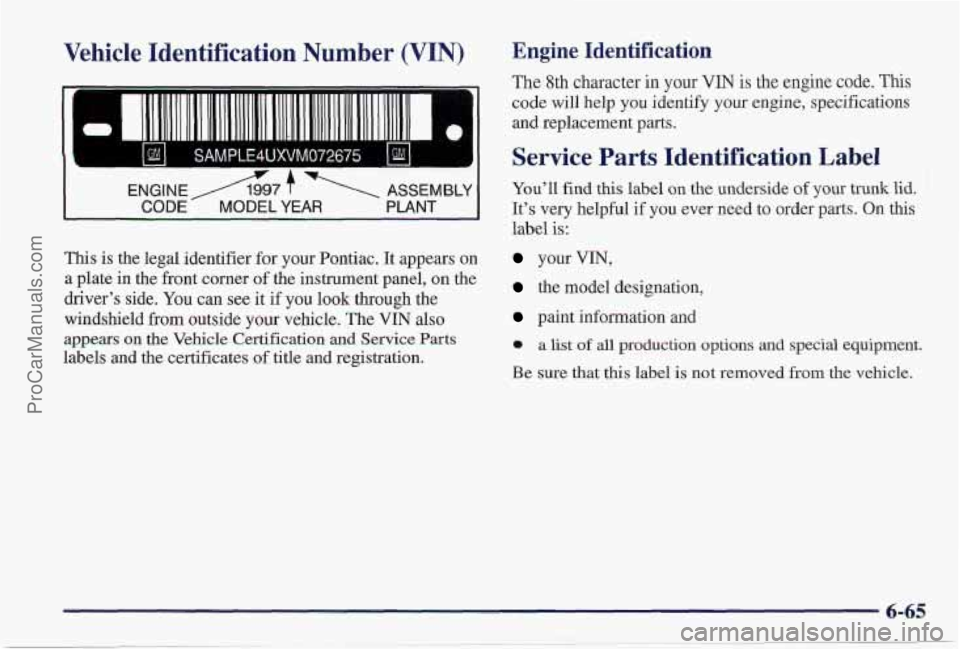
This is the legal identifier for your Pontiac. It appears on
a plate in the front corner
of the instrument panel, on the
driver’s side. You can see it if
you look through the
windshield
from outside your vehicle. The VIN also
appears on the Vehicle Certification and Service Parts
labels and the certificates of title and registration.
Engine Identification
The 8th character in your VIN is the engine code. This
code will help you identify your engine, specifications
and replacement parts.
Service Parts Identification Label
You’ll find this label on the underside of your trunk lid.
It’s very helpful if
you ever need to order parts. On this
label
is:
your VIN,
the model designation,
paint information and
0 a list of all production options and special equipment.
Be
sure that this label is not removed from the vehicle.
ProCarManuals.com
Page 339 of 419
Fuse
ECM
CRUISE
I/P-IGN SIR
TURN
ABS
BTSI
HVAC CTRL
DIC/HVAC
AB’S IGN
DRL
Description
ECM
Cruise Control ChimeMall Module, Cluster, Trip
Computer, Head-Up Display,
Brake-Transaxle Shift Interlock
Supplemental Inflatable Restraint
(Air
Bag)
Turn Signal
Anti-Lock Brakes
PRNDL, Brake-Transaxle Shift Interlock
Blower Control, HVAC
Rear Defog, HVAC, Driver
Information Center, Daytime
Running Lamps, Heated Seats
Anti-Lock Brakes Ignition
Daytime Running Lamps
Underhood Electrical Center
-- Passenger’s Side
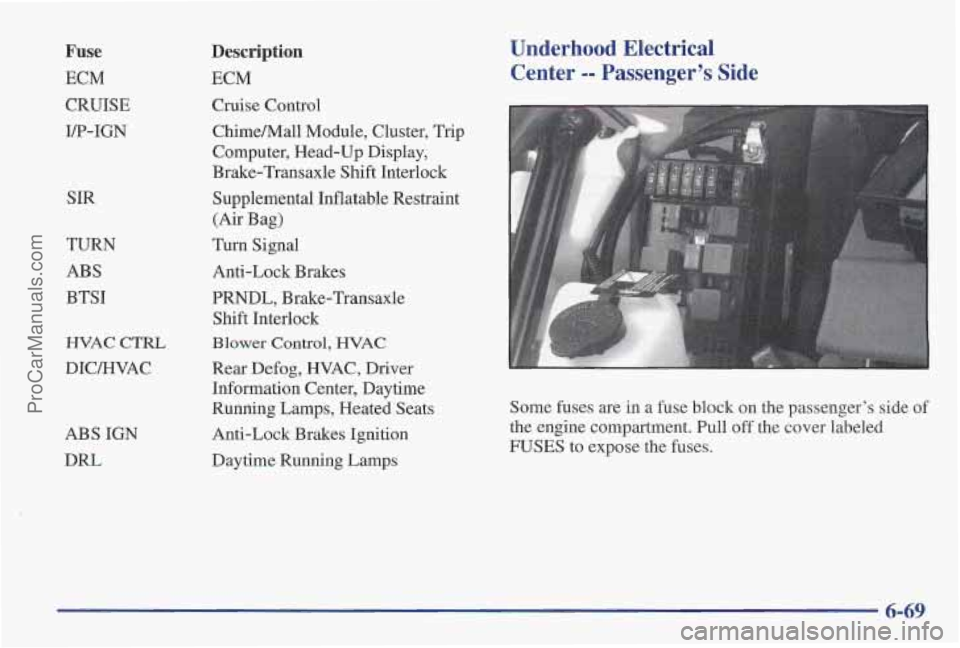
Some fuses are in a fuse block on the passenger’s side of
the engine compartment. Pull off the cover labeled
FUSES to expose the fuses.
6-69
ProCarManuals.com
Page 342 of 419

Replacement Bulbs
Exterior Lamps Bulb Number
Back-up ............................... 3 156
Center High-Mounted Stop
................ 1141
Front Parking/Turn Signal
.............. .3357NA
Headlamps ............................. 9007
Stop/Tail/Turn Signal ..................... 3057
Front/Rear Side Marker .................... 194
Capacities and Specifications
Please refer to “Recommended Fluids and Lubricants”
in the Index for more information.
Automatic Transaxle with Overdrive .
Pan Removal and Replacement ... 7.4 quarts (7.0 L)
After Complete Overhaul ......... 10 quarts (9.5 L)
When drainingheplucing converter or auxiliary coolel;
more fluid may be needed,
Cooling System Including Reservoir
3100 (Code M) .............. 11.0 quarts (10.42 L)
3800 (Code K) .............. 10.2 quarts (9.63 L)
3800 Supercharged (Code 1) ... 10.2 quarts (9.63 L)
Refrigerunt (R- 134a),
Air Conditioning” ............. 1.9 pounds (0.85 kg)
Engine Crankcase (Oil Change with Filter Change)
3 100 (Code M) ................ 4.5 quarts (4.3 L)
3800 (Code K) ................ 4.5 quarts (4.3 L)
3800 Supercharged (Code 1) ....... 5 quarts (4.7 L)
Fuel Tank ................. 18.0 gallons (68.0 L)
*See “Air Conditioning Refrigerants ’’ later in this section.
3100 (Code M) Engine Specifications
Type .................................... V6
Displacement ............... 191 CID (3.1L L82)
Firing Order ...................... 1-2-3-4-5-6
Thermostat Temperature
........... 195°F (91°C)
Horsepower
............................. 160
3800 (Code K) Engine Specifications
Type .................................... V4
Displacement ............... 231 CID (3.8L L36)
Firing Order ...................... 1-6-5-4-3-2
Thermostat Temperature
........... 195°F (91°C)
Horsepower ................ ......... 195
6-72
ProCarManuals.com
Page 343 of 419

3800 Supercharged (Code 1)
Engine Specifications
Type .................. ............. V6
Displacement
......... . . 231 CID (3.8LL67)
Firing Order ...................... 1-6-5-4-3-2
Thermostat Temperature 195°F (91OC)
Horsepower
............ . 240
Vehicle Dimensions
Wheelbase ...........
Tread Width
Front
...
Rear ........ ,..
Overall Length ......
Overall Width .....
Overall Height ........
, . 110.5” (280.7 cm)
....... 61.7” (156.8 cm)
..... 61.1” (155.2 cm)
. 196.5” (499.1 cm)
. . 72.7” (184.5 cm)
....... 54.7” (139.0 cm)
.......
Normal Maintenance Replacement Parts
Air Cleaner Filter
Battery
All Engines ..... ... A1208C
3100 (Code M) ................. 600 CCA
3800 (Code K) ...................... 690 CCA
3800 Supercharged (Code 1) ........... 770 CCA
Engine Oil Filter
PCV Valve Radiator Cap
Spark
Plugs
All Engines ................... AC Type PF47
All Engines .... ... CV892C
All Engines
. . . . AC Type RC27
3100 (Code
M) ...
.......
..... AC Type 41-940
Gap:
0.060” (1.52 mm)
3800 (Code K) . . ..... AC Type 41-921
Gap: 0.060” (1.52
mm)
3800 Supercharged (Code 1) ..... AC Type 41-921
Gap:
0.060” (1.52 mm)
Type ..................... ........ Hook
Length ...................... 20” (50.8 cm)
Wiper Blades
Air Conditioning Refrigerants
Not all air conditioning refrigerants are the same. If
the air conditioning system in your vehicle needs
refrigerant, be sure the proper refrigerant
is used. If
you’re not sure, ask your Pontiac dealer.
ProCarManuals.com
Page 346 of 419
IMPORTANT-
KEEP ENGINE OIL
AT THE PROPER
LEVEL AND CHANGE AS
RECOMMENDED
I
Have you purchased the GM Protection Plan? The Plan
supplements
your rtew vehicle warranties. See your
Warranty and OwPzer Assistance booklet, or your
Pontiac dealer for details.
Introduction
Your Vehicle and the Environment
Proper vehicle maintenance not only helps to keep your
vehicle in go'od working condition, but also helps the
environment. All recommended maintenance procedures
are important. Improper vehicle maintenance can even
affect the quality
of the air we breathe. Improper fluid
levels
or the wrong tire inflation can increase the level
of emissions from your vehicle. To help protect our
environment, and to keep your vehicle
in good
condition, please maintain your vehicle properly.
7-2
ProCarManuals.com
Page 349 of 419
Maintenance Schedule
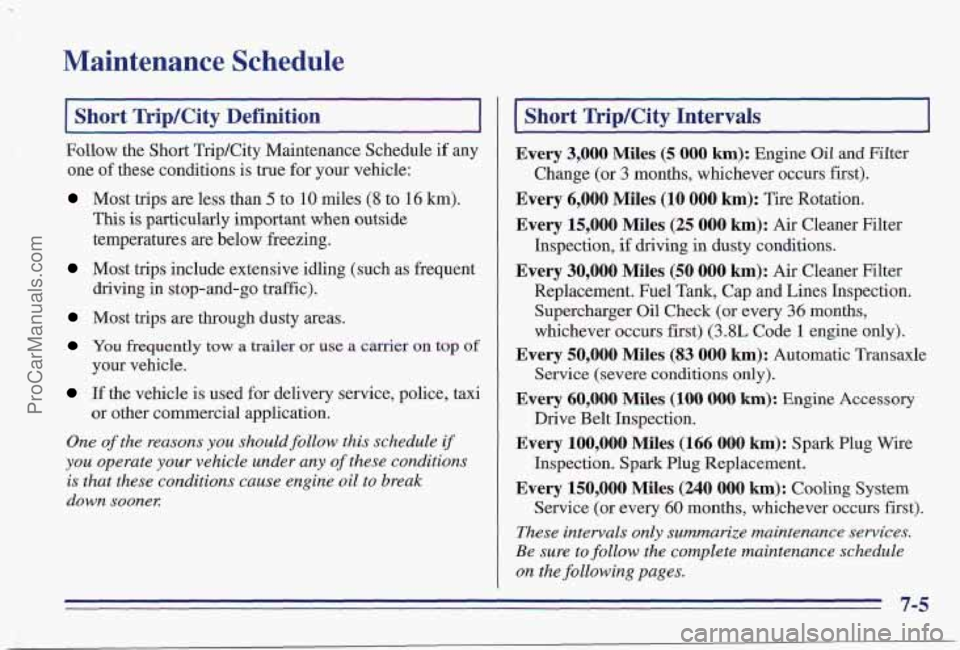
I Short TripKity Definition I ~____ ~~ ~~
Follow the Short TripKity Maintenance Schedule if any
one of these conditions is true for your vehicle:
Most trips are less than 5 to 10 miles (8 to 16 km).
This is particularly important when outside
temperatures are below freezing.
Most trips include extensive idling (such as frequent
driving in stop-and-go traffic).
Most trips are through dusty areas.
You frequently tow a trailer or use a carrier on top of
If the vehicle is used for delivery service, police, taxi
your
vehicle.
or other commercial application.
One of the reasons you should follow this schedule if
you operate your vehicle under any of these conditions
is that these conditions cause engine oil to break
down soonex
Short Trip/City Intervals
Every 3,000 Miles (5 000 km): Engine Oil and Filter
Change (or
3 months, whichever occurs first).
Every 6,000 Miles (10 000 km): Tire Rotation.
Every 15,000 Miles (25 000 km): Air Cleaner Filter
Inspection,
if driving in dusty conditions.
Every 30,000 Miles (50 000 km): Air Cleaner Filter
Replacement. Fuel Tank, Cap and Lines Inspection.
Supercharger Oil Check (or every 36 months,
whichever occurs first) (3.8L Code
1 engine only).
Every 50,000 Miles (83 000 km): Automatic Transaxle
Service (severe conditions
only).
Every 60,000 Miles (100 000 km): Engine Accessory
Drive Belt Inspection.
Every 100,000 Miles (166 000 km): Spark Plug Wire
Inspection. Spark Plug Replacement.
Every 150,000 Miles (240 000 km): Cooling System
Service (or every
60 months, whichever occurs first).
These intervals only summarize maintenance services.
Be sure to follow the complete maintenance schedule
on the following pages.
7-5
ProCarManuals.com
Page 350 of 419
Maintenance Schedule
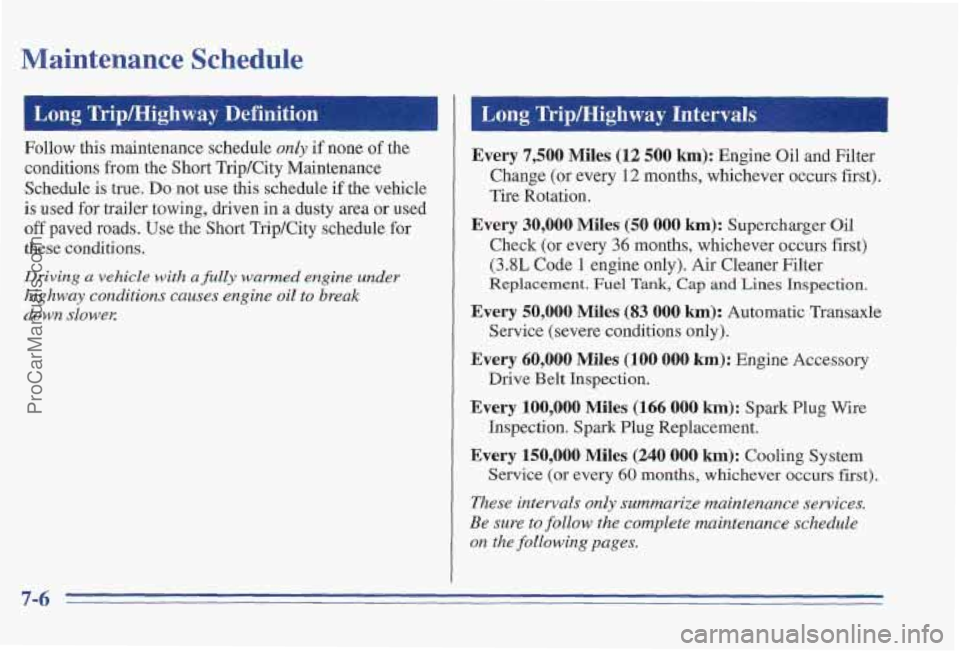
Follow this maintenance schedule only if none of the
conditions from the Short TripKity Maintenance
Schedule is true.
Do not use this schedule if the vehicle
is used for trailer towing, driven in a dusty area or used
off paved roads. Use the Short Trip/City schedule for
these
conditions.
Driving a vehicle with a filly warmed engine under
highway conditions causes engine oil to break
down slowel:
Every 7,500 Miles (12 500 km): Engine Oil and Filter
Change (or every
I2 months, whichever occurs first).
Tire Rotation.
Every 30,000 Miles (50 000 km): Supercharger Oil
Check (or every
36 months, whichever occurs first)
(3.8L Code 1 engine only). Air Cleaner Filter
Replacement. Fuel Tank, Cap and Lines Inspection.
Every 50,000 Miles (83 000 km): Automatic Transaxle
Service (severe conditions only).
Every 60,000 Miles (I00 000 km): Engine Accessory
Every 100,000 Miles (166 000 km): Spark Plug Wire
Drive Belt Inspection.
Inspection.
Spark Plug Replacement.
Every 150,000 Miles (240 000 km): Cooling System
These
intervals only summarize maintenance services.
Be sure to follow the complete maintenance schedule
on the fo Zlowing pages.
Service (or every 60 months, whichever occurs first).
7-6
ProCarManuals.com
Page 351 of 419
1 Short Trip/City Maintenance Schedule I
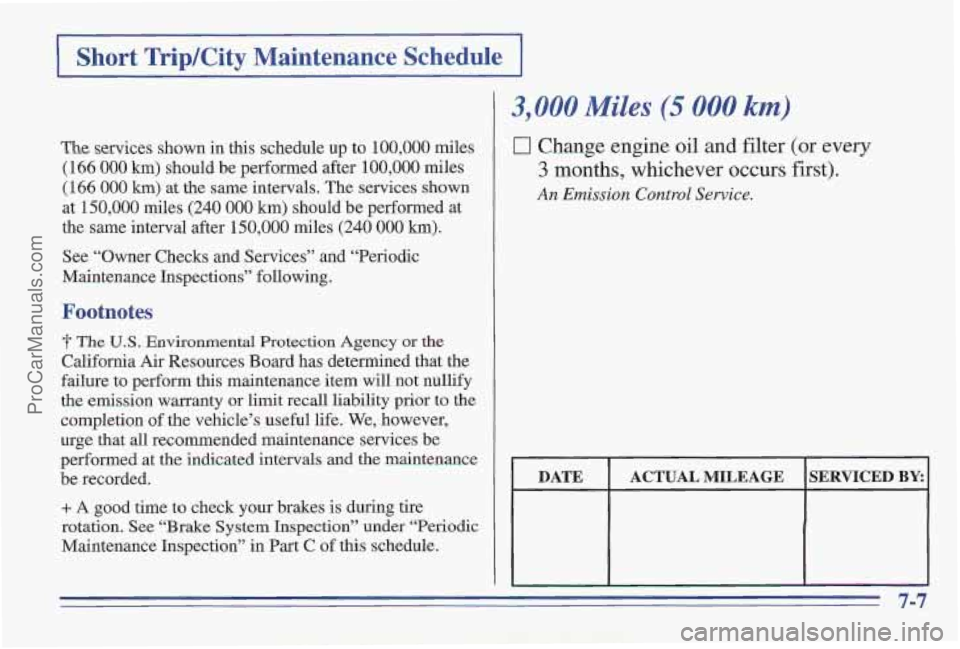
The services shown in this schedule up to 100,000 miles
(166 000 km) should be performed after 100,000 miles
(166 000 km) at the same intervals. The services shown
at
150,000 miles (240 000 km) should be performed at
the same interval after 150,000 miles
(240 000 km).
See “Owner Checks and Services” and “Periodic
Maintenance Inspections” following.
Footnotes
? The U.S. Environmental Protection Agency or the
California Air Resources Board has determined that the
failure to perform this maintenance item will not nullify
the emission warranty or limit recall liability prior
to the
completion of the vehicle’s useful life. We, however,
urge that all recommended maintenance services be
performed at the indicated intervals and the maintenance
be recorded.
+ A good time to check your brakes is during tire
rotation. See
“Brake System Inspection” under “Periodic
Maintenance Inspection” in Part
C of this schedule.
3,000 Miles (5 000 km)
0 Change engine oil and filter (or every
3 months, whichever occurs first).
An Emission Control Service.
DATE ACTUAL MILEAGE SERVICED BY:
7-7
ProCarManuals.com