ignition PONTIAC PONTIAC 1997 User Guide
[x] Cancel search | Manufacturer: PONTIAC, Model Year: 1997, Model line: PONTIAC, Model: PONTIAC PONTIAC 1997Pages: 419, PDF Size: 19.67 MB
Page 90 of 419
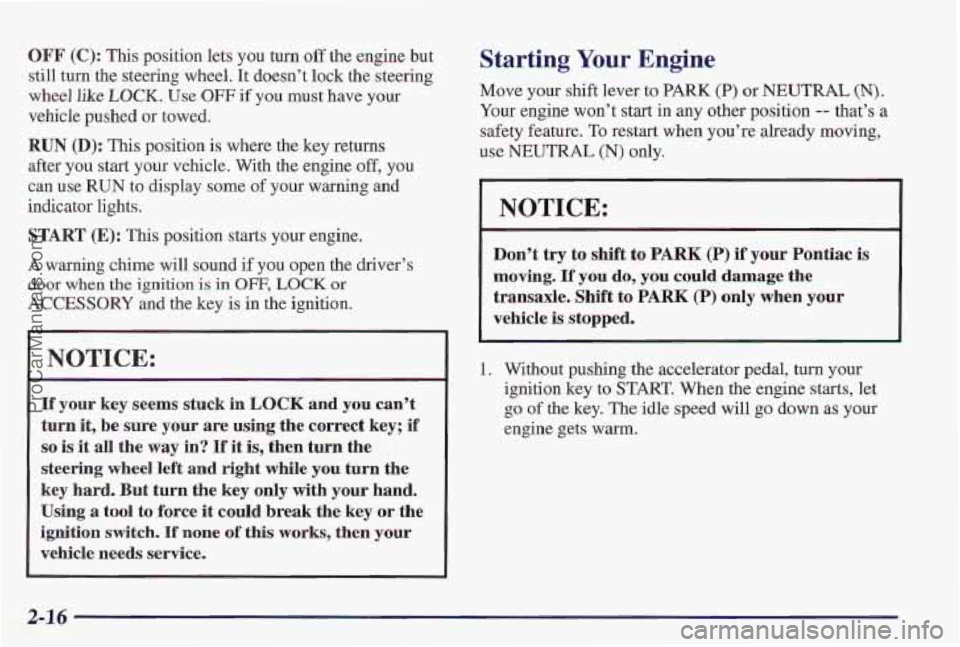
OFF (C): This position lets you turn off the engine but
still
turn the steering wheel. It doesn’t lock the steering
wheel like LOCK. Use OFF if you must have your
vehicle
pushed or towed.
RUN (D): This position is where the key returns
after
you start your vehicle. With the engine off, you
can use RUN to display some of your warning and
indicator lights.
START (E): This position starts your engine.
A warning chime will sound if you open the driver’s
door when the ignition is in OFF, LOCK or
ACCESSORY and the key is in the ignition,
~
NOTICE:
~~
If your key seems stuck in LOCK and you can’t
turn it, be sure your are using the correct key; if
so is it all the way in? If it is, then turn the
steering wheel left and right while yon turn the
key hard.
But turn the key only with your hand.
Using
a tool to force it could break the key or the
ignition
switch. If none of this works, then your
vehicle needs service.
Starting Your Engine
Move your shift lever to PARK (P) or NEUTRAL (N).
Your engine won’t start in any other position -- that’s a
safety feature. To restart when you’re already moving,
use NEUTRAL
(N) only.
NOTICE:
Don’t try to shift to PARK (P) if your Pontiac is
moving. If you do, you could, damage the
transaxle. Shift to
PARK (P) only when your
vehicle
is stopped.
1. Without pushing the accelerator pedal, turn your
ignition key to
START. When the engine starts, let
go of the key. The idle speed will go down as your
engine gets warm.
2-16
ProCarManuals.com
Page 94 of 419
Make sure the shift lever is fully into PARK (P) NEUTRAL (N): In this position, your engine
range before starting the engine.
Your Pontiac has a doesn’t connect with the wheels. To restart when you’re
brake-transaxle shift interlock.
You must fully apply already moving, use NEUTRAL (N) only. Also, use
your regular brakes before
you can shift from PARK (P) NEUTRAL (N) when your vehicle is being towed.
when the ignition is in
RUN. If you cannot shift out of
PARK (P), ease pressure on the shift lever by pushing
it all the way into PARK (P) while keeping the brake
pedal pushed down. Release the shift lever button
if you
have a console shift. Then move the shift lever out of
PARK (P), being sure to press the shift lever button
if you have a console shift. See “Shifting Out of
PARK (P)” in the Index.
REVERSE (R): Use this gear to back up.
Shifting out of PARK (P) or NEUTRAL (N) while
your engine is “racing” (running at high speed)
is
dangerous. Unless your foot is firmly on the
brake pedal, your vehicle could move very
rapidly.
You could lose ‘control and hit people
I 1 I or objects. Don’t shift out of PARK (P) or I
NOTICE: NEUTRAL (N) while your engine is racing.
~ -
I Shifting to REVERSE (R) while your vehicle is I
moving forward could damage your transaxle.
Shift
to REVERSE (R) only after your vehicle
is stopped. NOTICE:
I I I I Damage to your transaxle caused by shifting out
To rock your vehicle back and forth to get out of snow,
ice
or sand without damaging your transaxle, see racing isn’t covered by your warranty. I
of PARK (P) or NEUTRAL (N) with the engine
“Stuck: In Sand, Mud, Ice or Snow” in the Index,
~ ~~
2-20
ProCarManuals.com
Page 96 of 419
FIRST (1): This position gives you even more power,
but lower fuel economy than
SECOND (2). You can use
it on very steep hills, or in deep snow or mud. If the shift
lever
is put in FIRST (1)’ the transaxle won’t shift into
first gear until the vehicle is going slowly enough.
NOTICE:
~~~~~~ ~
If your front wheels can’t rotate, don’t try to
drive. This might happen if you were stuck in
very deep sand or mud or were up against a solid
object. You could damage your transaxle.
Also, if you stop when going uphill, don’t hold
your vehicle there with only the accelerator
pedal. This could overheat and damage the
transaxle. Use
your brakes or shift into PARK (P)
to hold your vehicle in position on a hill.
Shift Lock Release (Console Shift)
If your vehicle’s battery should go dead, there are two override
access slots that will allow you to override
park lock.
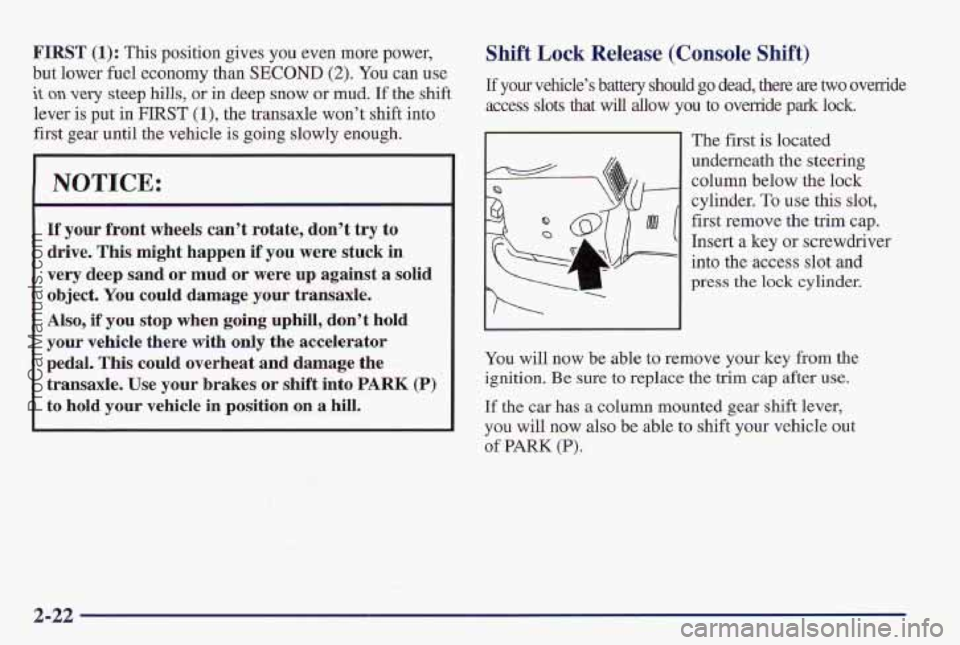
The first is located
underneath the steering
column below the lock
cylinder.
To use this slot,
first remove the trim
cap.
Insert a key or screwdriver
into the access slot and
press
the lock cylinder.
You will now be able to remove your key from the
ignition. Be sure
to replace the trim cap after use.
If the car has a column mounted gear shift lever,
you will now also
be able to shift your vehicle out
of PARK (P).
2-22
ProCarManuals.com
Page 100 of 419
Move the lever up as far as it will go.
3, Move the ignition key to LOCK.
4. Remove the key and take it with you. If you can
leave your vehicle with the ignition key in your
hand, your vehicle is in
PARK (P).
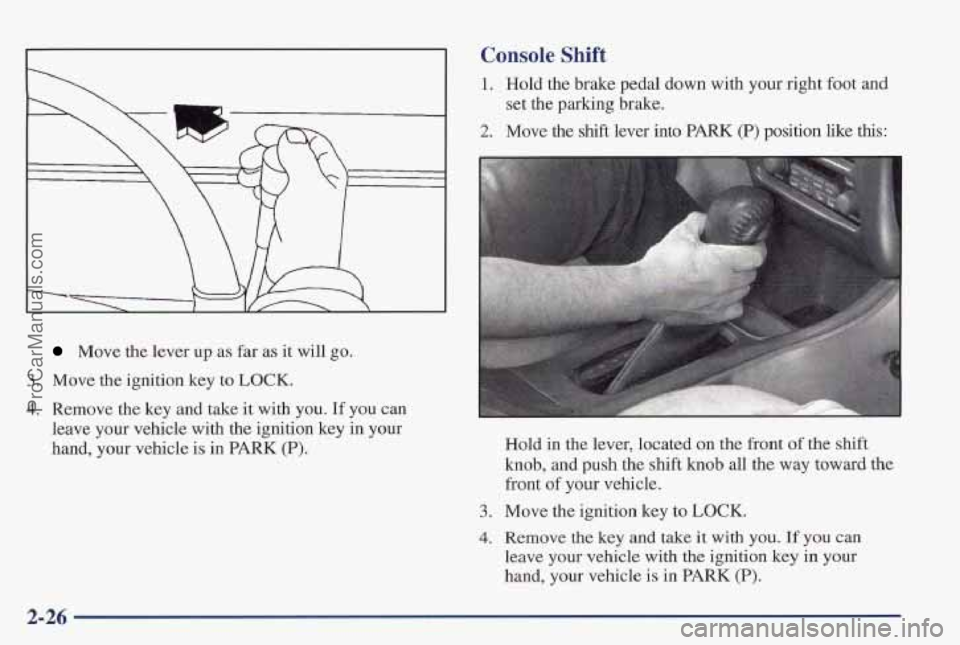
Console Shift
I. Hold the brake pedal down with your right foot and
2, Move the shift lever into PARK (P) position like this:
set the parking brake.
3.
4.
Hold in the lever, located on the front of the shift
knob, and push the shift knob all the way toward the
front of your vehicle.
Move the ignition key
to LOCK.
Remove the key and take it with you. If you can
leave your vehicle with the ignition key in your
hand, your vehicle is in PARK (P).
2-26
ProCarManuals.com
Page 102 of 419
Shifting Out of PARK (P)
Your Pontiac has a Brake-Transaxle Shift Interlock.
You must fully apply your regular brakes before
you can
shift from
PARK (P) when the ignition is in RUN. See
“Automatic Transaxle Operation” in the Index.
If
you cannot shift out of PARK (P), ease pressure on
the shift lever by pushing it all the way into PARK
(P)
while keeping the brake pedal pushed down. Release the
shift lever button if you have
a console shift. Then move
the shift lever out of PARK (P), being sure to press the
shift lever button if you have a console shift.
If you ever hold the brake pedal down but still can’t
shift out of PARK
(P) with column shift, try this:
1. Turn the key to OFF.
2. Apply and hold the brake until the end of Step 4.
3. Shift to NEUTRAL (N).
4. Start the engine and shift to the drive gear you want.
5. Have the vehicle fixed as soon as you can.
With Console Shift
see “Shift Lock Release” section.
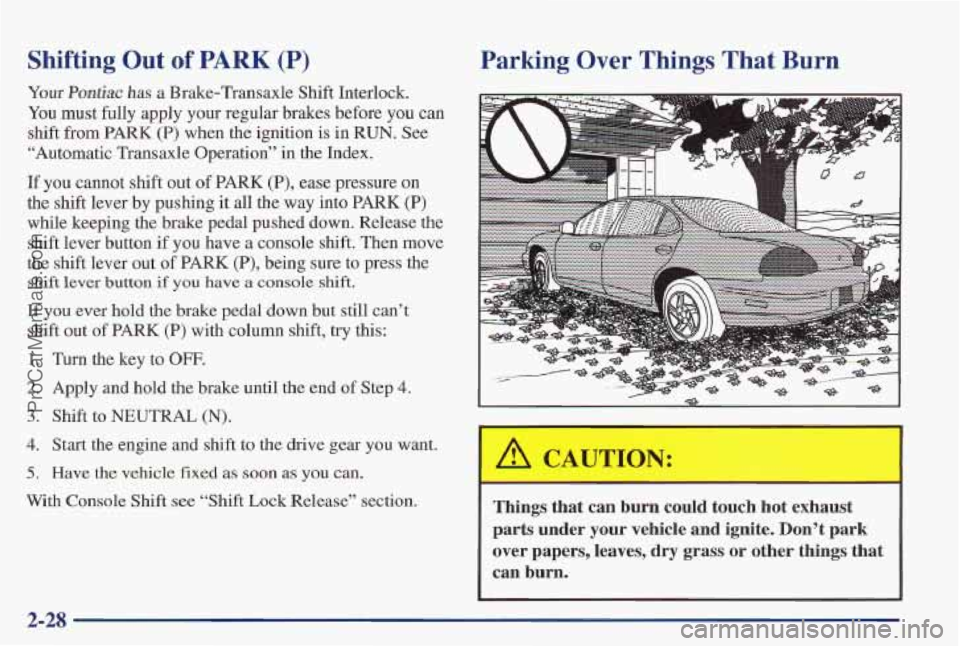
Parking Over Things That Burn
r
Things that can burn could touch hot exhaust
parts under your vehicle
and ignite. Don’t park
over papers, leaves, dry grass or other things that
can burn.
2-28
ProCarManuals.com
Page 104 of 419
It can be dangerous to get out of your vehicle if
the shift lever is not fully in PARK (P) with the
parking brake firmly set. Your vehicle can roll.
Don’t leave your vehicle when the engine is
running unless you have to.
If you’ve left the
engine running, the vehicle can move suddenly.
Yon or others could be injured. To be sure your
vehicle won’t move, even when you’re on fairly
level ground, always set your parking brake and
move the
shift lever to PARK (P).
Follow the proper steps to be sure your vehicle won’t
move.
See “Shifting Into PARK (P)” in the Index.
If you are parking on a hill and if you’re pulling a
trailer, also see “Towing a Trailer’’ in
the Index.
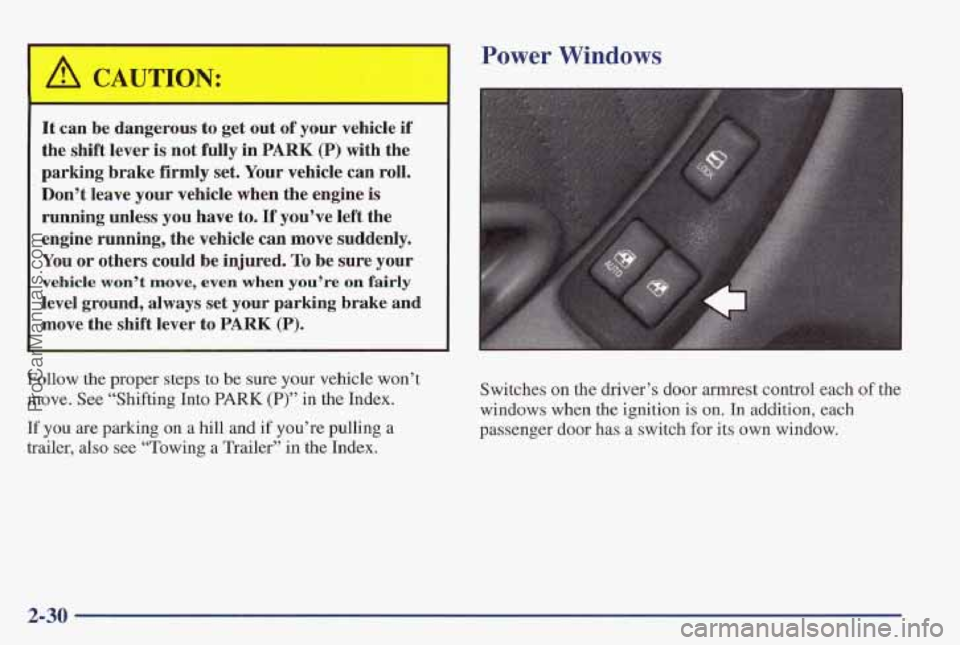
Power Windows
Switches on the driver’s door armrest control each of the
windows when the ignition is on. In addition, each
passenger door has
a switch for its own window.
2-30
ProCarManuals.com
Page 112 of 419

Passing Another Vehicle While Using Cruise Control
Use the accelerator pedal to increase your speed. When
you take your foot off the pedal,
your vehicle will slow
down to the cruise control speed
you set earlier.
Using Cruise Control on Hills
How well your cruise control will work on hills depends
upon your speed, load and the steepness of the hills.
When going up steep hills,
you may have to step on the
accelerator pedal to maintain
your speed. When going
downhill, you may have to brake or shift
to a lower gear
to keep your speed down.
Of course, applying the brake
takes you out of cruise control, Many drivers find this to
be too much trouble and don't use cruise control on
steep hills.
Ending Cruise Control
There are two ways to turn off the cruise control:
Step lightly on the brake pedal; OR
Move the cruise switch to OFF.
Erasing Cruise Speed Memory
When you turn off the cruise control or the ignition, or
shift into
PARK (P) or NEUTRAL (N), your cruise
control set speed memory is erased.
Lamps
The lamp controls are located on the lower, left side of
the instrument panel, to the left
of the steering wheel.
They control these systems:
Headlamps
@ Taillamps
Parking Lamps
License Lamps
0 Sidemarker Lamps
0 Instrument Panel Lights
0 Courtesy Lamps
0 Fo'g Lamps
2-38
ProCarManuals.com
Page 113 of 419
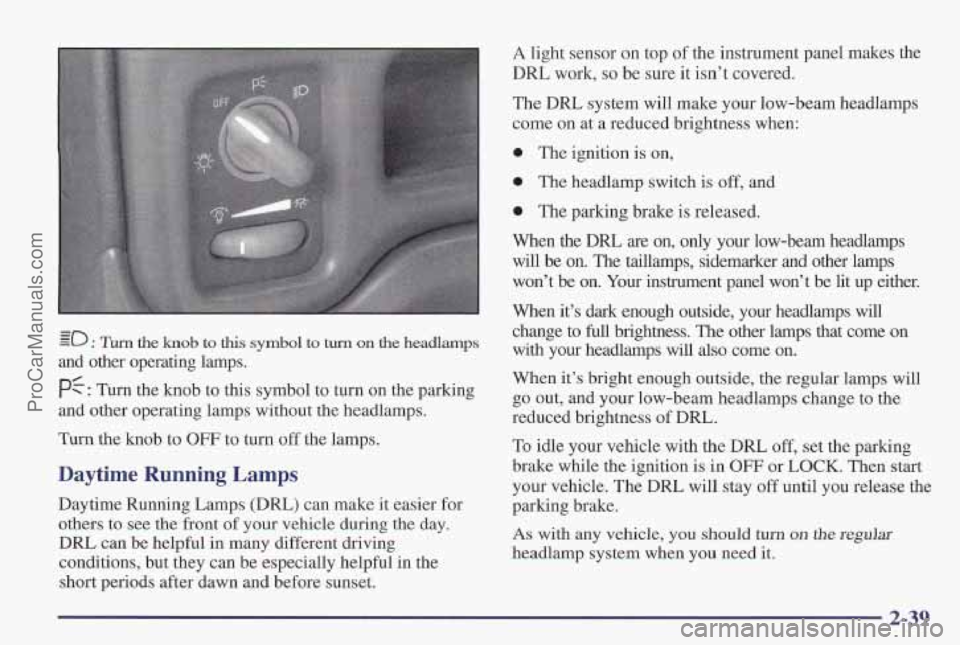
go : Turn the knob to this symbol to turn on the headlamps
and other operating lamps.
PG: Turn the knob to this symbol to turn on the parking
and other operating lamps without the headlamps.
Turn the knob to
OFF to turn off the lamps.
Daytime Running Lamps
Daytime Running Lamps (DRL) can make it easier for
others to see the front of your vehicle during the day.
DRL can be helpful in many different driving
conditions,
but they can be especially helpful in the
short periods after dawn and before sunset.
A light sensor on top of the instrument panel makes the
DRL work, so be sure it isn't covered.
The DRL system will make your low-beam headlamps
come on at a reduced brightness when:
0 The ignition is on,
0 The headlamp switch is off, and
0 The parking brake is released.
When the
DRL are on, only your low-beam headlamps
will be on. The taillamps, sidemarker and other lamps
won't be on. Your instrument panel won't be lit up either.
When it's dark enough outside, your headlamps will change to full brightness. The other lamps that come on
with your headlamps will also come on.
When it's bright enough outside, the regular lamps will
go out, and your low-beam headlamps change to the
reduced brightness of DRL.
To idle your vehicle with the DRL off, set the parking
brake while the ignition is in
OFF or LOCK. Then start
your vehicle. The DRL will stay
off until you release the
parking brake.
As with any vehicle, you should turn on the regular
headlamp system when you need it.
ProCarManuals.com
Page 115 of 419
Courtesy Lamps
When any door is opened, several lamps come on. These
lamps are courtesy lamps. They make
it easy for you to
enter and leave your vehicle at night. You can also turn
these lamps
on by turning the interior lamps dial all the
way to the right.
Illuminated Entry
The Illuminated Entry feature will illuminate the interior
so that you can see the inside of your vehicle before you
enter at night. The interior lamps will come on for
40
seconds when you unlock your doors using the key
chain transmitter (if equipped) and the ignition is in the
LOCK or
OFF position. After 40 seconds have elapsed,
the interior lamps will slowly fade out. The lamps will
fade out before
40 seconds have elapsed if you:
Lock all doors using your key chain transmitter.
Lock the doors using the power door lock switch.
When any door is opened, illuminated entry is canceled.
The interior lamps will stay on while any door is opened
and slowly fade out when all doors are closed. The
interior lamps may stay on for up to
25 seconds after
all
doors have been closed if they have not been locked.
See “Delayed Illumination” later in this section.
Delayed Illumination
The Delayed Illumination feature will continue to
illuminate the interior for
25 seconds after all the doors
have been closed so that you can find the ignition and
buckle your seat belt at night. Delayed Illumination will
not occur while the ignition is in RUN or ACCESSORY
position. After
25 seconds have elapsed, the interior
lamps will slowly fade out. The lamps will fade out
before the
25 seconds have elapsed if you:
0 Turn the ignition to the RUN or
Lock all doors using your key chain transmitter
Lock the doors using the power door lock switch.
To turn Delayed Illumination feature off or on. See
“Locks and Lighting Choices” in the Index.
ACCESSORY
position.
(if equipped).
2-41
ProCarManuals.com
Page 116 of 419
Exit Lighting Battery Saver
Your vehicle has a feature to help prevent you from
draining the battery
in case you accidentally leave the
interior, trunk or underhood lamps on.
If YOU leave any
of these lamps on while the ignition
is in LOCK or
OFF position, they will automatically turn off after
10 minutes. The lamps won’t come back on again until
you do one of the following:
So that you can see to exit the vehicle at wight, your
vehicle
is equipped with the Exit Lighting feature. The
interior lamps will illuminate for up to 25 seconds when
you remove your
key from the ignition. After 25 seconds
have elapsed, the interior lamps will slowly fade out. The
lamps will fade out before
the 25 seconds have elapsed
if you:
Turn the ignition to the RUN or
ACCESSORY position.
(if equipped).
Lock all doors using your key chain transmitter
0 Lock the doors using the power door lo’ck switch.
When any door is opened, Exit Lighting is canceled.
The
interior lamps will stay on while any ‘door is opened and
will slowly fade out when all the
doors are closed. The
interior lamps may stay on €or
up to 25 seconds after all
the doors have been closed if they have not been locked.
See“De1ayed Illumination” earlier in this section.
To turn the Exit Lighting feature
off or on, see “Locks
and Lighting Choices” in the Index.
Turn the ignition to the RUN or
ACCESSORY position;
Turn the interior lamp dial all the way to the right,
then back slightly to the left;
Open (or close and reopen) a door that is closed.
Note that if your vehicle has less than
15 miles (25 Pun)
on the odometer, the battery saver will turn off the lamps
after only three minutes.
Retained Accessory Power
With retained accessory power, your power windows,
audio system and sunroof will continue to
work up to
10 minutes after the ignition key is turned to the OFF
position and 4, of the doors are opened.
2-42
ProCarManuals.com