light PONTIAC PONTIAC 1997 User Guide
[x] Cancel search | Manufacturer: PONTIAC, Model Year: 1997, Model line: PONTIAC, Model: PONTIAC PONTIAC 1997Pages: 419, PDF Size: 19.67 MB
Page 80 of 419
Last Door Closed Locking
The Last Door Closed Locking makes it more
convenient €or you to use your power door lo’cks to lock
all doors when leaving your vehicle. When any door
is
open, the first time you attempt to lock the doors using
the power
door lock switch or key chain transmitter will
result in three chimes to signal that Last
Door Closed
Locking is being used. All doors can be opened for any
reason for five seconds from the time the last door has
been closed. Five seconds after the last door is closed,
all doors will lock. You can lock the doors immediately
by using the power door lock switch or the key chain
transmitter
to lock again.
The Last Door Closed
Locking feature will not
occur and d’oors will not
be locked as a result of this
feature when
the ignition switch is in the RUN or
ACCESSORY position. The Last Door Closed Locking
feature
is not enabled from the factory.
Automatic Door Locks
I
Unlocked doors can be dangerous.
Passengers -- especially children -- can easily
open the doors and fall out. When
a door is
locked, the inside handle won’t open
it.
Outsiders can easily enter through an unlocked
door when you slow down or stop your vehicle.
This
may not be so obvious: You increase the
chance
of being thrown out of the vehicle in a
crash
if the doors aren’t locked. Wear safety belts
properly, lock your doors, and you will
be far
better off whenever you drive your vehicle.
To turn the Last Door Closed Locking feature on or off,
see “Locks and Lighting Choices” in the Index. All of the
doors will lock automatically when you move
your shift lever
out of PARK (P). All doors will. unl’ock
automatically when the ignition
is turned off while the
shift lever
is in PARK (P). If you prefer to have your
doors unlocked automatically at any time, see “Locks
and Lighting Choices” in the Index.
2-6
ProCarManuals.com
Page 81 of 419
It can be dangerous to get out of your vehicle if
the shift lever is not fully in PARK (P) with the
parking brake firmly set. Your vehicle can roll.
Don’t leave your vehicle when the engine
is
running unless you have to. If you’ve left the
engine running, the vehicle can move suddenly.
You or others could be injured.
To be sure your
vehicle won’t move, even when you’re on fairly
level ground, always set your parking brake and
move the shift lever to PARK
(P).
If someone needs to get in or out of the vehicle after
the doors have been automatically locked, place the shift
lever into PARK (P). Unlock all doors by using the
power door lock switch or unlock just the door you want
by using the inside lever.
If you have programmed your
automatic door locks (see ”Locks and Lighting choices”
in the Index.) to unlock the doors when the shift lever
is shifted into
PARK (P), the doors will be automatically
unlocked for you. The doors will be automatically
locked when you move your shift lever out of
PARK (P)
with the ignition on. If
you don’t want the doors to unlock automatically
when you turn
the ignition off, see “Locks and Lighting
Choices” in
the Index.
Rear Door Security Locks (4-DoOr Models)
A
1
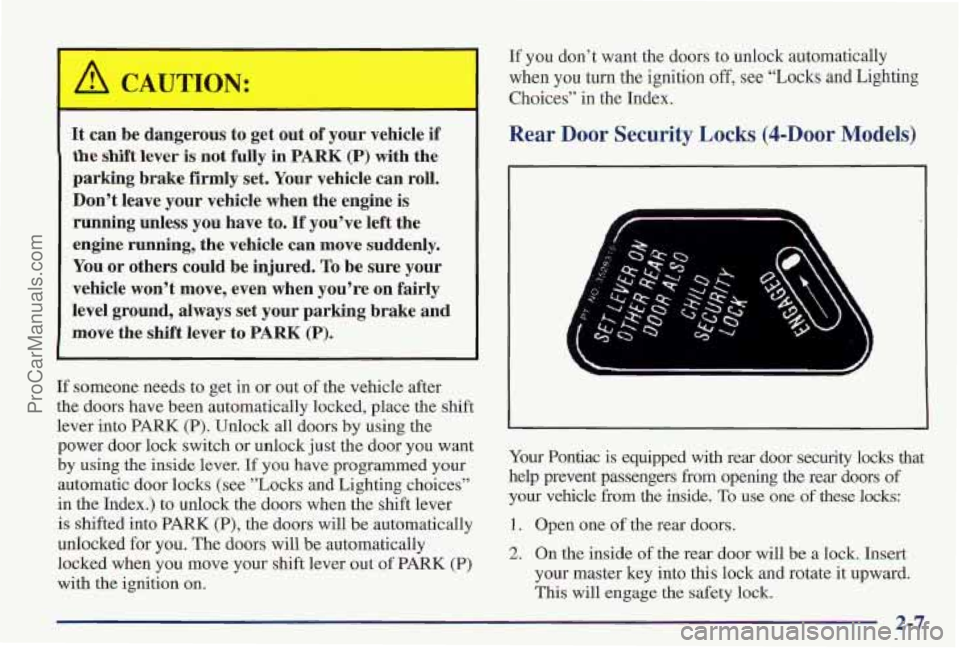
Your Pontiac is equipped with rear door security locks that
help prevent passengers
from opening the rear doors of
your vehicle from the inside.
To use one of these locks:
1. Open one of the rear doors.
2. On the inside of the rear door will be a lock. Insert
your master key into this lock and rotate it upward.
This will engage the safety lock.
2-7
ProCarManuals.com
Page 83 of 419

Operation
3-Button Key Fob 4-Button Key Fob
Remote All Door Lock
To lock all doors, press LOCK on the key chain
transmitter (see “Power Door Locks” in the Index
for more details
on power door lock features). If your
vehicle is equipped with the Content Theft-Deterrent system, the
LOCK button may arm the system
(see “Content Theft-Deterrent” in the Index for
more details).
Remote Driver’s Door and All Door Unlock
When you press UNLOCK on the key chain transmitter,
only the driver’s door will unlock.
If you press
UNLOCK again within five seconds, all the doors will
unlock.
If you would like all doors to unlock the first
time you press UNLOCK, see “Locks and Lighting
Choices” in the Index. If your vehicle
is equipped with
the Content Theft-Deterrent system, the UNLOCK
button on the key chain transmitter will disarm the
system (see “Content Theft-Deterrent” in the Index
for more details).
Remote Trunk Release
Press the trunk symbol on your key chain transmitter to
open your trunk. The transaxle must be in PARK (P) for
this feature to operate.
Remote Alarm (If Equipped)
When you press the horn button on the key chain
transmitter, your vehicle’s headlamps will flash and the
horn will sound. This will allow you to attract attention,
if needed.
Remote Lock/Unlock Confirmation (If Equipped)
This feature provides feedback to the holder of the key
chain transmitter that a command has been received by
2-9
ProCarManuals.com
Page 84 of 419
the Remote Lock Control receiver. To signal that a
command has been received, the headlamps will flash
and the horn will sound briefly.
To program the various
modes available, see “Locks and Lighting Choices” in
the Index.
Matching Transmitter(s) To Your Vehicle
Each key chain transmitter is coded to prevent another
transmitter
from unlocking your vehicle. If a transmitter
is lost or stolen, a replacement can ble purchased through
your dealer. Remember to bring any remaining
transmitters
with you when you go to your dealer. When
the dealer matches the replacement transmitter to your
vehicle, any remaining transmitters must also be matched.
Once your dealer has coded the new transmitter, the lost
transmitter will not unlock your vehicle. Each vehicle
can
have only four transmitters matched to it,
Battery Replacement
Under normal use, the battiry in your remote keyless
entry transmitter should last about two years.
You can tell
the battery is weak if the transmitter won’t
work at the
normal range in any location. If you have to
get close to your vehicle before
the transmitter works, it’s
probably time
to change the battery.
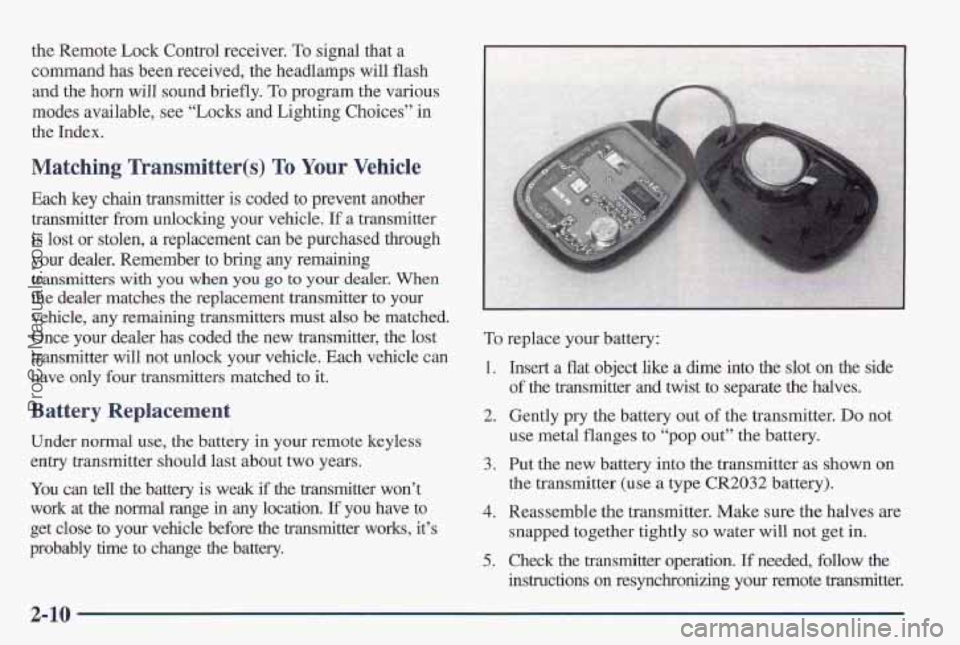
To replace your battery:
1.
2.
3.
4.
5,
Insert a flat object like a dime into the slot ‘on the side
of the trmsdtter md twist to separate the halves.
Gently
pry the battery out of the transmitter. Do not
use metal flanges to “pop out” the battery.
Put
the new battery into the transmitter as shown on
the transmitter
(use a type CR2032 battery).
Rleassemblle the transmitter. Make sure the halves are
snapped together tightly so water will not get in,
Check the transmitter operation. If needed, follow the
instructions on resynchronizing your remote transmi~r.
2-10
ProCarManuals.com
Page 87 of 419

Parking at Night
Park in a lighted spot, close all windows and lock your
vehicle. Remember to keep your valuables out of sight.
Put them in a storage area,
or take them with you.
Parking Lots
If you park in a lot where someone will be watching
your vehicle, it’s best to lock
it up and take your keys.
But what
if you have to leave your ignition key? What if
you have to leave something valuable in your vehicle?
Put your valuables in a storage area, like your trunk
or glove box.
0 Lock the glove box.
0 Lock all doors except the driver’s.
0 Give the valet key to the valet. Then take the master
key with you.
Content Theft-Deterrent (If Equipped)
If your Grand Prix has this option, it has a
theft-deterrent alarm system.
A red light located on top of your instrument panel (near
the center
of the vehicle, next to the windshield) will
flash slowly when the system is armed.
While armed, the doors will not unlock with the power
lock switch. The alarm will go
off if someone damages
the vehicle, tampers with the trunk lock, enters the
vehicle (without using the key chain transmitter or key
to unlock the doors), or turns
the ignition on. Your horn
will sound and your headlamps will flash
for up to two
minutes. The system will also cut
off the fuel supply,
preventing the vehicle
from being driven.
2-13
ProCarManuals.com
Page 88 of 419

Arming with the Power Lock Switch
Your alarm system will arm when you use either power
lock switch to lock the doors while any door is open and
the key is removed from the ignition (if you would like
to turn off the power door lock switch arming, see
“Locks and Lighting Choices”
in the Index). The
security light flashes quickly to let
you know when the
system is ready to arm with the power door switches.
The security light will
stop flashing and stay on, when
you press the rear
of the power lock switch, to let you
know the system is arming. After all doors are closed
and locked, the security light will begin flashing at a
very slow rate to let you know the system is armed.
Arming with the Key Chain Transmitter
Your alarm system will arm when you use your key chain
transmitter to lock the doors while the key is removed
from the ignition. The security light will turn on to let you
know the system is arming. After all doors are closed and locked, the security light will begin flashing
at a very slow
rate to let you know the system is armed.
Arming Confirmation
If remote unlock confirmation is on (see “Locks and Lighting
Choices” in the Index), your headlamps will flash briefly to
let you
know when your alarm system has armed.
Disarming with the Key. Chain Transmitter
Your alarm system will disarm when you use your key
chain transmitter to unlock the doors. The security light
will stop flashing
to let you know the system is disarmed.
Disarming with Your Key
Your alarm system will disarm when you use your key
to unlock the doors. The security light will stop flashing
to let
you know the system is disarmed. If you would
like your key to disarm the alarm system,
see “Locks
and Lighting Choices” in the Index.
Nuisance Alarms
If you experience nuisance alarms (alarms which are not
caused by
the opening of a door and are not desirable),
you may need to reduce the damage detection sensitivity.
Try programming your Content Theft-Deterrent to mode
1, see “Locks and Lighting Choices” in the Index. If you
continue
to experience nuisance alarms, you may want to
try turning off damage detection by programming your
Content Theft-Deterrent
to mode 2, see “Locks and
Lighting Choices”
in the Index.
If you are still having trouble with nuisance alarms, you
can turn off the Content Theft-Deterrent system by
programming your Content Theft-Deterrent to mode
3,
see “Locks and Lighting Choices” in the Index. See your
dealer
or a qualified technician for service.
2-14
ProCarManuals.com
Page 90 of 419
OFF (C): This position lets you turn off the engine but
still
turn the steering wheel. It doesn’t lock the steering
wheel like LOCK. Use OFF if you must have your
vehicle
pushed or towed.
RUN (D): This position is where the key returns
after
you start your vehicle. With the engine off, you
can use RUN to display some of your warning and
indicator lights.
START (E): This position starts your engine.
A warning chime will sound if you open the driver’s
door when the ignition is in OFF, LOCK or
ACCESSORY and the key is in the ignition,
~
NOTICE:
~~
If your key seems stuck in LOCK and you can’t
turn it, be sure your are using the correct key; if
so is it all the way in? If it is, then turn the
steering wheel left and right while yon turn the
key hard.
But turn the key only with your hand.
Using
a tool to force it could break the key or the
ignition
switch. If none of this works, then your
vehicle needs service.
Starting Your Engine
Move your shift lever to PARK (P) or NEUTRAL (N).
Your engine won’t start in any other position -- that’s a
safety feature. To restart when you’re already moving,
use NEUTRAL
(N) only.
NOTICE:
Don’t try to shift to PARK (P) if your Pontiac is
moving. If you do, you could, damage the
transaxle. Shift to
PARK (P) only when your
vehicle
is stopped.
1. Without pushing the accelerator pedal, turn your
ignition key to
START. When the engine starts, let
go of the key. The idle speed will go down as your
engine gets warm.
2-16
ProCarManuals.com
Page 107 of 419

If a bulb is burned out, replace it to help avoid an
accident.
If the arrows don’t go on at all when you
signal a turn, check for burned-out bulbs and then check
the fuse (see “Fuses and Circuit Breakers” in the Index).
A chme will sound if you leave your turn signal on for
more than
3/4 mile (1.2 km).
Headlamp HigWLow Beam
To change your headlamps
from low beam to high
beam, or high to low, pull
the multifunction lever all
the way toward you. Then
release it. When the high
beams are on, a light on the
instrument panel also will
be
on.
Flash-to-Pass
When your headlamps are off, pull the lever toward you
to momentarily switch on the high beams (to signal that
you are going to pass). When you release the lever they
will
turn off.
Windshield Wipers
You control the windshield wipers by turning the band
marked
WIPER. For a single wiping cycle, turn the band
to MIST. Hold it there until the wipers start, then let go.
The wipers will stop after one cycle. If you want more
cycles, hold the band on
MIST longer.
2-33
ProCarManuals.com
Page 108 of 419
For steady wiping at low speed, turn the band to LO. For
high-speed wiping, turn the band further, to
HI. To stop
the
wipers, turn the band to OFF.
You can set the wiper speed for a long or short delay
between wipes. This can be very useful in light rain or
snow. Turn the band
to choose the delay time. The
closer to
LO, the shorter the delay.
Be sure to clear ice and snow from the wiper blades
before using them.
If they’re frozen to the windshield,
carefully loosen
or thaw them. If your blades do become
damaged, get new blades
or blade inserts.
Heavy snow
or ice can overload your wipers. A circuit
breaker will stop them until the motor cools. Clear away
snow or ice to prevent an overload.
Windshield Washer
At the top of the multifunction lever, there’s a paddle
with the word
PUSH on it. To spray washer fluid on the
windshield, push the paddle. The wipers will run for
several sweeps and then either stop or return
to your
preset speed. See “Windshield Washer Fluid”
in
the Index.
In freezing weather, don’t use your washer until
the windshield is warmed. Otherwise the washer
fluid can form ice on the windshield, blocking
your vision.
2-34
ProCarManuals.com
Page 112 of 419

Passing Another Vehicle While Using Cruise Control
Use the accelerator pedal to increase your speed. When
you take your foot off the pedal,
your vehicle will slow
down to the cruise control speed
you set earlier.
Using Cruise Control on Hills
How well your cruise control will work on hills depends
upon your speed, load and the steepness of the hills.
When going up steep hills,
you may have to step on the
accelerator pedal to maintain
your speed. When going
downhill, you may have to brake or shift
to a lower gear
to keep your speed down.
Of course, applying the brake
takes you out of cruise control, Many drivers find this to
be too much trouble and don't use cruise control on
steep hills.
Ending Cruise Control
There are two ways to turn off the cruise control:
Step lightly on the brake pedal; OR
Move the cruise switch to OFF.
Erasing Cruise Speed Memory
When you turn off the cruise control or the ignition, or
shift into
PARK (P) or NEUTRAL (N), your cruise
control set speed memory is erased.
Lamps
The lamp controls are located on the lower, left side of
the instrument panel, to the left
of the steering wheel.
They control these systems:
Headlamps
@ Taillamps
Parking Lamps
License Lamps
0 Sidemarker Lamps
0 Instrument Panel Lights
0 Courtesy Lamps
0 Fo'g Lamps
2-38
ProCarManuals.com