page 5 16 PONTIAC SOLSTICE 2006 Owner's Manual
[x] Cancel search | Manufacturer: PONTIAC, Model Year: 2006, Model line: SOLSTICE, Model: PONTIAC SOLSTICE 2006Pages: 328, PDF Size: 1.92 MB
Page 65 of 328

This device complies with RSS-210 of Industry Canada.
Operation is subject to the following two conditions:
1. This device may not cause interference.
2. This device must accept any interference received,
including interference that may cause undesired
operation of the device.
Changes or modications to this system by other than
an authorized service facility could void authorization to
use this equipment.
PASS-Key
®III+ uses a radio frequency transponder in
the key that matches a decoder in your vehicle.
PASS-Key®III+ Operation
Your vehicle is equipped with PASS-Key®III+
(Personalized Automotive Security System)
theft-deterrent system. PASS-Key
®III+ is a passive
theft-deterrent system. This means you do not have to do
anything special to arm or disarm the system. It works
when you insert or remove the key from the ignition.
When the PASS-Key
®III+ system senses that someone
is using the wrong key, it prevents the vehicle from
starting. Anyone using a trial-and-error method to start
the vehicle will be discouraged because of the high
number of electrical key codes.When trying to start the vehicle if the engine does not
start and the security light on the instrument panel cluster
comes on, the key may have a damaged transponder.
Turn the ignition off and try again.
If the engine still does not start, and the key appears to be
not damaged, try another ignition key. At this time, you
may also want to check the fuse, seeFuses and Circuit
Breakers on page 5-78. If the engine still does not start
with the other key, your vehicle needs service. If your
vehicle does start, the rst key may be faulty. See your
dealer who can service the PASS-Key
®III+ to have a
new key made. In an emergency, contact Roadside
Assistance. SeeRoadside Assistance Program on
page 7-6.
It is possible for the PASS-Key
®III+ decoder to “learn”
the transponder value of a new or replacement key.
Up to 10 keys may be programmed for the vehicle. The
following procedure is for programming additional keys
only. If all the currently programmed keys are lost or do
not operate, you must see your dealer or a locksmith who
can service PASS-Key
®III+ to have keys made and
programmed to the system.
See your dealer or a locksmith who can service
PASS-Key
®III+ to get a new key blank that is cut
exactly as the ignition key that operates the system.
2-15
Page 71 of 328

Ensure the shift lever is fully in PARK (P) before starting
the engine. Your vehicle has an automatic transmission
shift lock control system. You must fully apply your
regular brakes before you can shift from PARK (P) when
the ignition key is in RUN. If you cannot shift out of
PARK (P), ease pressure on the shift lever. Push the shift
lever all the way into PARK (P) while pressing the button
on the shift lever as you maintain brake application. Then
move the shift lever into the gear you wish. SeeShifting
Out of Park (P) (Automatic Transmission) on page 2-26.
Notice:Shifting to REVERSE (R) while your vehicle
is moving forward could damage the transmission.
The repairs would not be covered by your warranty.
Shift to REVERSE (R) only after your vehicle is
stopped.
REVERSE (R):Use this gear to back up.
At low vehicle speeds, you can also use REVERSE (R) to
rock your vehicle back and forth to get out of snow, ice or
sand without damaging your transmission. SeeIf Your
Vehicle is Stuck in Sand, Mud, Ice or Snow on page 4-28
for additional information.NEUTRAL (N):In this position, the engine does not
connect with the wheels. To restart when you are
already moving, use NEUTRAL (N) only. You can also
use NEUTRAL (N) when your vehicle is being towed.
{CAUTION:
Shifting into a drive gear while your engine is
running at high speed is dangerous. Unless
your foot is rmly on the brake pedal, your
vehicle could move very rapidly. You could
lose control and hit people or objects. Do not
shift into a drive gear while your engine is
running at high speed.
Notice:Shifting out of PARK (P) or NEUTRAL (N)
with the engine running at high speed may damage
the transmission. The repairs would not be covered
by your warranty. Be sure the engine is not running
at high speed when shifting your vehicle.
2-21
Page 74 of 328
Parking Brake
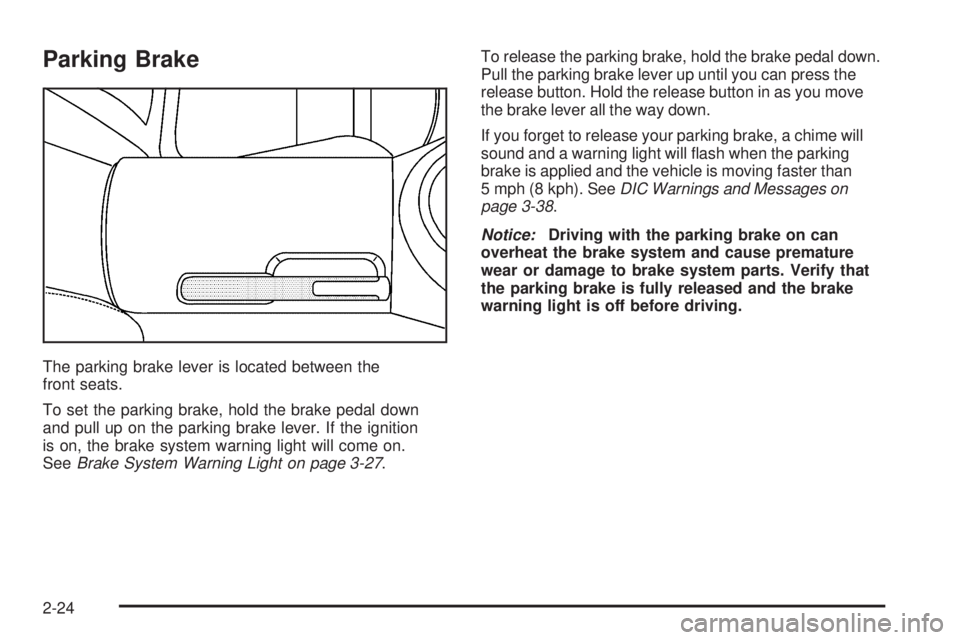
The parking brake lever is located between the
front seats.
To set the parking brake, hold the brake pedal down
and pull up on the parking brake lever. If the ignition
is on, the brake system warning light will come on.
SeeBrake System Warning Light on page 3-27.To release the parking brake, hold the brake pedal down.
Pull the parking brake lever up until you can press the
release button. Hold the release button in as you move
the brake lever all the way down.
If you forget to release your parking brake, a chime will
sound and a warning light will ash when the parking
brake is applied and the vehicle is moving faster than
5 mph (8 kph). SeeDIC Warnings and Messages on
page 3-38.
Notice:Driving with the parking brake on can
overheat the brake system and cause premature
wear or damage to brake system parts. Verify that
the parking brake is fully released and the brake
warning light is off before driving.
2-24
Page 76 of 328

Torque Lock
If you are parking on a hill and you do not shift your
transmission into PARK (P) properly, the weight of the
vehicle may put too much force on the parking pawl in the
transmission. You may nd it difficult to pull the shift lever
out of PARK (P). This is called “torque lock.” To prevent
torque lock, set the parking brake and then shift into
PARK (P) properly before you leave the driver’s seat.
To nd out how, seeShifting Into Park (P) (Automatic
Transmission) on page 2-25.
When you are ready to drive, move the shift lever out of
PARK (P)beforeyou release the parking brake.
If torque lock does occur, you may need to have another
vehicle push yours a little uphill to take some of the
pressure from the parking pawl in the transmission,
so you can pull the shift lever out of PARK (P).
Shifting Out of Park (P)
(Automatic Transmission)
This vehicle is equipped with an electronic shift lock
release system. The shift lock release is designed to:
Prevent ignition key removal unless the shift
lever is in PARK (P) with the shift lever button fully
released, and
prevent movement of the shift lever out of PARK (P)
unless the ignition is in a position other than LOCK.
The shift lock release is always functional except in the
case of a discharged or low voltage (less than 9 volt)
battery.
If your vehicle has a discharged battery or a battery with
low voltage, try charging or jump starting the battery.
SeeJump Starting on page 5-35for more information.
If you still cannot move the shift lever from PARK (P),
consult your dealer or a professional towing service.
2-26
Page 77 of 328
Parking Your Vehicle
(Manual Transmission)
If your vehicle has a manual transmission. Before leaving
your vehicle, fully press the clutch pedal in, move the shift
lever in either FIRST (1) gear or REVERSE (R), and
rmly apply the parking brake. SeeManual Transmission
Operation on page 2-23.
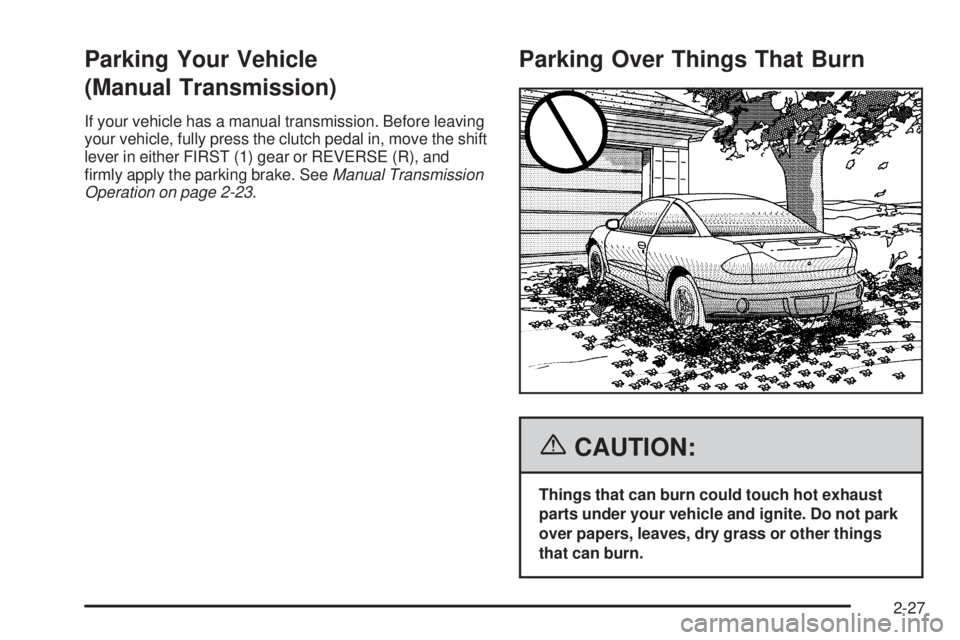
Parking Over Things That Burn
{CAUTION:
Things that can burn could touch hot exhaust
parts under your vehicle and ignite. Do not park
over papers, leaves, dry grass or other things
that can burn.
2-27
Page 78 of 328
Engine Exhaust
{CAUTION:
Engine exhaust can kill. It contains the gas
carbon monoxide (CO), which you cannot see or
smell. It can cause unconsciousness and death.
You might have exhaust coming in if:
Your exhaust system sounds strange or
different.
Your vehicle gets rusty underneath.
Your vehicle was damaged in a collision.
Your vehicle was damaged when driving
over high points on the road or over road
debris.
Repairs were not done correctly.
Your vehicle or exhaust system had been
modied improperly.
If you ever suspect exhaust is coming into your
vehicle:
Drive it only with all the windows down to
blow out any CO; and
Have your vehicle xed immediately.
Running the Engine While Parked
It is better not to park with the engine running. But if you
ever have to, here are some things to know.
{CAUTION:
Idling the engine with the climate control
system off could allow dangerous exhaust into
your vehicle. See the earlier caution under
Engine Exhaust on page 2-28.
Also, idling in a closed-in place can let deadly
carbon monoxide (CO) into your vehicle even if
the climate control fan is at the highest setting.
One place this can happen is a garage.
Exhaust — with CO — can come in easily.
NEVER park in a garage with the engine
running.
Another closed-in place can be a blizzard.
SeeWinter Driving on page 4-24.
2-28
Page 79 of 328

{CAUTION:
It can be dangerous to get out of your vehicle
if the automatic transmission shift lever is not
fully in PARK (P) with the parking brake rmly
set. Your vehicle can roll. Do not leave your
vehicle when the engine is running unless you
have to. If you have left the engine running,
the vehicle can move suddenly. You or others
could be injured. To be sure your vehicle will
not move, even when it is on fairly level
ground, always set the parking brake and
move the automatic transmission shift lever to
PARK (P), or the manual transmission shift
lever to NEUTRAL.
Follow the proper steps to be sure your vehicle will not
move. SeeShifting Into Park (P) (Automatic
Transmission) on page 2-25andParking Your Vehicle
(Manual Transmission) on page 2-27.
Mirrors
Manual Rearview Mirror
When you are sitting in a comfortable driving position,
adjust the mirror so you can see clearly behind your
vehicle. Grip the mirror in the center to move it up
or down and side to side. The day/night adjustment
allows you to adjust the mirror to avoid glare from the
lamps behind you. Move the lever to the right for
nighttime use and to the left for daytime use.
Manual Rearview Mirror with
OnStar
®
If the vehicle has this mirror, while sitting in a comfortable
driving position, adjust the mirror so you can see clearly
behind the vehicle. Grip the mirror in the center and move
it up and down or side to side. The day/night control,
located at the bottom of the mirror, allows adjustment to
lessen glare from the lamps behind you. Flip the lever
right for nighttime use; ip the lever left for daytime use.
There are three OnStar
®buttons located at the bottom of
the mirror face. For more information about OnStar®and
the services it provides, seeOnStar®System on
page 2-30.
2-29
Page 83 of 328
Storage Areas
Glove Box
To open the glove box, lift up on the lever. Use key to
lock and unlock.
Cupholder(s)
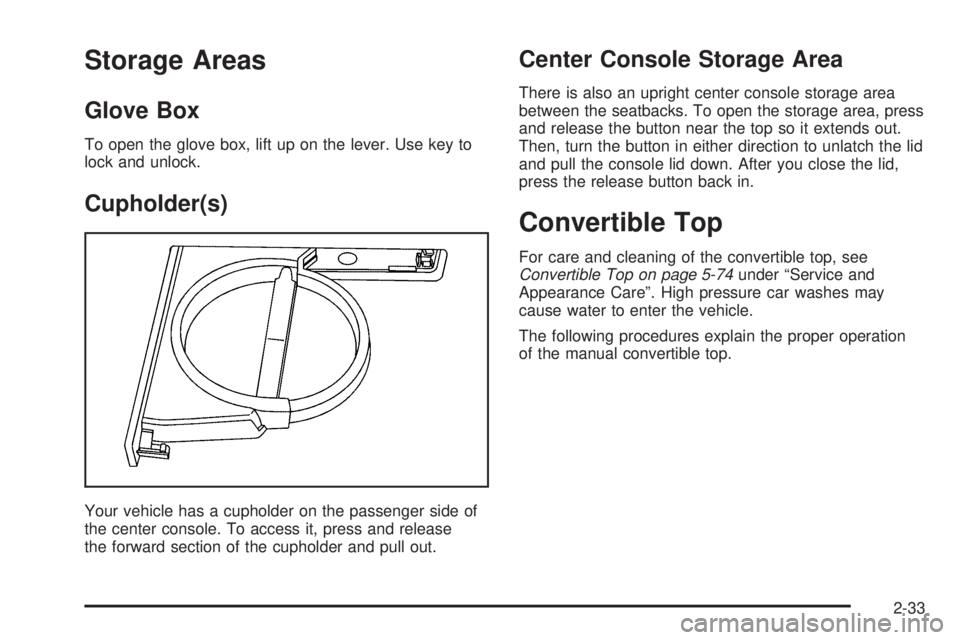
Your vehicle has a cupholder on the passenger side of
the center console. To access it, press and release
the forward section of the cupholder and pull out.
Center Console Storage Area
There is also an upright center console storage area
between the seatbacks. To open the storage area, press
and release the button near the top so it extends out.
Then, turn the button in either direction to unlatch the lid
and pull the console lid down. After you close the lid,
press the release button back in.
Convertible Top
For care and cleaning of the convertible top, see
Convertible Top on page 5-74under “Service and
Appearance Care”. High pressure car washes may
cause water to enter the vehicle.
The following procedures explain the proper operation
of the manual convertible top.
2-33
Page 91 of 328

The main components of your instrument panel are the following:
A. Side Window Outlets. SeeClimate Control System
on page 3-17.
B. Air Outlets. SeeOutlet Adjustment on page 3-20.
C. Turn Signal/Multifunction Lever. SeeTurn
Signal/Multifunction Lever on page 3-7.
D. Cruise Control Buttons (If Equipped). SeeCruise
Control on page 3-10.
E. Instrument Panel Cluster. SeeInstrument Panel
Cluster on page 3-21.
F. Audio Steering Wheel Controls (If Equipped). See
Audio Steering Wheel Controls on page 3-69.
G. Instrument Panel Brightness Control. SeeInstrument
Panel Brightness on page 3-15.
H. Passenger Air Bag Status Indicator. SeePassenger
Airbag Status Indicator on page 3-25.
I. Hazard Warning Flashers Button. SeeHazard
Warning Flashers on page 3-6.
J. Fog Lamp Button (If Equipped). SeeFog Lamps on
page 3-14.
K. Drive Information Center (DIC) Controls. SeeDriver
Information Center (DIC) on page 3-36.L. Horn. SeeHorn on page 3-6.
M. Windshield Wiper/Washer Controls. SeeWindshield
Wipers on page 3-9andWindshield Washer on
page 3-10.
N. Climate Controls. SeeClimate Control System on
page 3-17.
O. Cigarette Lighter (If Equipped). Accessory Power
Outlet (If Equipped). SeeAshtray(s) and Cigarette
Lighter on page 3-16andAccessory Power Outlet(s)
on page 3-15.
P. Shift Lever. SeeManual Transmission Operation on
page 2-23. SeeAutomatic Transmission Operation on
page 2-20(if equipped with automatic transmission).
Q. Parking Brake Lever. SeeParking Brake on
page 2-24.
R. Audio System. SeeAudio System(s) on page 3-45.
S. Cupholder. SeeCupholder(s) on page 2-33.
T. Trunk Release. SeeTrunk on page 2-9.
U. Glove Box. SeeGlove Box on page 2-33.
3-5
Page 93 of 328

The lever that allows you to tilt the steering wheel is
located on the left side of the steering column.
To tilt the wheel, pull down the lever. Then move the
wheel to a comfortable position, pull up the lever to lock
the wheel in place.Turn Signal/Multifunction Lever
The lever on the left side of the steering column
includes the following:
GTurn and Lane-Change Signals. SeeTurn and
Lane-Change Signals on page 3-8.
3Headlamp High/Low-Beam Changer. See
Headlamp High/Low-Beam Changer on page 3-8.
Flash-to-Pass. SeeFlash-to-Pass on page 3-8.
2Exterior Light Control. SeeHeadlamps
on page 3-13.
3-7