light PONTIAC SOLSTICE 2007 Owners Manual
[x] Cancel search | Manufacturer: PONTIAC, Model Year: 2007, Model line: SOLSTICE, Model: PONTIAC SOLSTICE 2007Pages: 396, PDF Size: 2.27 MB
Page 283 of 396
Replacement Bulbs
Exterior Lamp Bulb Number
Back-Up Lamps 3047
Fog Lamp 898*
Front Parking/Turn Signal Lamp 3757NAK
Front Sidemarker Lamp 194
Headlamps, High/Low-Beam/
Daytime Running LightsH13
License Plate Lamp 168
Stoplamp, Taillamp and
Turn Signal Lamp3157K
* Uplevel Model
For replacement bulbs not listed here, contact
your dealer.
Windshield Wiper Blade
Replacement
Windshield wiper blades should be inspected for
wear and cracking. SeeAt Least Twice a Year
on page 347for more information.Replacement blades come in different types and
are removed in different ways. For proper type and
length, seeNormal Maintenance Replacement
Parts on page 355.
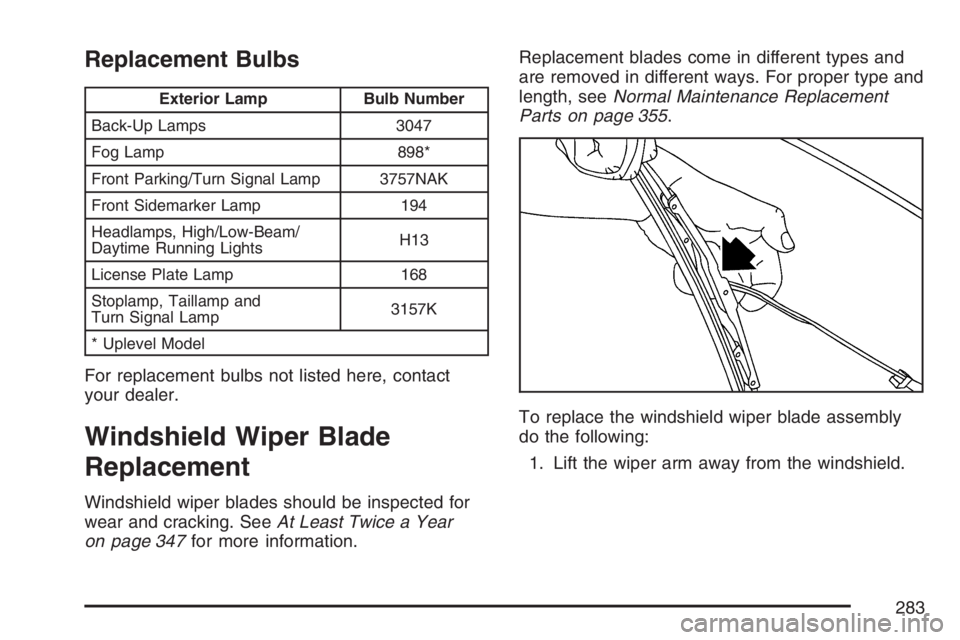
To replace the windshield wiper blade assembly
do the following:
1. Lift the wiper arm away from the windshield.
283
Page 290 of 396
GAWR RR:Gross Axle Weight Rating for the rear
axle. SeeLoading Your Vehicle on page 226.
Intended Outboard Sidewall:The side of
an asymmetrical tire, that must always face
outward when mounted on a vehicle.
Kilopascal (kPa):The metric unit for air pressure.
Light Truck (LT-Metric) Tire:A tire used on
light duty trucks and some multipurpose passenger
vehicles.
Load Index:An assigned number ranging from
1 to 279 that corresponds to the load carrying
capacity of a tire.
Maximum Ination Pressure:The maximum
air pressure to which a cold tire may be inated.
The maximum air pressure is molded onto the
sidewall.
Maximum Load Rating:The load rating for a tire
at the maximum permissible ination pressure
for that tire.
Maximum Loaded Vehicle Weight:The sum of
curb weight, accessory weight, vehicle capacity
weight, and production options weight.Normal Occupant Weight:The number of
occupants a vehicle is designed to seat multiplied
by 150 lbs (68 kg). SeeLoading Your Vehicle
on page 226.
Occupant Distribution:Designated seating
positions.
Outward Facing Sidewall:The side of an
asymmetrical tire that has a particular side that
faces outward when mounted on a vehicle.
The side of the tire that contains a whitewall,
bears white lettering, or bears manufacturer,
brand, and/or model name molding that is higher
or deeper than the same moldings on the
other sidewall of the tire.
Passenger (P-Metric) Tire:A tire used on
passenger cars and some light duty trucks and
multipurpose vehicles.
Recommended Ination Pressure:Vehicle
manufacturer’s recommended tire ination
pressure as shown on the tire placard. See
Ination - Tire Pressure on page 292and
Loading Your Vehicle on page 226.
290
Page 298 of 396

Uniform Tire Quality Grading
Quality grades can be found where applicable on
the tire sidewall between tread shoulder and
maximum section width. For example:
Treadwear 200 Traction AA Temperature A
The following information relates to the system
developed by the United States National Highway
Traffic Safety Administration (NHTSA), which
grades tires by treadwear, traction, and
temperature performance. This applies only to
vehicles sold in the United States. The grades are
molded on the sidewalls of most passenger car
tires. The Uniform Tire Quality Grading (UTQG)
system does not apply to deep tread, winter-type
snow tires, space-saver, or temporary use
spare tires, tires with nominal rim diameters of
10 to 12 inches (25 to 30 cm), or to some
limited-production tires.
While the tires available on General Motors
passenger cars and light trucks may vary with
respect to these grades, they must also conform
to federal safety requirements and additional
General Motors Tire Performance Criteria (TPC)
standards.
Treadwear
The treadwear grade is a comparative rating
based on the wear rate of the tire when tested
under controlled conditions on a specied
government test course. For example, a tire
graded 150 would wear one and a half (1.5) times
as well on the government course as a tire
graded 100. The relative performance of tires
depends upon the actual conditions of their use,
however, and may depart signicantly from
the norm due to variations in driving habits, service
practices, and differences in road characteristics
and climate.
Traction – AA, A, B, C
The traction grades, from highest to lowest, are
AA, A, B, and C. Those grades represent the tire’s
ability to stop on wet pavement as measured
under controlled conditions on specied
government test surfaces of asphalt and concrete.
A tire marked C may have poor traction
performance.
Warning:The traction grade assigned to this tire
is based on straight-ahead braking traction
tests, and does not include acceleration, cornering,
hydroplaning, or peak traction characteristics.
298
Page 308 of 396

9. Inate the tire up to the recommended
ination pressure, found on the Tire and
Loading Information label located on
the vehicle’s center pillar (B-pillar) below the
vehicle’s door latch, using the air pressure
gage on the top of the unit.
The pressure gage reading is slightly high
while the compressor is on. Turn the
compressor off to get an accurate pressure
reading.
Notice:If the recommended pressure cannot
be reached after 15 minutes, the vehicle
should not be driven farther. Damage to the
tire is severe and the sealant will not be
effective. Remove the air compressor plug
from the accessory power outlet and unscrew
the inating hose from the tire valve. See
Roadside Assistance Program on page 368.
10. Move the inator kit switch to the O (off)
position once the correct tire pressure is
obtained.11. Turn off the engine.
12. Unplug the air compressor accessory plug
from the accessory power outlet in the
vehicle.
13. Disconnect the sealant lling hose from the
tire valve stem, by turning it counterclockwise,
and replace the tire valve stem cap.
Be careful when handling the tire inator
components as they could be hot after usage.
14. Wrap the sealant lling hose around the air
compressor channel to stow it in its original
location.
15. Stow the air compressor accessory plug back
in the air compressor. To do this, wrap the
air compressor accessory plug, snap in
the plug, and then push in the bottom and
then the top of the wrapped air compressor
accessory plug.
308
Page 314 of 396

Appearance Care
Cleaning the Inside of Your Vehicle
Your vehicle’s interior will continue to look its
best if it is cleaned often. Although not always
visible, dust and dirt can accumulate on your
upholstery. Dirt can damage carpet, fabric, leather,
and plastic surfaces. Regular vacuuming is
recommended to remove particles from your
upholstery. It is important to keep your upholstery
from becoming and remaining heavily soiled.
Soils should be removed as quickly as possible.
Your vehicle’s interior may experience extremes
of heat that could cause stains to set rapidly.
Lighter colored interiors may require more frequent
cleaning. Use care because newspapers and
garments that transfer color to your home
furnishings may also transfer color to your
vehicle’s interior.
When cleaning your vehicle’s interior, only use
cleaners specically designed for the surfaces
being cleaned. Permanent damage may result from
using cleaners on surfaces for which they were
not intended. Use glass cleaner only on glass.Remove any accidental over-spray from other
surfaces immediately. To prevent over-spray, apply
cleaner directly to the cleaning cloth.
Notice:If you use abrasive cleaners when
cleaning glass surfaces on your vehicle, you
could scratch the glass and/or cause damage
to the rear window defogger. When cleaning
the glass on your vehicle, use only a soft cloth
and glass cleaner.
Many cleaners contain solvents that may become
concentrated in your vehicle’s breathing space.
Before using cleaners, read and adhere to
all safety instructions on the label. While cleaning
your vehicle’s interior, maintain adequate
ventilation by opening your vehicle’s doors and
windows.
Dust may be removed from small buttons and
knobs using a small brush with soft bristles.
Your dealer has a product for cleaning your
vehicle’s glass. Should it become necessary, you
can also obtain a product from your dealer to
remove odors from your vehicle’s upholstery.
314
Page 320 of 396
Windshield and Wiper Blades
If the windshield is not clear after using the
windshield washer, or if the wiper blade chatters
when running, wax, sap, or other material may
be on the blade or windshield.
Clean the outside of the windshield with a glass
cleaning liquid or powder and water solution.
The windshield is clean if beads do not form when
it is rinsed with water.
Grime from the windshield will stick to the wiper
blades and affect their performance. Clean
the blade by wiping vigorously with a cloth soaked
in full-strength windshield washer solvent. Then
rinse the blade with water.
Check the wiper blades and clean them as
necessary; replace blades that look worn.
Convertible Top
The vehicle’s convertible top should be cleaned
often. However, high pressure car washes
may cause water to enter your vehicle.When you hand wash the top, do it in partial
shade. Use a mild soap, lukewarm water and a
soft sponge. A chamois or cloth may leave lint on
the top, and a brush can chafe the threads in
the top fabric. Do not use detergents, harsh
cleaners, solvents or bleaching agents.
Wet the entire vehicle and wash the top evenly to
avoid spots or rings. Let the soap remain on
the fabric for a few minutes. When the top is really
dirty, use a mild foam-type cleaner. Thoroughly
rinse the entire vehicle, then let the top dry
in direct sunlight.
To protect the convertible top:
After you wash the vehicle, make sure the top
is completely dry before you lower it.
Do not get any cleaner on the vehicle’s
painted nish; it could leave streaks.
If you decide to go through an automatic car
wash, ask the manager if the equipment
could damage your top.
320
Page 324 of 396
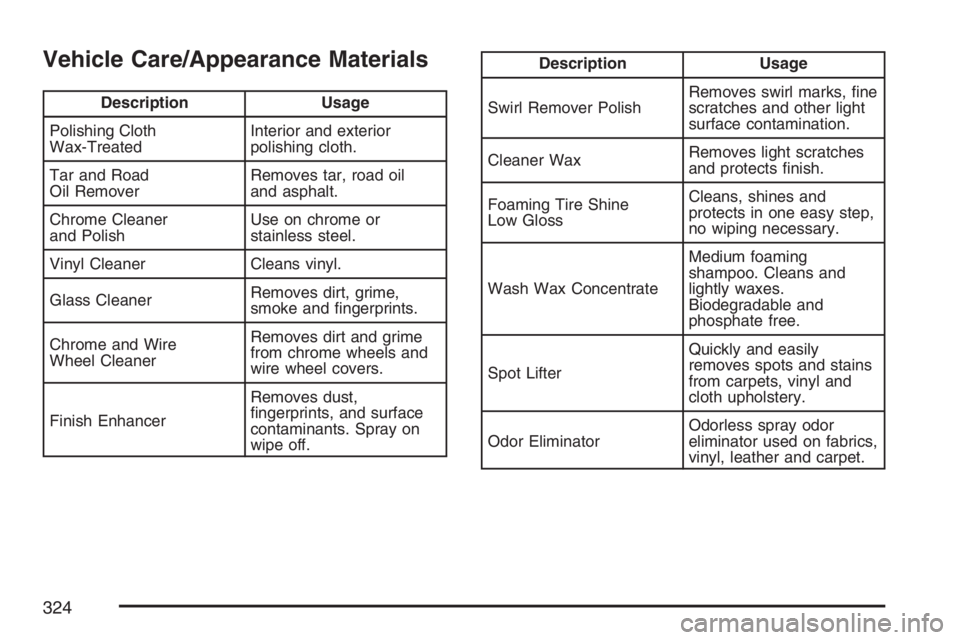
Vehicle Care/Appearance Materials
Description Usage
Polishing Cloth
Wax-TreatedInterior and exterior
polishing cloth.
Tar and Road
Oil RemoverRemoves tar, road oil
and asphalt.
Chrome Cleaner
and PolishUse on chrome or
stainless steel.
Vinyl Cleaner Cleans vinyl.
Glass CleanerRemoves dirt, grime,
smoke and ngerprints.
Chrome and Wire
Wheel CleanerRemoves dirt and grime
from chrome wheels and
wire wheel covers.
Finish EnhancerRemoves dust,
ngerprints, and surface
contaminants. Spray on
wipe off.
Description Usage
Swirl Remover PolishRemoves swirl marks, ne
scratches and other light
surface contamination.
Cleaner WaxRemoves light scratches
and protects nish.
Foaming Tire Shine
Low GlossCleans, shines and
protects in one easy step,
no wiping necessary.
Wash Wax ConcentrateMedium foaming
shampoo. Cleans and
lightly waxes.
Biodegradable and
phosphate free.
Spot LifterQuickly and easily
removes spots and stains
from carpets, vinyl and
cloth upholstery.
Odor EliminatorOdorless spray odor
eliminator used on fabrics,
vinyl, leather and carpet.
324
Page 327 of 396
Look at the silver-colored band inside the fuse.
If the band is broken or melted, replace the fuse.
Be sure you replace a bad fuse with a new
one of the identical size and rating.
If you ever have a problem on the road and do not
have a spare fuse, you can borrow one that has
the same amperage. Just pick some feature of your
vehicle that you can get along without — like the
radio or cigarette lighter — and use its fuse, if it
is the correct amperage. Replace it as soon as
you can.
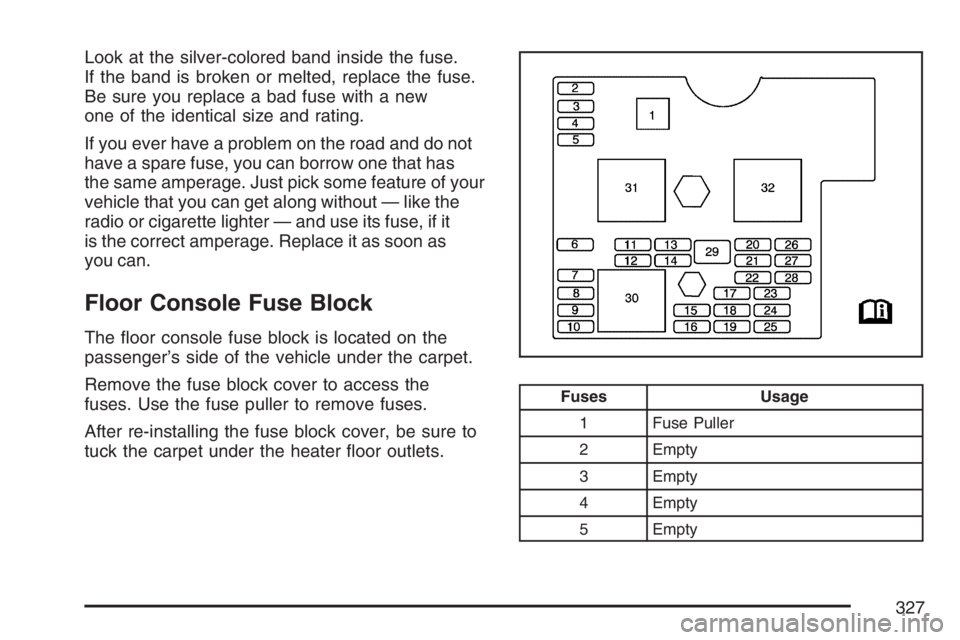
Floor Console Fuse Block
The oor console fuse block is located on the
passenger’s side of the vehicle under the carpet.
Remove the fuse block cover to access the
fuses. Use the fuse puller to remove fuses.
After re-installing the fuse block cover, be sure to
tuck the carpet under the heater oor outlets.
Fuses Usage
1 Fuse Puller
2 Empty
3 Empty
4 Empty
5 Empty
327
Page 328 of 396

Fuses Usage
6 Amplier
7 Cluster
8 Ignition Switch, PassKey III+
9 Stoplamp
10Climate Control System,
PassKey III+
11 Empty
12 Spare
13 Airbag
14 Spare
15 Wiper
16Climate Control System,
Automatic Occupant Sensing
Module, Clutch Switch,
Crank Relay, Instrument
Panel Cluster
17 Empty
18 EmptyFuses Usage
19Electric Power Steering,
Steering Wheel Controls
20 Spare
21 Spare
22 Empty
23 Radio
24 Sensing and Diagnostic Module
25Engine Control Module,
Transmission Control Module
26 Door Locks
27 Interior Lamps
28 Steering Wheel Control Backlighting
29 Power Windows
30 Climate Control System
31 Empty
32 Retained Accessory Power
328
Page 347 of 396
At Least Twice a Year
Restraint System Check
Make sure the safety belt reminder light and all
your belts, buckles, latch plates, retractors
and anchorages are working properly. Look for
any other loose or damaged safety belt system
parts. If you see anything that might keep a safety
belt system from doing its job, have it repaired.
Have any torn or frayed safety belts replaced.
Also look for any opened or broken airbag
coverings, and have them repaired or replaced.
The airbag system does not need regular
maintenance.
Wiper Blade Check
Inspect wiper blades for wear or cracking. Replace
blade inserts that appear worn or damaged or
that streak or miss areas of the windshield. Also
seeWindshield and Wiper Blades on page 320.
Weatherstrip Lubrication
Silicone grease on weatherstrips will make them
last longer, seal better, and not stick or squeak.
Apply silicone grease with a clean cloth.During very cold, damp weather more frequent
application may be required. SeePart D:
Recommended Fluids and Lubricants on page 353.
Manual Transmission Check
It is not necessary to check the transmission uid
level. Check for leaks. A uid leak is the only
reason for uid loss. Have the system inspected
and repaired if needed.
Automatic Transmission Inspection
It is not necessary to check the transmission uid
level. A transmission uid leak is the only
reason for uid loss. Check for leaks. If a leak
occurs, take the vehicle to your dealer and have it
repaired as soon as possible.
Hydraulic Clutch System Check
Check the uid level in the brake system and
clutch system reservoir. SeeHydraulic Clutch on
page 256. A uid loss in the brake or clutch
hydraulic system could indicate a problem. Have
the system inspected and repaired at once.
347