automatic transmission PONTIAC SOLSTICE 2007 User Guide
[x] Cancel search | Manufacturer: PONTIAC, Model Year: 2007, Model line: SOLSTICE, Model: PONTIAC SOLSTICE 2007Pages: 396, PDF Size: 2.27 MB
Page 100 of 396
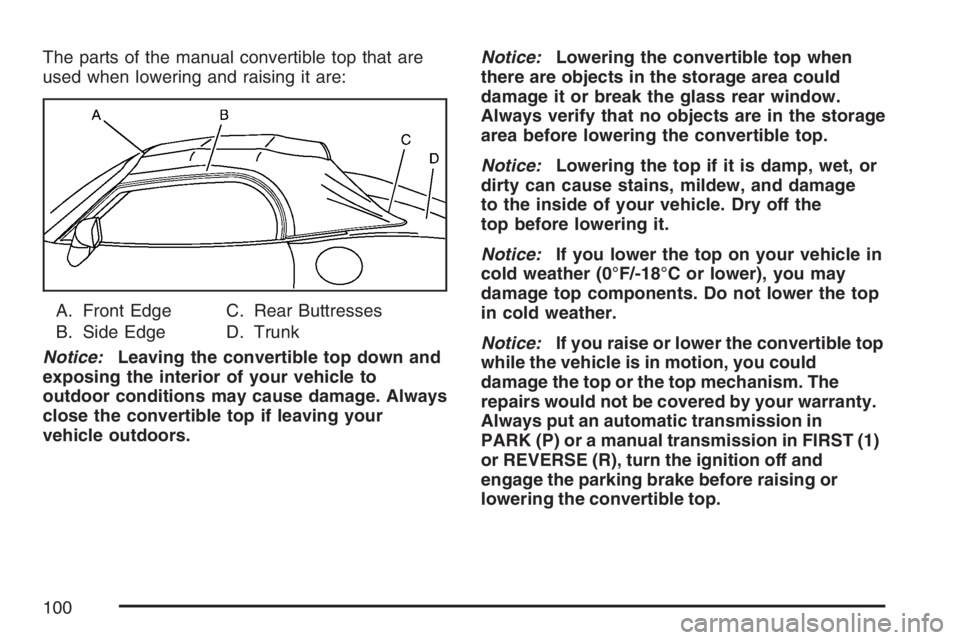
The parts of the manual convertible top that are
used when lowering and raising it are:
A. Front Edge
B. Side EdgeC. Rear Buttresses
D. Trunk
Notice:Leaving the convertible top down and
exposing the interior of your vehicle to
outdoor conditions may cause damage. Always
close the convertible top if leaving your
vehicle outdoors.Notice:Lowering the convertible top when
there are objects in the storage area could
damage it or break the glass rear window.
Always verify that no objects are in the storage
area before lowering the convertible top.
Notice:Lowering the top if it is damp, wet, or
dirty can cause stains, mildew, and damage
to the inside of your vehicle. Dry off the
top before lowering it.
Notice:If you lower the top on your vehicle in
cold weather (0°F/-18°C or lower), you may
damage top components. Do not lower the top
in cold weather.
Notice:If you raise or lower the convertible top
while the vehicle is in motion, you could
damage the top or the top mechanism. The
repairs would not be covered by your warranty.
Always put an automatic transmission in
PARK (P) or a manual transmission in FIRST (1)
or REVERSE (R), turn the ignition off and
engage the parking brake before raising or
lowering the convertible top.
100
Page 101 of 396
{CAUTION:
Moving parts of the convertible top can be
dangerous. People can be injured by the
convertible top and its mechanism. Keep
people away from your vehicle when you
are lowering or raising the top.
Lowering the Manual Convertible Top
1. Park on a level surface and set the parking
brake. Shift an automatic transmission into
PARK (P). Shift a manual transmission
into FIRST (1) or REVERSE (R).
2. Make sure the ignition is turned off.
3. Push the trunk release button located in the
glove box, or on the remote keyless entry,
if equipped.
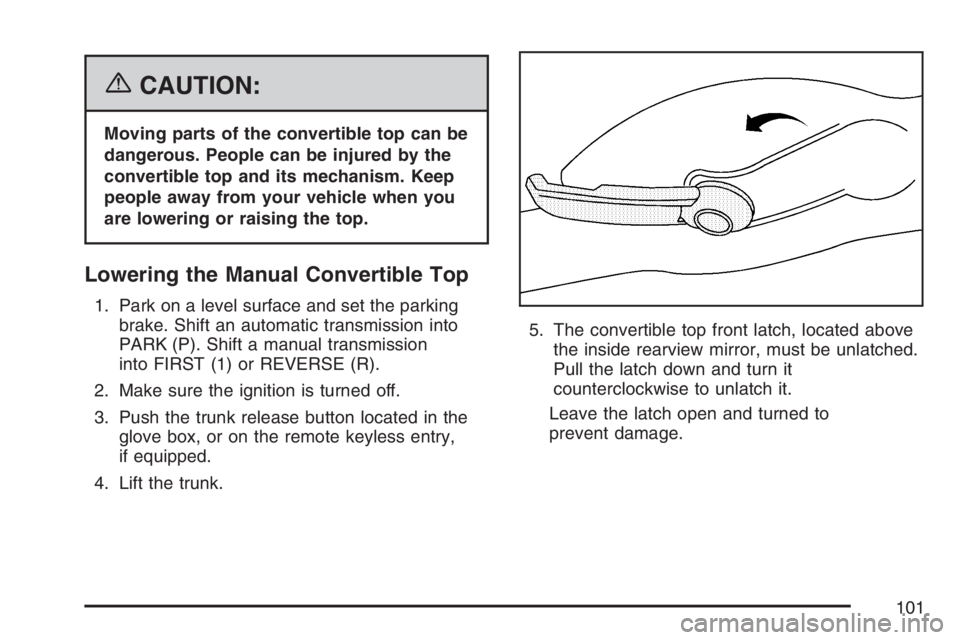
4. Lift the trunk.5. The convertible top front latch, located above
the inside rearview mirror, must be unlatched.
Pull the latch down and turn it
counterclockwise to unlatch it.
Leave the latch open and turned to
prevent damage.
101
Page 102 of 396
6. Pull rearward on the side edge (B) of the
convertible top and pull it off of the windshield
frame.
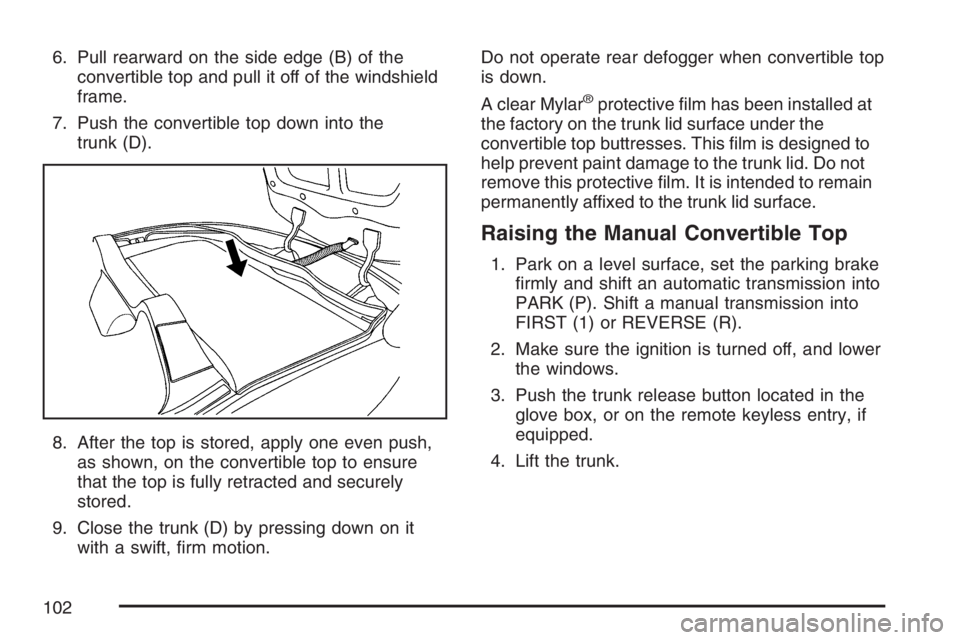
7. Push the convertible top down into the
trunk (D).
8. After the top is stored, apply one even push,
as shown, on the convertible top to ensure
that the top is fully retracted and securely
stored.
9. Close the trunk (D) by pressing down on it
with a swift, rm motion.Do not operate rear defogger when convertible top
is down.
A clear Mylar
®protective lm has been installed at
the factory on the trunk lid surface under the
convertible top buttresses. This lm is designed to
help prevent paint damage to the trunk lid. Do not
remove this protective lm. It is intended to remain
permanently affixed to the trunk lid surface.
Raising the Manual Convertible Top
1. Park on a level surface, set the parking brake
rmly and shift an automatic transmission into
PARK (P). Shift a manual transmission into
FIRST (1) or REVERSE (R).
2. Make sure the ignition is turned off, and lower
the windows.
3. Push the trunk release button located in the
glove box, or on the remote keyless entry, if
equipped.
4. Lift the trunk.
102
Page 109 of 396
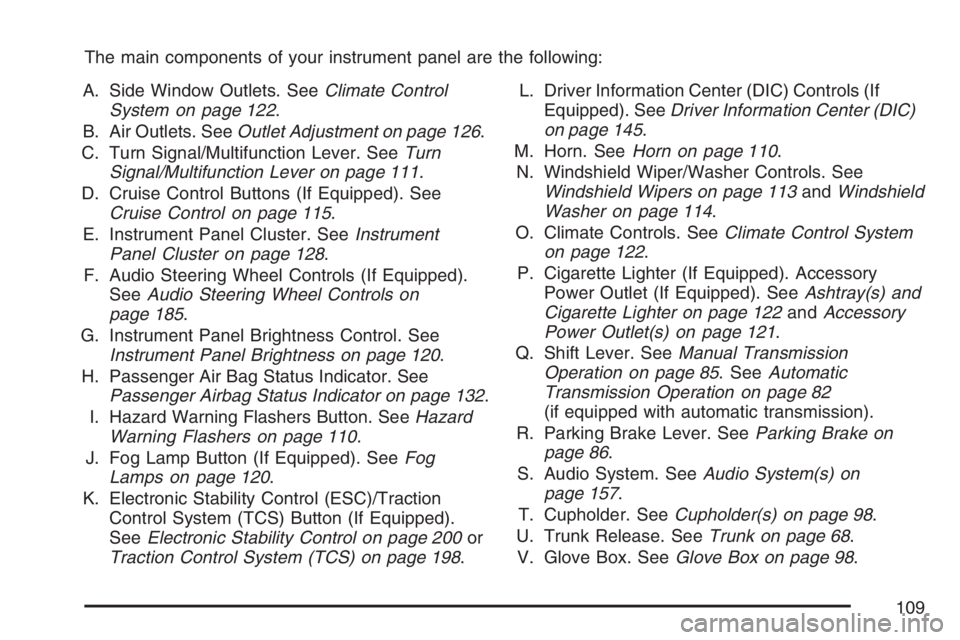
The main components of your instrument panel are the following:
A. Side Window Outlets. SeeClimate Control
System on page 122.
B. Air Outlets. SeeOutlet Adjustment on page 126.
C. Turn Signal/Multifunction Lever. SeeTurn
Signal/Multifunction Lever on page 111.
D. Cruise Control Buttons (If Equipped). See
Cruise Control on page 115.
E. Instrument Panel Cluster. SeeInstrument
Panel Cluster on page 128.
F. Audio Steering Wheel Controls (If Equipped).
SeeAudio Steering Wheel Controls on
page 185.
G. Instrument Panel Brightness Control. See
Instrument Panel Brightness on page 120.
H. Passenger Air Bag Status Indicator. See
Passenger Airbag Status Indicator on page 132.
I. Hazard Warning Flashers Button. SeeHazard
Warning Flashers on page 110.
J. Fog Lamp Button (If Equipped). SeeFog
Lamps on page 120.
K. Electronic Stability Control (ESC)/Traction
Control System (TCS) Button (If Equipped).
SeeElectronic Stability Control on page 200or
Traction Control System (TCS) on page 198.L. Driver Information Center (DIC) Controls (If
Equipped). SeeDriver Information Center (DIC)
on page 145.
M. Horn. SeeHorn on page 110.
N. Windshield Wiper/Washer Controls. See
Windshield Wipers on page 113andWindshield
Washer on page 114.
O. Climate Controls. SeeClimate Control System
on page 122.
P. Cigarette Lighter (If Equipped). Accessory
Power Outlet (If Equipped). SeeAshtray(s) and
Cigarette Lighter on page 122andAccessory
Power Outlet(s) on page 121.
Q. Shift Lever. SeeManual Transmission
Operation on page 85. SeeAutomatic
Transmission Operation on page 82
(if equipped with automatic transmission).
R. Parking Brake Lever. SeeParking Brake on
page 86.
S. Audio System. SeeAudio System(s) on
page 157.
T. Cupholder. SeeCupholder(s) on page 98.
U. Trunk Release. SeeTrunk on page 68.
V. Glove Box. SeeGlove Box on page 98.
109
Page 118 of 396
Headlamps
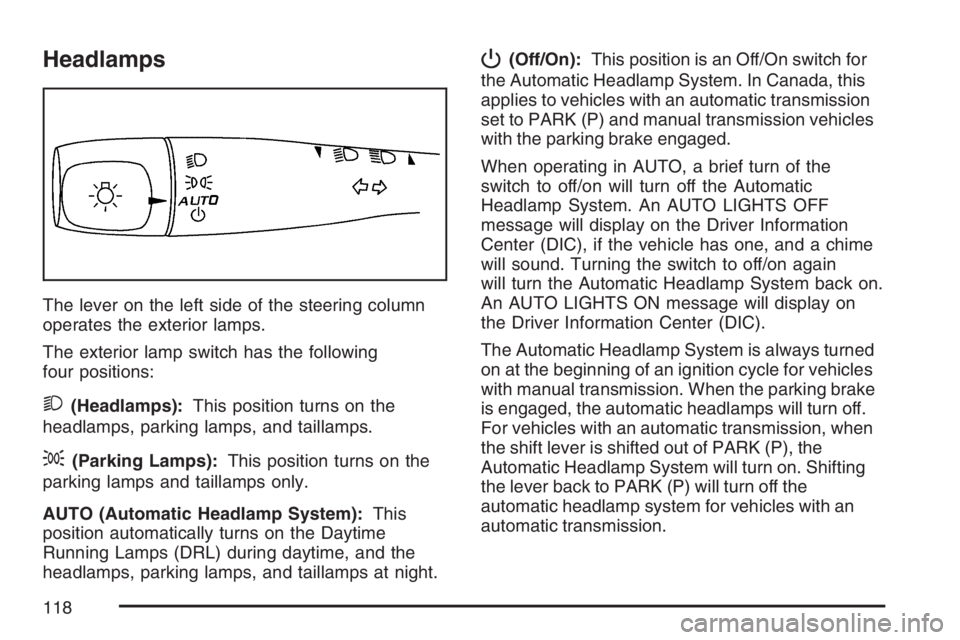
The lever on the left side of the steering column
operates the exterior lamps.
The exterior lamp switch has the following
four positions:
2(Headlamps):This position turns on the
headlamps, parking lamps, and taillamps.
;(Parking Lamps):This position turns on the
parking lamps and taillamps only.
AUTO (Automatic Headlamp System):This
position automatically turns on the Daytime
Running Lamps (DRL) during daytime, and the
headlamps, parking lamps, and taillamps at night.
P(Off/On):This position is an Off/On switch for
the Automatic Headlamp System. In Canada, this
applies to vehicles with an automatic transmission
set to PARK (P) and manual transmission vehicles
with the parking brake engaged.
When operating in AUTO, a brief turn of the
switch to off/on will turn off the Automatic
Headlamp System. An AUTO LIGHTS OFF
message will display on the Driver Information
Center (DIC), if the vehicle has one, and a chime
will sound. Turning the switch to off/on again
will turn the Automatic Headlamp System back on.
An AUTO LIGHTS ON message will display on
the Driver Information Center (DIC).
The Automatic Headlamp System is always turned
on at the beginning of an ignition cycle for vehicles
with manual transmission. When the parking brake
is engaged, the automatic headlamps will turn off.
For vehicles with an automatic transmission, when
the shift lever is shifted out of PARK (P), the
Automatic Headlamp System will turn on. Shifting
the lever back to PARK (P) will turn off the
automatic headlamp system for vehicles with an
automatic transmission.
118
Page 119 of 396

Headlamps on Reminder
If you open the driver’s door with the ignition off
and the lamps on, you will hear a warning chime.
Daytime Running Lamps (DRL)
Daytime Running Lamps (DRL) can make it easier
for others to see the front of your vehicle during
the day. DRL can be helpful in many different
driving conditions, but they can be especially
helpful in the short periods after dawn and before
sunset. Fully functional daytime running lamps
are required on all vehicles rst sold in Canada.
Your vehicle has a light sensor on top of the
instrument panel that helps control the DRL. Make
sure it is not covered or the headlamps will
come on when they are not needed.The DRL system makes both low beam headlamps
turn on at reduced intensity when the following
conditions are met:
The ignition is on.
The exterior lamp control is turned to AUTO.
The light sensor detects daytime light.
The shift lever is not in PARK (P).
While the DRL system is on, the taillamps,
sidemarker lamps, and instrument panel lights will
not be on.
The DRL system turns off on U.S. vehicles by
using the on/off switch for one ignition cycle, if the
vehicle is in the PARK (P) position, or if the
vehicle speed is less than 5 mph (8 km h) after
the vehicle is started.
For vehicles rst sold in Canada the DRL system
will turn off when a automatic transmission
vehicle is in the PARK (P) position or the park
brake is set on a manual transmission vehicle and
the vehicle speed is less than 8 mph (13 km h).
As with any vehicle, you should turn on the regular
headlamp system when it is needed.
119
Page 155 of 396

AUTO UNLK (Unlock)
This feature, which allows the vehicle to
automatically unlock certain doors, can be enabled
or disabled. When AUTO UNLK appears on the
display, press and hold the reset button for at least
one second to scroll through the available settings:
ALL (default):All of the doors will automatically
unlock.
DRIVER:The driver’s door will
automatically unlock.
NONE:None of the doors will automatically unlock.
You will need to manually unlock the doors.
If you have a manual transmission vehicle, the
door(s) will automatically unlock when the key is
turned off.
If you have an automatic transmission vehicle, you
can select when the automatic unlocking will occur.
See “UNLK (Unlock) (Automatic Transmission
Only)” following.
SeeAutomatic Door Unlock on page 67for more
information.
Choose one of the available settings and press
the information button to select it and move on to
the next feature.
UNLK (Unlock) (Automatic
Transmission Only)
This screen displays only if your vehicle has an
automatic transmission and DRIVER or ALL is
selected for the AUTO UNLK feature. This feature
determines when the automatic door unlocking will
occur. When UNLK appears on the display, press
and hold the reset button for at least one second to
scroll through the available settings:
KEY OFF:The door(s) will unlock when the key
is turned off.
SHIFT TO P (Park) (default):The door(s) will
unlock when the vehicle is shifted into PARK (P).
SeeAutomatic Door Unlock on page 67for
more information.
Choose one of the available settings and press
the information button to select it and move on to
the next feature.
155
Page 200 of 396

Notice:When traction control is turned off,
or Competitive Driving Mode is active, it is
possible to lose traction. If you attempt to shift
with the rear wheels spinning with a loss of
traction, it is possible to cause damage to the
transmission. Do not attempt to shift when the
rear wheels do not have traction. Damage
caused by misuse of the vehicle is not covered.
See your warranty book for additional
information.
The traction control system may activate on dry or
rough roads or under conditions such as heavy
acceleration while turning or abrupt upshifts/
downshifts of the transmission. When this
happens, you may notice a reduction in
acceleration, or may hear a noise or vibration.
This is normal.
If your vehicle is in cruise control when the system
activates, the ESC/TCS light will ash and the
cruise control will automatically disengage. When
road conditions allow you to use cruise control
again, you may re-engage the cruise control. See
Cruise Control on page 115.
Adding non-GM accessories can affect your
vehicle’s performance. SeeAccessories and
Modications on page 235for more information.Limited-Slip Rear Axle
Your vehicle may have a limited-slip rear
differential which provides maximum power and
performance. It is designed to give you additional
traction on snow, mud, ice, sand or gravel. It
works like a standard axle most of the time, but
when one of the rear wheels has no traction
and the other does, this feature will allow
the wheel with traction to move the vehicle.
During a sudden shift, such as shifting from
FIRST (1) to SECOND (2) gear at low engine
speeds or suddenly applying the clutch, you may
feel or hear a clunking or rattling noise. This is
normal.
Electronic Stability Control
Your vehicle may be equipped with an Electronic
Stability Control (ESC) system which combines
antilock brake, traction and stability control
systems and helps the driver maintain directional
control of the vehicle in most driving conditions.
When you rst start your vehicle and begin to drive
away, the system performs several diagnostic
checks to ensure there are no problems. You may
hear or feel the system working.
200
Page 233 of 396

Service........................................................ 235
Accessories and Modications................... 235
California Proposition 65 Warning.............. 236
Doing Your Own Service Work.................. 236
Adding Equipment to the Outside
of Your Vehicle...................................... 237
Fuel............................................................. 237
Gasoline Octane........................................ 237
Gasoline Specications.............................. 237
California Fuel........................................... 238
Additives................................................... 238
Fuels in Foreign Countries........................ 239
Filling the Tank......................................... 240
Filling a Portable Fuel Container............... 242
Checking Things Under the Hood.............. 242
Hood Release........................................... 243
Engine Compartment Overview.................. 244
Engine Oil................................................. 247
Engine Oil Life System.............................. 252
Engine Air Cleaner/Filter............................ 254
Automatic Transmission Fluid.................... 256
Manual Transmission Fluid........................ 256
Hydraulic Clutch........................................ 256
Engine Coolant.......................................... 257Coolant Surge Tank Pressure Cap............ 260
Engine Overheating................................... 260
Cooling System......................................... 262
Power Steering Fluid ................................. 268
Windshield Washer Fluid........................... 269
Brakes...................................................... 270
Battery...................................................... 273
Jump Starting............................................ 274
Rear Axle.................................................... 279
Bulb Replacement....................................... 280
Halogen Bulbs........................................... 280
Headlamps................................................ 280
Front Turn Signal, Parking and
Fog Lamps............................................ 281
Taillamps, Turn Signal, and Stoplamps...... 281
Back-Up Lamps......................................... 282
License Plate Lamp................................... 282
Replacement Bulbs................................... 283
Windshield Wiper Blade Replacement....... 283
Tires............................................................ 284
Winter Tires.............................................. 285
Tire Sidewall Labeling............................... 286
Tire Terminology and Denitions............... 289
Section 5 Service and Appearance Care
233
Page 256 of 396
Automatic Transmission Fluid
It is not necessary to check the transmission
uid level. A transmission uid leak is the only
reason for uid loss. If a leak occurs, take
your vehicle to the dealership service department
and have it repaired as soon as possible.
Change the uid and lter at the intervals
listed in the Maintenance Schedule. See
Part A: Scheduled Maintenance Services on
page 336. Be sure to use the transmission uid
listed inPart D: Recommended Fluids and
Lubricants on page 353.
Notice:Use of the incorrect automatic
transmission uid may damage your
vehicle, and the damages may not be
covered by your warranty. Always use
the automatic transmission uid listed
inPart D: Recommended Fluids and
Lubricants on page 353.
Manual Transmission Fluid
It is not necessary to check the manual
transmission uid level. A transmission uid leak
is the only reason for uid loss. If a leak occurs,
take the vehicle to the dealership service
department and have it repaired as soon as
possible. You may also have your uid level
checked by your dealer when you have your
oil changed. SeePart D: Recommended Fluids
and Lubricants on page 353for the proper
uid to use.
Hydraulic Clutch
The hydraulic clutch linkage in your vehicle is
self-adjusting. This system does not have its own
reservoir. It receives uid from the brake master
cylinder reservoir.
SeeBrakes on page 270for more information.
256