traction control PONTIAC SOLSTICE 2007 User Guide
[x] Cancel search | Manufacturer: PONTIAC, Model Year: 2007, Model line: SOLSTICE, Model: PONTIAC SOLSTICE 2007Pages: 396, PDF Size: 2.27 MB
Page 189 of 396
Your Driving, the Road, and Your Vehicle.... 190
Defensive Driving...................................... 190
Drunken Driving........................................ 191
Control of a Vehicle.................................. 194
Braking...................................................... 194
Anti-Lock Brake System (ABS).................. 195
Braking in Emergencies............................. 197
Traction Control System (TCS).................. 198
Limited-Slip Rear Axle............................... 200
Electronic Stability Control......................... 200
Steering.................................................... 203
Off-Road Recovery.................................... 206
Passing..................................................... 206
Loss of Control.......................................... 208
Driving at Night......................................... 209Driving in Rain and on Wet Roads............ 211
City Driving............................................... 214
Freeway Driving........................................ 215
Before Leaving on a Long Trip.................. 216
Highway Hypnosis..................................... 217
Hill and Mountain Roads........................... 218
Winter Driving........................................... 220
If Your Vehicle is Stuck in Sand, Mud,
Ice, or Snow.......................................... 224
Rocking Your Vehicle to Get It Out........... 225
Loading Your Vehicle................................ 226
Towing........................................................ 231
Towing Your Vehicle ................................. 231
Recreational Vehicle Towing...................... 231
Towing a Trailer........................................ 231
Section 4 Driving Your Vehicle
189
Page 194 of 396
Control of a Vehicle
You have three systems that make your
vehicle go where you want it to go. They are the
brakes, the steering, and the accelerator. All
three systems have to do their work at the places
where the tires meet the road.
Sometimes, as when you are driving on snow or
ice, it is easy to ask more of those control systems
than the tires and road can provide. That means
you can lose control of your vehicle. SeeTraction
Control System (TCS) on page 198and
Electronic Stability Control on page 200.
Adding non-GM accessories can affect your
vehicle’s performance. SeeAccessories and
Modications on page 235.
Braking
SeeBrake System Warning Light on page 134.
Braking action involves perception time and
reaction time.
First, you have to decide to push on the brake
pedal. That is perception time. Then you have to
bring up your foot and do it. That is reaction time.
Average reaction time is about three-fourths of a
second. But that is only an average. It might be less
with one driver and as long as two or three seconds
or more with another. Age, physical condition,
alertness, coordination, and eyesight all play a part.
So do alcohol, drugs, and frustration. But even in
three-fourths of a second, a vehicle moving at
60 mph (100 km/h) travels 66 feet (20 m). That
could be a lot of distance in an emergency, so
keeping enough space between your vehicle and
others is important.
And, of course, actual stopping distances vary
greatly with the surface of the road, whether it is
pavement or gravel; the condition of the road,
whether it is wet, dry, or icy; tire tread; the
condition of the brakes; the weight of the vehicle;
and the amount of brake force applied.
194
Page 198 of 396

Traction Control System (TCS)
Your vehicle may have a Traction Control System
(TCS) that limits wheel spin. This is especially
useful in slippery road conditions. The system
operates only if it senses that the rear wheels are
spinning too much or are beginning to lose
traction. When this happens, the system works the
rear brakes and reduces engine power by
closing the throttle and managing engine spark to
limit wheel spin.
This light will ash
when your traction
control system is limiting
wheel spin.
You may feel or hear the system working, but this
is normal.
SeeElectronic Stability Control (ESC)/Traction
Control System (TCS) Indicator/Warning Light
(2.0L Engine Only) on page 136for more
information.If your vehicle is in cruise control when TCS
begins to limit wheel spin, the cruise control will
automatically disengage. When road conditions
allow you to safely use it again, you may
re-engage the cruise control. SeeTurn
Signal/Multifunction Lever on page 111.
When this light is on
solid and either the
SERVICE TRACTION
or TRACTION OFF
message is displayed,
the system will not
limit wheel spin.
Adjust your driving accordingly. SeeDIC Warnings
and Messages on page 148for more information.
The Traction Control System is automatically
enabled whenever you start your vehicle. To limit
wheel spin, especially in slippery road conditions,
you should always leave the system enabled.
You can turn TCS off if you ever need to.
198
Page 199 of 396

It is recommended to leave the system on for
normal driving conditions, but it may be necessary
to turn the system off if your vehicle is stuck in
sand, mud, ice or snow, and you want to
“rock” your vehicle to attempt to free it. It may also
be necessary to turn off the system when driving
in extreme off-road conditions where high
wheel spin is required. SeeIf Your Vehicle is
Stuck in Sand, Mud, Ice, or Snow on page 224.
To turn the system off
or on, press and release
this button located on
the instrument panel.
The DIC will display the appropriate message as
described previously when you press the button.Traction Control Operation
Traction control limits wheel spin by reducing
engine power to the wheels (engine speed
management) and by applying brakes to each
individual wheel (brake-traction control) as
necessary.
The traction control system is enabled
automatically when you start your vehicle, and it
will activate and ash the ESC/TCS light and
display the LOW TRACTION message if it senses
that any of the wheels are spinning or beginning
to lose traction while driving. For more information
on the LOW TRACTION message, seeDriver
Information Center (DIC) on page 145.
Notice:If you allow the wheel(s) of one axle to
spin excessively while the ESC/TCS, ABS and
Brake warning lights and the SERVICE ESC
and/or SERVICE TRACTION messages are
displayed, you could damage the differential.
The repairs would not be covered by your
warranty. Reduce engine power and do not spin
the wheel(s) excessively while these lights and
this message are displayed.
199
Page 200 of 396

Notice:When traction control is turned off,
or Competitive Driving Mode is active, it is
possible to lose traction. If you attempt to shift
with the rear wheels spinning with a loss of
traction, it is possible to cause damage to the
transmission. Do not attempt to shift when the
rear wheels do not have traction. Damage
caused by misuse of the vehicle is not covered.
See your warranty book for additional
information.
The traction control system may activate on dry or
rough roads or under conditions such as heavy
acceleration while turning or abrupt upshifts/
downshifts of the transmission. When this
happens, you may notice a reduction in
acceleration, or may hear a noise or vibration.
This is normal.
If your vehicle is in cruise control when the system
activates, the ESC/TCS light will ash and the
cruise control will automatically disengage. When
road conditions allow you to use cruise control
again, you may re-engage the cruise control. See
Cruise Control on page 115.
Adding non-GM accessories can affect your
vehicle’s performance. SeeAccessories and
Modications on page 235for more information.Limited-Slip Rear Axle
Your vehicle may have a limited-slip rear
differential which provides maximum power and
performance. It is designed to give you additional
traction on snow, mud, ice, sand or gravel. It
works like a standard axle most of the time, but
when one of the rear wheels has no traction
and the other does, this feature will allow
the wheel with traction to move the vehicle.
During a sudden shift, such as shifting from
FIRST (1) to SECOND (2) gear at low engine
speeds or suddenly applying the clutch, you may
feel or hear a clunking or rattling noise. This is
normal.
Electronic Stability Control
Your vehicle may be equipped with an Electronic
Stability Control (ESC) system which combines
antilock brake, traction and stability control
systems and helps the driver maintain directional
control of the vehicle in most driving conditions.
When you rst start your vehicle and begin to drive
away, the system performs several diagnostic
checks to ensure there are no problems. You may
hear or feel the system working.
200
Page 201 of 396
This is normal and does not mean there is
a problem with your vehicle. The system
should initialize before the vehicle reaches
20 mph (32 km/h).
If the system fails to turn on or activate, the
ESC/TCS light will be on solid, and the ESC OFF
or SERVICE ESC message will be displayed.
For more information, seeDriver Information
Center (DIC) on page 145andElectronic Stability
Control (ESC)/Traction Control System (TCS)
Indicator/Warning Light (2.0L Engine Only)
on page 136.
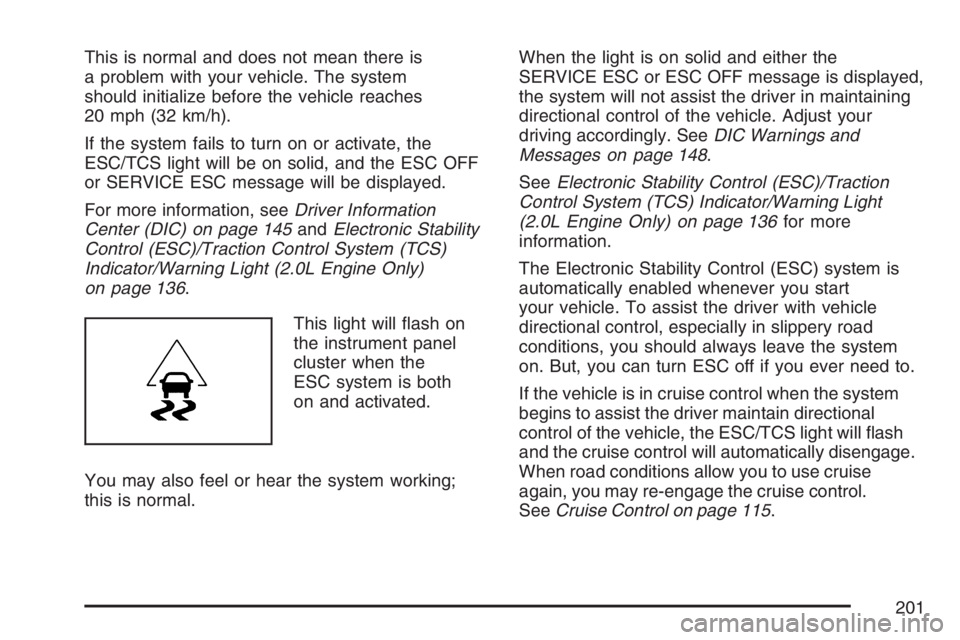
This light will ash on
the instrument panel
cluster when the
ESC system is both
on and activated.
You may also feel or hear the system working;
this is normal.When the light is on solid and either the
SERVICE ESC or ESC OFF message is displayed,
the system will not assist the driver in maintaining
directional control of the vehicle. Adjust your
driving accordingly. SeeDIC Warnings and
Messages on page 148.
SeeElectronic Stability Control (ESC)/Traction
Control System (TCS) Indicator/Warning Light
(2.0L Engine Only) on page 136for more
information.
The Electronic Stability Control (ESC) system is
automatically enabled whenever you start
your vehicle. To assist the driver with vehicle
directional control, especially in slippery road
conditions, you should always leave the system
on. But, you can turn ESC off if you ever need to.
If the vehicle is in cruise control when the system
begins to assist the driver maintain directional
control of the vehicle, the ESC/TCS light will ash
and the cruise control will automatically disengage.
When road conditions allow you to use cruise
again, you may re-engage the cruise control.
SeeCruise Control on page 115.
201
Page 202 of 396
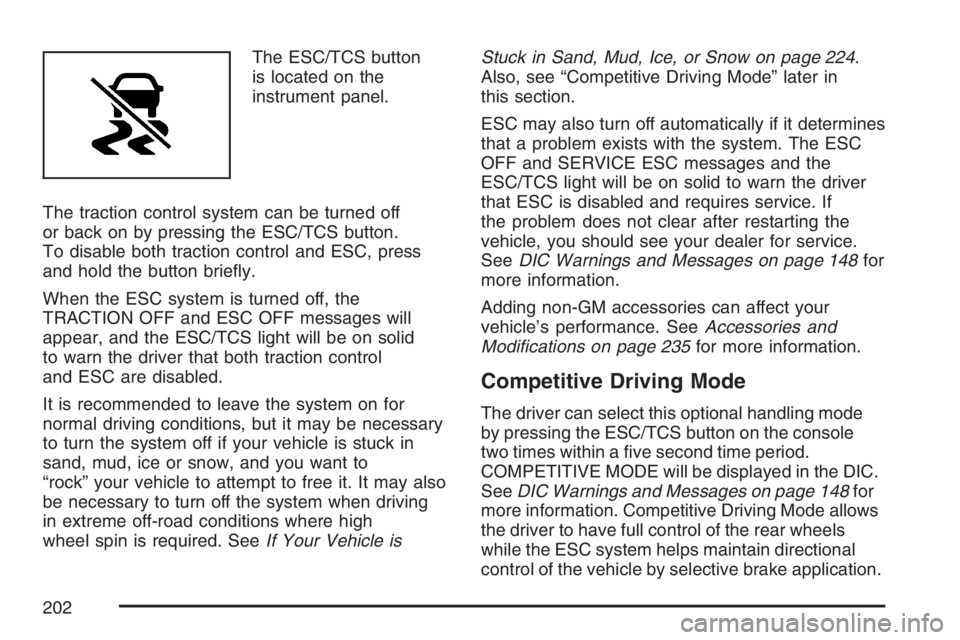
The ESC/TCS button
is located on the
instrument panel.
The traction control system can be turned off
or back on by pressing the ESC/TCS button.
To disable both traction control and ESC, press
and hold the button briey.
When the ESC system is turned off, the
TRACTION OFF and ESC OFF messages will
appear, and the ESC/TCS light will be on solid
to warn the driver that both traction control
and ESC are disabled.
It is recommended to leave the system on for
normal driving conditions, but it may be necessary
to turn the system off if your vehicle is stuck in
sand, mud, ice or snow, and you want to
“rock” your vehicle to attempt to free it. It may also
be necessary to turn off the system when driving
in extreme off-road conditions where high
wheel spin is required. SeeIf Your Vehicle isStuck in Sand, Mud, Ice, or Snow on page 224.
Also, see “Competitive Driving Mode” later in
this section.
ESC may also turn off automatically if it determines
that a problem exists with the system. The ESC
OFF and SERVICE ESC messages and the
ESC/TCS light will be on solid to warn the driver
that ESC is disabled and requires service. If
the problem does not clear after restarting the
vehicle, you should see your dealer for service.
SeeDIC Warnings and Messages on page 148for
more information.
Adding non-GM accessories can affect your
vehicle’s performance. SeeAccessories and
Modications on page 235for more information.
Competitive Driving Mode
The driver can select this optional handling mode
by pressing the ESC/TCS button on the console
two times within a ve second time period.
COMPETITIVE MODE will be displayed in the DIC.
SeeDIC Warnings and Messages on page 148for
more information. Competitive Driving Mode allows
the driver to have full control of the rear wheels
while the ESC system helps maintain directional
control of the vehicle by selective brake application.
202
Page 203 of 396

The ESC/TCS light will be on and the traction
control system will not be operating. Adjust your
driving accordingly. This electronic stability control
mode is recommended only for use during closed
track events and competitive driving venues.
When you press the ESC button again, or restart
the vehicle, the ESC and TCS will be turned
back on.
Notice:When traction control is turned off,
or Competitive Driving Mode is active, it
is possible to lose traction. If you attempt to
shift with the rear wheels spinning with a loss
of traction, it is possible to cause damage
to the transmission. Do not attempt to shift
when the rear wheels do not have traction.
Damage caused by misuse of the vehicle is
not covered. See your warranty book for
additional information.Steering
Power Steering
If you lose power steering assist because the
engine stops or the system is not functioning,
you can steer but it will take much more effort.
Steering Tips
It is important to take curves at a reasonable speed.
A lot of the “driver lost control” accidents
mentioned on the news happen on curves.
Here is why:
Experienced driver or beginner, each of us is
subject to the same laws of physics when driving on
curves. The traction of the tires against the road
surface makes it possible for the vehicle to change
its path when you turn the front wheels. If there is
no traction, inertia will keep the vehicle going in the
same direction. If you have ever tried to steer a
vehicle on wet ice, you will understand this.
203
Page 204 of 396
The traction you can get in a curve depends on
the condition of your tires and the road surface,
the angle at which the curve is banked, and
your speed. While you are in a curve, speed is the
one factor you can control.
Suppose you are steering through a sharp curve.
Then you suddenly apply the brakes. Both
control systems — steering and braking — have
to do their work where the tires meet the road.
Unless you have four-wheel anti-lock brakes,
adding the hard braking can demand too much of
those places. You can lose control.
The same thing can happen if you are steering
through a sharp curve and you suddenly
accelerate. Those two control systems — steering
and acceleration — can overwhelm those
places where the tires meet the road and make
you lose control. SeeTraction Control System
(TCS) on page 198andElectronic Stability Control
on page 200.What should you do if this ever happens? Ease up
on the brake or accelerator pedal, steer the
vehicle the way you want it to go, and slow down.
Speed limit signs near curves warn that you
should adjust your speed. Of course, the posted
speeds are based on good weather and road
conditions. Under less favorable conditions you will
want to go slower.
If you need to reduce your speed as you approach
a curve, do it before you enter the curve, while
your front wheels are straight ahead.
Try to adjust your speed so you can “drive”
through the curve. Maintain a reasonable, steady
speed. Wait to accelerate until you are out of
the curve, and then accelerate gently into
the straightaway.
Adding non-GM accessories can affect your
vehicle’s performance. SeeAccessories and
Modications on page 235.
204
Page 209 of 396

Of course, traction is reduced when water,
snow, ice, gravel, or other material is on the
road. For safety, you will want to slow down and
adjust your driving to these conditions. It is
important to slow down on slippery surfaces
because stopping distance will be longer and
vehicle control more limited.
While driving on a surface with reduced traction,
try your best to avoid sudden steering, acceleration,
or braking, including reducing vehicle speed by
shifting to a lower gear. Any sudden changes could
cause the tires to slide. You may not realize the
surface is slippery until your vehicle is skidding.
Learn to recognize warning clues — such as
enough water, ice, or packed snow on the road to
make a mirrored surface — and slow down when
you have any doubt.
If you have the Anti-Lock Brake System (ABS),
remember: It helps avoid only the braking skid.
If you do not have ABS, then in a braking skid,
where the wheels are no longer rolling, release
enough pressure on the brakes to get the wheels
rolling again. This restores steering control. Push
the brake pedal down steadily when you have to
stop suddenly. As long as the wheels are rolling,
you will have steering control.Driving at Night
Night driving is more dangerous than day driving.
One reason is that some drivers are likely to
be impaired — by alcohol or drugs, with night
vision problems, or by fatigue.
Here are some tips on night driving.
Drive defensively.
Do not drink and drive.
Adjust the inside rearview mirror to reduce the
glare from headlamps behind you.
Since you cannot see as well, you may need
to slow down and keep more space between
you and other vehicles.
Slow down, especially on higher speed roads.
Your vehicle’s headlamps can light up only so
much road ahead.
In remote areas, watch for animals.
If you are tired, pull off the road in a safe
place and rest.
209