battery PONTIAC SOLSTICE 2007 Owner's Manual
[x] Cancel search | Manufacturer: PONTIAC, Model Year: 2007, Model line: SOLSTICE, Model: PONTIAC SOLSTICE 2007Pages: 396, PDF Size: 2.27 MB
Page 276 of 396

The remote negative (−)
ground bracket is
located in the rear of the
engine compartment,
on the passenger’s side
of the vehicle, and is
marked GND (−).
SeeEngine Compartment Overview on
page 244for more information on the location
of the positive (+) and negative (−) terminals
on your vehicle.
{CAUTION:
An electric fan can start up even when
the engine is not running and can injure
you. Keep hands, clothing and tools away
from any underhood electric fan.
{CAUTION:
Using a match near a battery can cause
battery gas to explode. People have been
hurt doing this, and some have been
blinded. Use a ashlight if you need
more light.
Be sure the battery has enough water.
You do not need to add water to the
battery installed in your new vehicle. But
if a battery has ller caps, be sure the
right amount of uid is there. If it is low,
add water to take care of that rst. If you
don’t, explosive gas could be present.
Battery uid contains acid that can
burn you. Do not get it on you. If you
accidentally get it in your eyes or on your
skin, ush the place with water and get
medical help immediately.
276
Page 277 of 396

{CAUTION:
Fans or other moving engine parts can
injure you badly. Keep your hands away
from moving parts once the engine is
running.
5. Check that the jumper cables do not have
loose or missing insulation. If they do, you
could get a shock. The vehicles could
be damaged too.
Before you connect the cables, here are some
basic things you should know. Positive (+)
will go to positive (+) or to a remote positive (+)
terminal if the vehicle has one. Negative (−)
will go to a heavy, unpainted metal engine part
or to a remote negative (−) terminal if the
vehicle has one.
Do not connect positive (+) to negative (−)
or you will get a short that would damage the
battery and maybe other parts too. And do
not connect the negative (−) cable to the
negative (−) terminal on the dead battery
because this can cause sparks.6. Connect the red positive (+) cable to the
positive (+) terminal location on the vehicle
with the dead battery. Use a remote
positive (+) terminal if the vehicle has one.
7. Do not let the other end touch metal. Connect
it to the positive (+) terminal of the good
battery. Use a remote positive (+) terminal if
the vehicle has one.
8. Now connect the black negative (−) cable to
the negative (−) terminal of the good battery.
Use a remote negative (−) terminal if the
vehicle has one.
Do not let the other end touch anything until
the next step. The other end of the negative (−)
cable does not go to the dead battery.
It goes to a heavy, unpainted metal engine
part or to a remote negative (−) terminal on
the vehicle with the dead battery.
277
Page 278 of 396

9. Connect the other end of the negative (−)
cable to the negative (−) terminal location
on the vehicle with the dead battery.
Your vehicle has a remote negative (−)
ground bracket for this purpose.
10. Now start the vehicle with the good battery
and run the engine for a while.
11. Try to start the vehicle that had the dead
battery. If it will not start after a few tries,
it probably needs service.
Notice:If the jumper cables are connected
or removed in the wrong order, electrical
shorting may occur and damage the vehicle.
The repairs would not be covered by your
warranty. Always connect and remove
the jumper cables in the correct order,
making sure that the cables do not touch
each other or other metal.A. Heavy, Unpainted Metal Engine Part or
Remote Negative (−) Terminal
B. Good Battery or Remote Positive (+) and
Remote Negative (−) Terminals
C. Dead Battery or Remote Positive (+) Terminal
Jumper Cable Removal
278
Page 279 of 396
To disconnect the jumper cables from both
vehicles, do the following:
1. Disconnect the black negative (−) cable from
the vehicle that had the dead battery.
2. Disconnect the black negative (−) cable from
the vehicle with the good battery.
3. Disconnect the red positive (+) cable from the
vehicle with the good battery.
4. Disconnect the red positive (+) cable from the
other vehicle.
5. Return the positive (+) terminal cover to its
original position.
Rear Axle
When to Check Lubricant
It is not necessary to regularly check rear axle
uid unless you suspect there is a leak or you
hear an unusual noise. A uid loss could indicate
a problem. Have it inspected and repaired.
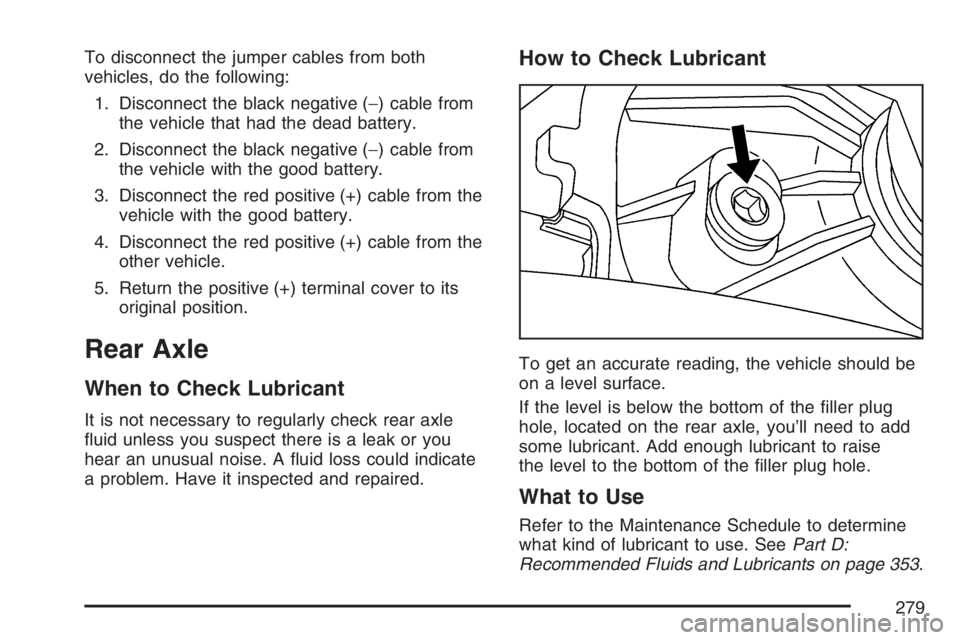
How to Check Lubricant
To get an accurate reading, the vehicle should be
on a level surface.
If the level is below the bottom of the ller plug
hole, located on the rear axle, you’ll need to add
some lubricant. Add enough lubricant to raise
the level to the bottom of the ller plug hole.
What to Use
Refer to the Maintenance Schedule to determine
what kind of lubricant to use. SeePart D:
Recommended Fluids and Lubricants on page 353.
279
Page 326 of 396

Electrical System
Add-On Electrical Equipment
Notice:Do not add anything electrical to your
vehicle unless you check with your dealer
rst. Some electrical equipment can damage
your vehicle and the damage would not
be covered by your warranty. Some add-on
electrical equipment can keep other
components from working as they should.
Add-on equipment can drain your vehicle’s battery,
even if your vehicle is not operating.
Your vehicle has an airbag system. Before
attempting to add anything electrical to your
vehicle, seeServicing Your Airbag-Equipped
Vehicle on page 54.
Headlamp Wiring
The headlamp wiring is protected by fuses. An
electrical overload will cause the lamps to remain
off. If this happens, have your headlamp wiring
checked right away.
Power Windows and Other
Power Options
Circuit breakers protect the power windows and
other power accessories. When the current load is
too heavy, the circuit breaker opens and closes,
protecting the circuit until the problem is xed
or goes away.
Fuses and Circuit Breakers
The wiring circuits in your vehicle are protected from
short circuits by a combination of J-Case fuses,
mini-fuses and circuit breakers. This greatly reduces
the chance of res caused by electrical problems.
326
Page 369 of 396
Emergency Tow From a Public Roadway or
Highway:Tow to the nearest dealership for
warranty service or in the event of a
vehicle-disabling accident. Winch-out
assistance when the vehicle is mired in sand,
mud, or snow.
Flat Tire Change:Installation of your spare tire
in good condition is covered at no charge. The
customer is responsible for the repair or
replacement of the tire if not covered by a
warrantable failure.
Jump Start:No-start occurrences which
require a battery jump start is covered at no
charge.
Additional Services for Canadian
Customers
Trip Routing Service:Upon Request,
Roadside Assistance can send you detailed,
computer-personalized maps, highlighting your
choice of either the most direct route or the
most scenic route to your destination,
anywhere in North America, along with any
helpful travel information we may have
pertaining to your trip. To request this service,
please call us toll-free at 1-800-268-6800.We will make every attempt to send your
personalized trip routing as quickly as
possible, but it’s best to allow three weeks
before your planned departure date.
Trip routing requests will be limited to
six per calendar year.
Trip Interruption Benets and Assistance:
In the event of a warranty related vehicle
disablement, while en route and over
250 kilometres from original point of departure,
you may qualify for trip interruption expense
assistance. This assistance covers reasonable
reimbursement of up to a maximum of $500
(Canadian) for (A) meals (maximum of
$50/day), (B) lodging (maximum of $100/night)
and (C) alternate ground transportation
(maximum of $40/day). This benet is to assist
you with some of the unplanned expense
you may incur while waiting for your vehicle to
be repaired.
Pre-authorization, original detailed receipts
and a copy of the repair order are required.
Once authorization has been given, your
advisor will help you make any necessary
arrangements and explain how to claim for trip
interruption expense assistance.
369
Page 384 of 396

Audio System(s).......................................... 157
Audio Steering Wheel Controls................. 185
Care of Your CD Player........................... 187
Care of Your CDs.................................... 187
Fixed Mast Antenna................................. 187
Radio with CD................................161, 166
Setting the Time..............................158, 159
Theft-Deterrent Feature............................ 185
Understanding Radio Reception............... 186
XM™ Satellite Radio Antenna System...... 187
Automatic Door Lock..................................... 67
Automatic Door Unlock.................................. 67
Automatic Transmission
Fluid........................................................ 256
Operation................................................... 82
B
Battery........................................................ 273
Run-Down Protection............................... 121
Before Leaving on a Long Trip.................... 216
Brake
Anti-Lock Brake System (ABS)................. 195
Emergencies............................................ 197
Parking...................................................... 86
System Inspection.................................... 352
System Warning Light.............................. 134Brakes........................................................ 270
Braking....................................................... 194
Braking in Emergencies............................... 197
Break-In, New Vehicle................................... 76
Bulb Replacement....................................... 280
Back-Up Lamps....................................... 282
Front Turn Signal, Parking and
Fog Lamps........................................... 281
Halogen Bulbs......................................... 280
Headlamps............................................... 280
License Plate Lamps................................ 282
Replacement Bulbs.................................. 283
Taillamps, Turn Signal, and Stoplamps..... 281
Buying New Tires........................................ 296
C
California Fuel............................................. 238
California Proposition 65 Warning................ 236
Canadian Owners........................................... 3
Capacities and Specications...................... 332
Carbon Monoxide.................. 68, 91,220, 231
Care of
Safety Belts............................................. 317
Your CD Player........................................ 187
Your CDs ................................................. 187
CD, MP3 ..................................................... 176
384
Page 387 of 396

Electronic Stability Control Indicator Light...... 136
Engine
Air Cleaner/Filter...................................... 254
Battery..................................................... 273
Check and Service Engine Soon Light..... 138
Coolant.................................................... 257
Coolant Temperature Warning Light.......... 137
Cooling System Inspection....................... 352
Drive Belt Routing.................................... 356
Engine Compartment Overview................ 244
Exhaust..................................................... 91
Oil ........................................................... 247
Oil Life System........................................ 252
Overheating............................................. 260
Reduced Power Light............................... 143
Starting...................................................... 80
Entry/Exit Lighting....................................... 120
Event Data Recorders (EDR)...................... 373
Extender, Safety Belt..................................... 26
F
Filter
Engine Air Cleaner................................... 254
Finish Damage............................................ 322
Fixed Mast Antenna.................................... 187Flashers, Hazard Warning........................... 110
Flash-to-Pass.............................................. 113
Flat Tire...................................................... 302
Fluid
Automatic Transmission............................ 256
Manual Transmission................................ 256
Power Steering........................................ 268
Windshield Washer.................................. 269
Fog Lamps.................................................. 120
Fuel............................................................ 237
Additives.................................................. 238
California Fuel.......................................... 238
Filling a Portable Fuel Container.............. 242
Filling Your Tank...................................... 240
Fuels in Foreign Countries....................... 239
Gage....................................................... 144
Gasoline Octane...................................... 237
Gasoline Specications............................ 237
Low Warning Light................................... 145
System Inspection.................................... 351
Fuses
Floor Console Fuse Block........................ 327
Fuses and Circuit Breakers...................... 326
Underhood Fuse Block............................. 329
387
Page 389 of 396

Instrument Panel
Overview.................................................. 108
Instrument Panel (I/P)
Brightness................................................ 120
Cluster..................................................... 128
J
Jump Starting.............................................. 274
K
Keyless Entry System................................... 61
Keys............................................................. 60
L
Labeling, Tire Sidewall................................. 286
Lamps
Battery Run-Down Protection................... 121
Fog .......................................................... 120
Mirror Reading......................................... 120
LATCH System
Child Restraints......................................... 37
Latches, Seatback......................................... 11License Plate Lamps................................... 282
Lift Seat, Power............................................ 12
Light
Airbag Readiness..................................... 131
Anti-Lock Brake System Warning............. 135
Brake System Warning............................. 134
Charging System..................................... 134
Electronic Stability Control........................ 136
Engine Coolant Temperature Warning....... 137
Highbeam On.......................................... 143
Low Coolant Warning............................... 138
Low Fuel Warning.................................... 145
Malfunction Indicator................................ 138
Oil Pressure............................................. 142
Passenger Airbag Status Indicator............ 132
Passenger Safety Belt Reminder.............. 130
Reduced Engine Power............................ 143
Safety Belt Reminder............................... 130
Security................................................... 143
Service Vehicle Soon............................... 144
Traction Control System........................... 136
Trunk Ajar................................................ 144
Lighting
Entry/Exit................................................. 120
Limited-Slip Rear Axle................................. 200
389