transmission PONTIAC SOLSTICE 2007 Owner's Manual
[x] Cancel search | Manufacturer: PONTIAC, Model Year: 2007, Model line: SOLSTICE, Model: PONTIAC SOLSTICE 2007Pages: 396, PDF Size: 2.27 MB
Page 117 of 396
Reducing Speed While Using
Cruise Control
If the cruise control system is already engaged,
Push and hold the SET−part of the button
until you reach the lower speed desired,
then release it.
To slow down in very small amounts, push the
SET−part of the button briey. Each time this
is done, your vehicle will go about 1 mph
(1.6 km/h) slower.
Passing Another Vehicle While Using
Cruise Control
Use the accelerator pedal to increase your speed.
When you take your foot off the pedal, your
vehicle will slow down to the cruise control speed
you set earlier.
Using Cruise Control on Hills
How well your cruise control will work on hills
depends upon the vehicle speed, load, and the
steepness of the hills. When going up steep hills,
you might have to step on the accelerator pedal
to maintain the vehicle speed. When going
downhill, you might have to brake or shift to a
lower gear to keep the vehicle speed down.
Of course, applying the brake turns off the cruise
control. Many drivers nd this to be too much
trouble and do not use cruise control on steep hills.
Ending Cruise Control
To end cruise control, step lightly on the brake
pedal or the clutch pedal if your vehicle has
a manual transmission.
Stepping on the brake pedal or clutch pedal will
only end the current cruise control session. Press
the cruise control on/off button to turn the
system completely off.
Erasing Speed Memory
When you turn off the cruise control or the
ignition, the cruise control set speed memory is
erased.
117
Page 118 of 396
Headlamps
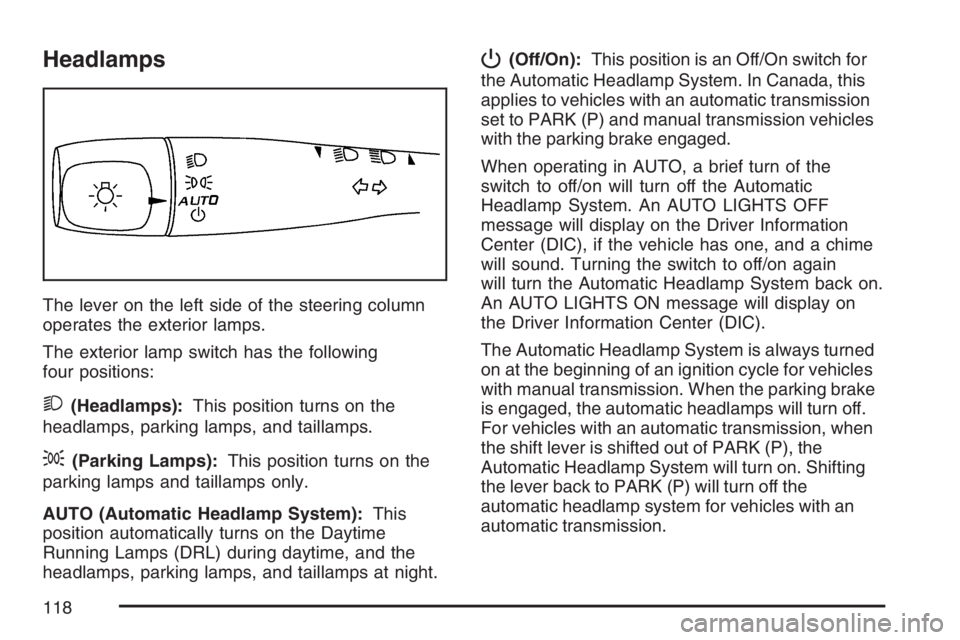
The lever on the left side of the steering column
operates the exterior lamps.
The exterior lamp switch has the following
four positions:
2(Headlamps):This position turns on the
headlamps, parking lamps, and taillamps.
;(Parking Lamps):This position turns on the
parking lamps and taillamps only.
AUTO (Automatic Headlamp System):This
position automatically turns on the Daytime
Running Lamps (DRL) during daytime, and the
headlamps, parking lamps, and taillamps at night.
P(Off/On):This position is an Off/On switch for
the Automatic Headlamp System. In Canada, this
applies to vehicles with an automatic transmission
set to PARK (P) and manual transmission vehicles
with the parking brake engaged.
When operating in AUTO, a brief turn of the
switch to off/on will turn off the Automatic
Headlamp System. An AUTO LIGHTS OFF
message will display on the Driver Information
Center (DIC), if the vehicle has one, and a chime
will sound. Turning the switch to off/on again
will turn the Automatic Headlamp System back on.
An AUTO LIGHTS ON message will display on
the Driver Information Center (DIC).
The Automatic Headlamp System is always turned
on at the beginning of an ignition cycle for vehicles
with manual transmission. When the parking brake
is engaged, the automatic headlamps will turn off.
For vehicles with an automatic transmission, when
the shift lever is shifted out of PARK (P), the
Automatic Headlamp System will turn on. Shifting
the lever back to PARK (P) will turn off the
automatic headlamp system for vehicles with an
automatic transmission.
118
Page 119 of 396

Headlamps on Reminder
If you open the driver’s door with the ignition off
and the lamps on, you will hear a warning chime.
Daytime Running Lamps (DRL)
Daytime Running Lamps (DRL) can make it easier
for others to see the front of your vehicle during
the day. DRL can be helpful in many different
driving conditions, but they can be especially
helpful in the short periods after dawn and before
sunset. Fully functional daytime running lamps
are required on all vehicles rst sold in Canada.
Your vehicle has a light sensor on top of the
instrument panel that helps control the DRL. Make
sure it is not covered or the headlamps will
come on when they are not needed.The DRL system makes both low beam headlamps
turn on at reduced intensity when the following
conditions are met:
The ignition is on.
The exterior lamp control is turned to AUTO.
The light sensor detects daytime light.
The shift lever is not in PARK (P).
While the DRL system is on, the taillamps,
sidemarker lamps, and instrument panel lights will
not be on.
The DRL system turns off on U.S. vehicles by
using the on/off switch for one ignition cycle, if the
vehicle is in the PARK (P) position, or if the
vehicle speed is less than 5 mph (8 km h) after
the vehicle is started.
For vehicles rst sold in Canada the DRL system
will turn off when a automatic transmission
vehicle is in the PARK (P) position or the park
brake is set on a manual transmission vehicle and
the vehicle speed is less than 8 mph (13 km h).
As with any vehicle, you should turn on the regular
headlamp system when it is needed.
119
Page 139 of 396

Notice:If you keep driving your vehicle with
this light on, after awhile, your emission
controls may not work as well, your fuel
economy may not be as good, and your engine
may not run as smoothly. This could lead to
costly repairs that may not be covered by your
warranty.
Notice:Modications made to the engine,
transmission, exhaust, intake, or fuel system
of your vehicle or the replacement of the
original tires with other than those of the same
Tire Performance Criteria (TPC) can affect
your vehicle’s emission controls and may
cause this light to come on. Modications to
these systems could lead to costly repairs not
covered by your warranty. This may also
result in a failure to pass a required Emission
Inspection/Maintenance test. SeeAccessories
and Modifications on page 235.This light should come on, as a check to show
you it is working, when the ignition is on and the
engine is not running. If the light does not
come on, have it repaired. This light will also
come on during a malfunction in one of two ways:
Light Flashing— A misre condition has
been detected. A misre increases vehicle
emissions and may damage the emission
control system on your vehicle. Diagnosis and
service may be required.
Light On Steady— An emission control
system malfunction has been detected on your
vehicle. Diagnosis and service may be
required.
139
Page 155 of 396

AUTO UNLK (Unlock)
This feature, which allows the vehicle to
automatically unlock certain doors, can be enabled
or disabled. When AUTO UNLK appears on the
display, press and hold the reset button for at least
one second to scroll through the available settings:
ALL (default):All of the doors will automatically
unlock.
DRIVER:The driver’s door will
automatically unlock.
NONE:None of the doors will automatically unlock.
You will need to manually unlock the doors.
If you have a manual transmission vehicle, the
door(s) will automatically unlock when the key is
turned off.
If you have an automatic transmission vehicle, you
can select when the automatic unlocking will occur.
See “UNLK (Unlock) (Automatic Transmission
Only)” following.
SeeAutomatic Door Unlock on page 67for more
information.
Choose one of the available settings and press
the information button to select it and move on to
the next feature.
UNLK (Unlock) (Automatic
Transmission Only)
This screen displays only if your vehicle has an
automatic transmission and DRIVER or ALL is
selected for the AUTO UNLK feature. This feature
determines when the automatic door unlocking will
occur. When UNLK appears on the display, press
and hold the reset button for at least one second to
scroll through the available settings:
KEY OFF:The door(s) will unlock when the key
is turned off.
SHIFT TO P (Park) (default):The door(s) will
unlock when the vehicle is shifted into PARK (P).
SeeAutomatic Door Unlock on page 67for
more information.
Choose one of the available settings and press
the information button to select it and move on to
the next feature.
155
Page 200 of 396

Notice:When traction control is turned off,
or Competitive Driving Mode is active, it is
possible to lose traction. If you attempt to shift
with the rear wheels spinning with a loss of
traction, it is possible to cause damage to the
transmission. Do not attempt to shift when the
rear wheels do not have traction. Damage
caused by misuse of the vehicle is not covered.
See your warranty book for additional
information.
The traction control system may activate on dry or
rough roads or under conditions such as heavy
acceleration while turning or abrupt upshifts/
downshifts of the transmission. When this
happens, you may notice a reduction in
acceleration, or may hear a noise or vibration.
This is normal.
If your vehicle is in cruise control when the system
activates, the ESC/TCS light will ash and the
cruise control will automatically disengage. When
road conditions allow you to use cruise control
again, you may re-engage the cruise control. See
Cruise Control on page 115.
Adding non-GM accessories can affect your
vehicle’s performance. SeeAccessories and
Modications on page 235for more information.Limited-Slip Rear Axle
Your vehicle may have a limited-slip rear
differential which provides maximum power and
performance. It is designed to give you additional
traction on snow, mud, ice, sand or gravel. It
works like a standard axle most of the time, but
when one of the rear wheels has no traction
and the other does, this feature will allow
the wheel with traction to move the vehicle.
During a sudden shift, such as shifting from
FIRST (1) to SECOND (2) gear at low engine
speeds or suddenly applying the clutch, you may
feel or hear a clunking or rattling noise. This is
normal.
Electronic Stability Control
Your vehicle may be equipped with an Electronic
Stability Control (ESC) system which combines
antilock brake, traction and stability control
systems and helps the driver maintain directional
control of the vehicle in most driving conditions.
When you rst start your vehicle and begin to drive
away, the system performs several diagnostic
checks to ensure there are no problems. You may
hear or feel the system working.
200
Page 203 of 396

The ESC/TCS light will be on and the traction
control system will not be operating. Adjust your
driving accordingly. This electronic stability control
mode is recommended only for use during closed
track events and competitive driving venues.
When you press the ESC button again, or restart
the vehicle, the ESC and TCS will be turned
back on.
Notice:When traction control is turned off,
or Competitive Driving Mode is active, it
is possible to lose traction. If you attempt to
shift with the rear wheels spinning with a loss
of traction, it is possible to cause damage
to the transmission. Do not attempt to shift
when the rear wheels do not have traction.
Damage caused by misuse of the vehicle is
not covered. See your warranty book for
additional information.Steering
Power Steering
If you lose power steering assist because the
engine stops or the system is not functioning,
you can steer but it will take much more effort.
Steering Tips
It is important to take curves at a reasonable speed.
A lot of the “driver lost control” accidents
mentioned on the news happen on curves.
Here is why:
Experienced driver or beginner, each of us is
subject to the same laws of physics when driving on
curves. The traction of the tires against the road
surface makes it possible for the vehicle to change
its path when you turn the front wheels. If there is
no traction, inertia will keep the vehicle going in the
same direction. If you have ever tried to steer a
vehicle on wet ice, you will understand this.
203
Page 218 of 396

Hill and Mountain Roads
Driving on steep hills or mountains is different
from driving in at or rolling terrain.If you drive regularly in steep country, or if you are
planning to visit there, here are some tips that
can make your trips safer and more enjoyable.
Keep your vehicle in good shape. Check
all uid levels and also the brakes, tires,
cooling system, and transmission. These parts
can work hard on mountain roads.
{CAUTION:
If you do not shift down, your brakes
could get so hot that they would not work
well. You would then have poor braking or
even none going down a hill. You could
crash. Shift down to let your engine assist
your brakes on a steep downhill slope.
218
Page 219 of 396

{CAUTION:
Coasting downhill in NEUTRAL (N) or with
the ignition off is dangerous. Your brakes
will have to do all the work of slowing
down. They could get so hot that they
would not work well. You would then have
poor braking or even none going down a
hill. You could crash. Always have your
engine running and your vehicle in gear
when you go downhill.
Know how to go down hills. The most important
thing to know is this: let your engine do some of
the slowing down. Shift to a lower gear when
you go down a steep or long hill.
Know how to go uphill. You may want to shift
down to a lower gear. The lower gears help
cool your engine and transmission, and you can
climb the hill better.
Stay in your own lane when driving on two-lane
roads in hills or mountains. Do not swing wide
or cut across the center of the road. Drive at
speeds that let you stay in your own lane.
As you go over the top of a hill, be alert. There
could be something in your lane, like a stalled
car or an accident.
You may see highway signs on mountains that
warn of special problems. Examples are long
grades, passing or no-passing zones, a falling
rocks area, or winding roads. Be alert to these
and take appropriate action.
219
Page 225 of 396

{CAUTION:
If you let your vehicle’s tires spin at high
speed, they can explode, and you or others
could be injured. And, the transmission or
other parts of the vehicle can overheat.
That could cause an engine compartment
re or other damage. When you are stuck,
spin the wheels as little as possible. Do not
spin the wheels above 35 mph (55 km/h)
as shown on the speedometer.
Notice:Spinning the wheels can destroy
parts of your vehicle as well as the tires. If you
spin the wheels too fast while shifting the
transmission back and forth, you can destroy
the transmission.
For information about using tire chains on your
vehicle, seeTire Chains on page 302.
Rocking Your Vehicle to Get It Out
First, turn the steering wheel left and right.
That will clear the area around the front wheels.
If your vehicle has traction control, you should
turn the traction control system off. SeeTraction
Control System (TCS) on page 198andElectronic
Stability Control on page 200. Then shift back
and forth between REVERSE (R) and a forward
gear, or with a manual transmission between
FIRST (1) or SECOND (2) and REVERSE (R),
spinning the wheels as little as possible. To
prevent transmission wear, allow the wheels to
stop spinning before shifting gears. Release
the accelerator pedal while you shift, and press
lightly on the accelerator pedal when the
transmission is in gear.
225