235 PONTIAC SOLSTICE 2007 Owners Manual
[x] Cancel search | Manufacturer: PONTIAC, Model Year: 2007, Model line: SOLSTICE, Model: PONTIAC SOLSTICE 2007Pages: 396, PDF Size: 2.27 MB
Page 2 of 396
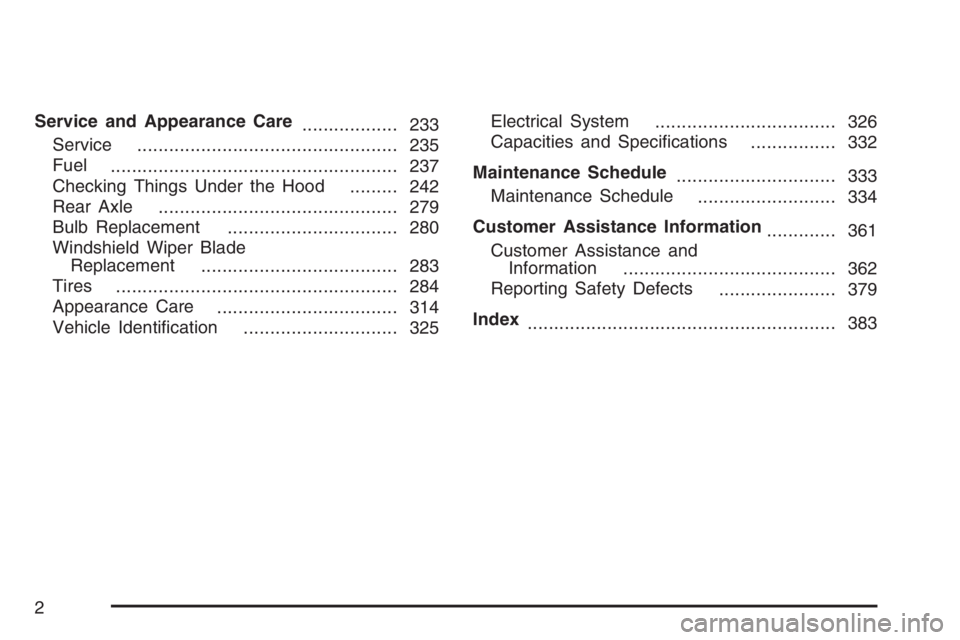
Service and Appearance Care
.................. 233
Service
................................................. 235
Fuel
...................................................... 237
Checking Things Under the Hood
......... 242
Rear Axle
............................................. 279
Bulb Replacement
................................ 280
Windshield Wiper Blade
Replacement
..................................... 283
Tires
..................................................... 284
Appearance Care
.................................. 314
Vehicle Identication
............................. 325Electrical System
.................................. 326
Capacities and Specications
................ 332
Maintenance Schedule
.............................. 333
Maintenance Schedule
.......................... 334
Customer Assistance Information
............. 361
Customer Assistance and
Information
........................................ 362
Reporting Safety Defects
...................... 379
Index
.......................................................... 383
2
Page 139 of 396

Notice:If you keep driving your vehicle with
this light on, after awhile, your emission
controls may not work as well, your fuel
economy may not be as good, and your engine
may not run as smoothly. This could lead to
costly repairs that may not be covered by your
warranty.
Notice:Modications made to the engine,
transmission, exhaust, intake, or fuel system
of your vehicle or the replacement of the
original tires with other than those of the same
Tire Performance Criteria (TPC) can affect
your vehicle’s emission controls and may
cause this light to come on. Modications to
these systems could lead to costly repairs not
covered by your warranty. This may also
result in a failure to pass a required Emission
Inspection/Maintenance test. SeeAccessories
and Modifications on page 235.This light should come on, as a check to show
you it is working, when the ignition is on and the
engine is not running. If the light does not
come on, have it repaired. This light will also
come on during a malfunction in one of two ways:
Light Flashing— A misre condition has
been detected. A misre increases vehicle
emissions and may damage the emission
control system on your vehicle. Diagnosis and
service may be required.
Light On Steady— An emission control
system malfunction has been detected on your
vehicle. Diagnosis and service may be
required.
139
Page 194 of 396
Control of a Vehicle
You have three systems that make your
vehicle go where you want it to go. They are the
brakes, the steering, and the accelerator. All
three systems have to do their work at the places
where the tires meet the road.
Sometimes, as when you are driving on snow or
ice, it is easy to ask more of those control systems
than the tires and road can provide. That means
you can lose control of your vehicle. SeeTraction
Control System (TCS) on page 198and
Electronic Stability Control on page 200.
Adding non-GM accessories can affect your
vehicle’s performance. SeeAccessories and
Modications on page 235.
Braking
SeeBrake System Warning Light on page 134.
Braking action involves perception time and
reaction time.
First, you have to decide to push on the brake
pedal. That is perception time. Then you have to
bring up your foot and do it. That is reaction time.
Average reaction time is about three-fourths of a
second. But that is only an average. It might be less
with one driver and as long as two or three seconds
or more with another. Age, physical condition,
alertness, coordination, and eyesight all play a part.
So do alcohol, drugs, and frustration. But even in
three-fourths of a second, a vehicle moving at
60 mph (100 km/h) travels 66 feet (20 m). That
could be a lot of distance in an emergency, so
keeping enough space between your vehicle and
others is important.
And, of course, actual stopping distances vary
greatly with the surface of the road, whether it is
pavement or gravel; the condition of the road,
whether it is wet, dry, or icy; tire tread; the
condition of the brakes; the weight of the vehicle;
and the amount of brake force applied.
194
Page 195 of 396

Avoid needless heavy braking. Some people drive
in spurts — heavy acceleration followed by heavy
braking — rather than keeping pace with traffic.
This is a mistake. The brakes may not have time to
cool between hard stops. The brakes will wear out
much faster if you do a lot of heavy braking. If you
keep pace with the traffic and allow realistic
following distances, you will eliminate a lot of
unnecessary braking. That means better braking
and longer brake life.
If your vehicle’s engine ever stops while you are
driving, brake normally but do not pump the
brakes. If you do, the pedal may get harder to
push down. If the engine stops, you will still have
some power brake assist. But you will use it
when you brake. Once the power assist is used
up, it may take longer to stop and the brake pedal
will be harder to push.
Adding non-GM accessories can affect your
vehicle’s performance. SeeAccessories and
Modications on page 235.Anti-Lock Brake System (ABS)
Your vehicle may have the Anti-Lock Brake
System (ABS), an advanced electronic braking
system that will help prevent a braking skid.
If your vehicle has ABS,
this warning light on the
instrument panel will
come on briey when
you start your vehicle.
When you start your engine, or when you begin to
drive away, your ABS will check itself. You may
hear a momentary motor or clicking noise
while this test is going on, and you may even
notice that your brake pedal moves or pulses a
little. This is normal.
195
Page 200 of 396

Notice:When traction control is turned off,
or Competitive Driving Mode is active, it is
possible to lose traction. If you attempt to shift
with the rear wheels spinning with a loss of
traction, it is possible to cause damage to the
transmission. Do not attempt to shift when the
rear wheels do not have traction. Damage
caused by misuse of the vehicle is not covered.
See your warranty book for additional
information.
The traction control system may activate on dry or
rough roads or under conditions such as heavy
acceleration while turning or abrupt upshifts/
downshifts of the transmission. When this
happens, you may notice a reduction in
acceleration, or may hear a noise or vibration.
This is normal.
If your vehicle is in cruise control when the system
activates, the ESC/TCS light will ash and the
cruise control will automatically disengage. When
road conditions allow you to use cruise control
again, you may re-engage the cruise control. See
Cruise Control on page 115.
Adding non-GM accessories can affect your
vehicle’s performance. SeeAccessories and
Modications on page 235for more information.Limited-Slip Rear Axle
Your vehicle may have a limited-slip rear
differential which provides maximum power and
performance. It is designed to give you additional
traction on snow, mud, ice, sand or gravel. It
works like a standard axle most of the time, but
when one of the rear wheels has no traction
and the other does, this feature will allow
the wheel with traction to move the vehicle.
During a sudden shift, such as shifting from
FIRST (1) to SECOND (2) gear at low engine
speeds or suddenly applying the clutch, you may
feel or hear a clunking or rattling noise. This is
normal.
Electronic Stability Control
Your vehicle may be equipped with an Electronic
Stability Control (ESC) system which combines
antilock brake, traction and stability control
systems and helps the driver maintain directional
control of the vehicle in most driving conditions.
When you rst start your vehicle and begin to drive
away, the system performs several diagnostic
checks to ensure there are no problems. You may
hear or feel the system working.
200
Page 202 of 396
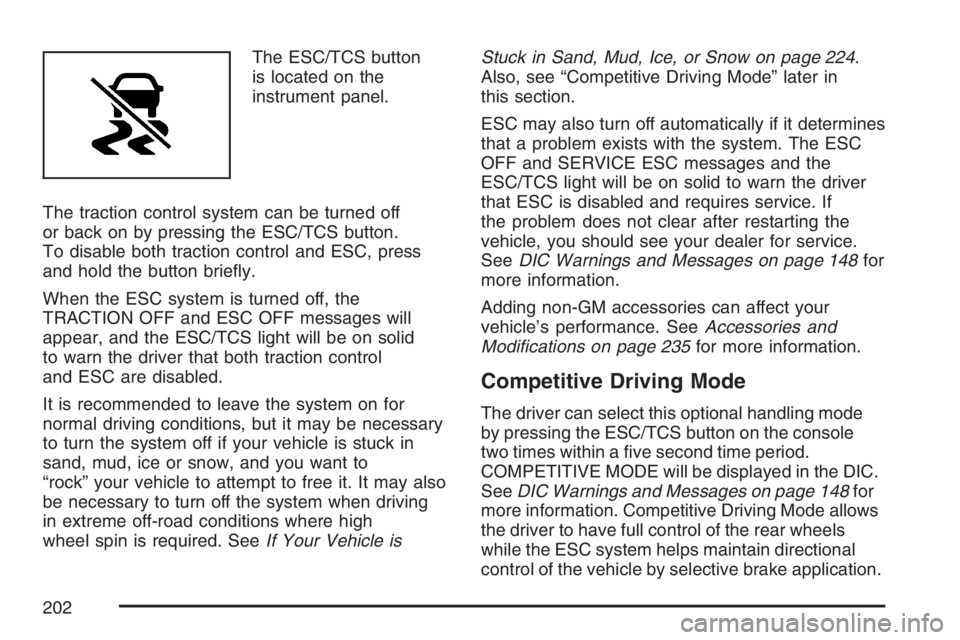
The ESC/TCS button
is located on the
instrument panel.
The traction control system can be turned off
or back on by pressing the ESC/TCS button.
To disable both traction control and ESC, press
and hold the button briey.
When the ESC system is turned off, the
TRACTION OFF and ESC OFF messages will
appear, and the ESC/TCS light will be on solid
to warn the driver that both traction control
and ESC are disabled.
It is recommended to leave the system on for
normal driving conditions, but it may be necessary
to turn the system off if your vehicle is stuck in
sand, mud, ice or snow, and you want to
“rock” your vehicle to attempt to free it. It may also
be necessary to turn off the system when driving
in extreme off-road conditions where high
wheel spin is required. SeeIf Your Vehicle isStuck in Sand, Mud, Ice, or Snow on page 224.
Also, see “Competitive Driving Mode” later in
this section.
ESC may also turn off automatically if it determines
that a problem exists with the system. The ESC
OFF and SERVICE ESC messages and the
ESC/TCS light will be on solid to warn the driver
that ESC is disabled and requires service. If
the problem does not clear after restarting the
vehicle, you should see your dealer for service.
SeeDIC Warnings and Messages on page 148for
more information.
Adding non-GM accessories can affect your
vehicle’s performance. SeeAccessories and
Modications on page 235for more information.
Competitive Driving Mode
The driver can select this optional handling mode
by pressing the ESC/TCS button on the console
two times within a ve second time period.
COMPETITIVE MODE will be displayed in the DIC.
SeeDIC Warnings and Messages on page 148for
more information. Competitive Driving Mode allows
the driver to have full control of the rear wheels
while the ESC system helps maintain directional
control of the vehicle by selective brake application.
202
Page 204 of 396
The traction you can get in a curve depends on
the condition of your tires and the road surface,
the angle at which the curve is banked, and
your speed. While you are in a curve, speed is the
one factor you can control.
Suppose you are steering through a sharp curve.
Then you suddenly apply the brakes. Both
control systems — steering and braking — have
to do their work where the tires meet the road.
Unless you have four-wheel anti-lock brakes,
adding the hard braking can demand too much of
those places. You can lose control.
The same thing can happen if you are steering
through a sharp curve and you suddenly
accelerate. Those two control systems — steering
and acceleration — can overwhelm those
places where the tires meet the road and make
you lose control. SeeTraction Control System
(TCS) on page 198andElectronic Stability Control
on page 200.What should you do if this ever happens? Ease up
on the brake or accelerator pedal, steer the
vehicle the way you want it to go, and slow down.
Speed limit signs near curves warn that you
should adjust your speed. Of course, the posted
speeds are based on good weather and road
conditions. Under less favorable conditions you will
want to go slower.
If you need to reduce your speed as you approach
a curve, do it before you enter the curve, while
your front wheels are straight ahead.
Try to adjust your speed so you can “drive”
through the curve. Maintain a reasonable, steady
speed. Wait to accelerate until you are out of
the curve, and then accelerate gently into
the straightaway.
Adding non-GM accessories can affect your
vehicle’s performance. SeeAccessories and
Modications on page 235.
204
Page 233 of 396

Service........................................................ 235
Accessories and Modications................... 235
California Proposition 65 Warning.............. 236
Doing Your Own Service Work.................. 236
Adding Equipment to the Outside
of Your Vehicle...................................... 237
Fuel............................................................. 237
Gasoline Octane........................................ 237
Gasoline Specications.............................. 237
California Fuel........................................... 238
Additives................................................... 238
Fuels in Foreign Countries........................ 239
Filling the Tank......................................... 240
Filling a Portable Fuel Container............... 242
Checking Things Under the Hood.............. 242
Hood Release........................................... 243
Engine Compartment Overview.................. 244
Engine Oil................................................. 247
Engine Oil Life System.............................. 252
Engine Air Cleaner/Filter............................ 254
Automatic Transmission Fluid.................... 256
Manual Transmission Fluid........................ 256
Hydraulic Clutch........................................ 256
Engine Coolant.......................................... 257Coolant Surge Tank Pressure Cap............ 260
Engine Overheating................................... 260
Cooling System......................................... 262
Power Steering Fluid ................................. 268
Windshield Washer Fluid........................... 269
Brakes...................................................... 270
Battery...................................................... 273
Jump Starting............................................ 274
Rear Axle.................................................... 279
Bulb Replacement....................................... 280
Halogen Bulbs........................................... 280
Headlamps................................................ 280
Front Turn Signal, Parking and
Fog Lamps............................................ 281
Taillamps, Turn Signal, and Stoplamps...... 281
Back-Up Lamps......................................... 282
License Plate Lamp................................... 282
Replacement Bulbs................................... 283
Windshield Wiper Blade Replacement....... 283
Tires............................................................ 284
Winter Tires.............................................. 285
Tire Sidewall Labeling............................... 286
Tire Terminology and Denitions............... 289
Section 5 Service and Appearance Care
233
Page 235 of 396
Service
Your dealer knows your vehicle best and wants
you to be happy with it. We hope you will go
to your dealer for all your service needs. You will
get genuine GM parts and GM-trained and
supported service people.
We hope you will want to keep your GM vehicle all
GM. Genuine GM parts have one of these marks:
Accessories and Modications
When you add non-GM accessories to your vehicle
they can affect your vehicle’s performance and
safety, including such things as, airbags, braking,
stability, ride and handling, emissions systems,
aerodynamics, durability, and electronic systems
like anti-lock brakes, traction control and
stability control. Some of these accessories may
even cause malfunction or damage not covered
by warranty.
GM Accessories are designed to complement
and function with other systems on your vehicle.
Your GM dealer can accessorize your vehicle
using genuine GM Accessories. When you go to
your GM dealer and ask for GM Accessories,
you will know that GM-trained and supported
service technicians will perform the work using
genuine GM Accessories.
235
Page 297 of 396
If you must replace your vehicle’s tires with those
that do not have a TPC Spec number, make
sure they are the same size, load range, speed
rating, and construction type (radial and
bias-belted tires) as your vehicle’s original tires.
Your vehicle’s original equipment tires are listed
on the Tire and Loading Information label.
This label is attached to the vehicle’s center pillar
(B-pillar). SeeLoading Your Vehicle on page 226,
for more information about the Tire and Loading
Information label.
Different Size Tires and Wheels
If you add wheels or tires that are a different size
than your original equipment wheels and tires, this
may affect the way your vehicle performs, including
its braking, ride and handling characteristics,
stability, and resistance to rollover. Additionally,
if your vehicle has electronic systems such as,
anti-lock brakes, traction control, and electronic
stability control, the performance of these systems
can be affected.
{CAUTION:
If you add different sized wheels, your
vehicle may not provide an acceptable
level of performance and safety if tires
not recommended for those wheels are
selected. You may increase the chance
that you will crash and suffer serious
injury. Only use GM specic wheel and
tire systems developed for your vehicle,
and have them properly installed by a
GM certied technician.
SeeBuying New Tires on page 296and
Accessories and Modications on page 235
for additional information.
297