heat PONTIAC SOLSTICE 2007 Owners Manual
[x] Cancel search | Manufacturer: PONTIAC, Model Year: 2007, Model line: SOLSTICE, Model: PONTIAC SOLSTICE 2007Pages: 396, PDF Size: 2.27 MB
Page 42 of 396
7. Push and pull the child restraint in different
directions to be sure it is secure.
8. If the airbag is off, the off indicator on the
instrument panel will be lit and stay lit
when the vehicle is started.
If a child restraint has been installed and the on
indicator is lit, turn the vehicle off. Remove the child
restraint from the vehicle and reinstall the child
restraint.
If, after reinstalling the child restraint and restarting
the vehicle, the on indicator is still lit, check to
make sure that the vehicle’s seatback is not
pressing the child restraint into the seat cushion.
If this happens, slightly recline the vehicle’s
seatback and adjust the seat cushion if possible.
A thick layer of additional material such as a
blanket, or aftermarket equipment such as
seat covers, seat heaters and seat massagers,
located between the seat cushion and the
child restraint or small occupant, can affect
how the passenger sensing system operates.Remove any additional material from the seat
cushion before reinstalling or securing the
child restraint and before a small occupant,
including a small adult, sits in the passenger
position.
If the on indicator is still lit, do not install a child
restraint in this vehicle and check with your dealer.
To remove the child restraint, just unbuckle the
vehicle’s safety belt and let it go back all the way.
The safety belt will move freely again and be ready
to work for an adult or larger child passenger.
Airbag System
Your vehicle has an airbag for the driver and an
airbag for the right front passenger.
Airbags are designed to supplement the protection
provided by safety belts. Even though today’s
airbags are also designed to help reduce the risk
of injury from the force of an inating bag, all
airbags must inate very quickly to do their job.
42
Page 53 of 396
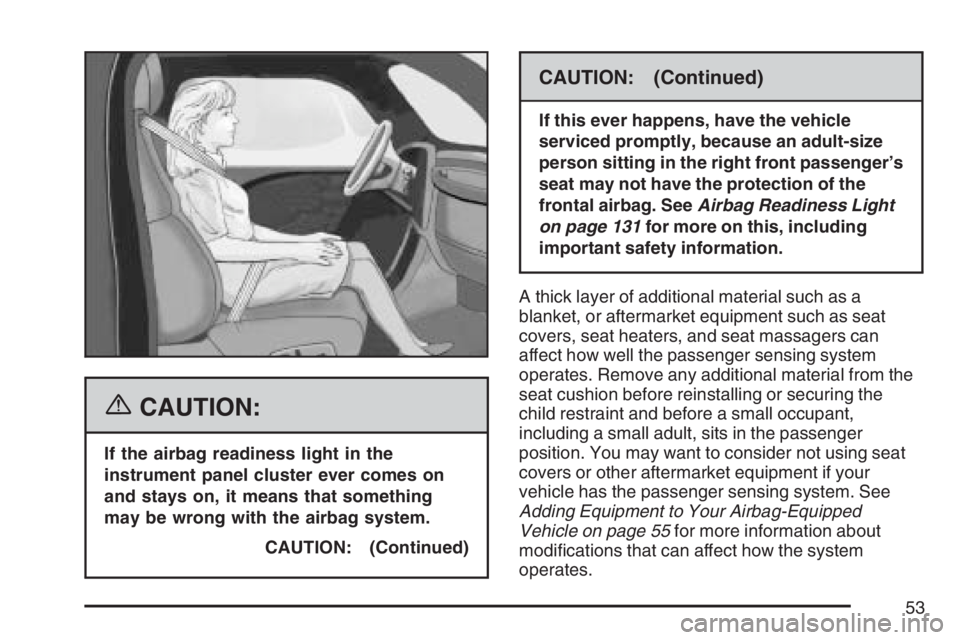
{CAUTION:
If the airbag readiness light in the
instrument panel cluster ever comes on
and stays on, it means that something
may be wrong with the airbag system.
CAUTION: (Continued)
CAUTION: (Continued)
If this ever happens, have the vehicle
serviced promptly, because an adult-size
person sitting in the right front passenger’s
seat may not have the protection of the
frontal airbag. SeeAirbag Readiness Light
on page 131for more on this, including
important safety information.
A thick layer of additional material such as a
blanket, or aftermarket equipment such as seat
covers, seat heaters, and seat massagers can
affect how well the passenger sensing system
operates. Remove any additional material from the
seat cushion before reinstalling or securing the
child restraint and before a small occupant,
including a small adult, sits in the passenger
position. You may want to consider not using seat
covers or other aftermarket equipment if your
vehicle has the passenger sensing system. See
Adding Equipment to Your Airbag-Equipped
Vehicle on page 55for more information about
modications that can affect how the system
operates.
53
Page 65 of 396

Doors and Locks
Manual Door Locks
{CAUTION:
Unlocked doors can be dangerous.
Passengers, especially children, can
easily open the doors and fall out of a
moving vehicle. When a door is
locked, the handle will not open it.
You increase the chance of being
thrown out of the vehicle in a crash if
the doors are not locked. So, wear
safety belts properly and lock the
doors whenever you drive.
CAUTION: (Continued)
CAUTION: (Continued)
Young children who get into unlocked
vehicles may be unable to get out.
A child can be overcome by extreme
heat and can suffer permanent injuries
or even death from heat stroke.
Always lock your vehicle whenever
you leave it.
Outsiders can easily enter through an
unlocked door when you slow down
or stop your vehicle. Locking your
doors can help prevent this from
happening.
There are a couple of ways to lock and unlock
your vehicle manually.
65
Page 68 of 396

Trunk
To release the trunk lid from the outside, use the
Remote Keyless Entry (RKE) transmitter, if the
vehicle has one. If your vehicle does not have an
RKE transmitter, see “Remote Trunk Release”
following.
{CAUTION:
It can be dangerous to drive with the trunk
lid open because carbon monoxide (CO)
gas can come into your vehicle. You
cannot see or smell CO. It can cause
unconsciousness and even death.
CAUTION: (Continued)
CAUTION: (Continued)
If you must drive with the trunk lid open
or if electrical wiring or other cable
connections must pass through the seal
between the body and the trunk lid:
Make sure all other windows are shut.
Turn the fan on your heating or
cooling system to its highest speed
and select the control setting that will
force outside air into your vehicle. See
Climate Control System.
If you have air outlets on or under
the instrument panel, open them all
the way.
SeeEngine Exhaust on page 91.
68
Page 70 of 396

Windows
{CAUTION:
Leaving children, helpless adults, or pets
in a vehicle with the windows closed is
dangerous. They can be overcome by the
extreme heat and suffer permanent
injuries or even death from heat stroke.
Never leave a child, a helpless adult, or a
pet alone in a vehicle, especially with the
windows closed in warm or hot weather.
70
Page 81 of 396

Your vehicle has a Computer-Controlled
Cranking System. This feature assists in
starting the engine and protects components.
If the ignition key is turned to the START
position, and then released when the engine
begins cranking, the engine will continue
cranking for a few seconds or until the vehicle
starts. If the engine does not start and the
key is held in START for many seconds,
cranking will be stopped after 15 seconds to
prevent cranking motor damage. To prevent
gear damage, this system also prevents
cranking if the engine is already running.
Engine cranking can be stopped by turning the
ignition switch to ACC or LOCK.
Notice:Cranking the engine for long periods
of time, by returning the key to the START
position immediately after cranking has ended,
can overheat and damage the cranking
motor, and drain the battery. Wait at least
15 seconds between each try, to allow
the cranking motor to cool down.2. If the engine does not start after 5-10 seconds,
especially in very cold weather (below 0°F
or−18°C), it could be ooded with too much
gasoline. Try pushing the accelerator
pedal all the way to the oor and holding it
there as you hold the key in START for up to
a maximum of 15 seconds. Wait at least
15 seconds between each try, to allow the
cranking motor to cool down. When the engine
starts, let go of the key and accelerator. If
the vehicle starts briey but then stops again,
do the same thing. This clears the extra
gasoline from the engine. Do not race the
engine immediately after starting it. Operate
the engine and transmission gently until the oil
warms up and lubricates all moving parts.
Notice:Your engine is designed to work with
the electronics in your vehicle. If you add
electrical parts or accessories, you could
change the way the engine operates. Before
adding electrical equipment, check with your
dealer. If you do not, your engine might not
perform properly. Any resulting damage would
not be covered by your vehicle’s warranty.
81
Page 87 of 396
To release the parking brake, hold the brake pedal
down. Pull the parking brake lever up until you can
press the release button. Hold the release button in
as you move the brake lever all the way down.
If you forget to release your parking brake, a chime
will sound and a warning message will be
displayed in the Driver Information Center (DIC)
when the vehicle is moving faster than 5 mph
(8 kph). SeeDIC Warnings and Messages
on page 148.
Notice:Driving with the parking brake on can
overheat the brake system and cause
premature wear or damage to brake system
parts. Verify that the parking brake is fully
released and the brake warning light is
off before driving.Shifting Into Park (P)
(Automatic Transmission)
{CAUTION:
It can be dangerous to get out of your
vehicle if the shift lever is not fully in
PARK (P) with the parking brake rmly
set. Your vehicle can roll. If you have left
the engine running, the vehicle can move
suddenly. You or others could be injured.
To be sure your vehicle will not move,
even when you are on fairly level ground,
use the steps that follow.
1. Hold the brake pedal down and set the
parking brake.
2. Move the shift lever into PARK (P) by holding
the button on the shift lever and pushing the
lever all the way toward the front of the vehicle.
3. Turn the ignition key to LOCK.
4. Remove the key and take it with you. If you
can leave your vehicle with the ignition key in
your hand, your vehicle is in PARK (P).
87
Page 88 of 396

Leaving Your Vehicle With the
Engine Running
{CAUTION:
It can be dangerous to leave your vehicle
with the engine running. Your vehicle
could move suddenly if the shift lever is
not fully in PARK (P) with the parking
brake rmly set. And, if you leave the
vehicle with the engine running, it could
overheat and even catch re. You or
others could be injured. Do not leave your
vehicle with the engine running.
If you have to leave your vehicle with the engine
running, be sure your vehicle is in PARK (P) and
your parking brake is rmly set before you leave it.
After you have moved the shift lever into PARK (P),
hold the regular brake pedal down. If the vehicle
has an automatic transmission, see if you can move
the shift lever away from PARK (P) without rst
pushing the shift lock release button. If you can, it
means that the shift lever was not fully locked into
PARK (P).
Torque Lock
If you are parking on a hill and you do not shift
your transmission into PARK (P) properly,
the weight of the vehicle may put too much force
on the parking pawl in the transmission. You
may nd it difficult to pull the shift lever out
of PARK (P). This is called “torque lock.” To
prevent torque lock, set the parking brake and then
shift into PARK (P) properly before you leave
the driver’s seat. To nd out how, seeShifting Into
Park (P) (Automatic Transmission) on page 87.
When you are ready to drive, move the shift
lever out of PARK (P)beforeyou release the
parking brake.
If torque lock does occur, you may need to have
another vehicle push yours a little uphill to
take some of the pressure from the parking pawl
in the transmission, so you can pull the shift
lever out of PARK (P).
88
Page 122 of 396
Ashtray(s) and Cigarette Lighter
Your vehicle may have an ashtray and cigarette
lighter. To use the lighter, located on the
instrument panel below the radio, push it in all the
way and let go. When it is ready, it will pop
back out by itself.
Notice:Holding a cigarette lighter in while it
is heating will not allow the lighter to back
away from the heating element when it is hot.
Damage from overheating may occur to the
lighter or heating element, or a fuse could be
blown. Do not hold a cigarette lighter in
while it is heating.
Notice:If you put papers, pins, or other
ammable items in the ashtray, hot cigarettes
or other smoking materials could ignite
them and possibly damage your vehicle. Never
put ammable items in the ashtray.
Climate Controls
Climate Control System
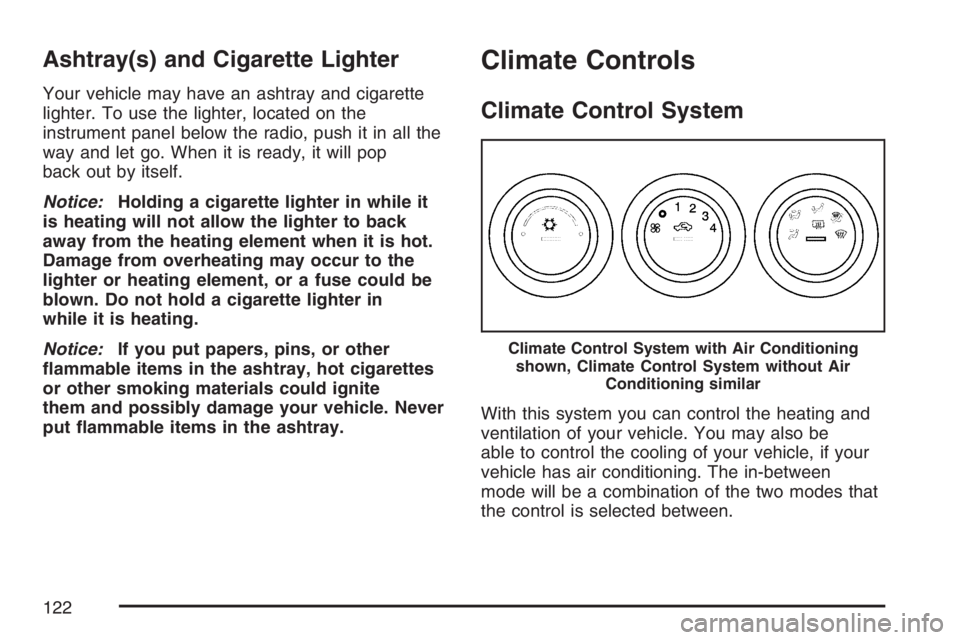
With this system you can control the heating and
ventilation of your vehicle. You may also be
able to control the cooling of your vehicle, if your
vehicle has air conditioning. The in-between
mode will be a combination of the two modes that
the control is selected between.
Climate Control System with Air Conditioning
shown, Climate Control System without Air
Conditioning similar
122
Page 124 of 396

9(Fan):Turn the center knob on the control
panel to control the fan speed. Turn the knob
clockwise or counterclockwise to increase
or decrease the fan speed.
9(Off):Turn the center knob to this position to
turn the fan off.
?(Recirculation):Press the center knob on
the control panel to recirculate air inside the
vehicle and prevent outside air from coming in.
It can be used to prevent outside odors from
entering your vehicle and cool the air inside your
vehicle more quickly. Press this button to turn
the recirculation mode on or off. An indicator light
on the button will come on to let you know the
recirculation mode is activated.
Recirculation is available in the bi-level and vent
modes. If recirculation is selected in either
oor/heat, oor/defog, or defrost mode, the LED
light will ash three times indicating it is not
available in that mode.The right knob on the control panel is used to
direct the airow inside your vehicle. Turn the knob
to select one of the following modes:
H(Vent):Turn the right knob on the control
panel to this mode to direct air to the instrument
panel outlets.
\(Bi-Level):Turn the right knob on the control
panel to this mode to direct air to the instrument
panel outlets, and the remaining air to the
oor outlets and the defroster and side window
outlets. Cooler air is directed to the upper outlets
and warmer air to the oor outlets.
[(Floor):Turn the right knob on the control
panel to this mode to direct most of the air to the
oor outlets. The remaining air is directed to
the side window and defroster outlets. If there is
little or no airow on the passenger side, make
sure that the carpet covering is tucked under the
oor outlets.
124