brake PONTIAC SOLSTICE 2008 Repair Manual
[x] Cancel search | Manufacturer: PONTIAC, Model Year: 2008, Model line: SOLSTICE, Model: PONTIAC SOLSTICE 2008Pages: 348, PDF Size: 5.23 MB
Page 268 of 348
Wheel Replacement
Replace any wheel that is bent, cracked, or badly rusted
or corroded. If wheel nuts keep coming loose, the wheel,
wheel bolts and wheel nuts should be replaced. If the
wheel leaks air, replace it (except some aluminum
wheels, which can sometimes be repaired). See
your dealer/retailer if any of these conditions exist.
Your dealer/retailer will know the kind of wheel
you need.
Each new wheel should have the same load-carrying
capacity, diameter, width, offset and be mounted
the same way as the one it replaces.
If you need to replace any of your wheels, wheel bolts
or wheel nuts, replace them only with new GM original
equipment parts. This way, you will be sure to have the
right wheel, wheel bolts and wheel nuts for your vehicle.{CAUTION:
Using the wrong replacement wheels, wheel
bolts, or wheel nuts on your vehicle can be
dangerous. It could affect the braking and
handling of your vehicle, make your tires lose
air and make you lose control. You could have
a collision in which you or others could be
injured. Always use the correct wheel, wheel
bolts, and wheel nuts for replacement.
Notice:The wrong wheel can also cause problems
with bearing life, brake cooling, speedometer or
odometer calibration, headlamp aim, bumper height,
vehicle ground clearance, and tire clearance to
the body and chassis.
5-72
Page 269 of 348
{CAUTION:
Rust or dirt on a wheel, or on the parts to
which it is fastened, can make wheel nuts
become loose after a time. The wheel
could come off and cause a crash. When
you change a wheel, remove any rust or
dirt from places where the wheel attaches
to the vehicle. In an emergency, you can
use a cloth or a paper towel to do this;
but be sure to use a scraper or wire brush
later, if you need to, to get all the rust or
dirt off.
{CAUTION:
Never use oil or grease on studs or the
threads of the wheel nuts. If you do, the wheel
nuts might come loose and the wheel could
fall off, causing a crash.
{CAUTION:
Incorrect wheel nuts or improperly tightened
wheel nuts can cause the wheel to become
loose and even come off. This could lead to a
crash. Be sure to use the correct wheel nuts.
If you have to replace them, be sure to get new
GM original equipment wheel nuts.
Notice:Improperly tightened wheel nuts can lead
to brake pulsation and rotor damage. To avoid
expensive brake repairs, evenly tighten the wheel
nuts in the proper sequence and to the proper
torque specication.
5-73
Page 270 of 348
Used Replacement Wheels
{CAUTION:
Putting a used wheel on your vehicle is
dangerous. You cannot know how it has been
used or how far it has been driven. It could fail
suddenly and cause a crash. If you have to
replace a wheel, use a new GM original
equipment wheel.
Tire Chains
{CAUTION:
Do not use tire chains. There is not enough
clearance. Tire chains used on a vehicle without
the proper amount of clearance can cause
damage to the brakes, suspension, or other
vehicle parts. The area damaged by the tire
chains could cause you to lose control of your
vehicle and you or others may be injured in a
crash. Use another type of traction device only
if its manufacturer recommends it for use on
your vehicle and tire size combination and
road conditions. Follow that manufacturer’s
instructions. To help avoid damage to your
vehicle, drive slowly, re-adjust or remove the
device if it is contacting your vehicle, and do
not spin your wheels. If you do nd traction
devices that will t, install them on the
rear tires.
5-74
Page 271 of 348
If a Tire Goes Flat
Your vehicle has a tire sealant and compressor kit.
SeeTire Sealant and Compressor Kit on page 5-76.
There is no spare tire, no tire changing equipment,
and no place to store a tire.
It is unusual for a tire to blow out while you are driving,
especially if you maintain your tires properly. SeeTires
on page 5-51. If air goes out of a tire, it is much more
likely to leak out slowly. But, if you should ever have a
blow out, here are a few tips about what to expect and
what to do:
If a front tire fails, the at tire will create a drag that
pulls the vehicle toward that side. Take your foot off the
accelerator pedal and grip the steering wheel rmly.
Steer to maintain lane position, and then gently brake
to a stop well out of the traffic lane.
A rear blow out, particularly on a curve, acts much
like a skid and may require the same correction
you would use in a skid. In any rear blow out, remove
your foot from the accelerator pedal. Get the vehicle
under control by steering the way you want the vehicle
to go. It may be very bumpy and noisy, but you can
still steer. Gently brake to a stop, well off the road
if possible.If a tire goes at, avoid further tire and wheel damage
by driving slowly to a level place and stopping.
Then do this:
1. Turn on the hazard warning ashers. SeeHazard
Warning Flashers on page 3-6.
2. Park your vehicle. If your vehicle has an automatic
transmission, set the parking brake rmly and put the
shift lever in PARK (P). SeeShifting Into PARK (P)
(Automatic Transmission) on page 2-26. If your
vehicle has a manual transmission, move the shift
lever to REVERSE (R) and set the parking brake
rmly. SeeParking Your Vehicle (Manual
Transmission) on page 2-28for additional
information.
3. Turn off the engine.
4. Inspect the at tire.
If the tire has been separated from the wheel, has
damaged sidewalls, or has a puncture larger than a
14inch (6 mm), the tire is too severely damaged for
the tire sealant and compressor kit to be effective.
SeeRoadside Assistance Program on page 7-7.
If the tire has a puncture less than a
14inch (6 mm)
in the tread area of the tire, seeTire Sealant and
Compressor Kit on page 5-76.
5-75
Page 295 of 348
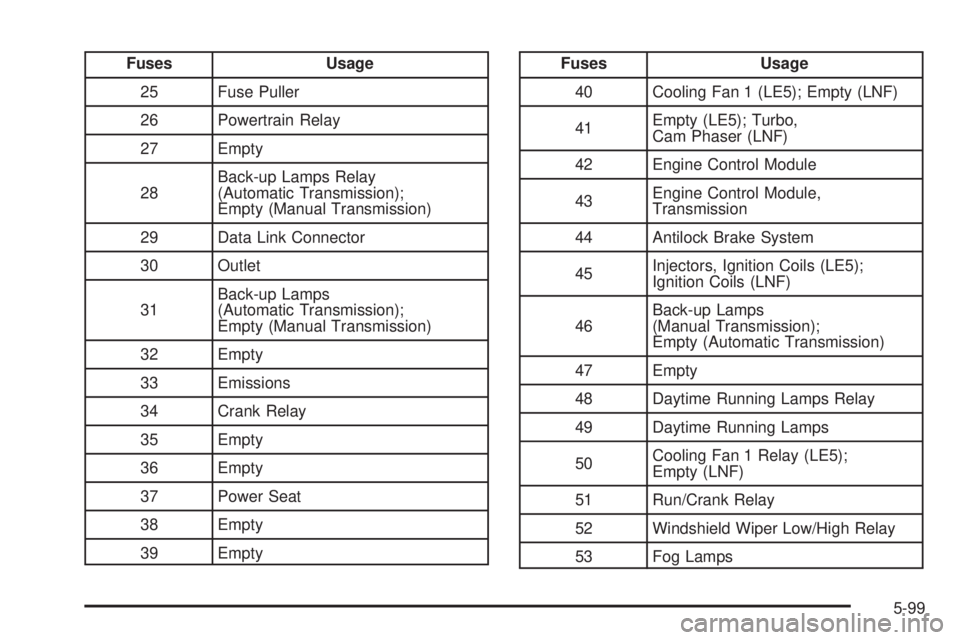
Fuses Usage
25 Fuse Puller
26 Powertrain Relay
27 Empty
28Back-up Lamps Relay
(Automatic Transmission);
Empty (Manual Transmission)
29 Data Link Connector
30 Outlet
31Back-up Lamps
(Automatic Transmission);
Empty (Manual Transmission)
32 Empty
33 Emissions
34 Crank Relay
35 Empty
36 Empty
37 Power Seat
38 Empty
39 EmptyFuses Usage
40 Cooling Fan 1 (LE5); Empty (LNF)
41Empty (LE5); Turbo,
Cam Phaser (LNF)
42 Engine Control Module
43Engine Control Module,
Transmission
44 Antilock Brake System
45Injectors, Ignition Coils (LE5);
Ignition Coils (LNF)
46Back-up Lamps
(Manual Transmission);
Empty (Automatic Transmission)
47 Empty
48 Daytime Running Lamps Relay
49 Daytime Running Lamps
50Cooling Fan 1 Relay (LE5);
Empty (LNF)
51 Run/Crank Relay
52 Windshield Wiper Low/High Relay
53 Fog Lamps
5-99
Page 296 of 348
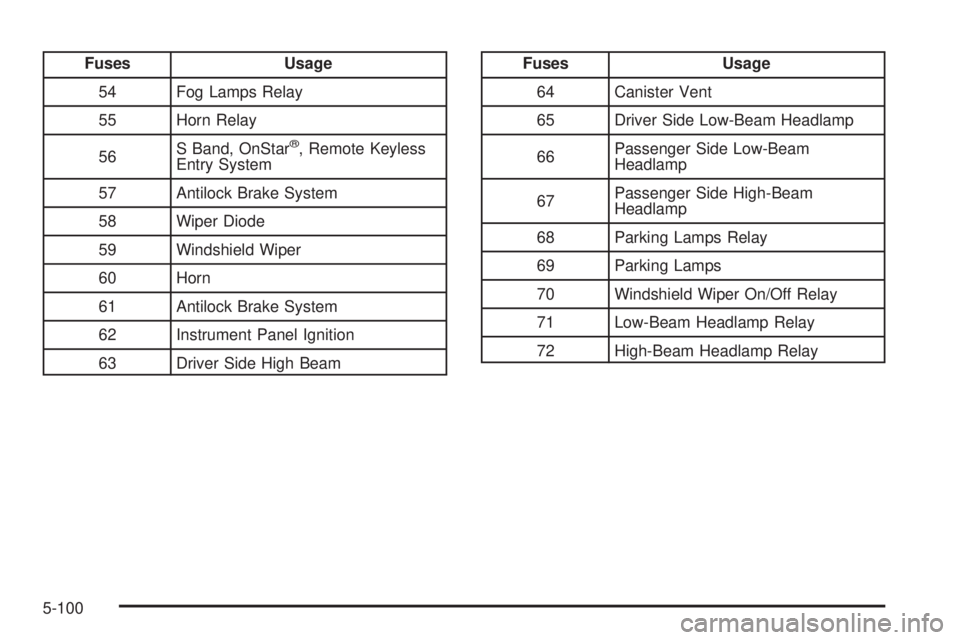
Fuses Usage
54 Fog Lamps Relay
55 Horn Relay
56S Band, OnStar
®, Remote Keyless
Entry System
57 Antilock Brake System
58 Wiper Diode
59 Windshield Wiper
60 Horn
61 Antilock Brake System
62 Instrument Panel Ignition
63 Driver Side High Beam
Fuses Usage
64 Canister Vent
65 Driver Side Low-Beam Headlamp
66Passenger Side Low-Beam
Headlamp
67Passenger Side High-Beam
Headlamp
68 Parking Lamps Relay
69 Parking Lamps
70 Windshield Wiper On/Off Relay
71 Low-Beam Headlamp Relay
72 High-Beam Headlamp Relay
5-100
Page 303 of 348
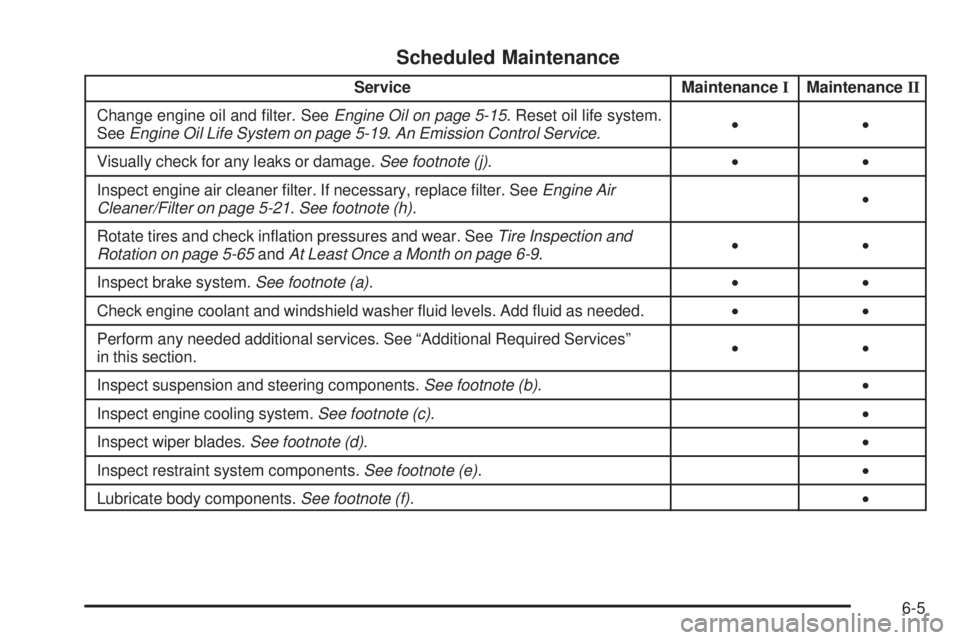
Scheduled Maintenance
Service MaintenanceIMaintenanceII
Change engine oil and lter. SeeEngine Oil on page 5-15. Reset oil life system.
SeeEngine Oil Life System on page 5-19.An Emission Control Service.••
Visually check for any leaks or damage.See footnote (j).••
Inspect engine air cleaner lter. If necessary, replace lter. SeeEngine Air
Cleaner/Filter on page 5-21.See footnote (h).•
Rotate tires and check ination pressures and wear. SeeTire Inspection and
Rotation on page 5-65andAt Least Once a Month on page 6-9.••
Inspect brake system.See footnote (a).••
Check engine coolant and windshield washer uid levels. Add uid as needed.••
Perform any needed additional services. See “Additional Required Services”
in this section.••
Inspect suspension and steering components.See footnote (b).•
Inspect engine cooling system.See footnote (c).•
Inspect wiper blades.See footnote (d).•
Inspect restraint system components.See footnote (e).•
Lubricate body components.See footnote (f).•
6-5
Page 305 of 348
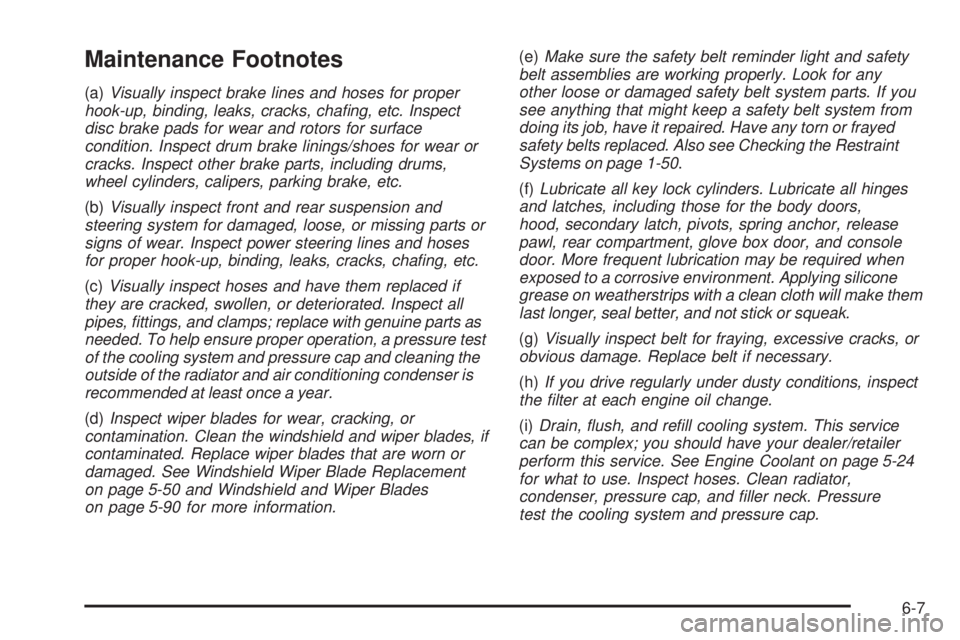
Maintenance Footnotes
(a)Visually inspect brake lines and hoses for proper
hook-up, binding, leaks, cracks, chafing, etc. Inspect
disc brake pads for wear and rotors for surface
condition. Inspect drum brake linings/shoes for wear or
cracks. Inspect other brake parts, including drums,
wheel cylinders, calipers, parking brake, etc.
(b)Visually inspect front and rear suspension and
steering system for damaged, loose, or missing parts or
signs of wear. Inspect power steering lines and hoses
for proper hook-up, binding, leaks, cracks, chafing, etc.
(c)Visually inspect hoses and have them replaced if
they are cracked, swollen, or deteriorated. Inspect all
pipes, fittings, and clamps; replace with genuine parts as
needed. To help ensure proper operation, a pressure test
of the cooling system and pressure cap and cleaning the
outside of the radiator and air conditioning condenser is
recommended at least once a year.
(d)Inspect wiper blades for wear, cracking, or
contamination. Clean the windshield and wiper blades, if
contaminated. Replace wiper blades that are worn or
damaged. See Windshield Wiper Blade Replacement
on page 5-50 and Windshield and Wiper Blades
on page 5-90 for more information.(e)Make sure the safety belt reminder light and safety
belt assemblies are working properly. Look for any
other loose or damaged safety belt system parts. If you
see anything that might keep a safety belt system from
doing its job, have it repaired. Have any torn or frayed
safety belts replaced. Also see Checking the Restraint
Systems on page 1-50.
(f)Lubricate all key lock cylinders. Lubricate all hinges
and latches, including those for the body doors,
hood, secondary latch, pivots, spring anchor, release
pawl, rear compartment, glove box door, and console
door. More frequent lubrication may be required when
exposed to a corrosive environment. Applying silicone
grease on weatherstrips with a clean cloth will make them
last longer, seal better, and not stick or squeak.
(g)Visually inspect belt for fraying, excessive cracks, or
obvious damage. Replace belt if necessary.
(h)If you drive regularly under dusty conditions, inspect
the filter at each engine oil change.
(i)Drain, flush, and refill cooling system. This service
can be complex; you should have your dealer/retailer
perform this service. See Engine Coolant on page 5-24
for what to use. Inspect hoses. Clean radiator,
condenser, pressure cap, and filler neck. Pressure
test the cooling system and pressure cap.
6-7
Page 307 of 348
At Least Once a Month
Tire Inspection and Ination Check
Inspect your vehicle’s tires for wear and make
sure they are inated to the correct pressures.
SeeInflation - Tire Pressure on page 5-58.
At Least Once a Year
Starter Switch Check
{CAUTION:
When you are doing this inspection, the
vehicle could move suddenly. If the vehicle
moves, you or others could be injured.
1. Before you start, be sure you have enough room
around the vehicle.
2. Firmly apply both the parking brake and the regular
brake. SeeParking Brake on page 2-25.
Do not use the accelerator pedal, and be ready to
turn off the engine immediately if it starts.3. On automatic transmission vehicles, try to start the
engine in each gear. The vehicle should start only
in PARK (P) or NEUTRAL (N). If the vehicle
starts in any other position, contact your
dealer/retailer for service.
On manual transmission vehicles, put the shift lever
in NEUTRAL, push the clutch pedal down halfway,
and try to start the engine. The vehicle should start
only when the clutch pedal is pushed down all the
way to the oor. If the vehicle starts when the clutch
pedal is not pushed all the way down, contact your
dealer/retailer for service.
6-9
Page 308 of 348
Automatic Transmission Shift Lock
Control System Check
{CAUTION:
When you are doing this inspection, the
vehicle could move suddenly. If the vehicle
moves, you or others could be injured.
1. Before you start, be sure you have enough room
around the vehicle. It should be parked on a level
surface.
2. Firmly apply the parking brake. SeeParking Brake
on page 2-25.
Be ready to apply the regular brake immediately if
the vehicle begins to move.
3. With the engine off, turn the ignition to ON/RUN,
but do not start the engine. Without applying the
regular brake, try to move the shift lever out
of PARK (P) with normal effort. If the shift lever
moves out of PARK (P), contact your dealer/retailer
for service.
Ignition Transmission Lock Check
While parked, and with the parking brake set, try to turn
the ignition to LOCK/OFF in each shift lever position.
With an automatic transmission, the ignition should
turn to LOCK/OFF only when the shift lever is in
PARK (P). The ignition key should come out only in
LOCK/OFF.
With a manual transmission, the ignition key should
come out only in LOCK/OFF.
Turn the steering wheel to the left and to the right. It
should only lock when turned to the right. Contact your
dealer/retailer if service is required.
6-10