wheel PONTIAC SOLSTICE 2008 Repair Manual
[x] Cancel search | Manufacturer: PONTIAC, Model Year: 2008, Model line: SOLSTICE, Model: PONTIAC SOLSTICE 2008Pages: 348, PDF Size: 5.23 MB
Page 271 of 348
If a Tire Goes Flat
Your vehicle has a tire sealant and compressor kit.
SeeTire Sealant and Compressor Kit on page 5-76.
There is no spare tire, no tire changing equipment,
and no place to store a tire.
It is unusual for a tire to blow out while you are driving,
especially if you maintain your tires properly. SeeTires
on page 5-51. If air goes out of a tire, it is much more
likely to leak out slowly. But, if you should ever have a
blow out, here are a few tips about what to expect and
what to do:
If a front tire fails, the at tire will create a drag that
pulls the vehicle toward that side. Take your foot off the
accelerator pedal and grip the steering wheel rmly.
Steer to maintain lane position, and then gently brake
to a stop well out of the traffic lane.
A rear blow out, particularly on a curve, acts much
like a skid and may require the same correction
you would use in a skid. In any rear blow out, remove
your foot from the accelerator pedal. Get the vehicle
under control by steering the way you want the vehicle
to go. It may be very bumpy and noisy, but you can
still steer. Gently brake to a stop, well off the road
if possible.If a tire goes at, avoid further tire and wheel damage
by driving slowly to a level place and stopping.
Then do this:
1. Turn on the hazard warning ashers. SeeHazard
Warning Flashers on page 3-6.
2. Park your vehicle. If your vehicle has an automatic
transmission, set the parking brake rmly and put the
shift lever in PARK (P). SeeShifting Into PARK (P)
(Automatic Transmission) on page 2-26. If your
vehicle has a manual transmission, move the shift
lever to REVERSE (R) and set the parking brake
rmly. SeeParking Your Vehicle (Manual
Transmission) on page 2-28for additional
information.
3. Turn off the engine.
4. Inspect the at tire.
If the tire has been separated from the wheel, has
damaged sidewalls, or has a puncture larger than a
14inch (6 mm), the tire is too severely damaged for
the tire sealant and compressor kit to be effective.
SeeRoadside Assistance Program on page 7-7.
If the tire has a puncture less than a
14inch (6 mm)
in the tread area of the tire, seeTire Sealant and
Compressor Kit on page 5-76.
5-75
Page 273 of 348
Accessing the Tire Sealant and
Compressor Kit
To access the tire sealant and compressor kit:
1. Make sure the convertible top is in the up position
before accessing the tire sealant and compressor kit.
2. Open the trunk. SeeTrunk on page 2-9for more
information.
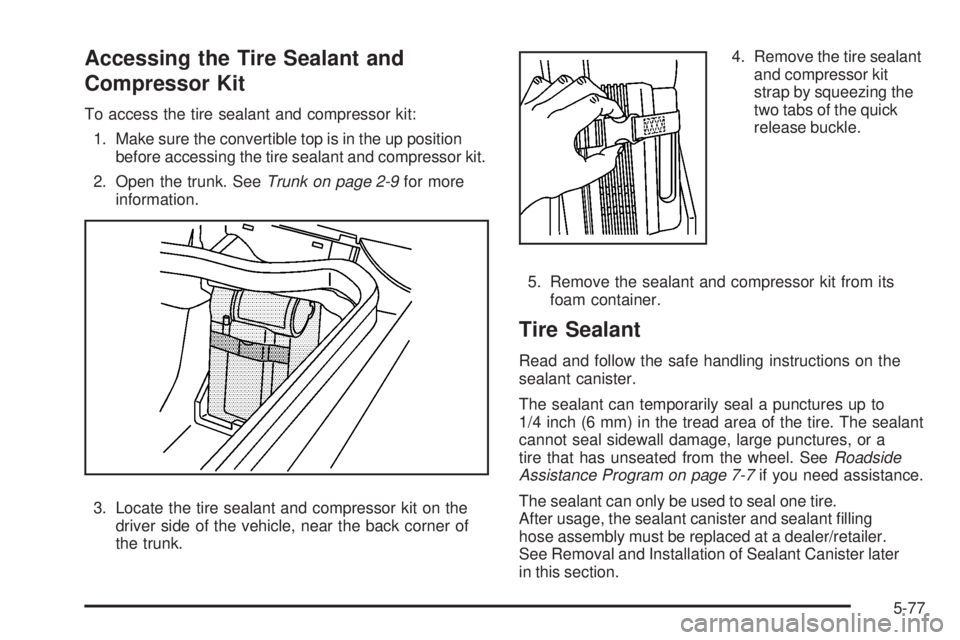
3. Locate the tire sealant and compressor kit on the
driver side of the vehicle, near the back corner of
the trunk.4. Remove the tire sealant
and compressor kit
strap by squeezing the
two tabs of the quick
release buckle.
5. Remove the sealant and compressor kit from its
foam container.
Tire Sealant
Read and follow the safe handling instructions on the
sealant canister.
The sealant can temporarily seal a punctures up to
1/4 inch (6 mm) in the tread area of the tire. The sealant
cannot seal sidewall damage, large punctures, or a
tire that has unseated from the wheel. SeeRoadside
Assistance Program on page 7-7if you need assistance.
The sealant can only be used to seal one tire.
After usage, the sealant canister and sealant lling
hose assembly must be replaced at a dealer/retailer.
See Removal and Installation of Sealant Canister later
in this section.
5-77
Page 277 of 348
{CAUTION:
Storing the tire sealant and compressor
kit or other equipment in the passenger
compartment of the vehicle could cause injury.
In a sudden stop or collision, loose equipment
could strike someone. Store the tire sealant
and compressor kit in the proper place.
16. Return the equipment to the proper storage location
in the trunk of your vehicle. You may need to
loosen the retention strap to wrap it around the
sealant and compressor kit and foam container.
To do this, pull apart the strap and loosen the strap
at the quick release buckle. Then snap the buckle
together, pull the strap tight, and secure the
loose end of the strap by mating the ends.
17. Immediately drive the vehicle 5 miles (8 km) to
distribute the sealant evenly in the tire.18. Stop at a safe location and check the tire pressure,
refer to Steps 1 through 8 under “Using the Air
Compressor without Sealant” next in this section.
If the tire pressure has not dropped more than
10 psi (68 kPa) from the recommended ination
pressure, you can inate the tire back up to
the recommended ination pressure.
19. If the tire pressure has fallen more then
10 psi (68 kPa), below the recommended ination
pressure, stop driving the vehicle. The tire is
too damaged for the sealant to work. See
Roadside Assistance Program on page 7-7.
20. Wipe off any sealant from the wheel, tire, and
vehicle with a rag.
21. Dispose of the sealant canister at a local
dealer/retailer or in accordance with local state
codes and practices.
After using the sealant canister, replace it with a
new canister from your dealer/retailer.
22. After temporarily sealing a tire with the tire sealant
and compressor kit, take your vehicle to your
dealer/retailer to have the tire inspected and
repaired.
5-81
Page 287 of 348
Aluminum or Chrome-Plated Wheels
and Trim
Your vehicle may have either aluminum or
chrome-plated wheels.
Keep the wheels clean using a soft clean cloth with mild
soap and water. Rinse with clean water. After rinsing
thoroughly, dry with a soft clean towel. A wax may then
be applied.
Notice:Chrome wheels and other chrome trim may
be damaged if you do not wash your vehicle after
driving on roads that have been sprayed with
magnesium, calcium or sodium chloride. These
chlorides are used on roads for conditions such as
ice and dust. Always wash your vehicle’s chrome
with soap and water after exposure.
Notice:If you use strong soaps, chemicals,
abrasive polishes, cleaners, brushes, or cleaners
that contain acid on aluminum or chrome-plated
wheels, you could damage the surface of the
wheel(s). The repairs would not be covered by your
warranty. Use only approved cleaners on aluminum
or chrome-plated wheels.
The surface of these wheels is similar to the painted
surface of your vehicle. Do not use strong soaps,
chemicals, abrasive polishes, abrasive cleaners,cleaners with acid, or abrasive cleaning brushes
on them because you could damage the surface.
Do not use chrome polish on aluminum wheels.
Notice:Using chrome polish on aluminum wheels
could damage the wheels. The repairs would not
be covered by your warranty. Use chrome polish
on chrome wheels only.
Use chrome polish only on chrome-plated wheels,
but avoid any painted surface of the wheel, and buff
off immediately after application.
Notice:If you drive your vehicle through an
automatic car wash that has silicone carbide tire
cleaning brushes, you could damage the aluminum
or chrome-plated wheels. The repairs would not
be covered by your warranty. Never drive a vehicle
equipped with aluminum or chrome-plated wheels
through an automatic car wash that uses silicone
carbide tire cleaning brushes.
Tires
To clean the tires, use a stiff brush with tire cleaner.
Notice:Using petroleum-based tire dressing
products on your vehicle may damage the paint
nish and/or tires. When applying a tire dressing,
always wipe off any overspray from all painted
surfaces on your vehicle.
5-91
Page 289 of 348
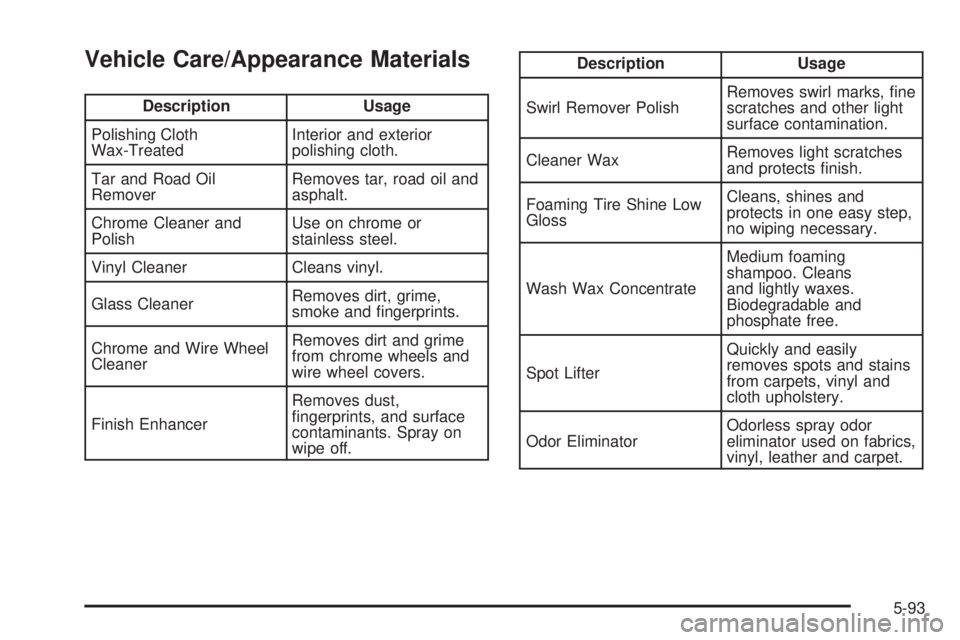
Vehicle Care/Appearance Materials
Description Usage
Polishing Cloth
Wax-TreatedInterior and exterior
polishing cloth.
Tar and Road Oil
RemoverRemoves tar, road oil and
asphalt.
Chrome Cleaner and
PolishUse on chrome or
stainless steel.
Vinyl Cleaner Cleans vinyl.
Glass CleanerRemoves dirt, grime,
smoke and ngerprints.
Chrome and Wire Wheel
CleanerRemoves dirt and grime
from chrome wheels and
wire wheel covers.
Finish EnhancerRemoves dust,
ngerprints, and surface
contaminants. Spray on
wipe off.
Description Usage
Swirl Remover PolishRemoves swirl marks, ne
scratches and other light
surface contamination.
Cleaner WaxRemoves light scratches
and protects nish.
Foaming Tire Shine Low
GlossCleans, shines and
protects in one easy step,
no wiping necessary.
Wash Wax ConcentrateMedium foaming
shampoo. Cleans
and lightly waxes.
Biodegradable and
phosphate free.
Spot LifterQuickly and easily
removes spots and stains
from carpets, vinyl and
cloth upholstery.
Odor EliminatorOdorless spray odor
eliminator used on fabrics,
vinyl, leather and carpet.
5-93
Page 293 of 348
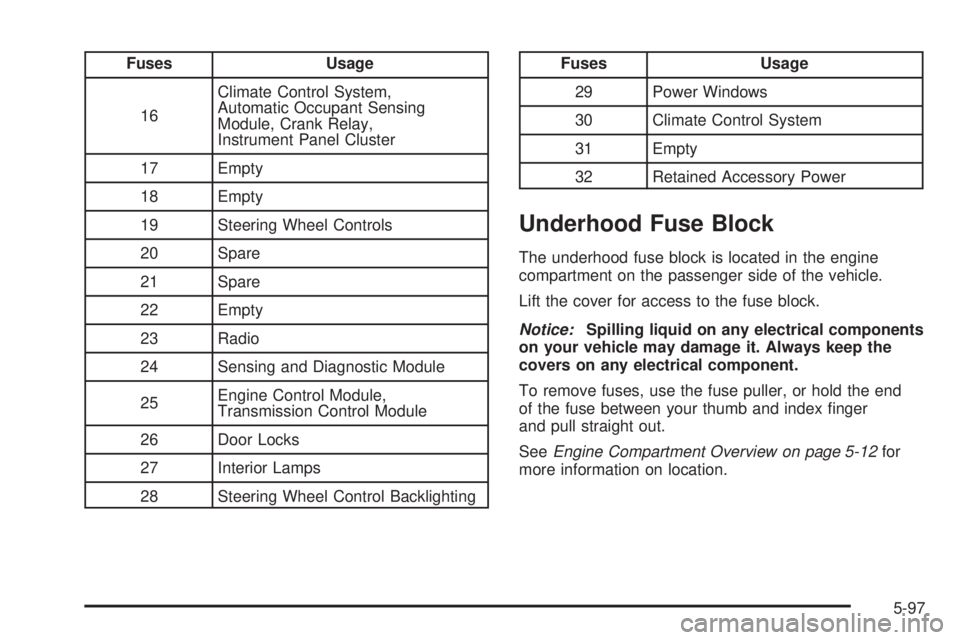
Fuses Usage
16Climate Control System,
Automatic Occupant Sensing
Module, Crank Relay,
Instrument Panel Cluster
17 Empty
18 Empty
19 Steering Wheel Controls
20 Spare
21 Spare
22 Empty
23 Radio
24 Sensing and Diagnostic Module
25Engine Control Module,
Transmission Control Module
26 Door Locks
27 Interior Lamps
28 Steering Wheel Control BacklightingFuses Usage
29 Power Windows
30 Climate Control System
31 Empty
32 Retained Accessory Power
Underhood Fuse Block
The underhood fuse block is located in the engine
compartment on the passenger side of the vehicle.
Lift the cover for access to the fuse block.
Notice:Spilling liquid on any electrical components
on your vehicle may damage it. Always keep the
covers on any electrical component.
To remove fuses, use the fuse puller, or hold the end
of the fuse between your thumb and index nger
and pull straight out.
SeeEngine Compartment Overview on page 5-12for
more information on location.
5-97
Page 297 of 348
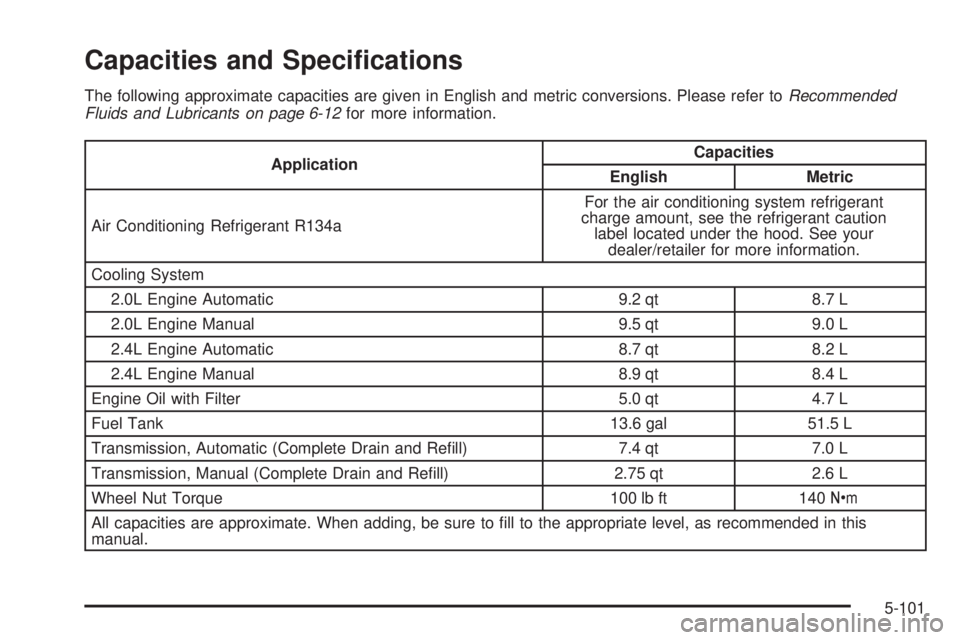
Capacities and Specications
The following approximate capacities are given in English and metric conversions. Please refer toRecommended
Fluids and Lubricants on page 6-12for more information.
ApplicationCapacities
English Metric
Air Conditioning Refrigerant R134aFor the air conditioning system refrigerant
charge amount, see the refrigerant caution
label located under the hood. See your
dealer/retailer for more information.
Cooling System
2.0L Engine Automatic 9.2 qt 8.7 L
2.0L Engine Manual 9.5 qt 9.0 L
2.4L Engine Automatic 8.7 qt 8.2 L
2.4L Engine Manual 8.9 qt 8.4 L
Engine Oil with Filter 5.0 qt 4.7 L
Fuel Tank 13.6 gal 51.5 L
Transmission, Automatic (Complete Drain and Rell) 7.4 qt 7.0 L
Transmission, Manual (Complete Drain and Rell) 2.75 qt 2.6 L
Wheel Nut Torque 100 lb ft 140Y
All capacities are approximate. When adding, be sure to ll to the appropriate level, as recommended in this
manual.
5-101
Page 305 of 348
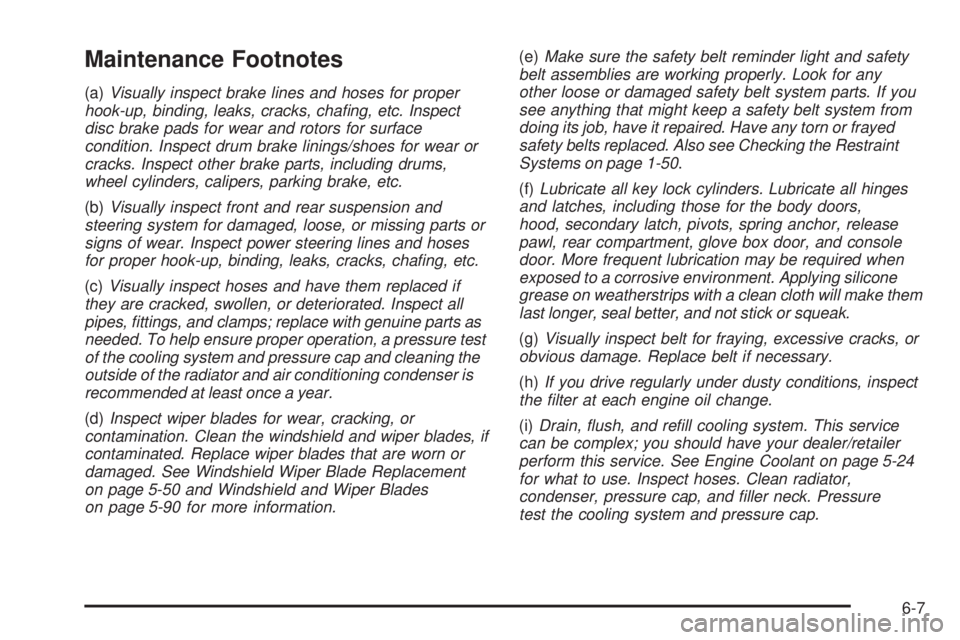
Maintenance Footnotes
(a)Visually inspect brake lines and hoses for proper
hook-up, binding, leaks, cracks, chafing, etc. Inspect
disc brake pads for wear and rotors for surface
condition. Inspect drum brake linings/shoes for wear or
cracks. Inspect other brake parts, including drums,
wheel cylinders, calipers, parking brake, etc.
(b)Visually inspect front and rear suspension and
steering system for damaged, loose, or missing parts or
signs of wear. Inspect power steering lines and hoses
for proper hook-up, binding, leaks, cracks, chafing, etc.
(c)Visually inspect hoses and have them replaced if
they are cracked, swollen, or deteriorated. Inspect all
pipes, fittings, and clamps; replace with genuine parts as
needed. To help ensure proper operation, a pressure test
of the cooling system and pressure cap and cleaning the
outside of the radiator and air conditioning condenser is
recommended at least once a year.
(d)Inspect wiper blades for wear, cracking, or
contamination. Clean the windshield and wiper blades, if
contaminated. Replace wiper blades that are worn or
damaged. See Windshield Wiper Blade Replacement
on page 5-50 and Windshield and Wiper Blades
on page 5-90 for more information.(e)Make sure the safety belt reminder light and safety
belt assemblies are working properly. Look for any
other loose or damaged safety belt system parts. If you
see anything that might keep a safety belt system from
doing its job, have it repaired. Have any torn or frayed
safety belts replaced. Also see Checking the Restraint
Systems on page 1-50.
(f)Lubricate all key lock cylinders. Lubricate all hinges
and latches, including those for the body doors,
hood, secondary latch, pivots, spring anchor, release
pawl, rear compartment, glove box door, and console
door. More frequent lubrication may be required when
exposed to a corrosive environment. Applying silicone
grease on weatherstrips with a clean cloth will make them
last longer, seal better, and not stick or squeak.
(g)Visually inspect belt for fraying, excessive cracks, or
obvious damage. Replace belt if necessary.
(h)If you drive regularly under dusty conditions, inspect
the filter at each engine oil change.
(i)Drain, flush, and refill cooling system. This service
can be complex; you should have your dealer/retailer
perform this service. See Engine Coolant on page 5-24
for what to use. Inspect hoses. Clean radiator,
condenser, pressure cap, and filler neck. Pressure
test the cooling system and pressure cap.
6-7
Page 308 of 348
Automatic Transmission Shift Lock
Control System Check
{CAUTION:
When you are doing this inspection, the
vehicle could move suddenly. If the vehicle
moves, you or others could be injured.
1. Before you start, be sure you have enough room
around the vehicle. It should be parked on a level
surface.
2. Firmly apply the parking brake. SeeParking Brake
on page 2-25.
Be ready to apply the regular brake immediately if
the vehicle begins to move.
3. With the engine off, turn the ignition to ON/RUN,
but do not start the engine. Without applying the
regular brake, try to move the shift lever out
of PARK (P) with normal effort. If the shift lever
moves out of PARK (P), contact your dealer/retailer
for service.
Ignition Transmission Lock Check
While parked, and with the parking brake set, try to turn
the ignition to LOCK/OFF in each shift lever position.
With an automatic transmission, the ignition should
turn to LOCK/OFF only when the shift lever is in
PARK (P). The ignition key should come out only in
LOCK/OFF.
With a manual transmission, the ignition key should
come out only in LOCK/OFF.
Turn the steering wheel to the left and to the right. It
should only lock when turned to the right. Contact your
dealer/retailer if service is required.
6-10
Page 322 of 348
Overseas — Customer Assistance
Please contact the local General Motors Business Unit.
Mexico, Central America and
Caribbean Islands/Countries
(Except Puerto Rico and U.S. Virgin
Islands) — Customer Assistance
General Motors de Mexico, S. de R.L. de C.V.
Customer Assistance Center
Paseo de la Reforma #2740
Col. Lomas de Bezares
C.P. 11910, Mexico, D.F.
01-800-508-0000
Long Distance: 011-52-53 29 0 800
GM Mobility Reimbursement
Program
This program, available to qualied applicants, can
reimburse you up to $1,000 of the cost of eligible
aftermarket adaptive equipment required for your vehicle,
such as hand controls or a wheelchair/scooter lift.
The offer is available for a very limited period of time
from the date of vehicle purchase/lease. For more
details, or to determine your vehicle’s eligibility, visit
gmmobility.com or call the GM Mobility Assistance
Center at 1-800-323-9935. Text telephone (TTY) users,
call 1-800-833-9935.
General Motors of Canada also has a Mobility
Program. Call 1-800-GM-DRIVE (463-7483) for details.
TTY users call 1-800-263-3830.
7-6