instrument panel PONTIAC SOLSTICE 2009 Owner's Guide
[x] Cancel search | Manufacturer: PONTIAC, Model Year: 2009, Model line: SOLSTICE, Model: PONTIAC SOLSTICE 2009Pages: 354, PDF Size: 1.98 MB
Page 182 of 354
Electronic Stability Control (ESC)
The vehicle has an Electronic Stability Control (ESC)
system which combines antilock brake, traction
and stability control systems and helps the driver
maintain directional control of the vehicle in most driving
conditions.
ESC activates when the computer senses a discrepancy
between the intended path and the direction the
vehicle is actually traveling. ESC selectively applies
braking pressure at any one of the vehicle’s brakes to
help steer the vehicle in the desired direction.
When you rst start the vehicle and begin to drive away,
the system performs several diagnostic checks to
ensure there are no problems. The system may be
heard or felt while it is working. This is normal and does
not mean there is a problem with the vehicle. The
system should initialize before the vehicle reaches
20 mph (32 km/h).
If the system fails to turn on or activate, the ESC/TCS
light comes on, and the ESC OFF and/or SERVICE ESC
message displays.
For more information, seeDriver Information Center
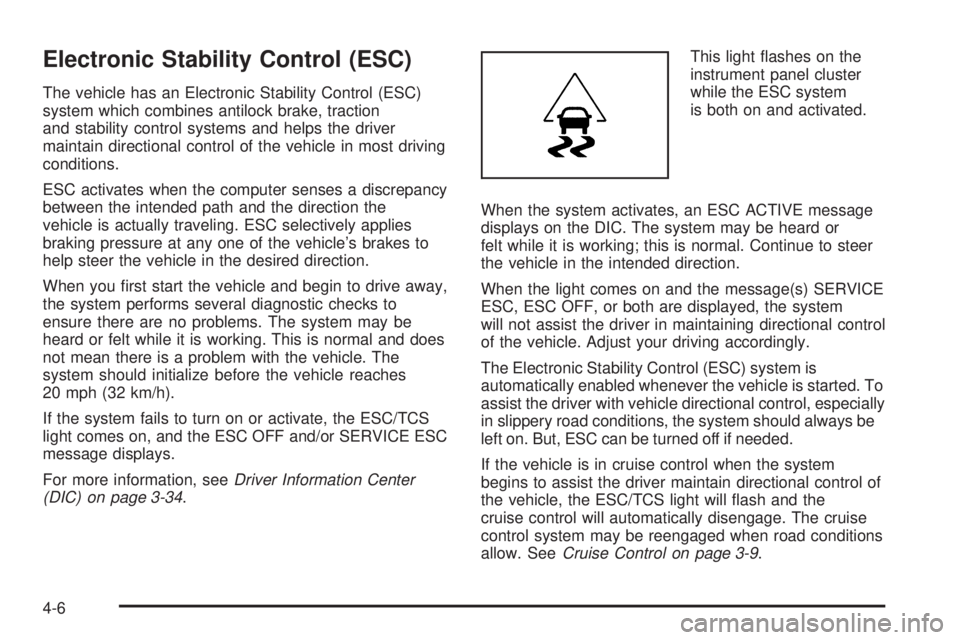
(DIC) on page 3-34.This light ashes on the
instrument panel cluster
while the ESC system
is both on and activated.
When the system activates, an ESC ACTIVE message
displays on the DIC. The system may be heard or
felt while it is working; this is normal. Continue to steer
the vehicle in the intended direction.
When the light comes on and the message(s) SERVICE
ESC, ESC OFF, or both are displayed, the system
will not assist the driver in maintaining directional control
of the vehicle. Adjust your driving accordingly.
The Electronic Stability Control (ESC) system is
automatically enabled whenever the vehicle is started. To
assist the driver with vehicle directional control, especially
in slippery road conditions, the system should always be
left on. But, ESC can be turned off if needed.
If the vehicle is in cruise control when the system
begins to assist the driver maintain directional control of
the vehicle, the ESC/TCS light will ash and the
cruise control will automatically disengage. The cruise
control system may be reengaged when road conditions
allow. SeeCruise Control on page 3-9.
4-6
Page 183 of 354
The ESC/TCS button
is located on the
instrument panel.
To turn the traction control system off or back on, press
and release the ESC/TCS button. To disable both
traction control and ESC, press and hold the button until
TRACTION OFF and ESC OFF messages appear,
and the ESC/TCS light comes on.
It is recommended to leave the system on for normal
driving conditions, but it may be necessary to turn the
system off if the vehicle is stuck in sand, mud, ice or
snow, and you want to “rock” the vehicle to attempt to
free it. It may also be necessary to turn off the system
when driving in extreme off-road conditions where high
wheel spin is required. SeeIf Your Vehicle is Stuck in
Sand, Mud, Ice, or Snow on page 4-19. Also, see
“Competitive Driving Mode” later in this section.
ESC may also turn off automatically if it determines that
a problem exists with the system. The ESC OFF and
SERVICE ESC messages and the ESC/TCS light will be
on solid to warn the driver that ESC is disabled and
requires service. If the problem does not clear after
restarting the vehicle, see your dealer/retailer for service.
SeeDIC Warnings and Messages on page 3-37for
more information.Adding non-dealer/non-retailer accessories can affect
the vehicle’s performance. SeeAccessories and
Modifications on page 5-3for more information.
Competitive Driving Mode
The driver can select this optional handling mode by
pressing the ESC/TCS button on the console two times
quickly. COMPETITIVE MODE displays in the DIC. See
DIC Warnings and Messages on page 3-37for more
information. Competitive Driving Mode allows the driver
to have full control of the rear wheels while the ESC
system helps maintain directional control of the vehicle by
selective brake application. The ESC/TCS light will be on
and the traction control system will not be operating.
Adjust your driving accordingly. This electronic stability
control mode is recommended only for use during closed
track events and competitive driving venues.
When the ESC/TCS button is pressed again, or the
vehicle is restarted, the ESC and TCS turn back on.
Notice:When traction control is turned off, or
Competitive Driving Mode is active, it is possible to
lose traction. If you attempt to shift with the drive
wheels spinning with a loss of traction, it is possible
to cause damage to the transmission. Do not
attempt to shift when the drive wheels do not have
traction. Damage caused by misuse of the vehicle
is not covered. See the warranty book for additional
information.
4-7
Page 185 of 354
To turn the system off or
on, press and release the
ESC/TCS button located
on the instrument panel.
The DIC will display the appropriate message the button
is pressed.
Traction Control Operation
Traction control limits wheel spin by reducing engine
power to the wheels (engine speed management)
and by applying brakes to each individual wheel
(brake-traction control) as necessary.
The traction control system is enabled automatically
when the vehicle is started, and it will activate and ash
the ESC/TCS light and display the LOW TRACTION
message if it senses either of the rear wheels are
spinning or beginning to lose traction while driving. For
more information on the LOW TRACTION message,
seeDriver Information Center (DIC) on page 3-34.Notice:If the wheel(s) of one axle are allowed to
spin excessively while the ESC/TCS, ABS and Brake
warning lights and the SERVICE ESC and/or
SERVICE TRACTION messages are displayed, the
differential could be damaged. The repairs would not
be covered by the vehicle warranty. Reduce engine
power and do not spin the wheel(s) excessively
while these lights and this message are displayed.
Notice:When traction control is turned off, or
Competitive Driving Mode is active, it is possible to
lose traction. If you attempt to shift with the drive
wheels spinning with a loss of traction, it is possible
to cause damage to the transmission. Do not
attempt to shift when the drive wheels do not have
traction. Damage caused by misuse of the vehicle
is not covered. See the warranty book for additional
information.
The traction control system may activate on dry or
rough roads or under conditions such as heavy
acceleration while turning or abrupt upshifts/downshifts
of the transmission. When this happens, a reduction
in acceleration may be noticed, or a noise or vibration
may be heard. This is normal.
Adding non-dealer/non-retailer accessories can affect
the vehicle’s performance. SeeAccessories and
Modifications on page 5-3for more information.
4-9
Page 194 of 354
Blizzard Conditions
Being stuck in snow can be in a serious situation. Stay
with the vehicle unless there is help nearby. If possible,
use theRoadside Assistance Program on page 7-6.To
get help and keep everyone in the vehicle safe:
Turn on theHazard Warning Flashers on page 3-5.
Tie a red cloth to an outside mirror.
{CAUTION:
Snow can trap engine exhaust under the vehicle.
This may cause exhaust gases to get inside.
Engine exhaust contains carbon monoxide (CO)
which cannot be seen or smelled. It can cause
unconsciousness and even death.
If the vehicle is stuck in the snow:
Clear away snow from around the base of
your vehicle, especially any that is blocking
the exhaust pipe.
Check again from time to time to be sure
snow does not collect there.
CAUTION: (Continued)
CAUTION: (Continued)
Open a window about two inches (5 cm) on
the side of the vehicle that is away from the
wind to bring in fresh air.
Fully open the air outlets on or under the
instrument panel.
Adjust the Climate Control system to a setting
that circulates the air inside the vehicle and
set the fan speed to the highest setting. See
Climate Control System in the Index.
For more information about carbon monoxide, see
Engine Exhaust on page 2-27.
Snow can trap exhaust gases under your vehicle.
This can cause deadly CO (carbon monoxide) gas
to get inside. CO could overcome you and kill you.
You cannot see it or smell it, so you might not
know it is in your vehicle. Clear away snow from
around the base of your vehicle, especially any
that is blocking the exhaust.
Run the engine for short periods only as needed to
keep warm, but be careful.
To save fuel, run the engine for only short periods as
needed to warm the vehicle and then shut the engine off
and close the window most of the way to save heat.
4-18
Page 204 of 354

Tire Pressure Monitor System.........................5-54
Tire Pressure Monitor Operation.....................5-56
Tire Inspection and Rotation...........................5-60
When It Is Time for New Tires.......................5-62
Buying New Tires.........................................5-63
Different Size Tires and Wheels......................5-65
Uniform Tire Quality Grading..........................5-65
Wheel Alignment and Tire Balance..................5-67
Wheel Replacement......................................5-67
Tire Chains..................................................5-70
If a Tire Goes Flat........................................5-70
Tire Sealant and Compressor Kit
(Without Selector Switch)............................5-71
Tire Sealant and Compressor Kit
(With Selector Switch)................................5-80
Tire Sealant and Compressor Kit Storage.........5-89
Appearance Care............................................5-90
Interior Cleaning...........................................5-90
Fabric/Carpet...............................................5-91
Leather.......................................................5-92
Instrument Panel, Vinyl, and Other Plastic
Surfaces..................................................5-92
Care of Safety Belts......................................5-93
Weatherstrips...............................................5-93Washing Your Vehicle...................................5-93
Cleaning Exterior Lamps/Lenses.....................5-94
Finish Care..................................................5-94
Windshield and Wiper Blades.........................5-95
Convertible Top............................................5-95
Aluminum or Chrome-Plated Wheels
and Trim..................................................5-96
Tires...........................................................5-96
Sheet Metal Damage.....................................5-97
Finish Damage.............................................5-97
Underbody Maintenance................................5-97
Chemical Paint Spotting.................................5-97
Vehicle Identication
......................................5-98
Vehicle Identication Number (VIN).................5-98
Service Parts Identication Label.....................5-98
Electrical System............................................5-98
Add-On Electrical Equipment..........................5-98
Headlamp Wiring..........................................5-99
Power Windows and Other Power Options.......5-99
Fuses and Circuit Breakers............................5-99
Floor Console Fuse Block..............................5-99
Underhood Fuse Block................................5-101
Capacities and Specications........................5-104
Section 5 Service and Appearance Care
5-2
Page 213 of 354

Hood Release
To open the hood, do the following:
1. Locate the interior
hood release lever. It is
located below the
instrument panel on
the driver’s side of the
vehicle.2. Pull down on the rear
edge of the lever to
release the hood latch.
3. Go to the side of the vehicle and pull up on the
rear edge of the hood, near the windshield to
open the hood.
Notice:Closing the hood with the doors open may
damage the hood and/or doors. Always close the
doors before closing the hood.
Before closing the hood, be sure all the ller caps are
on properly. Then, pull the hood down and close it rmly.
5-11
Page 231 of 354

Engine Overheating
The vehicle has an indicator to warn of engine
overheating.
There is an engine coolant temperature warning light on
your vehicle’s instrument panel. SeeEngine Coolant
Temperature Warning Light on page 3-28for more
information.
You may decide not to lift the hood when this warning
appears, but instead get service help right away.
SeeRoadside Assistance Program on page 7-6.
If you do decide to lift the hood, make sure the vehicle
is parked on a level surface.
Then check to see if the engine cooling fan is running. If
the engine is overheating, the fan should be running.
If not, do not continue to run the engine and have
the vehicle serviced.
Notice:Engine damage from running the engine
without coolant is not covered by the warranty.
Notice:If the engine catches re because of being
driven with no coolant, your vehicle can be badly
damaged. The costly repairs would not be covered
by the vehicle warranty.
If Steam Is Coming From The Engine
Compartment
{CAUTION:
Steam from an overheated engine can burn you
badly, even if you just open the hood. Stay away
from the engine if you see or hear steam coming
from it. Just turn it off and get everyone away from
the vehicle until it cools down. Wait until there is
no sign of steam or coolant before you open
the hood.
If you keep driving when your engine is
overheated, the liquids in it can catch re. You or
others could be badly burned. Stop your engine if
it overheats, and get out of the vehicle until the
engine is cool.
5-29
Page 258 of 354

The TPMS operates on a radio frequency and complies
with RSS-210 of Industry and Science Canada.
Operation is subject to the following two conditions:
1. This device may not cause interference.
2. This device must accept any interference received,
including interference that may cause undesired
operation of the device.
Changes or modications to this system by other than
an authorized service facility could void authorization to
use this equipment.
Tire Pressure Monitor Operation
This vehicle may have a Tire Pressure Monitor System
(TPMS). The TPMS is designed to warn the driver
when a low tire pressure condition exists. TPMS sensors
are mounted onto each tire and wheel assembly. The
TPMS sensors monitor the air pressure in the vehicle’s
tires and transmits the tire pressure readings to a
receiver located in the vehicle.When a low tire pressure
condition is detected, the
TPMS illuminates the
low tire pressure warning
light located on the
instrument panel cluster.
At the same time a message to check the pressure in a
specic tire appears on the Driver Information Center
(DIC) display. The low tire pressure warning light
and the DIC warning message come on at each ignition
cycle until the tires are inated to the correct ination
pressure. Using the DIC, tire pressure levels can
be viewed by the driver. For additional information and
details about the DIC operation and displays see
DIC Operation and Displays on page 3-35andDIC
Warnings and Messages on page 3-37.
The low tire pressure warning light may come on in cool
weather when the vehicle is rst started, and then
turn off as you start to drive. This could be an early
indicator that the air pressure in the tire(s) are getting
low and need to be inated to the proper pressure.
5-56
Page 294 of 354

To clean:
1. Saturate a lint-free, clean white cloth with water or
club soda.
2. Wring the cloth to remove excess moisture.
3. Start on the outside edge of the soil and gently rub
toward the center. Continue cleaning, using a clean
area of the cloth each time it becomes soiled.
4. Continue to gently rub the soiled area until the
cleaning cloth remains clean.
5. If the soil is not completely removed, use a mild
soap solution and repeat the cleaning process
that was used with plain water.
If any of the soil remains, a commercial fabric cleaner or
spot lifter may be necessary. When a commercial
upholstery cleaner or spot lifter is to be used, test a
small hidden area for colorfastness rst. If the locally
cleaned area gives any impression that a ring formation
may result, clean the entire surface.
After the cleaning process has been completed, a paper
towel can be used to blot excess moisture from the
fabric or carpet.Leather
A soft cloth dampened with water can be used to
remove dust. If a more thorough cleaning is necessary,
a soft cloth dampened with a mild soap solution can
be used. Allow the leather to dry naturally. Do not use
heat to dry. Never use steam to clean leather. Never
use spot lifters or spot removers on leather. Many
commercial leather cleaners and coatings that are sold
to preserve and protect leather may permanently
change the appearance and feel of the leather and are
not recommended. Do not use silicone or wax-based
products, or those containing organic solvents to clean
the vehicle’s interior because they can alter the
appearance by increasing the gloss in a non-uniform
manner. Never use shoe polish on leather.
Instrument Panel, Vinyl, and Other
Plastic Surfaces
A soft cloth dampened with water may be used to
remove dust. If a more thorough cleaning is necessary,
a clean soft cloth dampened with a mild soap solution
can be used to gently remove dust and dirt. Never use
spot lifters or removers on plastic surfaces. Many
commercial cleaners and coatings that are sold to
preserve and protect soft plastic surfaces may
permanently change the appearance and feel of the
interior and are not recommended. Do not use silicone
5-92
Page 295 of 354

or wax-based products, or those containing organic
solvents to clean the vehicle’s interior because they can
alter the appearance by increasing the gloss in a
non-uniform manner.
Some commercial products may increase gloss on the
instrument panel. The increase in gloss may cause
annoying reections in the windshield and even make it
difficult to see through the windshield under certain
conditions.
Care of Safety Belts
Keep belts clean and dry.
{CAUTION:
Do not bleach or dye safety belts. It may severely
weaken them. In a crash, they might not be able
to provide adequate protection. Clean safety belts
only with mild soap and lukewarm water.
Weatherstrips
Silicone grease on weatherstrips will make them last
longer, seal better, and not stick or squeak. Apply
silicone grease with a clean cloth. During very cold,
damp weather frequent application may be required. See
Recommended Fluids and Lubricants on page 6-12.
Washing Your Vehicle
The best way to preserve the vehicle’s nish is to keep
it clean by washing it often.
Notice:Certain cleaners contain chemicals that can
damage the emblems or nameplates on the vehicle.
Check the cleaning product label. If it states that
it should not be used on plastic parts, do not use it
on the vehicle or damage may occur and it would
not be covered by the warranty.
Do not wash the vehicle in direct sunlight. Use a car
washing soap. Do not use cleaning agents that
are petroleum based or that contain acid or abrasives,
as they can damage the paint, metal or plastic on
the vehicle. Approved cleaning products can be obtained
from your dealer/retailer. Follow all manufacturers’
directions regarding correct product usage, necessary
safety precautions and appropriate disposal of any
vehicle care product.
5-93