spare wheel PONTIAC SOLSTICE 2009 Owners Manual
[x] Cancel search | Manufacturer: PONTIAC, Model Year: 2009, Model line: SOLSTICE, Model: PONTIAC SOLSTICE 2009Pages: 354, PDF Size: 1.98 MB
Page 267 of 354

Different Size Tires and Wheels
If you add wheels or tires that are a different size than
your original equipment wheels and tires, this may
affect the way your vehicle performs, including its
braking, ride and handling characteristics, stability, and
resistance to rollover. Additionally, if your vehicle
has electronic systems such as, antilock brakes, traction
control, and electronic stability control, the performance
of these systems can be affected.
{CAUTION:
If you add different sized wheels, your vehicle may
not provide an acceptable level of performance
and safety if tires not recommended for those
wheels are selected. You may increase the
chance that you will crash and suffer serious
injury. Only use GM specic wheel and tire
systems developed for your vehicle, and have
them properly installed by a GM certied
technician.
SeeBuying New Tires on page 5-63andAccessories
and Modifications on page 5-3for additional information.
Uniform Tire Quality Grading
Quality grades can be found where applicable on
the tire sidewall between tread shoulder and
maximum section width. For example:
Treadwear 200 Traction AA
Temperature A
The following information relates to the system
developed by the United States National Highway
Traffic Safety Administration (NHTSA), which
grades tires by treadwear, traction, and
temperature performance. This applies only to
vehicles sold in the United States. The grades are
molded on the sidewalls of most passenger car
tires. The Uniform Tire Quality Grading (UTQG)
system does not apply to deep tread, winter-type
snow tires, space-saver, or temporary use
spare tires, tires with nominal rim diameters of
10 to 12 inches (25 to 30 cm), or to some
limited-production tires.
While the tires available on General Motors
passenger cars and light trucks may vary with
respect to these grades, they must also conform
to federal safety requirements and additional
General Motors Tire Performance Criteria (TPC)
standards.
5-65
Page 272 of 354

Tire Chains
{CAUTION:
Do not use tire chains. There is not enough
clearance. Tire chains used on a vehicle without
the proper amount of clearance can cause
damage to the brakes, suspension, or other
vehicle parts. The area damaged by the tire
chains could cause you to lose control of the
vehicle and you or others may be injured in a
crash. Use another type of traction device only if
its manufacturer recommends it for use on the
vehicle and tire size combination and road
conditions. Follow that manufacturer’s instructions.
To help avoid damage to the vehicle, drive slowly,
re-adjust or remove the device if it is contacting
the vehicle, and do not spin the wheels. If you do
nd traction devices that will t, install them on the
rear tires.
If a Tire Goes Flat
Your vehicle has a tire sealant and compressor kit. See
Tire Sealant and Compressor Kit (Without Selector
Switch) on page 5-71orTire Sealant and Compressor
Kit (With Selector Switch) on page 5-80. There is
no spare tire, no tire changing equipment, and no place
to store a tire.
It is unusual for a tire to blow out while you are driving,
especially if you maintain your tires properly. See
Tires on page 5-47. If air goes out of a tire, it is much
more likely to leak out slowly. But, if you should
ever have a blow out, here are a few tips about what to
expect and what to do:
If a front tire fails, the at tire will create a drag that
pulls the vehicle toward that side. Take your foot off the
accelerator pedal and grip the steering wheel rmly.
Steer to maintain lane position, and then gently brake to
a stop well out of the traffic lane.
A rear blow out, particularly on a curve, acts much like
a skid and may require the same correction you
would use in a skid. In any rear blow out, remove your
foot from the accelerator pedal. Get the vehicle
under control by steering the way you want the vehicle
to go. It may be very bumpy and noisy, but you can
still steer. Gently brake to a stop, well off the road
if possible.
5-70
Page 275 of 354
{CAUTION:
Storing the tire sealant and compressor kit or
other equipment in the passenger compartment of
the vehicle could cause injury. In a sudden stop or
collision, loose equipment could strike someone.
Store the tire sealant and compressor kit in its
original location.
If this vehicle has a tire sealant and compressor kit,
there may not be a spare tire, tire changing equipment,
and on some vehicles there may not be a place to
store a tire.
The tire sealant and compressor can be used to
temporarily seal punctures up to
14inch (6 mm) in the
tread area of the tire. It can also be used to inate
an under inated tire.
If the tire has been separated from the wheel, has
damaged sidewalls, or has a large puncture, the tire is
too severely damaged for the tire sealant and
compressor kit to be effective. SeeRoadside Assistance
Program on page 7-6.Read and follow all of the tire sealant and compressor
kit instructions.
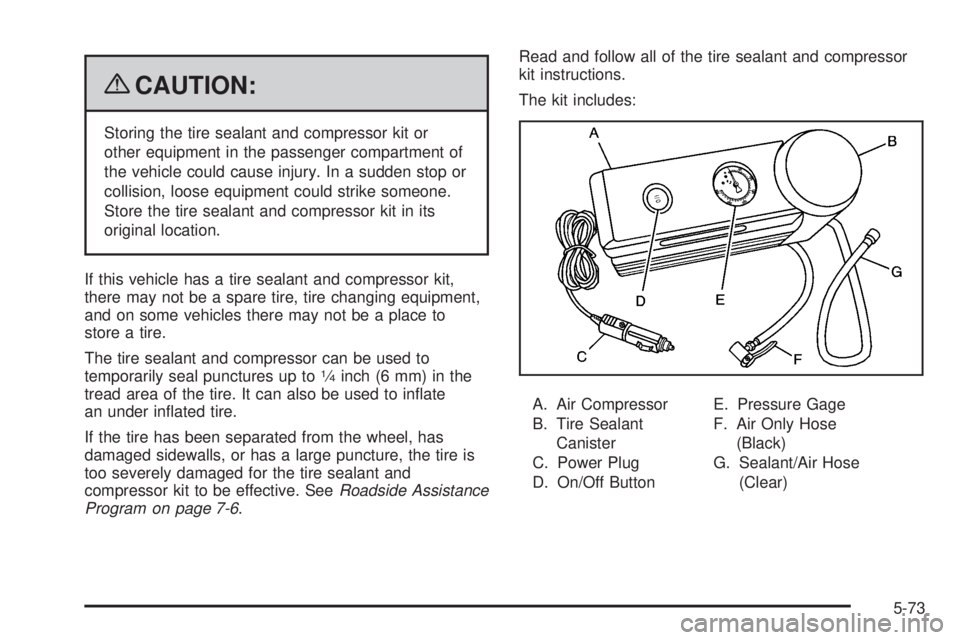
The kit includes:
A. Air Compressor
B. Tire Sealant
Canister
C. Power Plug
D. On/Off ButtonE. Pressure Gage
F. Air Only Hose
(Black)
G. Sealant/Air Hose
(Clear)
5-73
Page 284 of 354

{CAUTION:
Storing the tire sealant and compressor kit or
other equipment in the passenger compartment of
the vehicle could cause injury. In a sudden stop or
collision, loose equipment could strike someone.
Store the tire sealant and compressor kit in its
original location.
If this vehicle has a tire sealant and compressor kit,
there may not be a spare tire, tire changing equipment,
and on some vehicles there may not be a place to
store a tire.
The tire sealant and compressor can be used to
temporarily seal punctures up to
14inch (6 mm) in the
tread area of the tire. It can also be used to inate
an under inated tire.
If the tire has been separated from the wheel, has
damaged sidewalls, or has a large puncture, the tire is
too severely damaged for the tire sealant and
compressor kit to be effective. SeeRoadside Assistance
Program on page 7-6.Read and follow all of the tire sealant and compressor
kit instructions.
The kit includes:
A. Selector Switch
(Sealant/Air or
Air Only)
B. On/Off Button
C. Pressure Gage
D. Pressure Deation
ButtonE. Tire Sealant
Canister
F. Sealant/Air Hose
(Clear)
G. Air Only Hose
(Black)
H. Power Plug
5-82
Page 302 of 354

Fuses Usage
1 Fuse Puller
2 Empty
3 Empty
4 Empty
5 Empty
6 Amplier
7 Cluster
Fuses Usage
8 Ignition Switch, PassKey III+
9 Stoplamp
10Climate Control System,
PassKey III+
11 Empty
12 Spare
13 Airbag
14 Spare
15 Wiper
16Climate Control System, Automatic
Occupant Sensing Module, Crank
Relay, Instrument Panel Cluster
17 Empty
18 Empty
19 Steering Wheel Controls
20 Spare
21 Spare
22 Empty
23 Radio
24 Sensing and Diagnostic Module
25Engine Control Module,
Transmission Control Module
26 Door Locks
27 Interior Lamps
5-100