seats PONTIAC TORRENT 2006 User Guide
[x] Cancel search | Manufacturer: PONTIAC, Model Year: 2006, Model line: TORRENT, Model: PONTIAC TORRENT 2006Pages: 368, PDF Size: 2.37 MB
Page 43 of 368
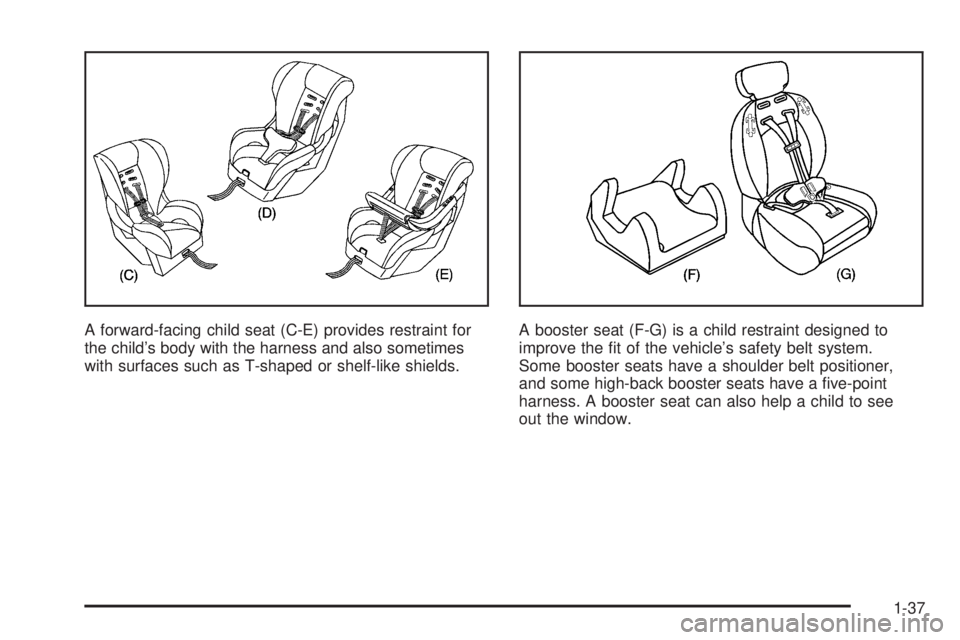
A forward-facing child seat (C-E) provides restraint for
the child’s body with the harness and also sometimes
with surfaces such as T-shaped or shelf-like shields.A booster seat (F-G) is a child restraint designed to
improve the t of the vehicle’s safety belt system.
Some booster seats have a shoulder belt positioner,
and some high-back booster seats have a ve-point
harness. A booster seat can also help a child to see
out the window.
1-37
Page 44 of 368
Q:How Should I Use a Child Restraint?
A:A child restraint system is any device designed for
use in a motor vehicle to restrain, seat, or position
children. A built-in child restraint system is a
permanent part of the motor vehicle. An add-on
child restraint system is a portable one, which
is purchased by the vehicle’s owner. To help
reduce injuries, an add-on child restraint must be
secured in the vehicle. With built-in or add-on
child restraints, the child has to be secured within
the child restraint.
When choosing an add-on child restraint, be
sure the child restraint is designed to be used in
a vehicle. If it is, it will have a label saying that
it meets federal motor vehicle safety standards.
Then follow the instructions for the restraint.
You may nd these instructions on the restraint
itself or in a booklet, or both.
Securing an Add-on Child Restraint
in the Vehicle
{CAUTION:
A child can be seriously injured or killed in a
crash if the child restraint is not properly
secured in the vehicle. Make sure the child
restraint is properly installed in the vehicle
using the vehicle’s safety belt or LATCH
system, following the instructions that came
with that restraint, and also the instructions
in this manual.
To help reduce the chance of injury, the child restraint
must be secured in the vehicle. Child restraint systems
must be secured in vehicle seats by lap belts or the
lap belt portion of a lap-shoulder belt, or by the LATCH
system. SeeLower Anchors and Tethers for Children
(LATCH) on page 1-42for more information. A child can
be endangered in a crash if the child restraint is not
properly secured in the vehicle.
1-38
Page 57 of 368
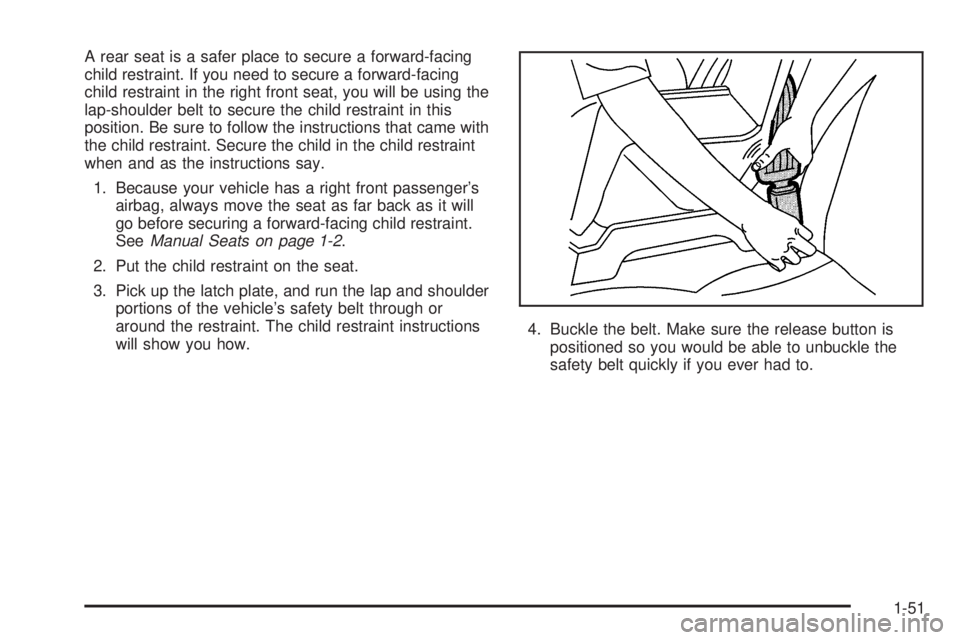
A rear seat is a safer place to secure a forward-facing
child restraint. If you need to secure a forward-facing
child restraint in the right front seat, you will be using the
lap-shoulder belt to secure the child restraint in this
position. Be sure to follow the instructions that came with
the child restraint. Secure the child in the child restraint
when and as the instructions say.
1. Because your vehicle has a right front passenger’s
airbag, always move the seat as far back as it will
go before securing a forward-facing child restraint.
SeeManual Seats on page 1-2.
2. Put the child restraint on the seat.
3. Pick up the latch plate, and run the lap and shoulder
portions of the vehicle’s safety belt through or
around the restraint. The child restraint instructions
will show you how.4. Buckle the belt. Make sure the release button is
positioned so you would be able to unbuckle the
safety belt quickly if you ever had to.
1-51
Page 115 of 368
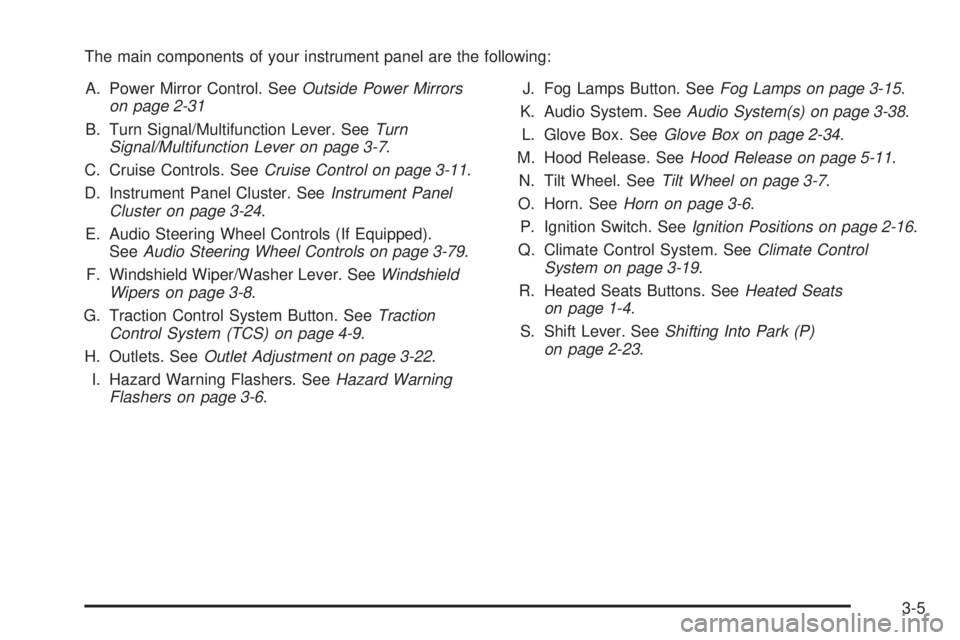
The main components of your instrument panel are the following:
A. Power Mirror Control. SeeOutside Power Mirrors
on page 2-31
B. Turn Signal/Multifunction Lever. SeeTurn
Signal/Multifunction Lever on page 3-7.
C. Cruise Controls. SeeCruise Control on page 3-11.
D. Instrument Panel Cluster. SeeInstrument Panel
Cluster on page 3-24.
E. Audio Steering Wheel Controls (If Equipped).
SeeAudio Steering Wheel Controls on page 3-79.
F. Windshield Wiper/Washer Lever. SeeWindshield
Wipers on page 3-8.
G. Traction Control System Button. SeeTraction
Control System (TCS) on page 4-9.
H. Outlets. SeeOutlet Adjustment on page 3-22.
I. Hazard Warning Flashers. SeeHazard Warning
Flashers on page 3-6.J. Fog Lamps Button. SeeFog Lamps on page 3-15.
K. Audio System. SeeAudio System(s) on page 3-38.
L. Glove Box. SeeGlove Box on page 2-34.
M. Hood Release. SeeHood Release on page 5-11.
N. Tilt Wheel. SeeTilt Wheel on page 3-7.
O. Horn. SeeHorn on page 3-6.
P. Ignition Switch. SeeIgnition Positions on page 2-16.
Q. Climate Control System. SeeClimate Control
System on page 3-19.
R. Heated Seats Buttons. SeeHeated Seats
on page 1-4.
S. Shift Lever. SeeShifting Into Park (P)
on page 2-23.
3-5
Page 132 of 368
Outlet Adjustment
Use the louvers located on the air outlets to change
the direction of the airow.
Operation Tips
Clear away any ice, snow, or leaves from the air
inlets at the base of the vehicle that may block
the ow of air into your vehicle.
Use of non-GM approved hood deectors may
adversely affect the performance of the system.
Keep the path under the front seats clear of
objects to help circulate the air inside of your
vehicle more effectively.
Passenger Compartment Air Filter
The passenger compartment outside air is routed
through a passenger compartment lter. The lter
removes certain particles from the air, including pollen
and dust particles. Reductions in airow, which may
occur more quickly in dusty areas, indicate that the
lter needs to be replaced early.
The lter should be replaced as part of routine
scheduled maintenance. SeeScheduled Maintenance
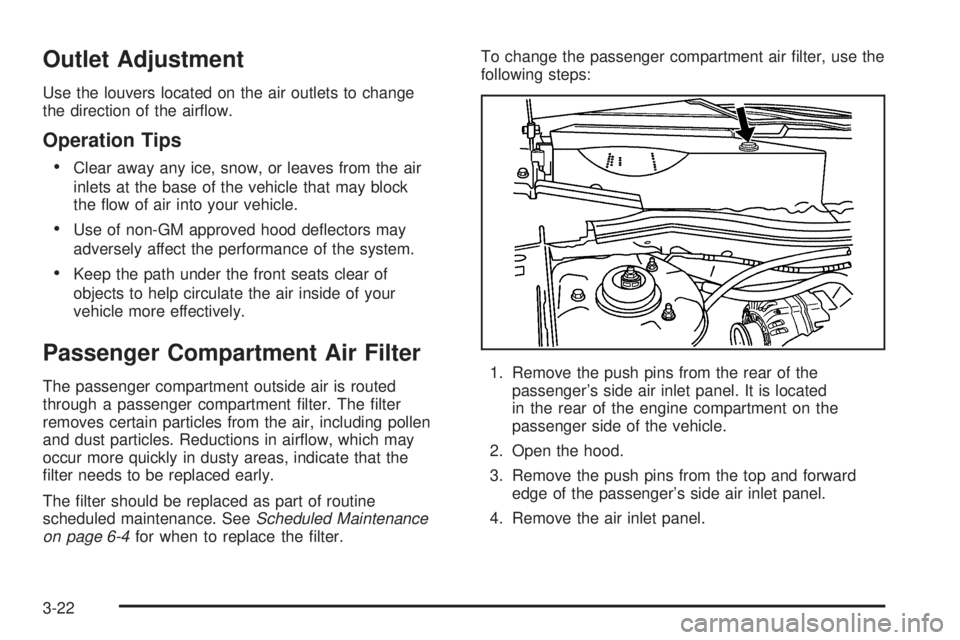
on page 6-4for when to replace the lter.To change the passenger compartment air lter, use the
following steps:
1. Remove the push pins from the rear of the
passenger’s side air inlet panel. It is located
in the rear of the engine compartment on the
passenger side of the vehicle.
2. Open the hood.
3. Remove the push pins from the top and forward
edge of the passenger’s side air inlet panel.
4. Remove the air inlet panel.
3-22
Page 228 of 368
If you put things inside your vehicle — like suitcases,
tools, packages, or anything else — they will go as
fast as the vehicle goes. If you have to stop or
turn quickly, or if there is a crash, they will keep going.
{CAUTION:
Things you put inside your vehicle can strike
and injure people in a sudden stop or turn,
or in a crash.
Put things in the cargo area of your
vehicle. Try to spread the weight evenly.
Never stack heavier things, like suitcases,
inside the vehicle so that some of them
are above the tops of the seats.
Do not leave an unsecured child restraint
in your vehicle.
When you carry something inside the
vehicle, secure it whenever you can.
Do not leave a seat folded down unless
you need to.
Towing
Towing Your Vehicle
Consult your dealer or a professional towing service if
you need to have your disabled vehicle towed. See
Roadside Assistance Program on page 7-6.
If you want to tow your vehicle behind another vehicle
for recreational purposes (such as behind a motorhome),
see “Recreational Vehicle Towing” following.
Recreational Vehicle Towing
Recreational vehicle towing means towing your vehicle
behind another vehicle – such as behind a motorhome.
The two most common types of recreational vehicle
towing are known as “dinghy towing” (towing your
vehicle with all four wheels on the ground) and
“dolly towing” (towing your vehicle with two wheels
on the ground and two wheels up on a device known
as a “dolly”).
With the proper preparation and equipment, many
vehicles can be towed in these ways. See “Dinghy
Towing” and “Dolly Towing,” following.
4-36
Page 286 of 368
Tire Terminology and Denitions
Air Pressure:The amount of air inside the tire pressing
outward on each square inch of the tire. Air pressure
is expressed in pounds per square inch (psi) or
kilopascal (kPa).
Accessory Weight:This means the combined weight
of optional accessories. Some examples of optional
accessories are, automatic transmission, power steering,
power brakes, power windows, power seats, and
air conditioning.
Aspect Ratio:The relationship of a tire’s height to
its width.
Belt:A rubber coated layer of cords that is located
between the plies and the tread. Cords may be made
from steel or other reinforcing materials.
Bead:The tire bead contains steel wires wrapped
by steel cords that hold the tire onto the rim.
Bias Ply Tire:A pneumatic tire in which the plies are
laid at alternate angles less than 90 degrees to the
centerline of the tread.
Cold Ination Pressure:The amount of air pressure
in a tire, measured in pounds per square inch (psi)
or kilopascals (kPa) before a tire has built up heat from
driving. SeeInation - Tire Pressure on page 5-52.Curb Weight:This means the weight of a motor
vehicle with standard and optional equipment including
the maximum capacity of fuel, oil and coolant, but
without passengers and cargo.
DOT Markings:A code molded into the sidewall of
a tire signifying that the tire is in compliance with
the U.S. Department of Transportation (DOT) motor
vehicle safety standards. The DOT code includes
the Tire Identication Number (TIN), an alphanumeric
designator which can also identify the tire manufacturer,
production plant, brand and date of production.
GVWR:Gross Vehicle Weight Rating, seeLoading
Your Vehicle on page 4-31.
GAWR FRT:Gross Axle Weight Rating for the front
axle, seeLoading Your Vehicle on page 4-31.
GAWR RR:Gross Axle Weight Rating for the rear axle,
seeLoading Your Vehicle on page 4-31.
Intended Outboard Sidewall:The side of an
asymmetrical tire, that must always face outward when
mounted on a vehicle.
Kilopascal (kPa):The metric unit for air pressure.
Light Truck (LT-Metric) Tire:A tire used on light duty
trucks and some multipurpose passenger vehicles.
5-50
Page 319 of 368
Electrical System
Add-On Electrical Equipment
Notice:Don’t add anything electrical to your
vehicle unless you check with your dealer rst.
Some electrical equipment can damage your
vehicle and the damage wouldn’t be covered by
your warranty. Some add-on electrical equipment
can keep other components from working as
they should.
Your vehicle has an airbag system. Before attempting
to add anything electrical to your vehicle, seeServicing
Your Airbag-Equipped Vehicle on page 1-61.
Windshield Wiper Fuses
The windshield wiper motor is protected by a circuit
breaker and a fuse. If the motor overheats due to heavy
snow or ice, the wiper will stop until the motor cools.
If the overload is caused by some electrical problem,
have it xed.
Power Windows and Other
Power Options
Circuit breakers in the fuse panel protect the power
seats. When the current load is too heavy, the circuit
breaker opens and closes, protecting the circuit until
the problem is xed.
Fuses and Circuit Breakers
The wiring circuits in your vehicle are protected from
short circuits by fuses. This greatly reduces the chance
of circuit overload and re caused by electrical
problems.
There are two fuse blocks — the underhood fuse block,
and the instrument panel fuse block.
To identify and check fuses and relays, refer to
the Fuse Usage Chart on the inside surface of the
fuse panel door.
5-83
Page 320 of 368
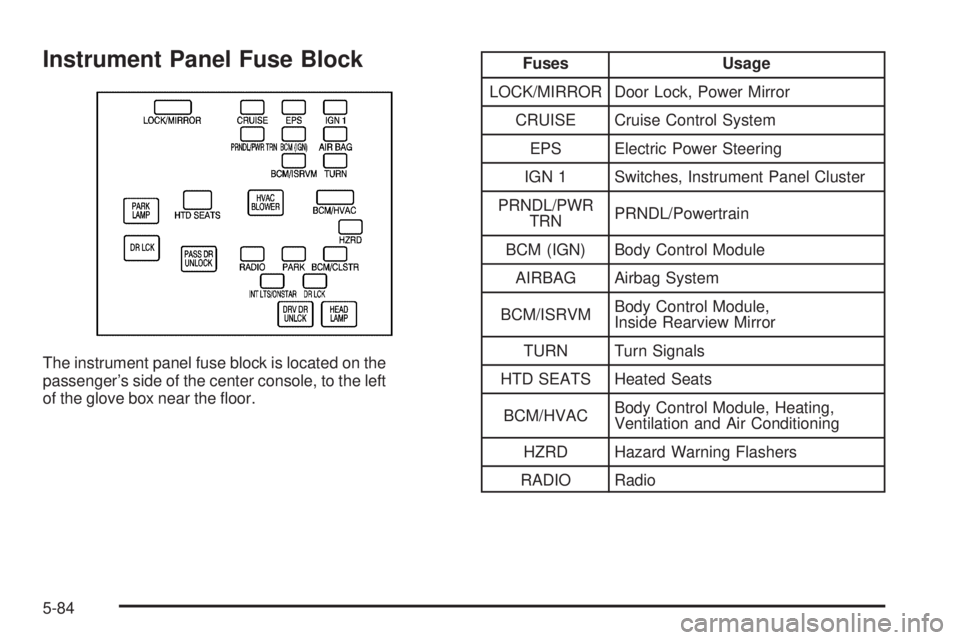
Instrument Panel Fuse Block
The instrument panel fuse block is located on the
passenger’s side of the center console, to the left
of the glove box near the oor.
Fuses Usage
LOCK/MIRROR Door Lock, Power Mirror
CRUISE Cruise Control System
EPS Electric Power Steering
IGN 1 Switches, Instrument Panel Cluster
PRNDL/PWR
TRNPRNDL/Powertrain
BCM (IGN) Body Control Module
AIRBAG Airbag System
BCM/ISRVMBody Control Module,
Inside Rearview Mirror
TURN Turn Signals
HTD SEATS Heated Seats
BCM/HVACBody Control Module, Heating,
Ventilation and Air Conditioning
HZRD Hazard Warning Flashers
RADIO Radio
5-84
Page 321 of 368
Fuses Usage
LOCK/MIRROR Door Lock, Power Mirror
PARK Parking Lamps
BCM/CLSTRBody Control Module,
Instrument Panel Cluster
INT LTS/
ONSTAR
®Interior Lights/OnStar®
DR LCK Door Locks
Relays Usage
PARK LAMP Parking Lamps Relay
HVAC
BLOWERHeating, Ventilation and
Air Conditioning Blower Motor
DR LCK Door Locks Relay
PASS DR
UNLOCKPassenger Door Unlock Relay
DRV DR
UNLCKDriver Door Unlock Relay
HEAD LAMP Headlamps
Engine Compartment Fuse Block
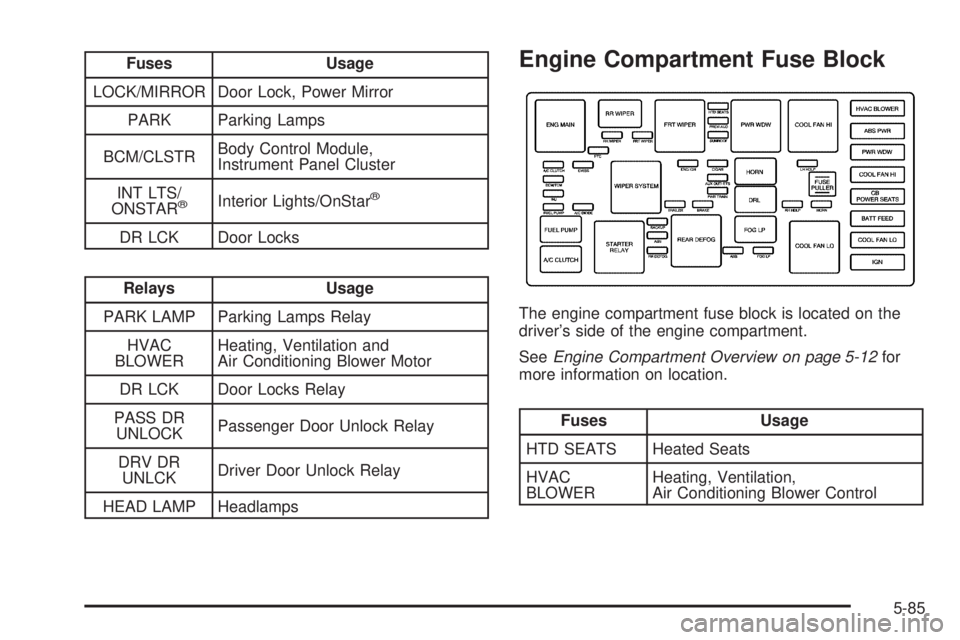
The engine compartment fuse block is located on the
driver’s side of the engine compartment.
SeeEngine Compartment Overview on page 5-12for
more information on location.
Fuses Usage
HTD SEATS Heated Seats
HVAC
BLOWERHeating, Ventilation,
Air Conditioning Blower Control
5-85