light PONTIAC TORRENT 2006 Owner's Manual
[x] Cancel search | Manufacturer: PONTIAC, Model Year: 2006, Model line: TORRENT, Model: PONTIAC TORRENT 2006Pages: 368, PDF Size: 2.37 MB
Page 118 of 368
Turn and Lane-Change Signals
The turn signal has two upward (for right) and
two downward (for left) positions. These positions
allow you to signal a turn or a lane change.
To signal a turn, move the lever all the way up or
down. When the turn is nished, the lever will return
automatically.
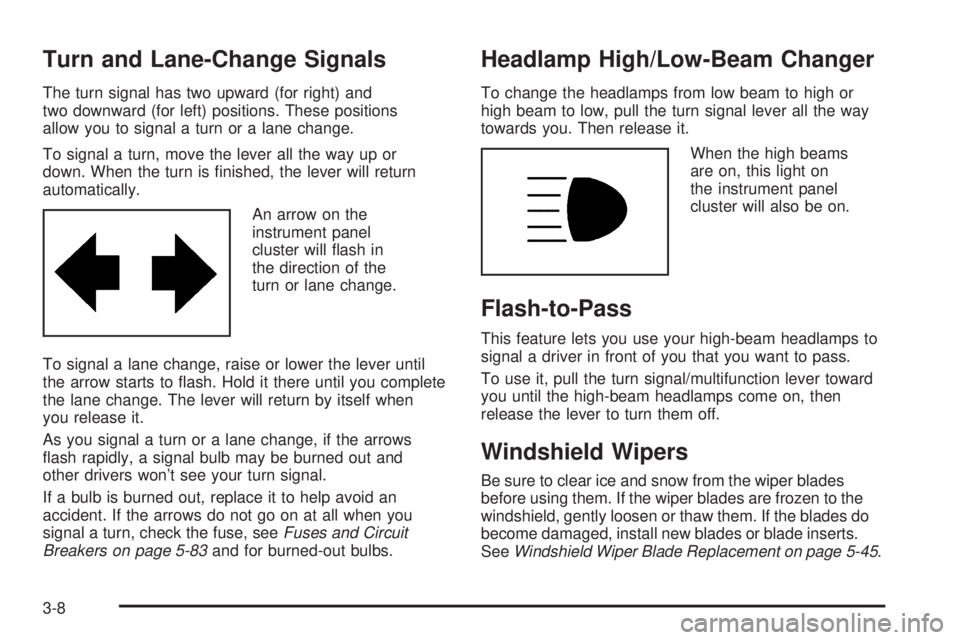
An arrow on the
instrument panel
cluster will ash in
the direction of the
turn or lane change.
To signal a lane change, raise or lower the lever until
the arrow starts to ash. Hold it there until you complete
the lane change. The lever will return by itself when
you release it.
As you signal a turn or a lane change, if the arrows
ash rapidly, a signal bulb may be burned out and
other drivers won’t see your turn signal.
If a bulb is burned out, replace it to help avoid an
accident. If the arrows do not go on at all when you
signal a turn, check the fuse, seeFuses and Circuit
Breakers on page 5-83and for burned-out bulbs.
Headlamp High/Low-Beam Changer
To change the headlamps from low beam to high or
high beam to low, pull the turn signal lever all the way
towards you. Then release it.
When the high beams
are on, this light on
the instrument panel
cluster will also be on.
Flash-to-Pass
This feature lets you use your high-beam headlamps to
signal a driver in front of you that you want to pass.
To use it, pull the turn signal/multifunction lever toward
you until the high-beam headlamps come on, then
release the lever to turn them off.
Windshield Wipers
Be sure to clear ice and snow from the wiper blades
before using them. If the wiper blades are frozen to the
windshield, gently loosen or thaw them. If the blades do
become damaged, install new blades or blade inserts.
SeeWindshield Wiper Blade Replacement on page 5-45.
3-8
Page 122 of 368
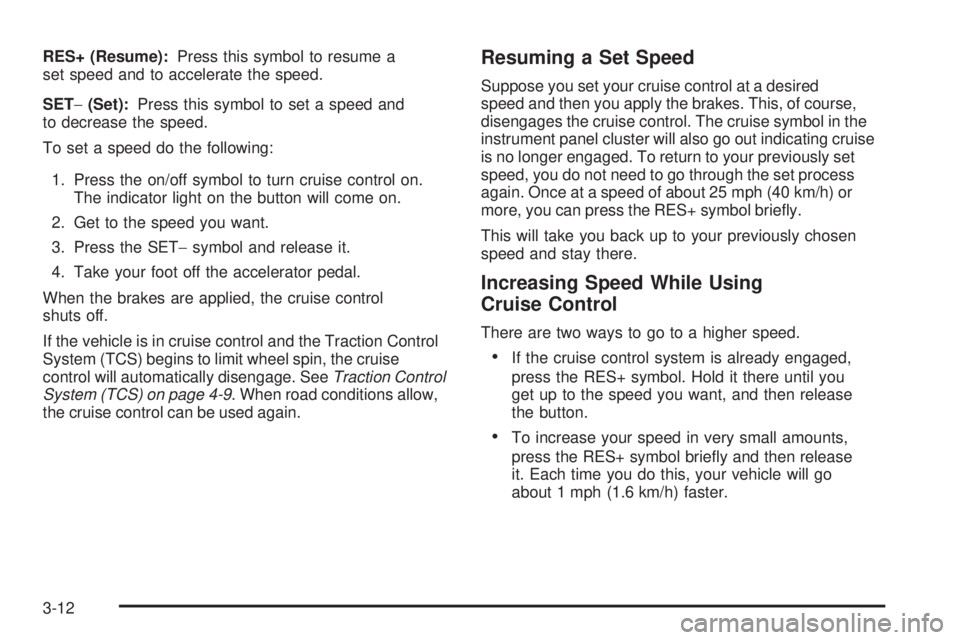
RES+ (Resume):Press this symbol to resume a
set speed and to accelerate the speed.
SET−(Set):Press this symbol to set a speed and
to decrease the speed.
To set a speed do the following:
1. Press the on/off symbol to turn cruise control on.
The indicator light on the button will come on.
2. Get to the speed you want.
3. Press the SET−symbol and release it.
4. Take your foot off the accelerator pedal.
When the brakes are applied, the cruise control
shuts off.
If the vehicle is in cruise control and the Traction Control
System (TCS) begins to limit wheel spin, the cruise
control will automatically disengage. SeeTraction Control
System (TCS) on page 4-9. When road conditions allow,
the cruise control can be used again.Resuming a Set Speed
Suppose you set your cruise control at a desired
speed and then you apply the brakes. This, of course,
disengages the cruise control. The cruise symbol in the
instrument panel cluster will also go out indicating cruise
is no longer engaged. To return to your previously set
speed, you do not need to go through the set process
again. Once at a speed of about 25 mph (40 km/h) or
more, you can press the RES+ symbol briey.
This will take you back up to your previously chosen
speed and stay there.
Increasing Speed While Using
Cruise Control
There are two ways to go to a higher speed.
If the cruise control system is already engaged,
press the RES+ symbol. Hold it there until you
get up to the speed you want, and then release
the button.
To increase your speed in very small amounts,
press the RES+ symbol briey and then release
it. Each time you do this, your vehicle will go
about 1 mph (1.6 km/h) faster.
3-12
Page 123 of 368
Reducing Speed While Using
Cruise Control
If the cruise control system is already engaged,
Push and hold the SET−symbol until you reach
the lower speed you want, then release it.
To slow down in very small amounts, push the
SET−symbol briey. Each time you do this, you
will go about 1 mph (1.6 km/h) slower.
Passing Another Vehicle While Using
Cruise Control
Use the accelerator pedal to increase your speed.
When you take your foot off the pedal, your vehicle will
slow down to the cruise control speed you set earlier.
However, if you use the accelerator to increase the
vehicle’s speed for approximately 60 seconds, cruise
control will disengage.
Using Cruise Control on Hills
How well your cruise control will work on hills depends
upon your speed, load, and the steepness of the
hills. When going up steep hills, you may have to step
on the accelerator pedal to maintain your vehicle’s
speed. When going downhill, you may have to brake or
shift to a lower gear to keep your vehicle’s speed
down. Of course, applying the brakes ends cruise
control. Many drivers nd this to be too much trouble
and do not use cruise control on steep hills.
Ending Cruise Control
To end a cruise control session, step lightly on the
brake pedal.
Stepping on the brake will end the current cruise control
session only. Press the cruise on/off button to turn off
the system completely.
If the driver takes over the acceleration pedal for more
than sixty seconds, cruise control will shut off.
Erasing Speed Memory
When you turn off the cruise control or the ignition,
your cruise control set speed memory is erased.
3-13
Page 124 of 368
Headlamps
The exterior lamp control is located on the turn
signal/multifunction lever.
O(Exterior Lamp Control):Turn the control with
this symbol on it to operate the exterior lamps.
The exterior lamp control has the following positions:
AUTO (Off/Automatic Headlamps):Turn the control to
this position to put the headlamps in automatic mode.
Automatic mode will turn the exterior lamps on and
off depending upon how much light is available outside
of the vehicle.
;(Parking Lamps):Turn the control to this
position to turn on the parking lamps together with
the following:
Sidemarker Lamps
Taillamps
License Plate Lamps
Instrument Panel Lights
53(Headlamps):Turning the control to this
position turns on the headlamps, together with the
previously listed lamps and lights.
Headlamps on Reminder
If you open the driver’s door with the ignition off and the
lamps on, you will hear a warning chime.
Daytime Running Lamps (DRL)
Daytime Running Lamps (DRL) can make it easier for
others to see the front of your vehicle during the
day. DRL can be helpful in many different driving
conditions, but they can be especially helpful in the short
periods after dawn and before sunset. Fully functional
daytime running lamps are required on all vehicles
rst sold in Canada.
The DRL system will make your low-beam headlamps
come on at a reduced brightness in daylight when
the following conditions are met:
The ignition is on,
the exterior lamp band is in the automatic position,
the transaxle is not in PARK (P),
the light sensor determines it is daytime, and
the parking brake is released.
When the DRL are on, the low-beam headlamps will be
on at a reduced brightness. The taillamps, sidemarker
and other lamps will not be on. The instrument panel
will not be lit up either.
3-14
Page 125 of 368
When you turn the exterior lamp band to the headlamp
position, your low-beam headlamps will come on.
The other lamps that come on with your headlamps
will also come on.
When you turn off the headlamps, the regular lamps
will go off, and your low-beam headlamps will come
on to the reduced brightness.
To idle your vehicle with the DRL off, move the shift
lever to PARK (P). The DRL will stay off until you
move the shift lever out of PARK (P).
As with any vehicle, you should turn on the regular
headlamp system when you need it.
Automatic Headlamp System
When it is dark enough outside and the exterior lamps
control is in the automatic position, the headlamps
will come on automatically. SeeHeadlamps on
page 3-14.
Your vehicle has a light sensor located on top of the
instrument panel. Make sure it is not covered, or
the headlamps will be on when you don’t need them.
The system may also turn on the headlamps when
driving through a parking garage or tunnel.
Fog Lamps
If your vehicle has this feature, use your fog lamps for
better visibility in foggy or misty conditions.
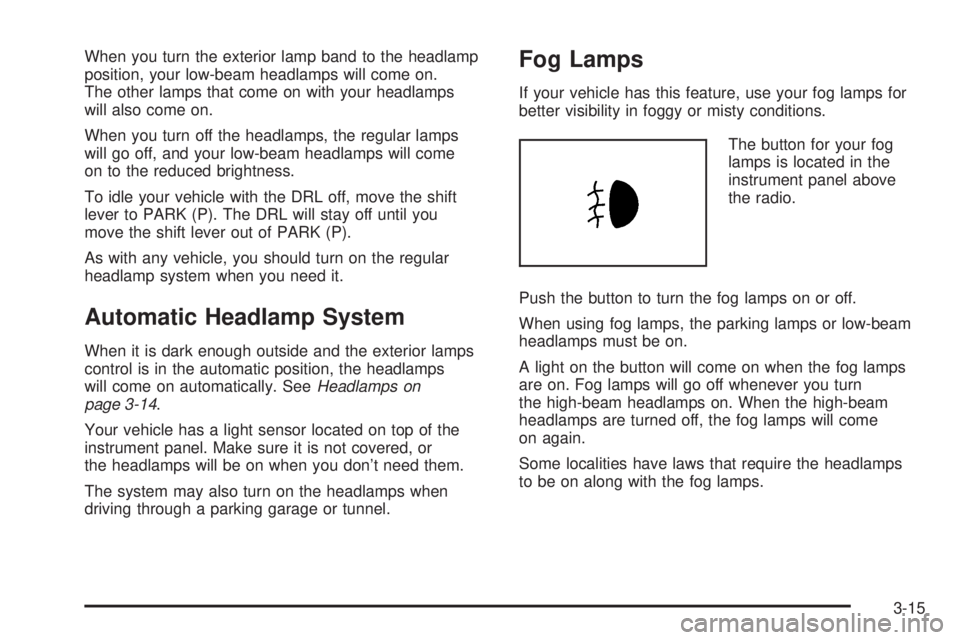
The button for your fog
lamps is located in the
instrument panel above
the radio.
Push the button to turn the fog lamps on or off.
When using fog lamps, the parking lamps or low-beam
headlamps must be on.
A light on the button will come on when the fog lamps
are on. Fog lamps will go off whenever you turn
the high-beam headlamps on. When the high-beam
headlamps are turned off, the fog lamps will come
on again.
Some localities have laws that require the headlamps
to be on along with the fog lamps.
3-15
Page 126 of 368
Instrument Panel Brightness
This feature controls the brightness of the instrument
panel lights.
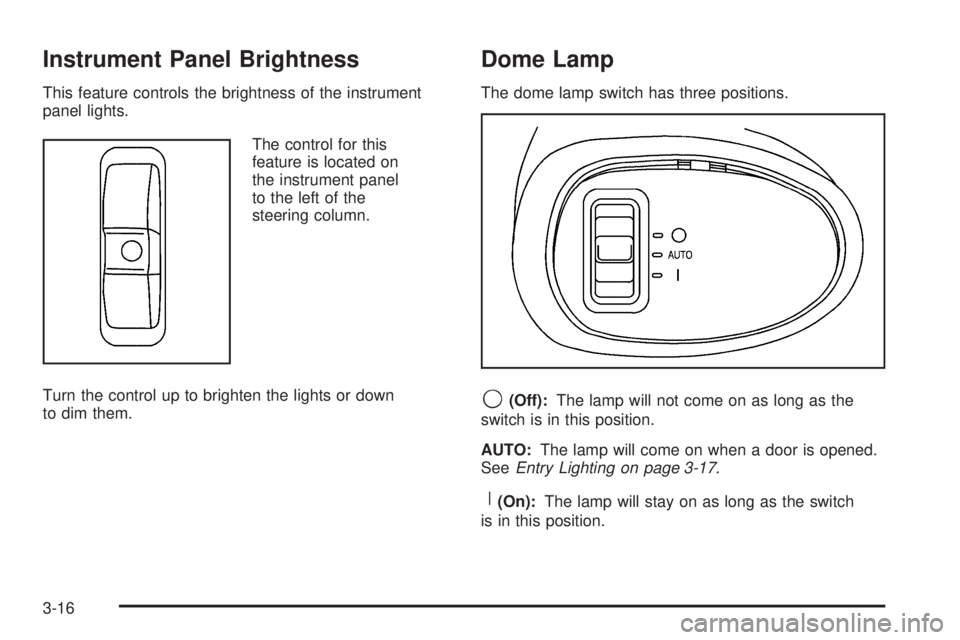
The control for this
feature is located on
the instrument panel
to the left of the
steering column.
Turn the control up to brighten the lights or down
to dim them.
Dome Lamp
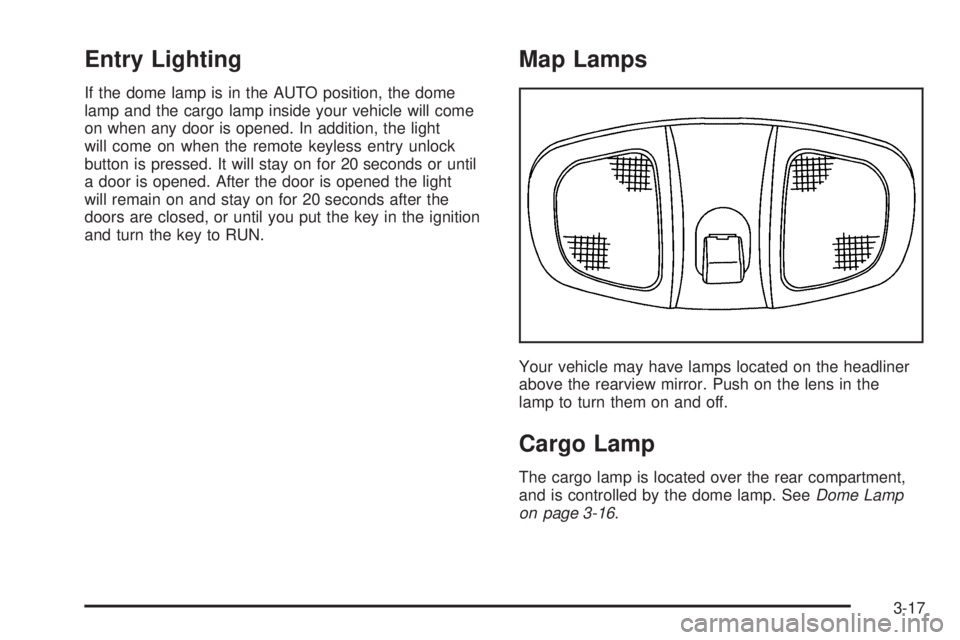
The dome lamp switch has three positions.
9(Off):The lamp will not come on as long as the
switch is in this position.
AUTO:The lamp will come on when a door is opened.
SeeEntry Lighting on page 3-17.
R(On):The lamp will stay on as long as the switch
is in this position.
3-16
Page 127 of 368
Entry Lighting
If the dome lamp is in the AUTO position, the dome
lamp and the cargo lamp inside your vehicle will come
on when any door is opened. In addition, the light
will come on when the remote keyless entry unlock
button is pressed. It will stay on for 20 seconds or until
a door is opened. After the door is opened the light
will remain on and stay on for 20 seconds after the
doors are closed, or until you put the key in the ignition
and turn the key to RUN.
Map Lamps
Your vehicle may have lamps located on the headliner
above the rearview mirror. Push on the lens in the
lamp to turn them on and off.
Cargo Lamp
The cargo lamp is located over the rear compartment,
and is controlled by the dome lamp. SeeDome Lamp
on page 3-16.
3-17
Page 129 of 368

Ashtray(s) and Cigarette Lighter
Your vehicle may have an ashtray and cigarette lighter.
Lift the lid to expose the ashtray. To remove the
ashtray, lift it up.
Lift the lid to expose the cigarette lighter.
To use the lighter, push it in all the way and let go.
When it is ready, it will pop back out by itself.
Notice:Holding a cigarette lighter in while it is
heating will not allow the lighter to back away from
the heating element when it is hot. Damage from
overheating may occur to the lighter or heating
element, or a fuse could be blown. Do not hold a
cigarette lighter in while it is heating.
Notice:If you put papers, pins, or other ammable
items in the ashtray, hot cigarettes or other
smoking materials could ignite them and possibly
damage your vehicle. Never put ammable items
in the ashtray.
Climate Controls
Climate Control System
With this system you can control the heating, cooling
and ventilation for your vehicle.
Operation
Temperature Control:Turn the center knob clockwise
or counterclockwise to increase or decrease the
temperature inside your vehicle.
3-19
Page 130 of 368
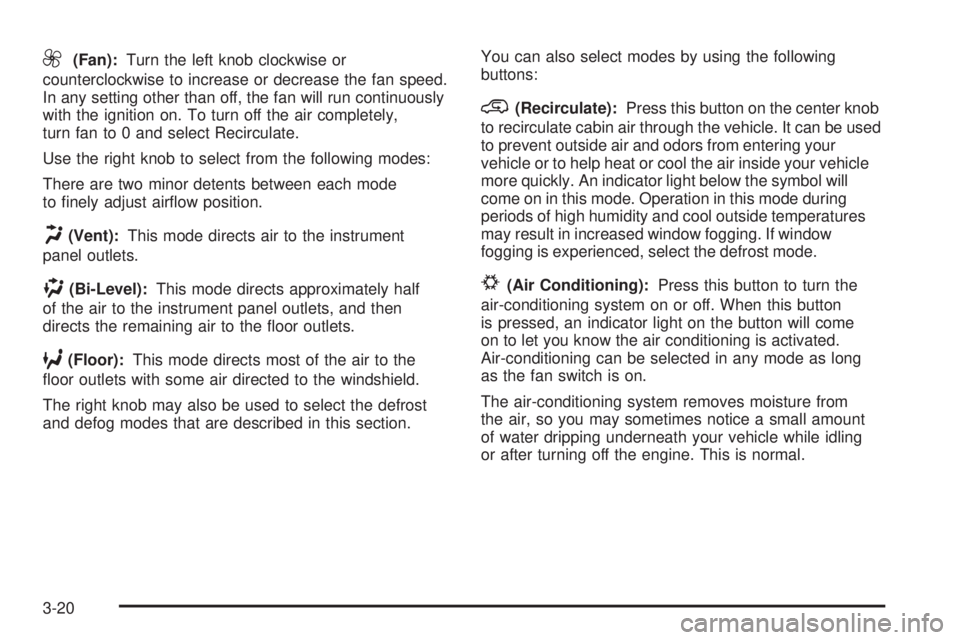
9(Fan):Turn the left knob clockwise or
counterclockwise to increase or decrease the fan speed.
In any setting other than off, the fan will run continuously
with the ignition on. To turn off the air completely,
turn fan to 0 and select Recirculate.
Use the right knob to select from the following modes:
There are two minor detents between each mode
to nely adjust airow position.
H(Vent):This mode directs air to the instrument
panel outlets.
)(Bi-Level):This mode directs approximately half
of the air to the instrument panel outlets, and then
directs the remaining air to the oor outlets.
6(Floor):This mode directs most of the air to the
oor outlets with some air directed to the windshield.
The right knob may also be used to select the defrost
and defog modes that are described in this section.You can also select modes by using the following
buttons:
@(Recirculate):Press this button on the center knob
to recirculate cabin air through the vehicle. It can be used
to prevent outside air and odors from entering your
vehicle or to help heat or cool the air inside your vehicle
more quickly. An indicator light below the symbol will
come on in this mode. Operation in this mode during
periods of high humidity and cool outside temperatures
may result in increased window fogging. If window
fogging is experienced, select the defrost mode.
#(Air Conditioning):Press this button to turn the
air-conditioning system on or off. When this button
is pressed, an indicator light on the button will come
on to let you know the air conditioning is activated.
Air-conditioning can be selected in any mode as long
as the fan switch is on.
The air-conditioning system removes moisture from
the air, so you may sometimes notice a small amount
of water dripping underneath your vehicle while idling
or after turning off the engine. This is normal.
3-20
Page 131 of 368
Defogging and Defrosting
Fog or frost on the inside of windows is a result of high
humidity (moisture) condensing on the cool window
glass. This can be minimized if the climate control
system is used properly. Use the defog mode to clear
the windows of fog or moisture and warm the
passengers. To avoid fogging windows on rainy and
humid days at temperatures above freezing, run the air
conditioning compressor. Also, it is best to avoid the
use of recirculation mode except when maximum
A/C performance is needed or for short times to avoid
exterior odors. Use the defrost mode to remove fog
or frost from the windshield more quickly. When
you select either of these modes (or the oor mode
which also helps defog the windows slightly), the system
runs the air-conditioning compressor and cancels
recirculation mode to dry the air; however, the
recirculation light will stay on. For best results, clear all
snow and ice from the windshield before defrosting.
Turn the right knob to select the defog or defrost mode.
-(Defog):This mode directs half of the air to the
windshield and the side window outlets and half to
the oor outlets.
0(Defrost):This mode directs most of the air to
the windshield and the side window outlets, with some
air directed to the oor outlets.
Rear Window Defogger
The rear window defogger uses a warming grid to
remove fog from the rear window.
The rear window defogger will only work when the
ignition is in RUN.
<(Rear):Press this button to turn the rear window
defogger on or off. An indicator light on the button
will come on to let you know that the rear window
defogger is activated.
The rear window defogger will only work when the
ignition is in RUN. The rear window defogger will stay
on for approximately 15 minutes after the button is
pressed, unless the ignition is turned to ACC or LOCK.
If turned on again, the defogger will only run for
approximately ve minutes before turning off. The
defogger can also be turned off by pressing the button
again or by turning off the engine.
Notice:Do not use anything sharp on the inside
of the rear window. If you do, you could cut or
damage the warming grid, and the repairs would
not be covered by your warranty. Do not attach
a temporary vehicle license, tape, a decal or
anything similar to the defogger grid.
3-21