instrument panel PONTIAC TORRENT 2006 Owner's Guide
[x] Cancel search | Manufacturer: PONTIAC, Model Year: 2006, Model line: TORRENT, Model: PONTIAC TORRENT 2006Pages: 368, PDF Size: 2.37 MB
Page 199 of 368
Anti-Lock Brake System (ABS)
Your vehicle may have anti-lock brakes. ABS is an
advanced electronic braking system that will help
prevent a braking skid.
If your vehicle has anti-lock
brakes, this warning light
on the instrument panel
will come on briey
when you start your
vehicle.
When you start your engine, or when you begin to
drive away, your anti-lock brake system will check itself.
You may hear a momentary motor or clicking noise
while this test is going on, and you may even notice
that your brake pedal moves or pulses a little.
This is normal.Let us say the road is wet and you are driving
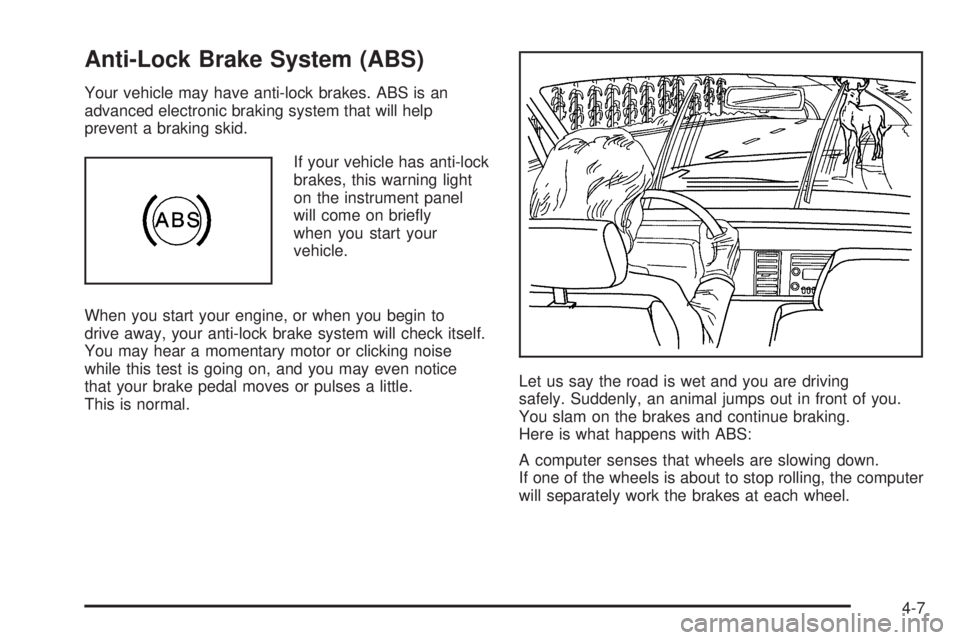
safely. Suddenly, an animal jumps out in front of you.
You slam on the brakes and continue braking.
Here is what happens with ABS:
A computer senses that wheels are slowing down.
If one of the wheels is about to stop rolling, the computer
will separately work the brakes at each wheel.
4-7
Page 202 of 368

The traction control system
can be turned off by
pressing the traction
control button, located
on the instrument panel
above the audio system.
The traction control system can be activated again by
pressing the traction control button.
If the system is limiting wheel spin when you press
the button, the traction control off light will appear on the
instrument panel cluster. The system will not turn off
until there is no longer a current need to limit wheel
spin. You can turn the system back on at any time by
pressing the button again. If the light does not come
on, you may not have traction control and your vehicle
should be serviced by a dealer.
Adding non-GM accessories can affect your vehicle’s
performance. SeeAccessories and Modications
on page 5-3for more information.All-Wheel Drive (AWD) System
If your vehicle has all-wheel drive (AWD), the AWD
system operates automatically without any action
required by the driver. If the front drive wheels begin
to slip, the rear wheels will automatically begin to
drive the vehicle as required. There may be a slight
engagement noise during hard use but this is normal.
This light will come on
when engine torque is
reduced to protect
the AWD system from
overheating. You may
feel or hear a change
in engine output, but
this is normal.
During heavy AWD applications, the engine torque
may be reduced to protect AWD system components.
If the vehicle is exposed to extended heavy AWD
usage, the AWD system will shut itself off to protect
the system from overheating. When the system
cools down, the AWD system will activate itself again
automatically; this cool-down can take up to 20 minutes
depending on outside temperature and vehicle use.
4-10
Page 235 of 368
Passing
You will need more passing distance up ahead when
you are towing a trailer. And, because you are a
good deal longer, you will need to go much farther
beyond the passed vehicle before you can return to
your lane.
Backing Up
Hold the bottom of the steering wheel with one hand.
Then, to move the trailer to the left, just move that hand
to the left. To move the trailer to the right, move your
hand to the right. Always back up slowly and, if possible,
have someone guide you.
Making Turns
Notice:Making very sharp turns while trailering
could cause the trailer to come in contact with
the vehicle. Your vehicle could be damaged.
Avoid making very sharp turns while trailering.
When you are turning with a trailer, make wider turns
than normal. Do this so your trailer will not strike
soft shoulders, curbs, road signs, trees or other objects.
Avoid jerky or sudden maneuvers. Signal well in
advance.
Turn Signals When Towing a Trailer
When you tow a trailer, your vehicle has to have
extra wiring.
The arrows on your instrument panel will ash whenever
you signal a turn or lane change. Properly hooked up,
the trailer lamps will also ash, telling other drivers
you are about to turn, change lanes or stop.
When towing a trailer, the arrows on your instrument
panel will ash for turns even if the bulbs on the trailer
are burned out. Thus, you may think drivers behind
you are seeing your signal when they are not. It’s
important to check occasionally to be sure the trailer
bulbs are still working.
Driving On Grades
Reduce speed and shift to a lower gear before you
start down a long or steep downgrade. If you do not
shift down, you might have to use your brakes so
much that they would get hot and no longer work well.
If you are towing a trailer that weighs more than
1,000 lbs (450 kg), drive in L4 instead of AUTOMATIC
OVERDRIVE (D) or, as you need to, a lower gear.
This will minimize heat build-up and extend the life
of your transaxle.
4-43
Page 238 of 368
If a Tire Goes Flat........................................5-62
Changing a Flat Tire.....................................5-62
Removing the Spare Tire and Tools................5-64
Removing the Flat Tire and Installing the
Spare Tire................................................5-65
Storing a Flat or Spare Tire and Tools............5-72
Compact Spare Tire......................................5-73
Appearance Care............................................5-74
Cleaning the Inside of Your Vehicle.................5-74
Fabric/Carpet...............................................5-75
Leather.......................................................5-76
Instrument Panel, Vinyl, and Other Plastic
Surfaces..................................................5-76
Care of Safety Belts......................................5-77
Weatherstrips...............................................5-77
Washing Your Vehicle...................................5-77
Cleaning Exterior Lamps/Lenses.....................5-78
Finish Care..................................................5-78
Windshield and Wiper Blades.........................5-78Aluminum Wheels.........................................5-79
Tires...........................................................5-80
Sheet Metal Damage.....................................5-80
Finish Damage.............................................5-80
Underbody Maintenance................................5-80
Chemical Paint Spotting.................................5-80
Vehicle Care/Appearance Materials..................5-81
Vehicle Identication......................................5-82
Vehicle Identication Number (VIN).................5-82
Service Parts Identication Label.....................5-82
Electrical System............................................5-83
Add-On Electrical Equipment..........................5-83
Windshield Wiper Fuses................................5-83
Power Windows and Other Power Options.......5-83
Fuses and Circuit Breakers............................5-83
Instrument Panel Fuse Block..........................5-84
Engine Compartment Fuse Block....................5-85
Capacities and Specications..........................5-88
Section 5 Service and Appearance Care
5-2
Page 259 of 368
{CAUTION:
Turning the surge tank pressure cap when the
engine and radiator are hot can allow steam
and scalding liquids to blow out and burn you
badly. Never turn the surge tank pressure
cap — even a little — when the engine and
radiator are hot.
The vehicle must be on a level surface. When your
engine is cold, the coolant level should be at the
COLD FILL line. When your engine is warm, the level
should be at the COLD FILL line or a little higher.
Adding Coolant
If you need more coolant, add the proper DEX-COOL®
coolant mixture at the surge tank, but only when the
engine is cool.
a
{CAUTION:
You can be burned if you spill coolant on hot
engine parts. Coolant contains ethylene glycol,
and it will burn if the engine parts are hot
enough. Do not spill coolant on a hot engine.
When replacing the pressure cap, make sure it is
hand-tight and fully seated.
Engine Overheating
You will nd a coolant temperature gage on your
vehicle’s instrument panel. SeeEngine Coolant
Temperature Gage on page 3-31.
5-23
Page 312 of 368
Leather
A soft cloth dampened with water may be used to
remove dust. If a more thorough cleaning is necessary,
a soft cloth dampened with a mild soap solution can
be used. Allow the leather to dry naturally. Do not use
heat to dry. Never use steam to clean leather. Never
use spot lifters or spot removers on leather. Many
commercial leather cleaners and coatings that are sold
to preserve and protect leather may permanently
change the appearance and feel of your leather and are
not recommended. Do not use silicone or wax-based
products, or those containing organic solvents to clean
your vehicle’s interior because they can alter the
appearance by increasing the gloss in a non-uniform
manner. Never use shoe polish on your leather.
Instrument Panel, Vinyl, and Other
Plastic Surfaces
A soft cloth dampened with water may be used to
remove dust. If a more thorough cleaning is necessary,
a clean soft cloth dampened with a mild soap solution
can be used to gently remove dust and dirt. Never
use spot lifters or removers on plastic surfaces.
Many commercial cleaners and coatings that are sold
to preserve and protect soft plastic surfaces may
permanently change the appearance and feel of your
interior and are not recommended. Do not use silicone
or wax-based products, or those containing organic
solvents to clean your vehicle’s interior because
they can alter the appearance by increasing the gloss
in a non-uniform manner.
Some commercial products may increase gloss on
your instrument panel. The increase in gloss may cause
annoying reections in the windshield and even make
it difficult to see through the windshield under certain
conditions.
5-76
Page 318 of 368
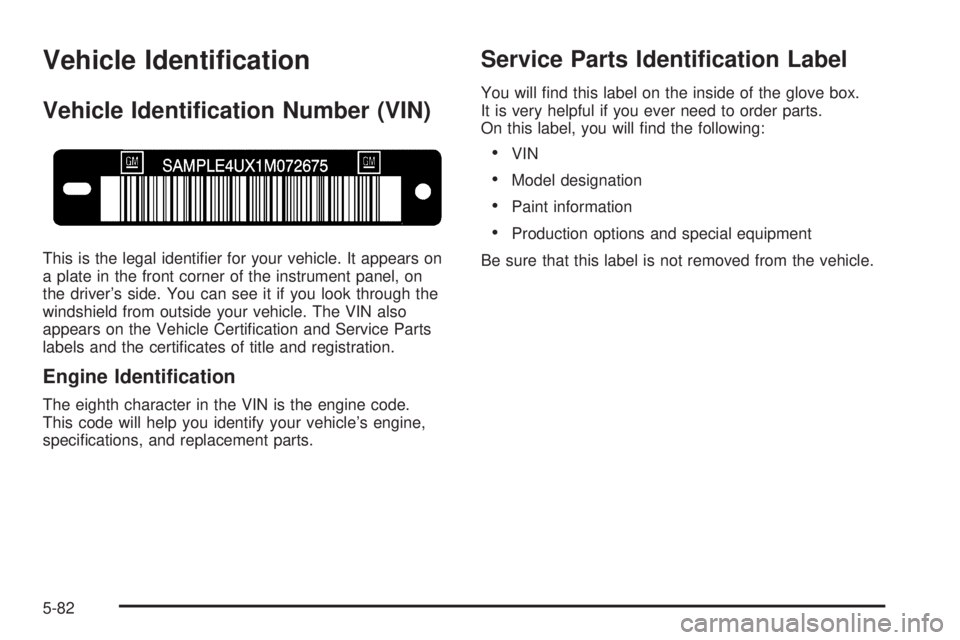
Vehicle Identication
Vehicle Identication Number (VIN)
This is the legal identier for your vehicle. It appears on
a plate in the front corner of the instrument panel, on
the driver’s side. You can see it if you look through the
windshield from outside your vehicle. The VIN also
appears on the Vehicle Certication and Service Parts
labels and the certicates of title and registration.
Engine Identication
The eighth character in the VIN is the engine code.
This code will help you identify your vehicle’s engine,
specications, and replacement parts.
Service Parts Identication Label
You will nd this label on the inside of the glove box.
It is very helpful if you ever need to order parts.
On this label, you will nd the following:
VIN
Model designation
Paint information
Production options and special equipment
Be sure that this label is not removed from the vehicle.
5-82
Page 319 of 368
Electrical System
Add-On Electrical Equipment
Notice:Don’t add anything electrical to your
vehicle unless you check with your dealer rst.
Some electrical equipment can damage your
vehicle and the damage wouldn’t be covered by
your warranty. Some add-on electrical equipment
can keep other components from working as
they should.
Your vehicle has an airbag system. Before attempting
to add anything electrical to your vehicle, seeServicing
Your Airbag-Equipped Vehicle on page 1-61.
Windshield Wiper Fuses
The windshield wiper motor is protected by a circuit
breaker and a fuse. If the motor overheats due to heavy
snow or ice, the wiper will stop until the motor cools.
If the overload is caused by some electrical problem,
have it xed.
Power Windows and Other
Power Options
Circuit breakers in the fuse panel protect the power
seats. When the current load is too heavy, the circuit
breaker opens and closes, protecting the circuit until
the problem is xed.
Fuses and Circuit Breakers
The wiring circuits in your vehicle are protected from
short circuits by fuses. This greatly reduces the chance
of circuit overload and re caused by electrical
problems.
There are two fuse blocks — the underhood fuse block,
and the instrument panel fuse block.
To identify and check fuses and relays, refer to
the Fuse Usage Chart on the inside surface of the
fuse panel door.
5-83
Page 320 of 368
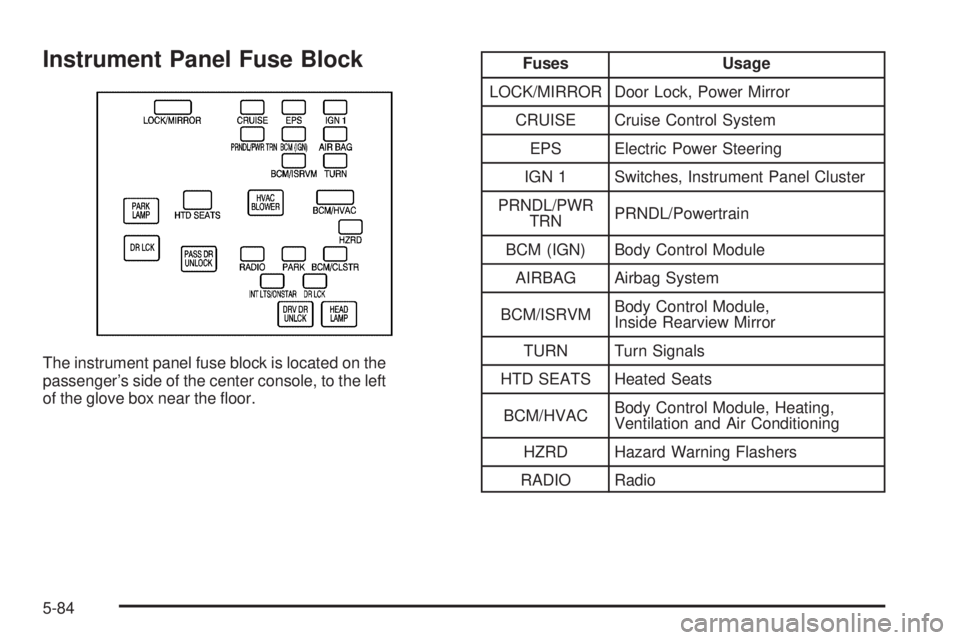
Instrument Panel Fuse Block
The instrument panel fuse block is located on the
passenger’s side of the center console, to the left
of the glove box near the oor.
Fuses Usage
LOCK/MIRROR Door Lock, Power Mirror
CRUISE Cruise Control System
EPS Electric Power Steering
IGN 1 Switches, Instrument Panel Cluster
PRNDL/PWR
TRNPRNDL/Powertrain
BCM (IGN) Body Control Module
AIRBAG Airbag System
BCM/ISRVMBody Control Module,
Inside Rearview Mirror
TURN Turn Signals
HTD SEATS Heated Seats
BCM/HVACBody Control Module, Heating,
Ventilation and Air Conditioning
HZRD Hazard Warning Flashers
RADIO Radio
5-84
Page 321 of 368
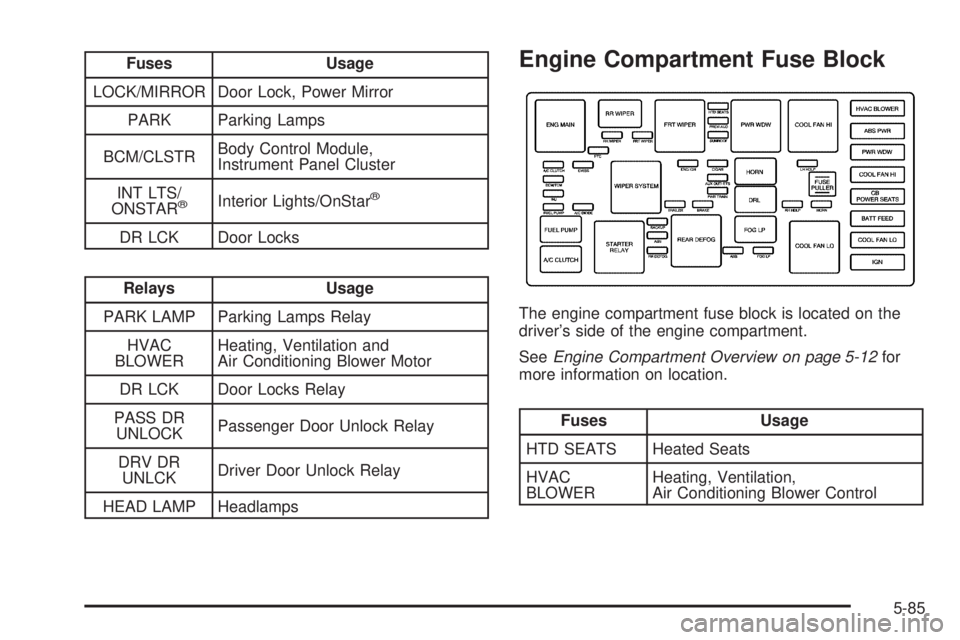
Fuses Usage
LOCK/MIRROR Door Lock, Power Mirror
PARK Parking Lamps
BCM/CLSTRBody Control Module,
Instrument Panel Cluster
INT LTS/
ONSTAR
®Interior Lights/OnStar®
DR LCK Door Locks
Relays Usage
PARK LAMP Parking Lamps Relay
HVAC
BLOWERHeating, Ventilation and
Air Conditioning Blower Motor
DR LCK Door Locks Relay
PASS DR
UNLOCKPassenger Door Unlock Relay
DRV DR
UNLCKDriver Door Unlock Relay
HEAD LAMP Headlamps
Engine Compartment Fuse Block
The engine compartment fuse block is located on the
driver’s side of the engine compartment.
SeeEngine Compartment Overview on page 5-12for
more information on location.
Fuses Usage
HTD SEATS Heated Seats
HVAC
BLOWERHeating, Ventilation,
Air Conditioning Blower Control
5-85