child lock PONTIAC TORRENT 2006 Owners Manual
[x] Cancel search | Manufacturer: PONTIAC, Model Year: 2006, Model line: TORRENT, Model: PONTIAC TORRENT 2006Pages: 368, PDF Size: 2.37 MB
Page 1 of 368
Seats and Restraint Systems........................... 1-1
Front Seats
............................................... 1-2
Rear Seats
..............................................1-10
Safety Belts
.............................................1-12
Child Restraints
.......................................1-30
Airbag System
.........................................1-53
Restraint System Check
............................1-62
Features and Controls..................................... 2-1
Keys
........................................................ 2-2
Doors and Locks
....................................... 2-6
Windows
.................................................2-11
Theft-Deterrent Systems
............................2-13
Starting and Operating Your Vehicle
...........2-15
Mirrors
....................................................2-27
OnStar
®System
......................................2-32
Storage Areas
.........................................2-34
Sunroof
..................................................2-40
Instrument Panel............................................. 3-1
Instrument Panel Overview
.......................... 3-4
Climate Controls
......................................3-19
Warning Lights, Gages, and Indicators
........3-23
Audio System(s)
.......................................3-38Driving Your Vehicle....................................... 4-1
Your Driving, the Road, and Your Vehicle
..... 4-2
Towing
...................................................4-36
Service and Appearance Care.......................... 5-1
Service
..................................................... 5-3
Fuel
......................................................... 5-5
Checking Things Under the Hood
...............5-10
All-Wheel Drive
........................................5-40
Bulb Replacement
....................................5-42
Windshield Wiper Blade Replacement
.........5-45
Tires
......................................................5-46
Appearance Care
.....................................5-74
Vehicle Identication
.................................5-82
Electrical System
......................................5-83
Capacities and Specications
.....................5-88
Maintenance Schedule..................................... 6-1
Maintenance Schedule
................................ 6-2
Customer Assistance and Information.............. 7-1
Customer Assistance and Information
........... 7-2
Reporting Safety Defects
...........................7-14
Index................................................................ 1
2006 Pontiac Torrent Owner ManualM
Page 31 of 368
Right Front Passenger Position
To learn how to wear the right front passenger’s safety
belt properly, seeDriver Position on page 1-18.
The right front passenger’s safety belt works the same
way as the driver’s safety belt — except for the
following.
If you ever pull the shoulder portion of the belt out all
the way, you will engage the child restraint locking
feature. If this happens, just let the belt go back all the
way and start again.
When the safety belt is not in use, slide the latch plate
up the safety belt webbing. The latch plate should
rest on the stitching on the safety belt, near the
guideloop.
Rear Seat Passengers
It is very important for rear seat passengers to buckle
up! Accident statistics show that unbelted people in
the rear seat are hurt more often in crashes than those
who are wearing safety belts.
Rear passengers who are not safety belted can be
thrown out of the vehicle in a crash. And they can strike
others in the vehicle who are wearing safety belts.
Lap-Shoulder Belt
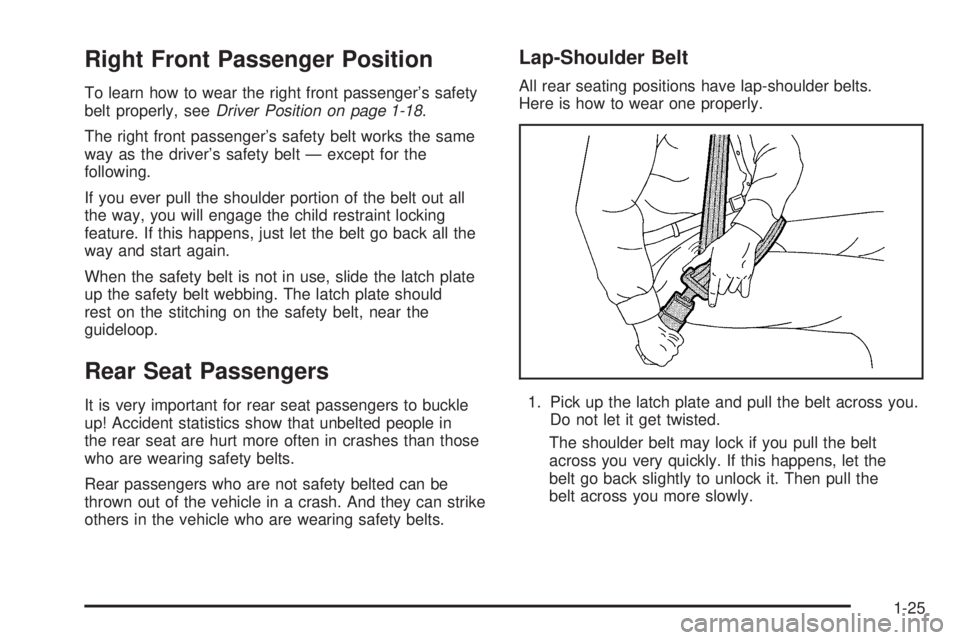
All rear seating positions have lap-shoulder belts.
Here is how to wear one properly.
1. Pick up the latch plate and pull the belt across you.
Do not let it get twisted.
The shoulder belt may lock if you pull the belt
across you very quickly. If this happens, let the
belt go back slightly to unlock it. Then pull the
belt across you more slowly.
1-25
Page 33 of 368
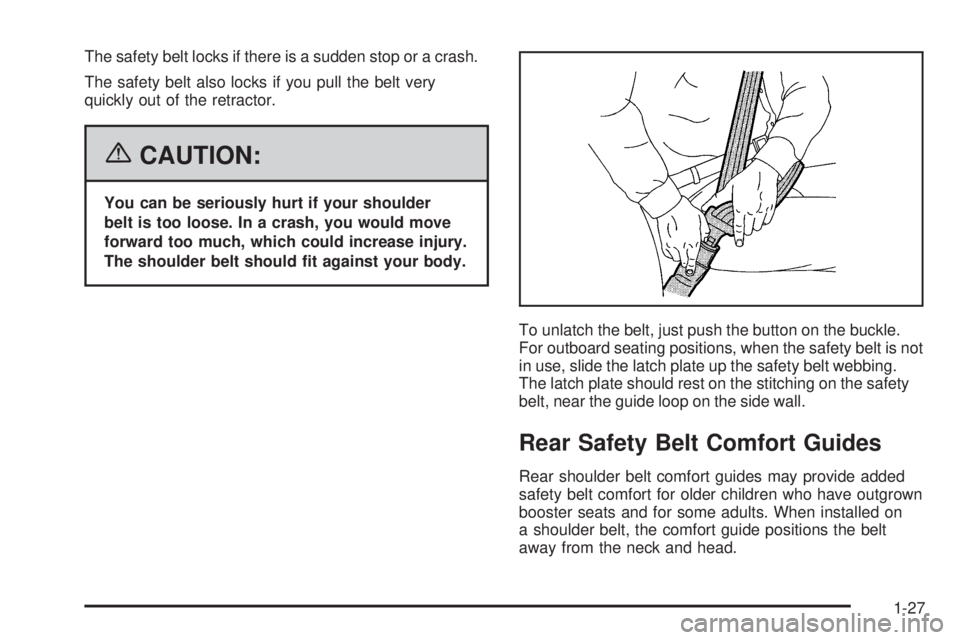
The safety belt locks if there is a sudden stop or a crash.
The safety belt also locks if you pull the belt very
quickly out of the retractor.
{CAUTION:
You can be seriously hurt if your shoulder
belt is too loose. In a crash, you would move
forward too much, which could increase injury.
The shoulder belt should t against your body.
To unlatch the belt, just push the button on the buckle.
For outboard seating positions, when the safety belt is not
in use, slide the latch plate up the safety belt webbing.
The latch plate should rest on the stitching on the safety
belt, near the guide loop on the side wall.
Rear Safety Belt Comfort Guides
Rear shoulder belt comfort guides may provide added
safety belt comfort for older children who have outgrown
booster seats and for some adults. When installed on
a shoulder belt, the comfort guide positions the belt
away from the neck and head.
1-27
Page 58 of 368
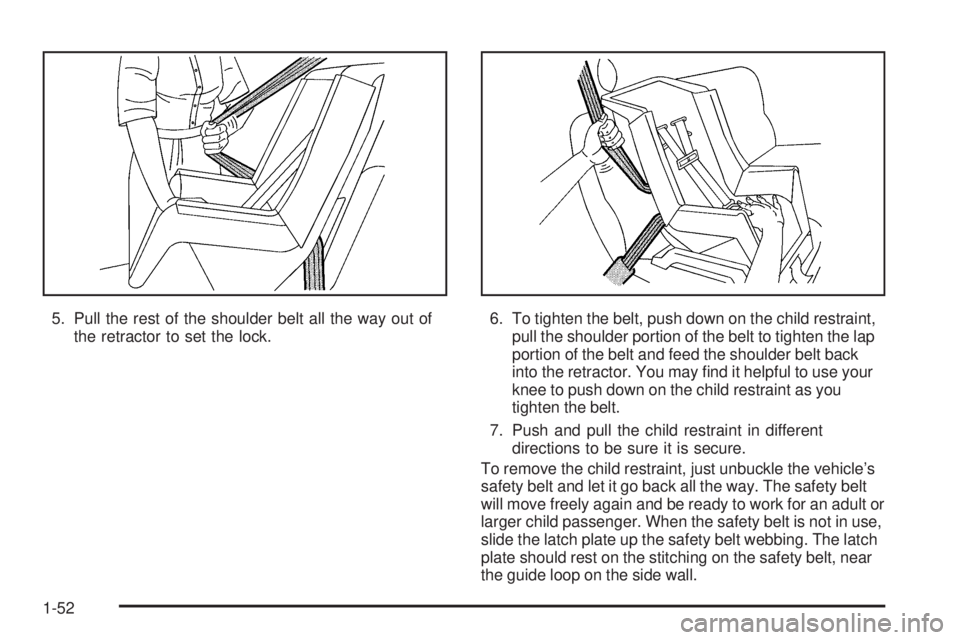
5. Pull the rest of the shoulder belt all the way out of
the retractor to set the lock.6. To tighten the belt, push down on the child restraint,
pull the shoulder portion of the belt to tighten the lap
portion of the belt and feed the shoulder belt back
into the retractor. You may nd it helpful to use your
knee to push down on the child restraint as you
tighten the belt.
7. Push and pull the child restraint in different
directions to be sure it is secure.
To remove the child restraint, just unbuckle the vehicle’s
safety belt and let it go back all the way. The safety belt
will move freely again and be ready to work for an adult or
larger child passenger. When the safety belt is not in use,
slide the latch plate up the safety belt webbing. The latch
plate should rest on the stitching on the safety belt, near
the guide loop on the side wall.
1-52
Page 72 of 368
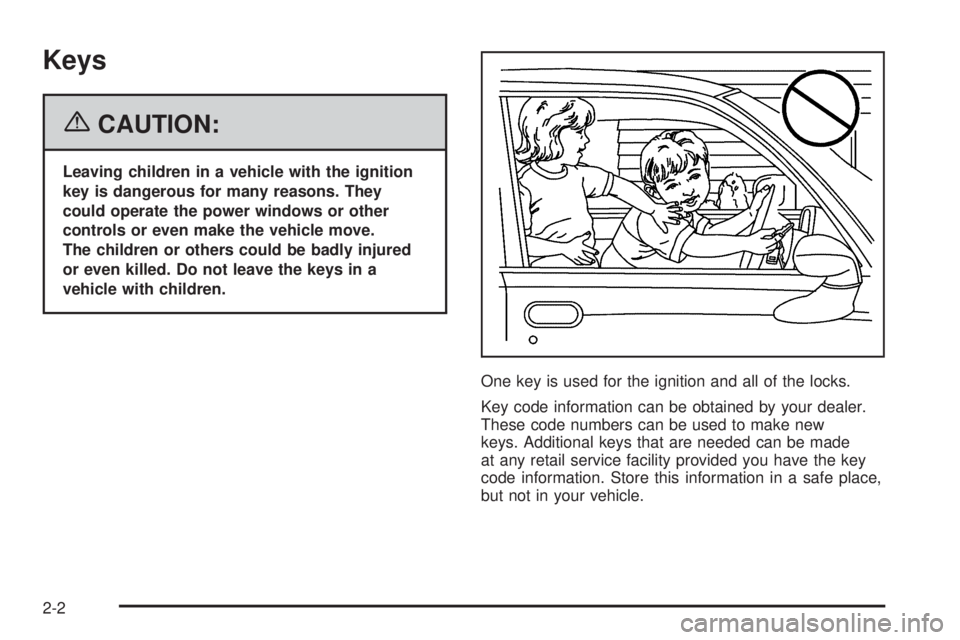
Keys
{CAUTION:
Leaving children in a vehicle with the ignition
key is dangerous for many reasons. They
could operate the power windows or other
controls or even make the vehicle move.
The children or others could be badly injured
or even killed. Do not leave the keys in a
vehicle with children.
One key is used for the ignition and all of the locks.
Key code information can be obtained by your dealer.
These code numbers can be used to make new
keys. Additional keys that are needed can be made
at any retail service facility provided you have the key
code information. Store this information in a safe place,
but not in your vehicle.
2-2
Page 76 of 368
Resynchronization
This is used to keep the transmitter of the vehicle
communicating with the receiver of the vehicle.
Resynchronization may be required due to the
security method used by this system.
Your vehicle has an automatic resynchronization
function built into the system. If your transmitter
is not working properly and you have to manually
resynchronize, press the lock and unlock buttons at
the same time for seven seconds while you are
near your vehicle. The doors will lock or unlock,
depending on their starting position. If they do not,
contact your dealer for service.
Doors and Locks
Door Locks
{CAUTION:
Unlocked doors can be dangerous.
Passengers — especially children — can
easily open the doors and fall out of a
moving vehicle. When a door is locked,
the handle will not open it. You increase
the chance of being thrown out of the
vehicle in a crash if the doors are not
locked. So, wear safety belts properly
and lock the doors whenever you drive.
Young children who get into unlocked
vehicles may be unable to get out. A child
can be overcome by extreme heat and
can suffer permanent injuries or even
death from heat stroke. Always lock your
vehicle whenever you leave it.
Outsiders can easily enter through an
unlocked door when you slow down or
stop your vehicle. Locking your doors
can help prevent this from happening.
2-6
Page 204 of 368

The same thing can happen if you are steering through
a sharp curve and you suddenly accelerate. Those
two control systems — steering and acceleration — can
overwhelm those places where the tires meet the
road and make you lose control. SeeTraction Control
System (TCS) on page 4-9.
What should you do if this ever happens? Ease up on
the brake or accelerator pedal, steer the vehicle the
way you want it to go, and slow down.
Speed limit signs near curves warn that you should
adjust your speed. Of course, the posted speeds
are based on good weather and road conditions. Under
less favorable conditions you will want to go slower.
If you need to reduce your speed as you approach
a curve, do it before you enter the curve, while your
front wheels are straight ahead.
Try to adjust your speed so you can “drive” through
the curve. Maintain a reasonable, steady speed.
Wait to accelerate until you are out of the curve,
and then accelerate gently into the straightaway.
Adding non-GM accessories can affect your vehicle’s
performance. SeeAccessories and Modications
on page 5-3.Steering in Emergencies
There are times when steering can be more effective
than braking. For example, you come over a hill and
nd a truck stopped in your lane, or a car suddenly
pulls out from nowhere, or a child darts out from
between parked cars and stops right in front of you.
You can avoid these problems by braking — if you
can stop in time. But sometimes you cannot; there is
not room. That is the time for evasive action — steering
around the problem.
Your vehicle can perform very well in emergencies
like these. First apply your brakes — but, unless you
have anti-lock brakes, not enough to lock your wheels.
SeeBraking on page 4-6. It is better to remove as
much speed as you can from a possible collision.
Then steer around the problem, to the left or right
depending on the space available.
4-12
Page 244 of 368
Filling the Tank
{CAUTION:
Fuel vapor burns violently and a fuel re
can cause bad injuries. To help avoid injuries
to you and others, read and follow all the
instructions on the pump island. Turn off your
engine when you are refueling. Do not smoke
if you are near fuel or refueling your vehicle.
Keep sparks, ames, and smoking materials
away from fuel. Do not leave the fuel pump
unattended when refueling your vehicle — this
is against the law in some places. Keep
children away from the fuel pump; never let
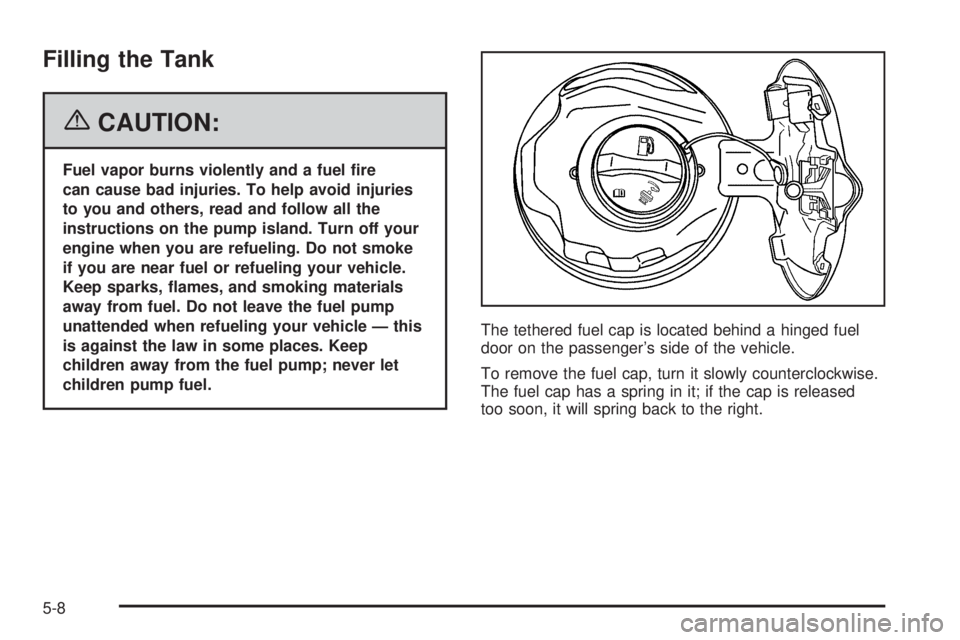
children pump fuel.The tethered fuel cap is located behind a hinged fuel
door on the passenger’s side of the vehicle.
To remove the fuel cap, turn it slowly counterclockwise.
The fuel cap has a spring in it; if the cap is released
too soon, it will spring back to the right.
5-8
Page 358 of 368
Audio System(s) (cont.)
Setting the Time..........................................3-40
Theft-Deterrent Feature................................3-79
Understanding Radio Reception.....................3-80
XM™ Satellite Radio Antenna System............3-81
Automatic Door Lock......................................... 2-8
Automatic Headlamp System............................3-15
Automatic Transaxle
Fluid..........................................................5-21
Operation...................................................2-19
B
Battery..........................................................5-34
Run-Down Protection...................................3-18
Battery Warning Light......................................3-27
Before Leaving on a Long Trip.........................4-22
Brake
Anti-Lock Brake System (ABS)........................ 4-7
Emergencies................................................ 4-8
Parking......................................................2-22
System Warning Light..................................3-28
Brakes..........................................................5-32
Braking........................................................... 4-6
Braking in Emergencies..................................... 4-8
Break-In, New Vehicle.....................................2-15
Bulb Replacement...........................................5-42
Halogen Bulbs............................................5-42Bulb Replacement (cont.)
Headlamps, Front Turn Signal, Sidemarker,
and Parking Lamps..................................5-42
Replacement Bulbs......................................5-44
Taillamps, Turn Signal, Stoplamps and
Back-up Lamps........................................5-43
Buying New Tires...........................................5-56
C
California Fuel.................................................. 5-6
California Proposition 65 Warning....................... 5-4
Canadian Owners................................................ ii
Capacities and Specications............................5-88
Carbon Monoxide....................2-10, 2-25, 4-26, 4-38
Care of
Safety Belts................................................5-77
Your CD Player...........................................3-81
Your CDs ...................................................3-80
Cargo Lamp...................................................3-17
Center Console Storage Area...........................2-35
Chains, Tire...................................................5-61
Check
Engine Light...............................................3-32
Checking Things Under the Hood......................5-10
Chemical Paint Spotting...................................5-80
Child Restraints
Child Restraint Systems...............................1-36
Infants and Young Children...........................1-33
2
Page 362 of 368
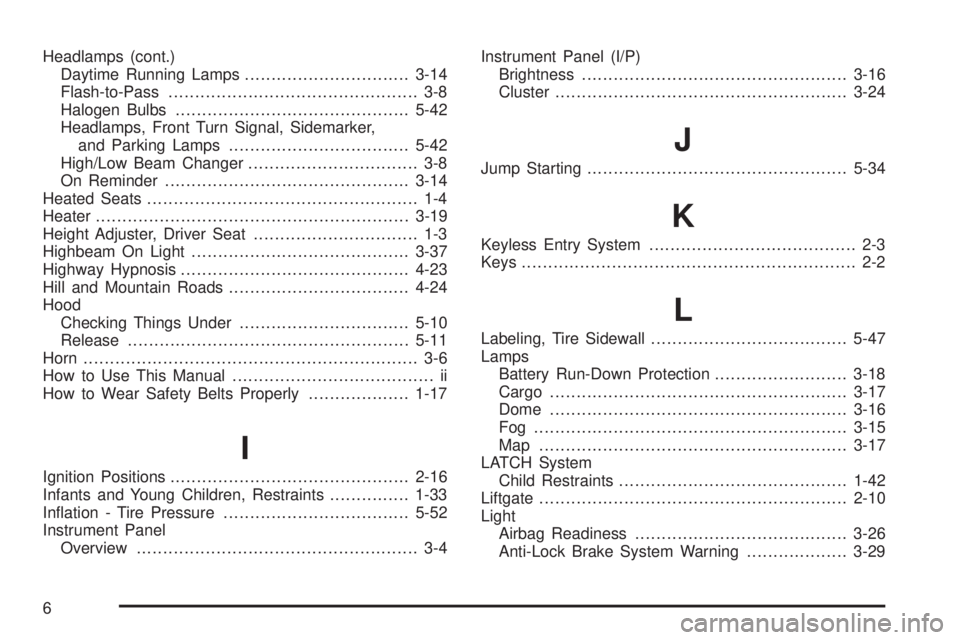
Headlamps (cont.)
Daytime Running Lamps...............................3-14
Flash-to-Pass............................................... 3-8
Halogen Bulbs............................................5-42
Headlamps, Front Turn Signal, Sidemarker,
and Parking Lamps..................................5-42
High/Low Beam Changer................................ 3-8
On Reminder..............................................3-14
Heated Seats................................................... 1-4
Heater...........................................................3-19
Height Adjuster, Driver Seat............................... 1-3
Highbeam On Light.........................................3-37
Highway Hypnosis...........................................4-23
Hill and Mountain Roads..................................4-24
Hood
Checking Things Under................................5-10
Release.....................................................5-11
Horn............................................................... 3-6
How to Use This Manual...................................... ii
How to Wear Safety Belts Properly...................1-17
I
Ignition Positions.............................................2-16
Infants and Young Children, Restraints...............1-33
Ination - Tire Pressure...................................5-52
Instrument Panel
Overview..................................................... 3-4Instrument Panel (I/P)
Brightness..................................................3-16
Cluster.......................................................3-24
J
Jump Starting.................................................5-34
K
Keyless Entry System....................................... 2-3
Keys............................................................... 2-2
L
Labeling, Tire Sidewall.....................................5-47
Lamps
Battery Run-Down Protection.........................3-18
Cargo........................................................3-17
Dome........................................................3-16
Fog ...........................................................3-15
Map ..........................................................3-17
LATCH System
Child Restraints...........................................1-42
Liftgate..........................................................2-10
Light
Airbag Readiness........................................3-26
Anti-Lock Brake System Warning...................3-29
6