lock PONTIAC TORRENT 2007 Owners Manual
[x] Cancel search | Manufacturer: PONTIAC, Model Year: 2007, Model line: TORRENT, Model: PONTIAC TORRENT 2007Pages: 490, PDF Size: 2.71 MB
Page 398 of 490
The TPMS matching process is outlined below:
1. Set the parking brake.
2. Turn the ignition switch to RUN with the
engine off.
3. Using the DIC, press the vehicle information
button until the TIRE LOCATIONS PRESS
V
TO LEARN message displays.
4. Press the set/reset button to allow the system
to learn the tire positions. The horn will sound
twice to indicate the receiver is ready, and
the TIRE LEARNING ACTIVE message
displays. The TPMS system is ready for the
sensor matching process to begin.
5. Start with the driver side front tire.
6. Remove the valve cap from the tire’s valve
stem. Activate the TPMS sensor by increasing
or decreasing the tire’s air pressure for
ve seconds, or until a horn chirp sounds.The horn chirp, which may take up to
30 seconds to sound, conrms that the sensor
identication code has been matched to the
tire/wheel position. To decrease the tire’s
air-pressure use the pointed end of the valve
cap, a pencil-style air pressure gage, or a key.
7. Proceed to the passenger side front tire, and
repeat the procedure in Step 6.
8. Proceed to the passenger side rear tire, and
repeat the procedure in Step 6.
9. Proceed to the driver side rear tire, and
repeat the procedure in Step 6.
10. After hearing the conrming horn chirp for the
driver side rear tire, the tire learning process
ends. Turn the ignition switch to LOCK.
11. Set all four tires to the recommended air
pressure level as indicated on the tire and
loading information label.
12. Put the valve caps back on the valve stems.
398
Page 403 of 490
Different Size Tires and Wheels
If you add wheels or tires that are a different size
than your original equipment wheels and tires,
this may affect the way your vehicle performs,
including its braking, ride and handling
characteristics, stability, and resistance to rollover.
Additionally, if your vehicle has electronic
systems such as, anti-lock brakes, traction control,
and electronic stability control, the performance
of these systems can be affected.
{CAUTION:
If you add different sized wheels, your
vehicle may not provide an acceptable
level of performance and safety if tires not
recommended for those wheels are
selected. You may increase the chance
that you will crash and suffer serious
injury. Only use GM specic wheel and
tire systems developed for your vehicle,
and have them properly installed by a GM
certied technician.SeeBuying New Tires on page 401and
Accessories and Modications on page 339for
additional information.
Uniform Tire Quality Grading
Quality grades can be found where applicable on
the tire sidewall between tread shoulder and
maximum section width. For example:
Treadwear 200 Traction AA Temperature A
The following information relates to the system
developed by the United States National Highway
Traffic Safety Administration (NHTSA), which
grades tires by treadwear, traction, and
temperature performance. This applies only to
vehicles sold in the United States. The grades are
molded on the sidewalls of most passenger car
tires. The Uniform Tire Quality Grading (UTQG)
system does not apply to deep tread, winter-type
snow tires, space-saver, or temporary use
spare tires, tires with nominal rim diameters of
10 to 12 inches (25 to 30 cm), or to some
limited-production tires.
403
Page 408 of 490
Changing a Flat Tire
If a tire goes at, avoid further tire and wheel
damage by driving slowly to a level place. Turn on
your vehicle’s hazard warning ashers. See
Hazard Warning Flashers on page 150for more
information.{CAUTION:
Changing a tire can be dangerous. The
vehicle can slip off the jack and roll over
or fall on you or other people. You and
they could be badly injured or even killed.
Find a level place to change your tire. To
help prevent the vehicle from moving:
1. Set the parking brake rmly.
2. Put the shift lever in PARK (P).
3. Turn off the engine and do not restart
while the vehicle is raised.
4. Do not allow passengers to remain in
the vehicle.
To be even more certain the vehicle will
not move, you should put blocks at the
front and rear of the tire farthest away
from the one being changed. That would
be the tire, on the other side, at the
opposite end of the vehicle.
408
Page 409 of 490
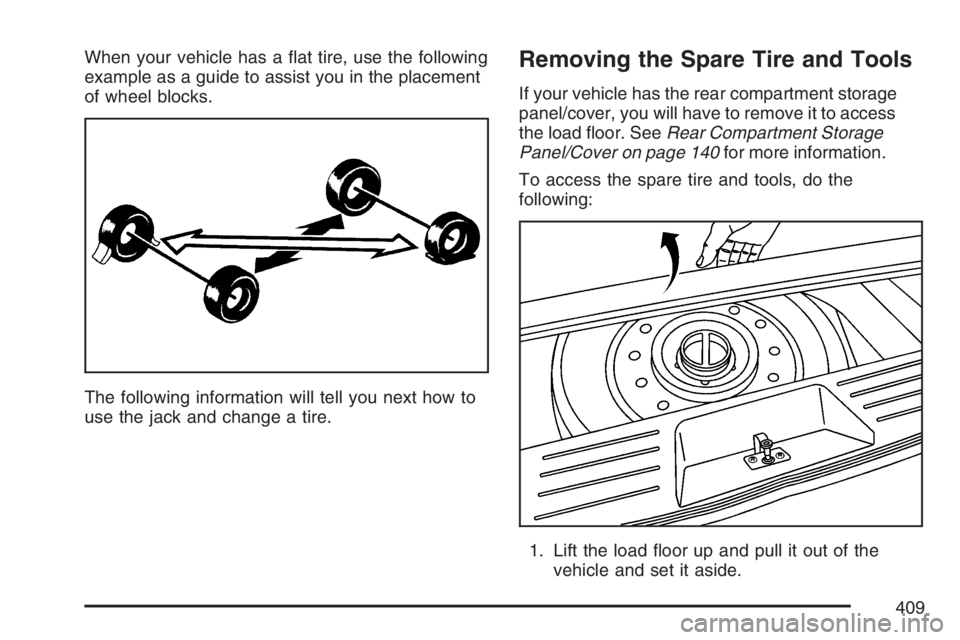
When your vehicle has a at tire, use the following
example as a guide to assist you in the placement
of wheel blocks.
The following information will tell you next how to
use the jack and change a tire.Removing the Spare Tire and Tools
If your vehicle has the rear compartment storage
panel/cover, you will have to remove it to access
the load oor. SeeRear Compartment Storage
Panel/Cover on page 140for more information.
To access the spare tire and tools, do the
following:
1. Lift the load oor up and pull it out of the
vehicle and set it aside.
409
Page 411 of 490
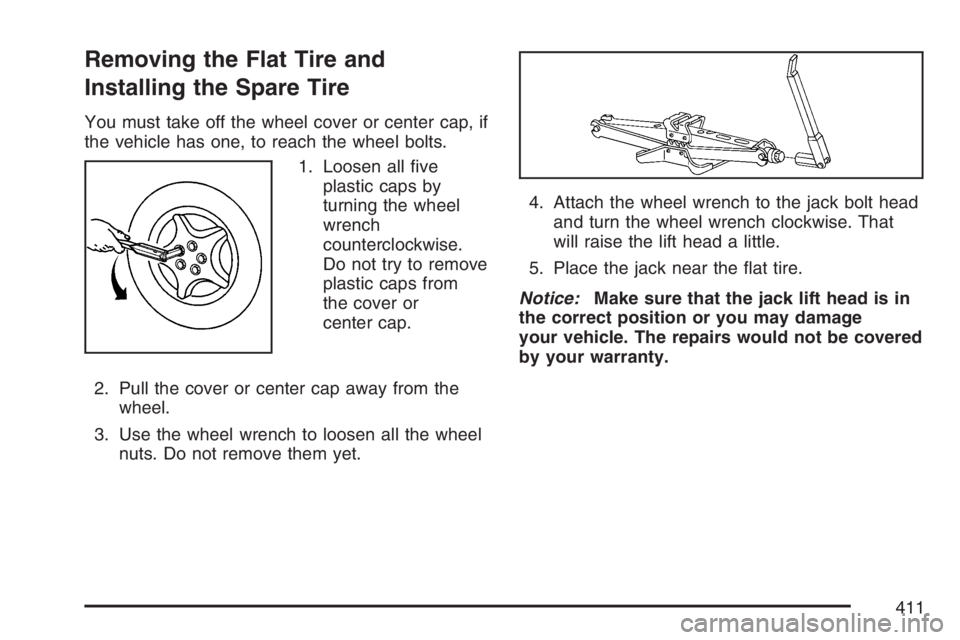
Removing the Flat Tire and
Installing the Spare Tire
You must take off the wheel cover or center cap, if
the vehicle has one, to reach the wheel bolts.
1. Loosen all ve
plastic caps by
turning the wheel
wrench
counterclockwise.
Do not try to remove
plastic caps from
the cover or
center cap.
2. Pull the cover or center cap away from the
wheel.
3. Use the wheel wrench to loosen all the wheel
nuts. Do not remove them yet.4. Attach the wheel wrench to the jack bolt head
and turn the wheel wrench clockwise. That
will raise the lift head a little.
5. Place the jack near the at tire.
Notice:Make sure that the jack lift head is in
the correct position or you may damage
your vehicle. The repairs would not be covered
by your warranty.
411
Page 414 of 490
{CAUTION:
Lifting a vehicle and getting under it to do
maintenance or repairs is dangerous
without the appropriate safety equipment
and training. The jack provided with your
vehicle is designed only for changing a
at tire. If it is used for anything else, you
or others could be badly injured or killed
if the vehicle slips off the jack. Use the
jack provided with your vehicle only for
changing a at tire.
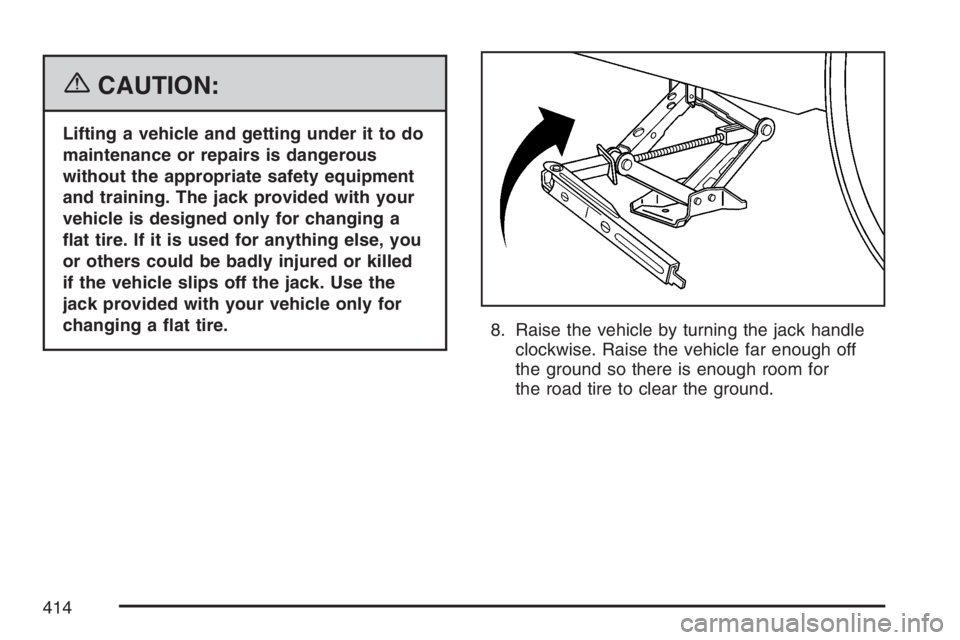
8. Raise the vehicle by turning the jack handle
clockwise. Raise the vehicle far enough off
the ground so there is enough room for
the road tire to clear the ground.
414
Page 416 of 490
12. Place the compact spare tire on the
wheel-mounting surface.
{CAUTION:
Never use oil or grease on studs or nuts.
If you do, the nuts might come loose.
Your wheel could fall off, causing a
serious accident.
13. Reinstall the wheel nuts. Tighten each nut by
hand until the wheel is held against the hub.
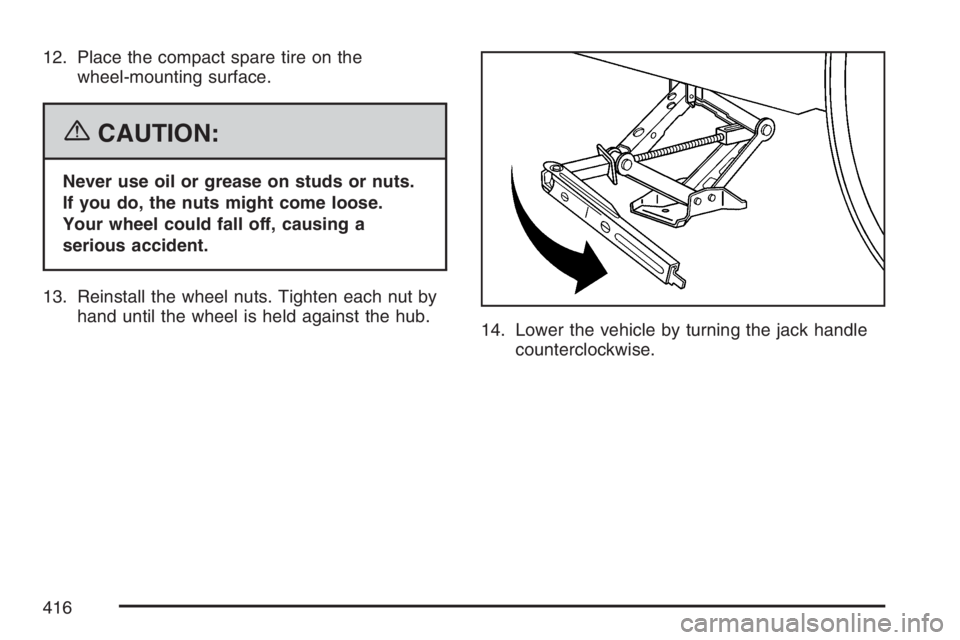
14. Lower the vehicle by turning the jack handle
counterclockwise.
416
Page 431 of 490
Electrical System
Add-On Electrical Equipment
Notice:Do not add anything electrical to your
vehicle unless you check with your dealer
rst. Some electrical equipment can damage
your vehicle and the damage would not
be covered by your warranty. Some add-on
electrical equipment can keep other
components from working as they should.
Add-on equipment can drain your vehicle’s battery,
even if your vehicle is not operating.
Your vehicle has an airbag system. Before
attempting to add anything electrical to your
vehicle, seeServicing Your Airbag-Equipped
Vehicle on page 88.
Windshield Wiper Fuses
The windshield wiper motor is protected by a
circuit breaker and a fuse. If the motor overheats
due to heavy snow or ice, the wiper will stop
until the motor cools. If the overload is caused by
some electrical problem, have it xed.
Fuses and Circuit Breakers
The wiring circuits in your vehicle are protected
from short circuits by fuses and circuit breakers.
This greatly reduces the chance of circuit overload
and re caused by electrical problems.
Your vehicle has an underhood fuse block and an
instrument panel fuse block.
To identify and check fuses, circuit breakers, and
relays, refer to the Fuse Usage Chart on the
inside surface of the fuse panel door.
431
Page 432 of 490
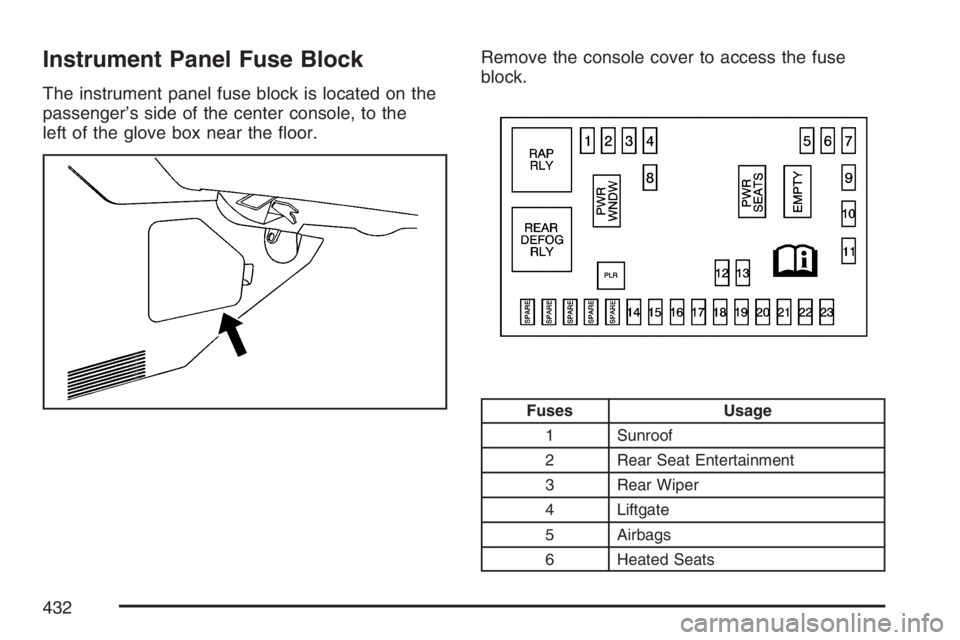
Instrument Panel Fuse Block
The instrument panel fuse block is located on the
passenger’s side of the center console, to the
left of the glove box near the oor.Remove the console cover to access the fuse
block.
Fuses Usage
1 Sunroof
2 Rear Seat Entertainment
3 Rear Wiper
4 Liftgate
5 Airbags
6 Heated Seats
432
Page 433 of 490
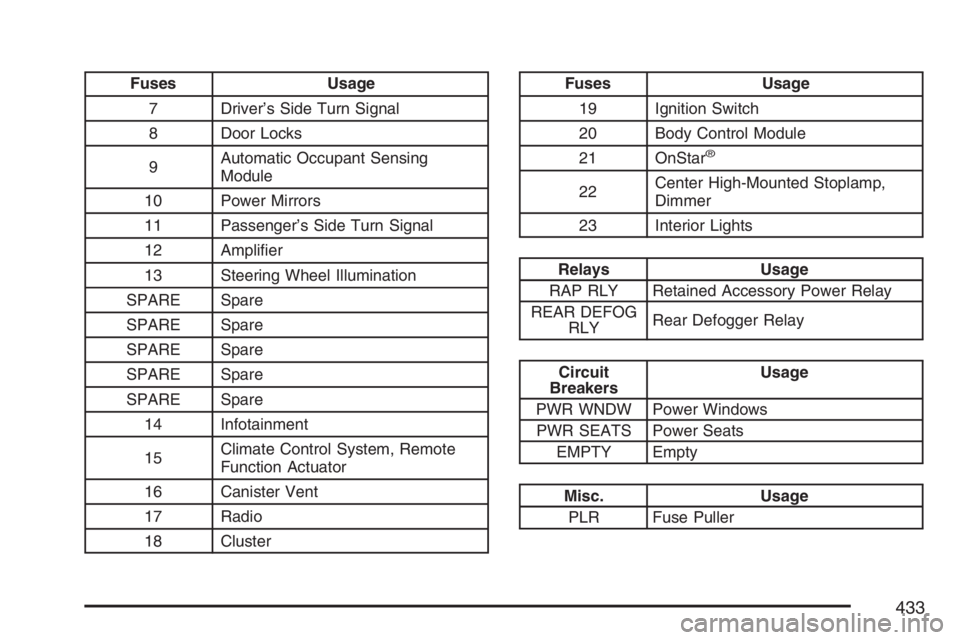
Fuses Usage
7 Driver’s Side Turn Signal
8 Door Locks
9Automatic Occupant Sensing
Module
10 Power Mirrors
11 Passenger’s Side Turn Signal
12 Amplier
13 Steering Wheel Illumination
SPARE Spare
SPARE Spare
SPARE Spare
SPARE Spare
SPARE Spare
14 Infotainment
15Climate Control System, Remote
Function Actuator
16 Canister Vent
17 Radio
18 ClusterFuses Usage
19 Ignition Switch
20 Body Control Module
21 OnStar
®
22Center High-Mounted Stoplamp,
Dimmer
23 Interior Lights
Relays Usage
RAP RLY Retained Accessory Power Relay
REAR DEFOG
RLYRear Defogger Relay
Circuit
BreakersUsage
PWR WNDW Power Windows
PWR SEATS Power Seats
EMPTY Empty
Misc. Usage
PLR Fuse Puller
433