mirror PONTIAC TORRENT 2007 User Guide
[x] Cancel search | Manufacturer: PONTIAC, Model Year: 2007, Model line: TORRENT, Model: PONTIAC TORRENT 2007Pages: 490, PDF Size: 2.71 MB
Page 162 of 490
Dome Lamp
The dome lamp switch has three positions.
9(Off):The lamp will not come on as long as
the switch is in this position.
AUTO (Automatic):The lamp will come on when a
door is opened. SeeEntry Lighting on page 162.
R(On):The lamp will stay on as long as the
switch is in this position.
Entry Lighting
If the dome lamp is in the AUTO position, the
dome lamp and the cargo lamp inside your vehicle
will come on when any door is opened. In
addition, the light will come on when the remote
keyless entry unlock button is pressed. It will
stay on for 20 seconds or until a door is opened.
After the door is opened the light will remain
on and stay on for 20 seconds after the doors are
closed, or until you put the key in the ignition
and turn the key to RUN.
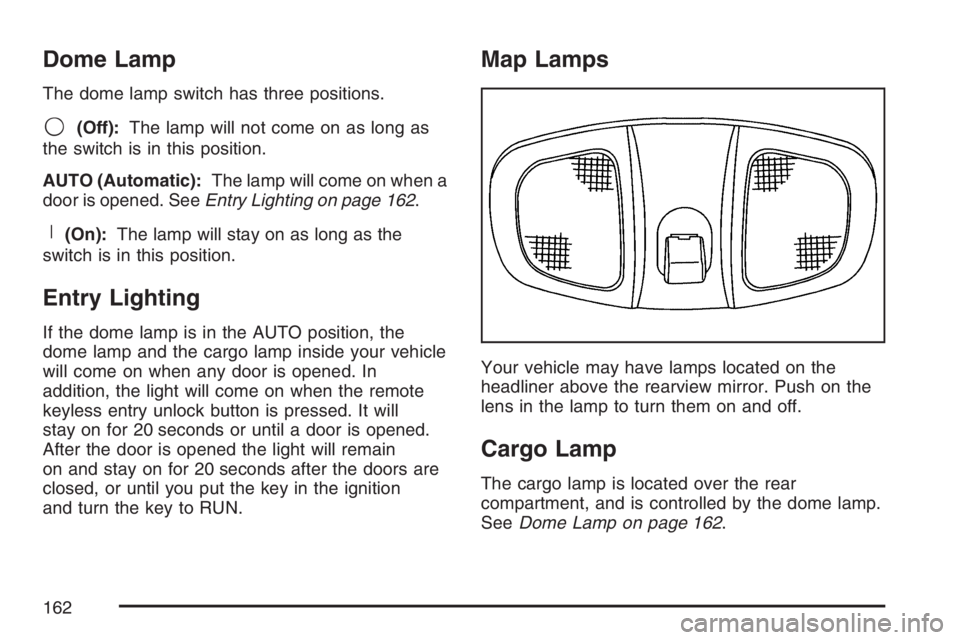
Map Lamps
Your vehicle may have lamps located on the
headliner above the rearview mirror. Push on the
lens in the lamp to turn them on and off.
Cargo Lamp
The cargo lamp is located over the rear
compartment, and is controlled by the dome lamp.
SeeDome Lamp on page 162.
162
Page 304 of 490
Watch for traffic signs, pavement markings,
and lines. If you can see a sign up ahead
that might indicate a turn or an intersection,
delay your pass. A broken center line
usually indicates it is all right to pass, providing
the road ahead is clear. Never cross a solid
line on your side of the lane or a double solid
line, even if the road seems empty of
approaching traffic.
Do not get too close to the vehicle you want
to pass while you are awaiting an opportunity.
For one thing, following too closely reduces
your area of vision, especially if you are
following a larger vehicle. Also, you will not
have adequate space if the vehicle ahead
suddenly slows or stops. Keep back a
reasonable distance.
When it looks like a chance to pass is coming
up, start to accelerate but stay in the right
lane and do not get too close. Time your move
so you will be increasing speed as the time
comes to move into the other lane. If the way
is clear to pass, you will have a running
start that more than makes up for the distance
you would lose by dropping back. And ifsomething happens to cause you to cancel
your pass, you need only slow down and drop
back again and wait for another opportunity.
If other vehicles are lined up to pass a slow
vehicle, wait your turn. But take care that
someone is not trying to pass you as you pull
out to pass the slow vehicle. Remember to
glance over your shoulder and check the
blind spot.
Check your vehicle’s mirrors, glance over your
shoulder, and start your left lane change
signal before moving out of the right lane to
pass. When you are far enough ahead of
the passed vehicle to see its front in
your vehicle’s inside mirror, activate the right
lane change signal and move back into
the right lane. Remember that your vehicle’s
passenger side outside mirror is convex.
The vehicle you just passed may seem to be
farther away from you than it really is.
Try not to pass more than one vehicle at a
time on two-lane roads. Reconsider before
passing the next vehicle.
304
Page 306 of 490
Of course, traction is reduced when water, snow,
ice, gravel, or other material is on the road.
For safety, you will want to slow down and adjust
your driving to these conditions. It is important
to slow down on slippery surfaces because
stopping distance will be longer and vehicle control
more limited.
While driving on a surface with reduced traction, try
your best to avoid sudden steering, acceleration, or
braking, including reducing vehicle speed by
shifting to a lower gear. Any sudden changes could
cause the tires to slide. You may not realize the
surface is slippery until your vehicle is skidding.
Learn to recognize warning clues — such as
enough water, ice, or packed snow on the road to
make a mirrored surface — and slow down when
you have any doubt.
Remember: Any Anti-Lock Brake System (ABS)
helps avoid only the braking skid.Driving at Night
Night driving is more dangerous than day driving.
One reason is that some drivers are likely to
be impaired — by alcohol or drugs, with night
vision problems, or by fatigue.
Here are some tips on night driving.
Drive defensively.
Do not drink and drive.
Adjust the inside rearview mirror to reduce the
glare from headlamps behind you.
Since you cannot see as well, you may need
to slow down and keep more space between
you and other vehicles.
Slow down, especially on higher speed roads.
Your vehicle’s headlamps can light up only so
much road ahead.
In remote areas, watch for animals.
If you are tired, pull off the road in a safe
place and rest.
306
Page 312 of 490
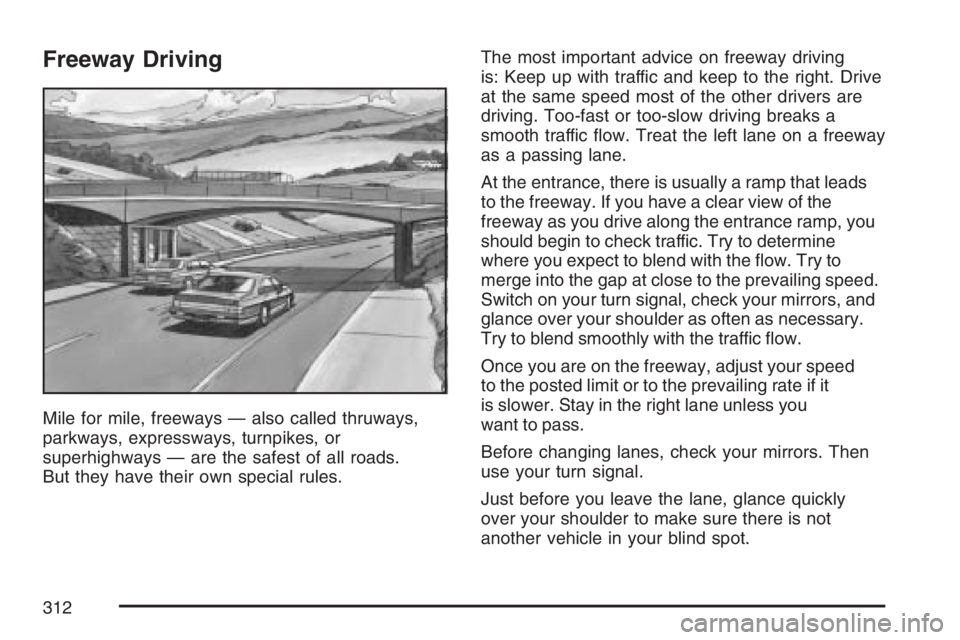
Freeway Driving
Mile for mile, freeways — also called thruways,
parkways, expressways, turnpikes, or
superhighways — are the safest of all roads.
But they have their own special rules.The most important advice on freeway driving
is: Keep up with traffic and keep to the right. Drive
at the same speed most of the other drivers are
driving. Too-fast or too-slow driving breaks a
smooth traffic ow. Treat the left lane on a freeway
as a passing lane.
At the entrance, there is usually a ramp that leads
to the freeway. If you have a clear view of the
freeway as you drive along the entrance ramp, you
should begin to check traffic. Try to determine
where you expect to blend with the ow. Try to
merge into the gap at close to the prevailing speed.
Switch on your turn signal, check your mirrors, and
glance over your shoulder as often as necessary.
Try to blend smoothly with the traffic ow.
Once you are on the freeway, adjust your speed
to the posted limit or to the prevailing rate if it
is slower. Stay in the right lane unless you
want to pass.
Before changing lanes, check your mirrors. Then
use your turn signal.
Just before you leave the lane, glance quickly
over your shoulder to make sure there is not
another vehicle in your blind spot.
312
Page 314 of 490
Highway Hypnosis
Is there actually such a condition as highway
hypnosis? Or is it just plain falling asleep at the
wheel? Call it highway hypnosis, lack of
awareness, or whatever.
There is something about an easy stretch of road
with the same scenery, along with the hum of the
tires on the road, the drone of the engine, and the
rush of the wind against the vehicle that can make
you sleepy. Do not let it happen to you! If it does,
your vehicle can leave the road in less than a
second, and you could crash and be injured.
What can you do about highway hypnosis?
First, be aware that it can happen.
Then here are some tips:
Make sure your vehicle is well ventilated, with
a comfortably cool interior.
Keep your eyes moving. Scan the road ahead
and to the sides. Check your mirrors and your
instruments frequently.
If you get sleepy, pull off the road into a rest,
service, or parking area and take a nap, get
some exercise, or both. For safety, treat
drowsiness on the highway as an emergency.
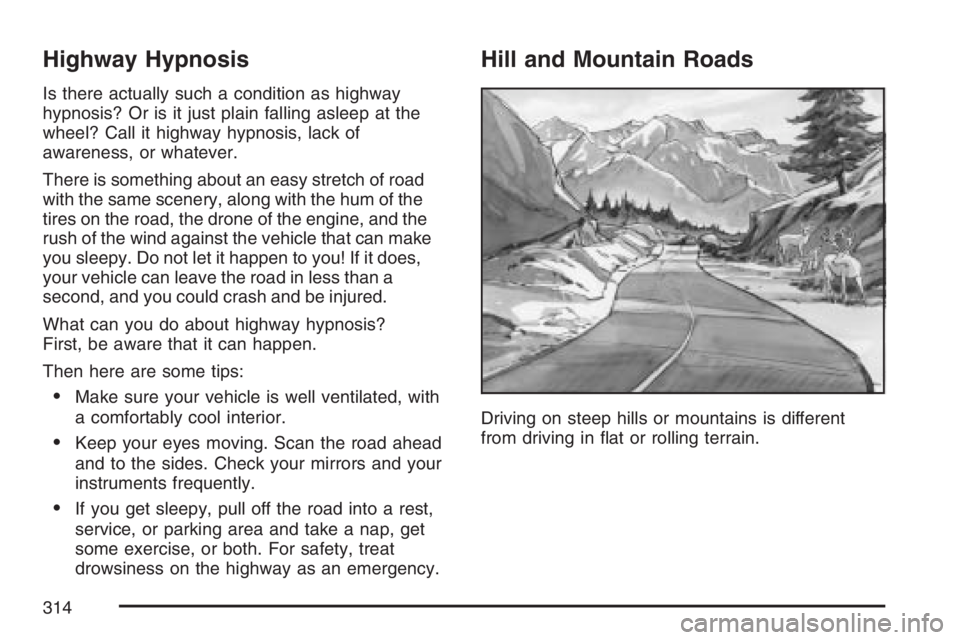
Hill and Mountain Roads
Driving on steep hills or mountains is different
from driving in at or rolling terrain.
314
Page 333 of 490
Before you start, check all trailer hitch parts and
attachments, safety chains, electrical connector,
lamps, tires and mirror adjustment. If the trailer has
electric brakes, start your vehicle and trailer
moving and then apply the trailer brake controller
by hand to be sure the brakes are working.
This lets you check your electrical connection at
the same time.
During your trip, check occasionally to be sure
that the load is secure, and that the lamps and any
trailer brakes are still working.
Following Distance
Stay at least twice as far behind the vehicle ahead
as you would when driving your vehicle without
a trailer. This can help you avoid situations
that require heavy braking and sudden turns.
Passing
You will need more passing distance up ahead
when you are towing a trailer. And, because
you are a good deal longer, you will need to go
much farther beyond the passed vehicle
before you can return to your lane.
Backing Up
Hold the bottom of the steering wheel with one
hand. Then, to move the trailer to the left,
just move that hand to the left. To move the trailer
to the right, move your hand to the right. Always
back up slowly and, if possible, have someone
guide you.
Making Turns
Notice:Making very sharp turns while
trailering could cause the trailer to come in
contact with the vehicle. Your vehicle could be
damaged. Avoid making very sharp turns
while trailering.
When you are turning with a trailer, make wider
turns than normal. Do this so your trailer will
not strike soft shoulders, curbs, road signs, trees
or other objects. Avoid jerky or sudden
maneuvers. Signal well in advance.
333
Page 433 of 490
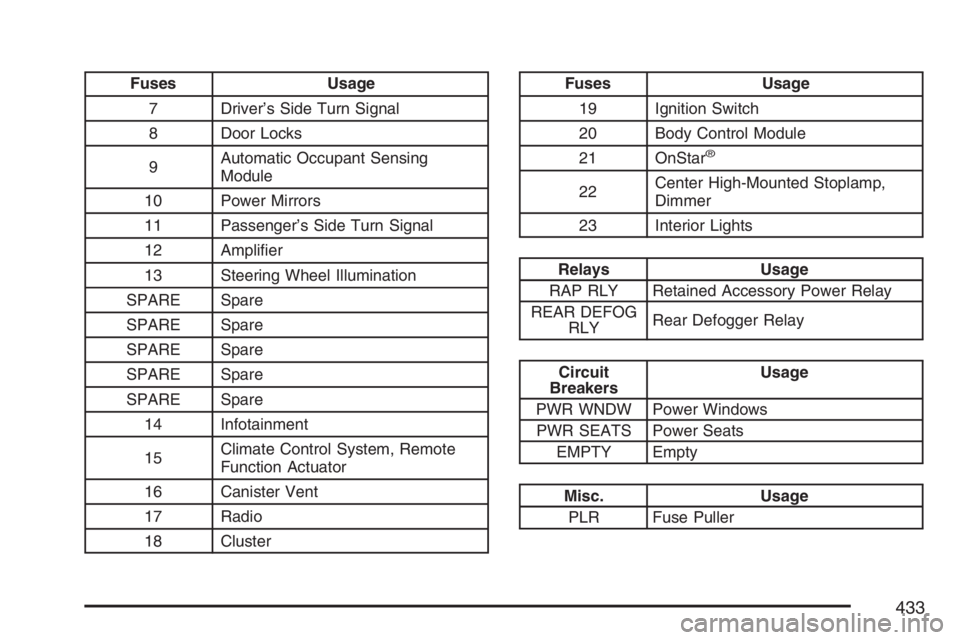
Fuses Usage
7 Driver’s Side Turn Signal
8 Door Locks
9Automatic Occupant Sensing
Module
10 Power Mirrors
11 Passenger’s Side Turn Signal
12 Amplier
13 Steering Wheel Illumination
SPARE Spare
SPARE Spare
SPARE Spare
SPARE Spare
SPARE Spare
14 Infotainment
15Climate Control System, Remote
Function Actuator
16 Canister Vent
17 Radio
18 ClusterFuses Usage
19 Ignition Switch
20 Body Control Module
21 OnStar
®
22Center High-Mounted Stoplamp,
Dimmer
23 Interior Lights
Relays Usage
RAP RLY Retained Accessory Power Relay
REAR DEFOG
RLYRear Defogger Relay
Circuit
BreakersUsage
PWR WNDW Power Windows
PWR SEATS Power Seats
EMPTY Empty
Misc. Usage
PLR Fuse Puller
433
Page 484 of 490
Light (cont.)
Security................................................... 189
Service All-Wheel-Drive............................ 191
Service Vehicle Soon............................... 192
TCS Warning Light.................................. 182
Tire Pressure........................................... 183
Traction Control System (TCS)
Warning................................................ 182
Lighting
Entry........................................................ 162
Loading Your Vehicle................................... 321
Lockout Protection....................................... 106
Locks
Delayed Locking...................................... 105
Door........................................................ 104
Lockout Protection................................... 106
Power Door............................................. 105
Programmable Automatic Door Locks....... 105
Rear Door Security Locks........................ 106
Loss of Control........................................... 305
Low Fuel Warning Light............................... 193
Luggage Carrier.......................................... 138
Lumbar
Manual Controls......................................... 10M
Maintenance Schedule
Additional Required Services.................... 443
At Each Fuel Fill...................................... 446
At Least Once a Month............................ 446
At Least Once a Year.............................. 447
Introduction.............................................. 438
Maintenance Footnotes............................ 444
Maintenance Record................................ 452
Maintenance Requirements...................... 438
Normal Maintenance Replacement Parts.... 450
Owner Checks and Services.................... 445
Recommended Fluids and Lubricants....... 449
Scheduled Maintenance........................... 440
Using....................................................... 439
Your Vehicle and the Environment............ 438
Malfunction Indicator Light........................... 184
Manual Lumbar Controls............................... 10
Manual Reclining Seatbacks.......................... 11
Manual Seats.................................................. 8
Map Lamps................................................. 162
Message
DIC Warnings and Messages................... 200
Mirrors
Automatic Dimming Rearview with
Compass.............................................. 131
484
Page 485 of 490
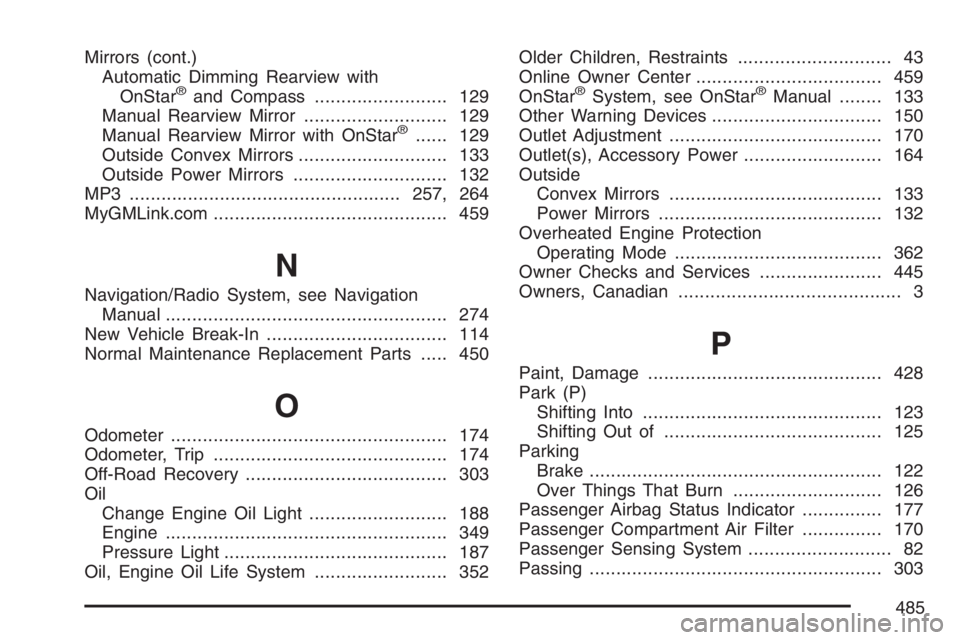
Mirrors (cont.)
Automatic Dimming Rearview with
OnStar
®and Compass......................... 129
Manual Rearview Mirror........................... 129
Manual Rearview Mirror with OnStar
®...... 129
Outside Convex Mirrors............................ 133
Outside Power Mirrors............................. 132
MP3 ...................................................257, 264
MyGMLink.com............................................ 459
N
Navigation/Radio System, see Navigation
Manual..................................................... 274
New Vehicle Break-In.................................. 114
Normal Maintenance Replacement Parts..... 450
O
Odometer.................................................... 174
Odometer, Trip............................................ 174
Off-Road Recovery...................................... 303
Oil
Change Engine Oil Light.......................... 188
Engine..................................................... 349
Pressure Light.......................................... 187
Oil, Engine Oil Life System......................... 352Older Children, Restraints............................. 43
Online Owner Center................................... 459
OnStar
®System, see OnStar®Manual........ 133
Other Warning Devices................................ 150
Outlet Adjustment........................................ 170
Outlet(s), Accessory Power.......................... 164
Outside
Convex Mirrors........................................ 133
Power Mirrors.......................................... 132
Overheated Engine Protection
Operating Mode....................................... 362
Owner Checks and Services....................... 445
Owners, Canadian.......................................... 3
P
Paint, Damage............................................ 428
Park (P)
Shifting Into............................................. 123
Shifting Out of......................................... 125
Parking
Brake....................................................... 122
Over Things That Burn............................ 126
Passenger Airbag Status Indicator............... 177
Passenger Compartment Air Filter............... 170
Passenger Sensing System........................... 82
Passing....................................................... 303
485
Page 486 of 490
PASS-Key®III+........................................... 112
PASS-Key®III+ Operation........................... 113
Power
Accessory Outlet(s).................................. 164
Door Locks.............................................. 105
Reduced Engine Light.............................. 190
Retained Accessory (RAP)....................... 116
Seat.......................................................... 10
Windows.................................................. 110
Pretensioners, Safety Belt............................. 42
Programmable Automatic Door Locks.......... 105
Q
Questions and Answers About Safety Belts...... 24
R
Radios........................................................ 218
Care of Your CD and DVD Player............ 288
Care of Your CDs and DVDs................... 288
Navigation/Radio System, see
Navigation Manual................................ 274
Radio with CD................................222, 228
Radio with CD and DVD.......................... 239
Setting the Time...................................... 220
Theft-Deterrent......................................... 285Radios (cont.)
Understanding Reception ......................... 287
Rear Compartment Storage
Panel/Cover............................................. 140
Rear Door Security Locks........................... 106
Rear Safety Belt Comfort Guides.................. 39
Rear Seat Armrest...................................... 141
Rear Seat Entertainment System................. 274
Rear Seat Passengers, Safety Belts.............. 36
Rear Windshield Washer/Wiper.................... 155
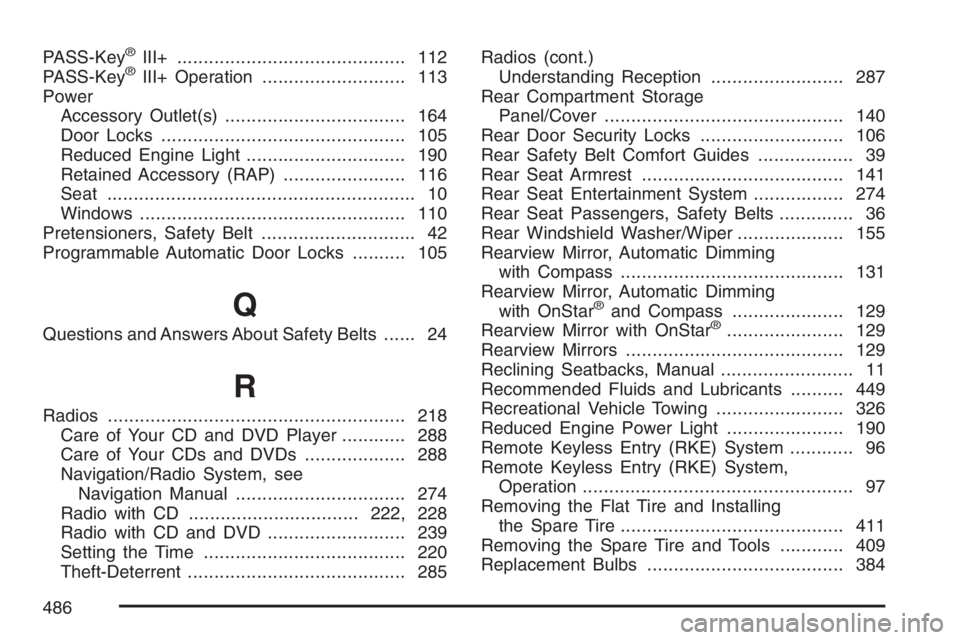
Rearview Mirror, Automatic Dimming
with Compass.......................................... 131
Rearview Mirror, Automatic Dimming
with OnStar
®and Compass..................... 129
Rearview Mirror with OnStar®...................... 129
Rearview Mirrors......................................... 129
Reclining Seatbacks, Manual......................... 11
Recommended Fluids and Lubricants.......... 449
Recreational Vehicle Towing........................ 326
Reduced Engine Power Light...................... 190
Remote Keyless Entry (RKE) System............ 96
Remote Keyless Entry (RKE) System,
Operation................................................... 97
Removing the Flat Tire and Installing
the Spare Tire.......................................... 411
Removing the Spare Tire and Tools............ 409
Replacement Bulbs..................................... 384
486