traction control PONTIAC TORRENT 2007 Owner's Manual
[x] Cancel search | Manufacturer: PONTIAC, Model Year: 2007, Model line: TORRENT, Model: PONTIAC TORRENT 2007Pages: 490, PDF Size: 2.71 MB
Page 308 of 490
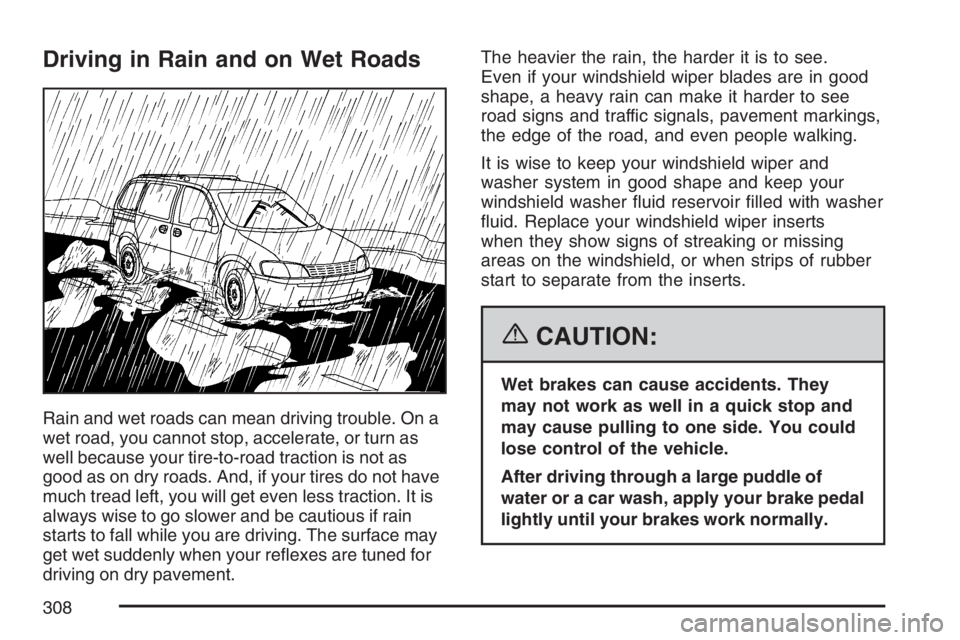
Driving in Rain and on Wet Roads
Rain and wet roads can mean driving trouble. On a
wet road, you cannot stop, accelerate, or turn as
well because your tire-to-road traction is not as
good as on dry roads. And, if your tires do not have
much tread left, you will get even less traction. It is
always wise to go slower and be cautious if rain
starts to fall while you are driving. The surface may
get wet suddenly when your reexes are tuned for
driving on dry pavement.The heavier the rain, the harder it is to see.
Even if your windshield wiper blades are in good
shape, a heavy rain can make it harder to see
road signs and traffic signals, pavement markings,
the edge of the road, and even people walking.
It is wise to keep your windshield wiper and
washer system in good shape and keep your
windshield washer uid reservoir lled with washer
uid. Replace your windshield wiper inserts
when they show signs of streaking or missing
areas on the windshield, or when strips of rubber
start to separate from the inserts.
{CAUTION:
Wet brakes can cause accidents. They
may not work as well in a quick stop and
may cause pulling to one side. You could
lose control of the vehicle.
After driving through a large puddle of
water or a car wash, apply your brake pedal
lightly until your brakes work normally.
308
Page 318 of 490
Traction control improves your ability to accelerate
when driving on a slippery road. But you can turn
the traction system off if you ever need to. You
should turn the traction system off if your vehicle
ever gets stuck in sand, mud, ice, or snow. SeeIf
Your Vehicle is Stuck in Sand, Mud, Ice, or Snow
on page 320. Even though your vehicle has a
traction system, you will want to slow down and
adjust your driving to the road conditions. Under
certain conditions, you may want to turn the traction
system off, such as when driving through deep
snow and loose gravel, to help maintain vehicle
motion at lower speeds. SeeTraction Control
System (TCS) on page 297andStabiliTrak
®
System on page 298.
The Anti-Lock Brake System (ABS) improves your
vehicle’s stability when you make a hard stop
on a slippery road. Even though you have ABS,
you will want to begin stopping sooner than
you would on dry pavement. SeeAnti-Lock Brake
System (ABS) on page 295.
Allow greater following distance on any
slippery road.
Watch for slippery spots. The road might be
ne until you hit a spot that is covered with
ice. On an otherwise clear road, ice patchesmay appear in shaded areas where the sun
cannot reach, such as around clumps of trees,
behind buildings, or under bridges. Sometimes
the surface of a curve or an overpass may
remain icy when the surrounding roads
are clear. If you see a patch of ice ahead of
you, brake before you are on it. Try not
to brake while you are actually on the ice, and
avoid sudden steering maneuvers.
If You Are Caught in a Blizzard
If you are stopped by heavy snow, you could be in a
serious situation. You should probably stay with
your vehicle unless you know for sure that you are
near help and you can hike through the snow. Here
are some things to do to summon help and keep
yourself and your passengers safe:
Turn on your hazard ashers.
Tie a red cloth to your vehicle to alert police that
you have been stopped by the snow.
Put on extra clothing or wrap a blanket around
you. If you do not have blankets or extra
clothing, make body insulators from
newspapers, burlap bags, rags, oor
mats — anything you can wrap around
yourself or tuck under your clothing to
keep warm.
318
Page 321 of 490
Rocking Your Vehicle to Get It Out
First, turn the steering wheel left and right.
That will clear the area around the front wheels. If
your vehicle has traction control, you should
turn the traction control system off. SeeTraction
Control System (TCS) on page 297. Then
shift back and forth between REVERSE (R) and a
forward gear, spinning the wheels as little as
possible. Release the accelerator pedal while you
shift, and press lightly on the accelerator pedal
when the transaxle is in gear. By slowly spinning
the wheels in the forward and reverse directions,
you will cause a rocking motion that may free your
vehicle. If that does not get your vehicle out
after a few tries, it may need to be towed out. If
your vehicle does need to be towed out, see
Towing Your Vehicle on page 326.
Loading Your Vehicle
It is very important to know how much weight your
vehicle can carry. Two labels on your vehicle
show how much weight it may properly carry, the
Tire and Loading Information label and the
Vehicle Certication label.
{CAUTION:
Do not load your vehicle any heavier than
the Gross Vehicle Weight Rating (GVWR),
or either the maximum front or rear Gross
Axle Weight Rating (GAWR). If you do,
parts on your vehicle can break, and it
can change the way your vehicle handles.
These could cause you to lose control
and crash. Also, overloading can shorten
the life of your vehicle.
321
Page 339 of 490
Service
Your dealer knows your vehicle best and wants
you to be happy with it. We hope you will go
to your dealer for all your service needs. You will
get genuine GM parts and GM-trained and
supported service people.
We hope you will want to keep your GM vehicle all
GM. Genuine GM parts have one of these marks:
Accessories and Modications
When you add non-GM accessories to your vehicle
they can affect your vehicle’s performance and
safety, including such things as, airbags, braking,
stability, ride and handling, emissions systems,
aerodynamics, durability, and electronic systems
like anti-lock brakes, traction control and
stability control. Some of these accessories may
even cause malfunction or damage not covered by
warranty.
GM Accessories are designed to complement and
function with other systems on your vehicle.
Your GM dealer can accessorize your vehicle
using genuine GM Accessories. When you go to
your GM dealer and ask for GM Accessories,
you will know that GM-trained and supported
service technicians will perform the work using
genuine GM Accessories.
339
Page 401 of 490
When It Is Time for New Tires
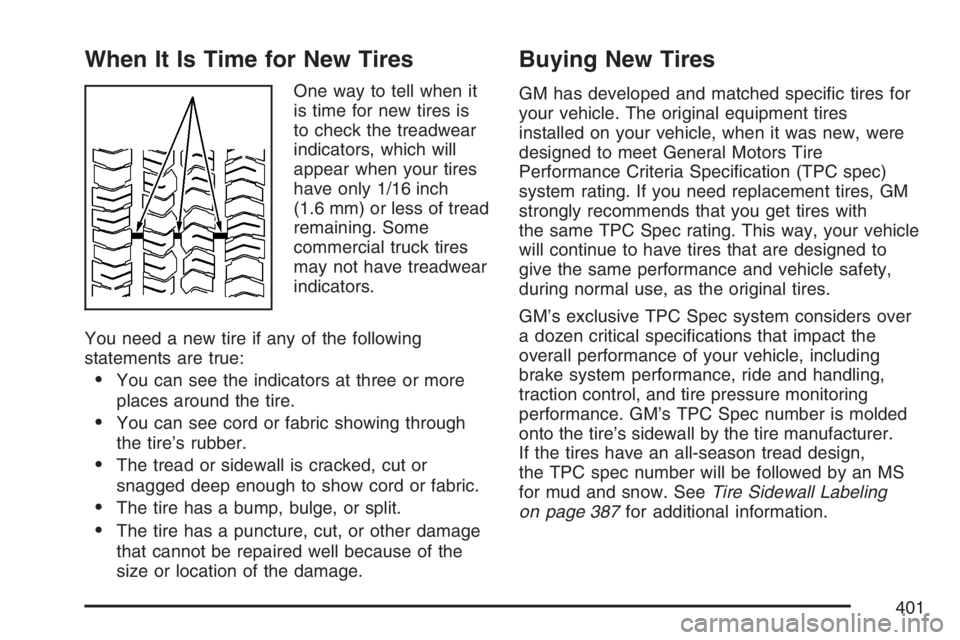
One way to tell when it
is time for new tires is
to check the treadwear
indicators, which will
appear when your tires
have only 1/16 inch
(1.6 mm) or less of tread
remaining. Some
commercial truck tires
may not have treadwear
indicators.
You need a new tire if any of the following
statements are true:
You can see the indicators at three or more
places around the tire.
You can see cord or fabric showing through
the tire’s rubber.
The tread or sidewall is cracked, cut or
snagged deep enough to show cord or fabric.
The tire has a bump, bulge, or split.
The tire has a puncture, cut, or other damage
that cannot be repaired well because of the
size or location of the damage.
Buying New Tires
GM has developed and matched specic tires for
your vehicle. The original equipment tires
installed on your vehicle, when it was new, were
designed to meet General Motors Tire
Performance Criteria Specication (TPC spec)
system rating. If you need replacement tires, GM
strongly recommends that you get tires with
the same TPC Spec rating. This way, your vehicle
will continue to have tires that are designed to
give the same performance and vehicle safety,
during normal use, as the original tires.
GM’s exclusive TPC Spec system considers over
a dozen critical specications that impact the
overall performance of your vehicle, including
brake system performance, ride and handling,
traction control, and tire pressure monitoring
performance. GM’s TPC Spec number is molded
onto the tire’s sidewall by the tire manufacturer.
If the tires have an all-season tread design,
the TPC spec number will be followed by an MS
for mud and snow. SeeTire Sidewall Labeling
on page 387for additional information.
401
Page 403 of 490
Different Size Tires and Wheels
If you add wheels or tires that are a different size
than your original equipment wheels and tires,
this may affect the way your vehicle performs,
including its braking, ride and handling
characteristics, stability, and resistance to rollover.
Additionally, if your vehicle has electronic
systems such as, anti-lock brakes, traction control,
and electronic stability control, the performance
of these systems can be affected.
{CAUTION:
If you add different sized wheels, your
vehicle may not provide an acceptable
level of performance and safety if tires not
recommended for those wheels are
selected. You may increase the chance
that you will crash and suffer serious
injury. Only use GM specic wheel and
tire systems developed for your vehicle,
and have them properly installed by a GM
certied technician.SeeBuying New Tires on page 401and
Accessories and Modications on page 339for
additional information.
Uniform Tire Quality Grading
Quality grades can be found where applicable on
the tire sidewall between tread shoulder and
maximum section width. For example:
Treadwear 200 Traction AA Temperature A
The following information relates to the system
developed by the United States National Highway
Traffic Safety Administration (NHTSA), which
grades tires by treadwear, traction, and
temperature performance. This applies only to
vehicles sold in the United States. The grades are
molded on the sidewalls of most passenger car
tires. The Uniform Tire Quality Grading (UTQG)
system does not apply to deep tread, winter-type
snow tires, space-saver, or temporary use
spare tires, tires with nominal rim diameters of
10 to 12 inches (25 to 30 cm), or to some
limited-production tires.
403
Page 404 of 490
While the tires available on General Motors
passenger cars and light trucks may vary with
respect to these grades, they must also conform
to federal safety requirements and additional
General Motors Tire Performance Criteria (TPC)
standards.
Treadwear
The treadwear grade is a comparative rating based
on the wear rate of the tire when tested under
controlled conditions on a specied government
test course. For example, a tire graded 150 would
wear one and a half (1.5) times as well on the
government course as a tire graded 100. The
relative performance of tires depends upon the
actual conditions of their use, however, and may
depart signicantly from the norm due to variations
in driving habits, service practices, and differences
in road characteristics and climate.
Traction – AA, A, B, C
The traction grades, from highest to lowest, are AA,
A, B, and C. Those grades represent the tire’s
ability to stop on wet pavement as measured under
controlled conditions on specied government test
surfaces of asphalt and concrete. A tire marked C
may have poor traction performance.Warning:The traction grade assigned to this tire
is based on straight-ahead braking traction
tests, and does not include acceleration, cornering,
hydroplaning, or peak traction characteristics.
Temperature – A, B, C
The temperature grades are A (the highest),
B, and C, representing the tire’s resistance to the
generation of heat and its ability to dissipate
heat when tested under controlled conditions on a
specied indoor laboratory test wheel. Sustained
high temperature can cause the material of the tire
to degenerate and reduce tire life, and excessive
temperature can lead to sudden tire failure.
The grade C corresponds to a level of performance
which all passenger car tires must meet under
the Federal Motor Vehicle Safety Standard
No. 109. Grades B and A represent higher levels
of performance on the laboratory test wheel
than the minimum required by law.
Warning:The temperature grade for this tire is
established for a tire that is properly inated
and not overloaded. Excessive speed,
under-ination, or excessive loading, either
separately or in combination, can cause heat
buildup and possible tire failure.
404
Page 406 of 490
Notice:The wrong wheel can also cause
problems with bearing life, brake cooling,
speedometer or odometer calibration,
headlamp aim, bumper height, vehicle ground
clearance, and tire or tire chain clearance
to the body and chassis.
SeeChanging a Flat Tire on page 408for more
information.
Used Replacement Wheels
{CAUTION:
Putting a used wheel on your vehicle is
dangerous. You cannot know how it has
been used or how far it has been driven. It
could fail suddenly and cause a crash. If
you have to replace a wheel, use a new
GM original equipment wheel.
Tire Chains
{CAUTION:
Do not use tire chains. There is not enough
clearance. Tire chains used on a vehicle
without the proper amount of clearance
can cause damage to the brakes,
suspension or other vehicle parts. The area
damaged by the tire chains could cause
you to lose control of your vehicle and you
or others may be injured in a crash.
Use another type of traction device only if
its manufacturer recommends it for use on
your vehicle and tire size combination and
road conditions. Follow that
manufacturer’s instructions. To help avoid
damage to your vehicle, drive slowly,
readjust or remove the device if it is
contacting your vehicle, and do not spin
your vehicle’s wheels. If you do nd
traction devices that will t, install them on
the front tires.
406
Page 484 of 490
Light (cont.)
Security................................................... 189
Service All-Wheel-Drive............................ 191
Service Vehicle Soon............................... 192
TCS Warning Light.................................. 182
Tire Pressure........................................... 183
Traction Control System (TCS)
Warning................................................ 182
Lighting
Entry........................................................ 162
Loading Your Vehicle................................... 321
Lockout Protection....................................... 106
Locks
Delayed Locking...................................... 105
Door........................................................ 104
Lockout Protection................................... 106
Power Door............................................. 105
Programmable Automatic Door Locks....... 105
Rear Door Security Locks........................ 106
Loss of Control........................................... 305
Low Fuel Warning Light............................... 193
Luggage Carrier.......................................... 138
Lumbar
Manual Controls......................................... 10M
Maintenance Schedule
Additional Required Services.................... 443
At Each Fuel Fill...................................... 446
At Least Once a Month............................ 446
At Least Once a Year.............................. 447
Introduction.............................................. 438
Maintenance Footnotes............................ 444
Maintenance Record................................ 452
Maintenance Requirements...................... 438
Normal Maintenance Replacement Parts.... 450
Owner Checks and Services.................... 445
Recommended Fluids and Lubricants....... 449
Scheduled Maintenance........................... 440
Using....................................................... 439
Your Vehicle and the Environment............ 438
Malfunction Indicator Light........................... 184
Manual Lumbar Controls............................... 10
Manual Reclining Seatbacks.......................... 11
Manual Seats.................................................. 8
Map Lamps................................................. 162
Message
DIC Warnings and Messages................... 200
Mirrors
Automatic Dimming Rearview with
Compass.............................................. 131
484
Page 489 of 490
Theft-Deterrent Systems (cont.)
PASS-Key®III+........................................ 112
PASS-Key®III+ Operation........................ 113
Tilt Wheel.................................................... 151
Tire
Pressure Light.......................................... 183
Tires........................................................... 386
Aluminum or Chrome-Plated Wheels,
Cleaning............................................... 426
Buying New Tires..................................... 401
Chains..................................................... 406
Changing a Flat Tire................................ 408
Cleaning.................................................. 427
Compact Spare Tire................................. 420
Different Size........................................... 403
If a Tire Goes Flat................................... 407
Ination - Tire Pressure............................ 393
Inspection and Rotation............................ 399
Installing the Spare Tire........................... 411
Pressure Monitor System......................... 395
Removing the Flat Tire............................. 411
Removing the Spare Tire and Tools......... 409
Storing a Flat or Spare Tire and Tools..... 418
Tire Sidewall Labeling.............................. 387
Tire Terminology and Denitions............... 390Tires (cont.)
Uniform Tire Quality Grading.................... 403
Wheel Alignment and Tire Balance........... 405
Wheel Replacement................................. 405
When It Is Time for New Tires................. 401
Towing
Recreational Vehicle................................. 326
Towing a Trailer....................................... 328
Your Vehicle............................................. 326
Traction
Control System (TCS) .............................. 297
Control System Warning Light.................. 182
StabiliTrak
®System................................. 298
Transaxle
Fluid, Automatic....................................... 357
Transaxle Operation, Automatic................... 119
Trip Odometer............................................. 174
Turn and Lane-Change Signals................... 152
Turn Signal/Multifunction Lever.................... 151
U
Understanding Radio Reception................... 287
Uniform Tire Quality Grading....................... 403
489