lock PONTIAC TORRENT 2007 Service Manual
[x] Cancel search | Manufacturer: PONTIAC, Model Year: 2007, Model line: TORRENT, Model: PONTIAC TORRENT 2007Pages: 490, PDF Size: 2.71 MB
Page 117 of 490
Your vehicle has a Computer-Controlled
Cranking System. This feature assists in
starting the engine and protects components.
If the ignition key is turned to the START
position, and then released when the engine
begins cranking, the engine will continue
cranking for a few seconds or until the vehicle
starts. If the engine does not start and the
key is held in START for many seconds,
cranking will be stopped after 15 seconds to
prevent cranking motor damage. To prevent
gear damage, this system also prevents
cranking if the engine is already running.
Engine cranking can be stopped by turning the
ignition switch to the ACC or LOCK position.
Notice:Cranking the engine for long periods
of time, by returning the key to the START
position immediately after cranking has ended,
can overheat and damage the cranking
motor, and drain the battery. Wait at least
15 seconds between each try, to allow
the cranking motor to cool down.2. If the engine does not start after 5-10 seconds,
especially in very cold weather (below 0°F
or−18°C), it could be ooded with too much
gasoline. Try pushing the accelerator
pedal all the way to the oor and holding it
there as you hold the key in START for up to
a maximum of 15 seconds. Wait at least
15 seconds between each try, to allow the
cranking motor to cool down. When the engine
starts, let go of the key and accelerator.
If the vehicle starts briey but then stops
again, do the same thing. This clears the extra
gasoline from the engine. Do not race the
engine immediately after starting it. Operate
the engine and transaxle gently until the
oil warms up and lubricates all moving parts.
Notice:Your engine is designed to work with
the electronics in your vehicle. If you add
electrical parts or accessories, you could
change the way the engine operates. Before
adding electrical equipment, check with
your dealer. If you do not, your engine might
not perform properly. Any resulting damage
would not be covered by your vehicle’s
warranty.
117
Page 119 of 490
Automatic Transaxle Operation
The shift lever is located on the center console.
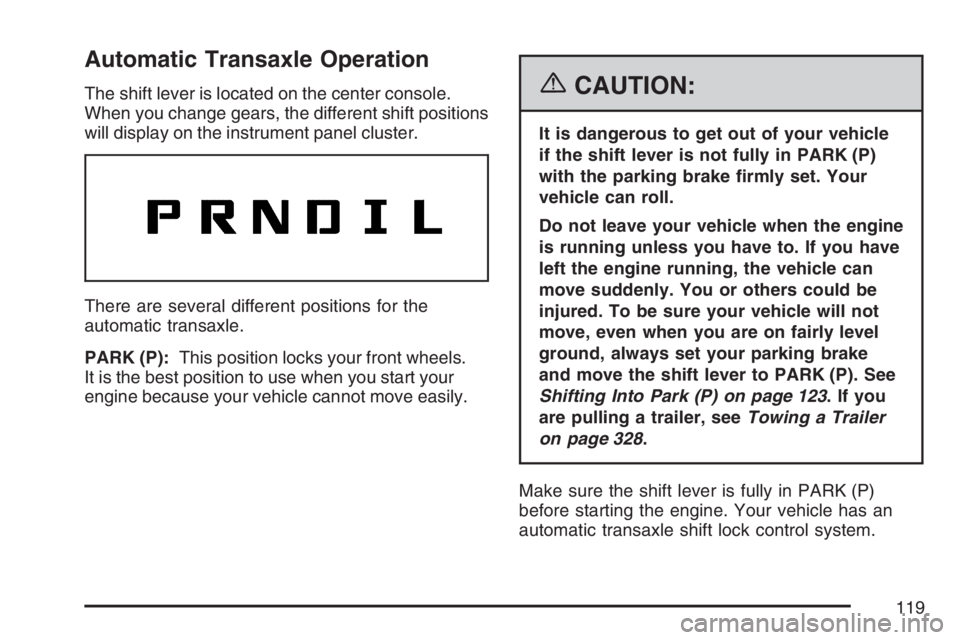
When you change gears, the different shift positions
will display on the instrument panel cluster.
There are several different positions for the
automatic transaxle.
PARK (P):This position locks your front wheels.
It is the best position to use when you start your
engine because your vehicle cannot move easily.{CAUTION:
It is dangerous to get out of your vehicle
if the shift lever is not fully in PARK (P)
with the parking brake rmly set. Your
vehicle can roll.
Do not leave your vehicle when the engine
is running unless you have to. If you have
left the engine running, the vehicle can
move suddenly. You or others could be
injured. To be sure your vehicle will not
move, even when you are on fairly level
ground, always set your parking brake
and move the shift lever to PARK (P). See
Shifting Into Park (P) on page 123.Ifyou
are pulling a trailer, seeTowing a Trailer
on page 328.
Make sure the shift lever is fully in PARK (P)
before starting the engine. Your vehicle has an
automatic transaxle shift lock control system.
119
Page 123 of 490
Make sure to release the parking brake before
driving the vehicle.
If the parking brake is applied and the vehicle is
moving at least 4 mph (6 km/h), a chime will
activate to remind you to release the parking brake.
Notice:Driving with the parking brake on can
overheat the brake system and cause premature
wear or damage to brake system parts. Verify
that the parking brake is fully released and the
brake warning light is off before driving.
Shifting Into Park (P)
{CAUTION:
It can be dangerous to get out of your
vehicle if the shift lever is not fully in
PARK (P) with the parking brake rmly set.
CAUTION: (Continued)
CAUTION: (Continued)
Your vehicle can roll. If you have left the
engine running, the vehicle can move
suddenly. You or others could be injured.
To be sure your vehicle will not move,
even when you are on fairly level ground,
use the steps that follow. If you are
pulling a trailer, seeTowing a Trailer on
page 328.
1. Hold the brake pedal down and set the
parking brake.
2. Move the shift lever into the PARK (P)
position by holding in the button on the
shift lever and pushing it all the way toward
the front of the vehicle.
3. Turn the ignition key to LOCK.
4. Remove the key and take it with you. If you
can leave your vehicle with the ignition key in
your hand, your vehicle is in PARK (P).
123
Page 124 of 490
Leaving Your Vehicle With the
Engine Running
{CAUTION:
It can be dangerous to leave your vehicle
with the engine running. Your vehicle
could move suddenly if the shift lever is
not fully in PARK (P) with the parking
brake rmly set. And, if you leave the
vehicle with the engine running, it could
overheat and even catch re. You or
others could be injured. Do not leave your
vehicle with the engine running.
If you have to leave your vehicle with the engine
running, be sure your vehicle is in PARK (P)
and your parking brake is rmly set before you
leave it. After you have moved the shift lever into
PARK (P), hold the regular brake pedal down.
Then, see if you can move the shift lever
away from PARK (P) without rst pushing the
button. If you can, it means that the shift lever was
not fully locked into PARK (P).
Torque Lock
If you are parking on a hill and you do not shift
your transaxle into PARK (P) properly, the weight
of the vehicle may put too much force on the
parking pawl in the transaxle. You may nd
it difficult to pull the shift lever out of PARK (P).
This is called “torque lock.” To prevent torque lock,
set the parking brake and then shift into PARK (P)
properly before you leave the driver’s seat. To
nd out how, seeShifting Into Park (P) on
page 123.
When you are ready to drive, move the shift lever
out of PARK (P) before you release the parking
brake.
If torque lock does occur, you may need to have
another vehicle push yours a little uphill to
take some of the pressure from the parking pawl
in the transaxle, so you can pull the shift lever
out of PARK (P).
124
Page 125 of 490
Shifting Out of Park (P)
Your vehicle has an automatic transaxle shift lock
control system. You have to fully apply your
regular brakes before you can shift from PARK (P)
when the ignition is in RUN.
If you cannot shift out of PARK (P), ease pressure
on the shift lever — push the shift lever all the
way into PARK (P), as you maintain brake
application. Then, press the button on the shift
lever and move the shift lever into the gear
you wish.If you ever hold the brake pedal down but still
cannot shift out of PARK (P), try this:
1. Turn the key to LOCK.
2. Apply and hold the brake until the end of
Step 4.
3. Shift to NEUTRAL (N).
4. Start the vehicle and then shift to the desired
drive gear.
5. Have your vehicle xed as soon as you can.
125
Page 130 of 490
Compass Operation
Press the on/off button once briey to turn the
compass on or off.
Compass Display
If the display reads CAL, the compass needs to
be calibrated. For more information, see “Compass
Calibration” later in this section.
Compass Variance
Compass variance is the difference between
earth’s magnetic north and true geographic north.
If not adjusted to account for compass variance,
the mirror’s compass could give false readings.
The mirror is set in zone eight upon leaving
the factory. It will be necessary to adjust the
compass to compensate for compass variance if
you live outside of zone eight. Under certain
circumstances, as during a long distance
cross-country trip, it will also be necessary to
adjust for compass variance.
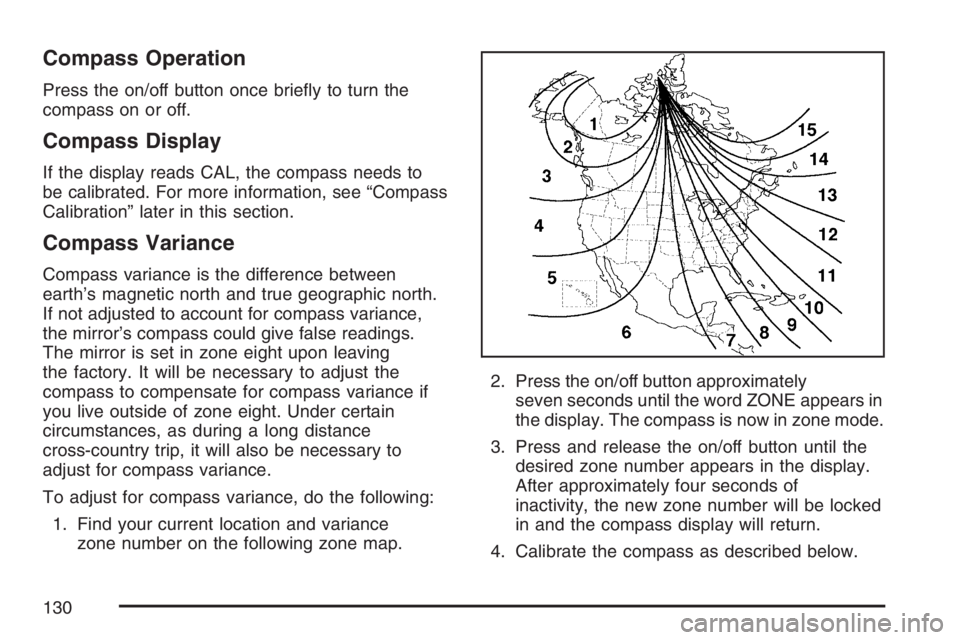
To adjust for compass variance, do the following:
1. Find your current location and variance
zone number on the following zone map.2. Press the on/off button approximately
seven seconds until the word ZONE appears in
the display. The compass is now in zone mode.
3. Press and release the on/off button until the
desired zone number appears in the display.
After approximately four seconds of
inactivity, the new zone number will be locked
in and the compass display will return.
4. Calibrate the compass as described below.
130
Page 133 of 490
Outside Convex Mirrors
The passenger’s side mirror is convex. A convex
mirror’s surface is curved, creating a wider
area of vision for the driver.
{CAUTION:
A convex mirror can make things (like
other vehicles) look farther away than
they really are. If you cut too sharply into
the right lane, you could hit a vehicle on
your right. Check your inside mirror or
glance over your shoulder before
changing lanes.
OnStar®System
OnStar®uses several innovative technologies and
live advisors to provide you with a wide range
of safety, security, information, and convenience
services. If your airbags deploy, the system is
designed to make an automatic call to OnStar
®
Emergency advisors who can request emergency
services be sent to your location. If you lock
your keys in the vehicle, call OnStar
®at
1-888-4-ONSTAR and they can send a signal to
unlock your doors. If you need roadside
assistance, press the OnStar
®button and they
can contact Roadside Service for you.
133
Page 134 of 490
OnStar®service is provided to you subject to the
OnStar®Terms and Conditions. You may cancel
your OnStar®service at any time by contacting
OnStar®as provided below. A complete OnStar®
Owners Guide and the OnStar®Terms and
Conditions are included in the vehicle’s OnStar®
Subscriber glove box literature. For more
information, visit onstar.com or onstar.ca, contact
OnStar
®at 1-888-4-ONSTAR (1-888-466-7827) or
TTY 1-877-248-2080, or press the OnStar®button
to speak with an OnStar®advisor 24 hours a day,
7 days a week.
Not all OnStar
®features are available on all
vehicles. To check if your vehicle is equipped to
provide the services described below, or for a
full description of OnStar
®services and system
limitations, see the OnStar®Owner’s Guide in your
glove box or visit onstar.com.
OnStar®Services
For new vehicles with OnStar®, the Safe & Sound
Plan, or the Directions & Connections®Plan is
included for one year from the date of purchase.
You can extend this plan beyond the rst year,
or upgrade to the Directions & Connections
®Plan.
For more information, press the OnStar®button
to speak with an advisor. Some OnStar®services
(such as Remote Door Unlock or Stolen Vehicle
Location Assistance) may not be available
until you register with OnStar
®.
134
Page 135 of 490
Available Services with Safe & Sound®Plan
Automatic Notication of Airbag Deployment
Advanced Automatic Crash Notication (AACN)
(If equipped)
Link to Emergency Services
Roadside Assistance
Stolen Vehicle Location Assistance
AccidentAssist
Remote Door Unlock/Vehicle Alert
OnStar®Vehicle Diagnostics
GM®Goodwrench®On Demand Diagnostics
OnStar®Hands-Free Calling with
30 complimentary minutes
OnStar®Virtual Advisor ( U.S. Only)
Available Services included with
Directions & Connections®Plan
All Safe and Sound Plan Services
Driving Directions - Advisor delivered or
OnStar®Turn-by-Turn Navigation (If equipped)
RideAssist
Information and Convenience Services
OnStar®Hands-Free Calling
OnStar®Hands-Free Calling allows eligible
OnStar®subscribers to make and receive calls
using voice commands. Hands-Free Calling is fully
integrated into the vehicle, and can be used
with OnStar
®Pre-Paid Minute Packages.
Hands-Free Calling may also be linked to a
Verizon Wireless service plan in the U.S. or a Bell
Mobility service plan in Canada, depending on
eligibility. To nd out more, refer to the OnStar
®
Owners Guide in the vehicle’s glove box, visit
www.onstar.com or www.onstar.ca, or speak with
an OnStar
®advisor by pressing the OnStar®
button or calling 1-888-4-ONSTAR
(1-888-466-7827).
OnStar®Virtual Advisor
OnStar®Virtual Advisor is a feature of OnStar®
Hands-Free Calling that uses your minutes to
access location-based weather, local traffic reports,
and stock quotes. By pressing the phone button
and giving a few simple voice commands, you can
browse through the various topics. See the OnStar
®
Owners Guide for more information (Only available
in the continental U.S.).
135
Page 138 of 490
Center Console Storage Area
Your vehicle has a center console armrest with
storage area. Use the lever on the front of
the console to open it.
Luggage Carrier
{CAUTION:
If you try to carry something on top of
your vehicle that is longer or wider than
the luggage carrier — like paneling,
plywood, a mattress and so forth — the
wind can catch it as you drive along. This
can cause you to lose control. What you
are carrying could be violently torn off,
and this could cause you or other drivers
to have a collision, and of course damage
your vehicle. You may be able to carry
something like this inside. But, never
carry something longer or wider than the
luggage carrier on top of your vehicle.A luggage carrier allows you to load things on top
of your vehicle. The luggage carrier has side
rails attached to the roof, sliding crossrails, if the
vehicle has them, and places to use for tying
things down. These let you load some things on
top of your vehicle, as long as they are not
wider or longer than the luggage carrier.
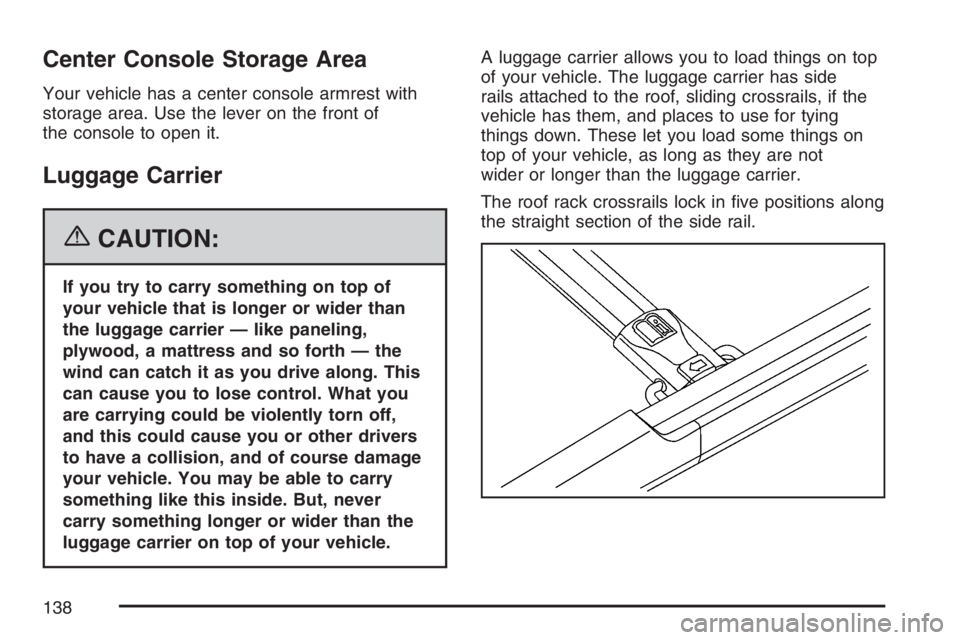
The roof rack crossrails lock in ve positions along
the straight section of the side rail.
138