cooling fans PONTIAC TORRENT 2007 Owners Manual
[x] Cancel search | Manufacturer: PONTIAC, Model Year: 2007, Model line: TORRENT, Model: PONTIAC TORRENT 2007Pages: 490, PDF Size: 2.71 MB
Page 163 of 490
Electric Power Management
The vehicle has Electric Power Management (EPM)
that estimates the battery’s temperature and state
of charge. It then adjusts the voltage for best
performance and extended life of the battery.
When the battery’s state of charge is low, the
voltage is raised slightly to quickly put the charge
back in. When the state of charge is high, the
voltage is lowered slightly to prevent overcharging.
If the vehicle has a voltmeter gage or voltage
display on the Driver Information Center (DIC), you
may see the voltage move up or down. This is
normal. If there is a problem, an alert will be
displayed.
The battery can be discharged at idle if the
electrical loads are very high. This is true for all
vehicles. This is because the generator (alternator)
may not be spinning fast enough at idle to
produce all the power that is needed for very high
electrical loads.A high electrical load occurs when several of the
following loads are on: headlamps, high beams,
fog lamps, rear window defogger, climate
control fan at high speed, heated seats, engine
cooling fans, trailer loads, and loads plugged into
accessory power outlets.
EPM works to prevent excessive discharge of the
battery. It does this by balancing the generator’s
output and the vehicle’s electrical needs. It
can increase engine idle speed to generate more
power, whenever needed. It can temporarily
reduce the power demands of some accessories.
Normally, these actions occur in steps or levels,
without being noticeable. In rare cases at the
highest levels of corrective action, this action may
be noticeable to the driver. If so, a Driver
Information Center (DIC) message might be
displayed, such as Battery Saver Active or Service
Battery Charging System. If this message is
displayed, it is recommended that the driver
reduce the electrical loads as much as possible.
SeeDIC Warnings and Messages on page 200.
163
Page 362 of 490
Overheated Engine Protection
Operating Mode
This emergency operating mode lets your vehicle
be driven to a safe place in an emergency situation.
If an overheated engine condition exists, an
overheat protection mode which alternates ring
groups of cylinders helps prevent engine damage.
In this mode, there is a signicant loss in power and
engine performance. The temperature gage
indicates an overheat condition exists. Driving
extended miles (km) and/or towing a trailer in the
overheat protection mode should be avoided.
Notice:After driving in the overheated engine
protection operating mode, to avoid engine
damage, allow the engine to cool before
attempting any repair. The engine oil will be
severely degraded. Repair the cause of coolant
loss, change the oil and reset the oil life system.
SeeEngine Oil on page 349.
Cooling System
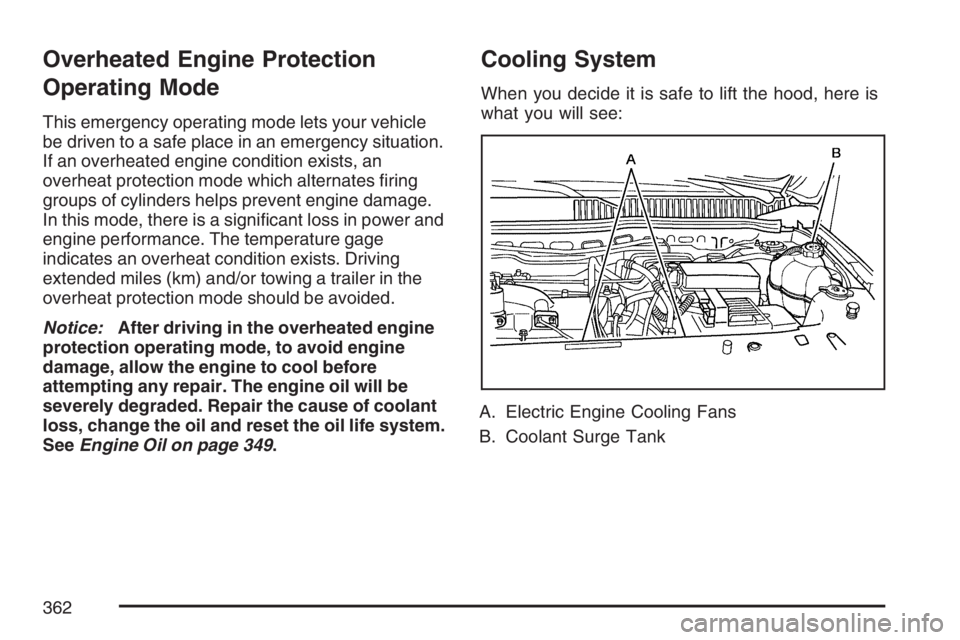
When you decide it is safe to lift the hood, here is
what you will see:
A. Electric Engine Cooling Fans
B. Coolant Surge Tank
362
Page 363 of 490
{CAUTION:
An electric engine cooling fan under the
hood can start up even when the engine
is not running and can injure you. Keep
hands, clothing, and tools away from any
underhood electric fan.
If the coolant inside the coolant surge tank is
boiling, do not do anything else until it cools down.
The vehicle should be parked on a level surface.
The coolant level should be at the COLD FILL line.
If it is not, you may have a leak at the radiator
hoses, heater hoses, radiator, water pump,
or somewhere else in the cooling system.
{CAUTION:
Heater and radiator hoses, and other
engine parts, can be very hot. Do not
touch them. If you do, you can be burned.
Do not run the engine if there is a leak. If
you run the engine, it could lose all
coolant. That could cause an engine re,
and you could be burned. Get any leak
xed before you drive the vehicle.
If there seems to be no leak, with the engine on,
check to see if the electric engine cooling fans
are running. If the engine is overheating, both fans
should be running. If they are not, your vehicle
needs service. Turn off the engine.
363
Page 367 of 490
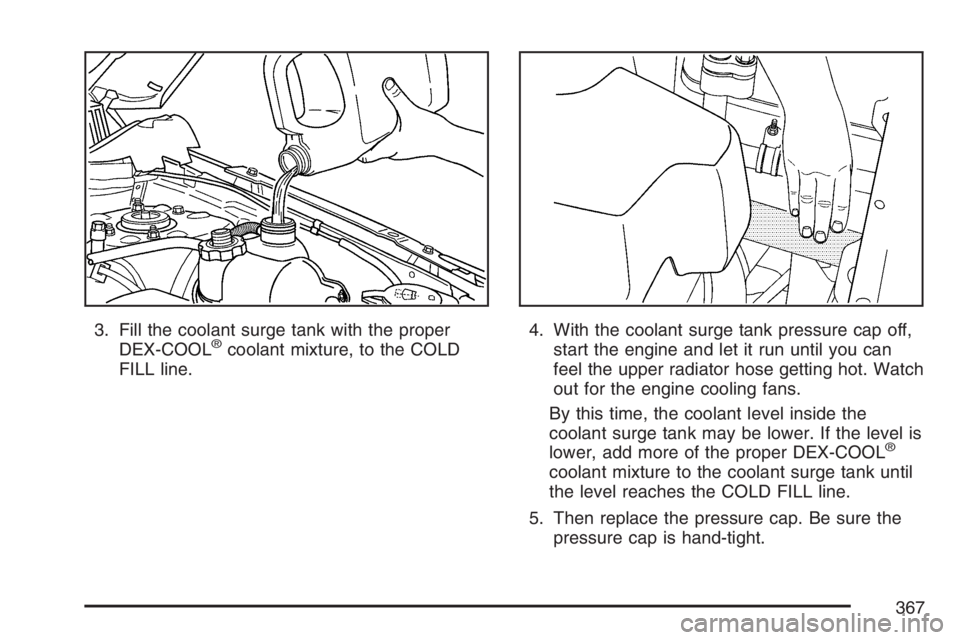
3. Fill the coolant surge tank with the proper
DEX-COOL®coolant mixture, to the COLD
FILL line.4. With the coolant surge tank pressure cap off,
start the engine and let it run until you can
feel the upper radiator hose getting hot. Watch
out for the engine cooling fans.
By this time, the coolant level inside the
coolant surge tank may be lower. If the level is
lower, add more of the proper DEX-COOL
®
coolant mixture to the coolant surge tank until
the level reaches the COLD FILL line.
5. Then replace the pressure cap. Be sure the
pressure cap is hand-tight.
367