ECU PONTIAC TORRENT 2008 Owner's Manual
[x] Cancel search | Manufacturer: PONTIAC, Model Year: 2008, Model line: TORRENT, Model: PONTIAC TORRENT 2008Pages: 434, PDF Size: 2.51 MB
Page 57 of 434
If your vehicle does not have a rear seat that will
accommodate a rear-facing child restraint, we
recommend that rear-facing child restraints not be
transported in your vehicle, even if the airbag is off.
If your child restraint has the LATCH system, seeLower
Anchors and Tethers for Children (LATCH) on
page 1-42for how to install your child restraint using
LATCH. If you secure a child restraint using a safety belt
and it uses a top tether, seeLower Anchors and
Tethers for Children (LATCH) on page 1-42for top
tether anchor locations.
Do not secure a child seat in a position without a top
tether anchor if a national or local law requires that the
top tether be anchored, or if the instructions that
come with the child restraint say that the top strap must
be anchored.
In Canada, the law requires that forward-facing child
restraints have a top tether, and that the tether be
attached.You will be using the lap-shoulder belt to secure the
child restraint in this position. Follow the instructions that
came with the child restraint.
1. Move the seat as far back as it will go before
securing the forward-facing child restraint.
When the passenger sensing system has turned off
the right front passenger’s frontal airbag, the off
indicator on the passenger airbag status indicator
should light and stay lit when you start the
vehicle. SeePassenger Airbag Status Indicator on
page 3-30.
2. Put the child restraint on the seat.
3. Pick up the latch plate, and run the lap and shoulder
portions of the vehicle’s safety belt through or
around the restraint. The child restraint instructions
will show you how.
1-53
Page 59 of 434
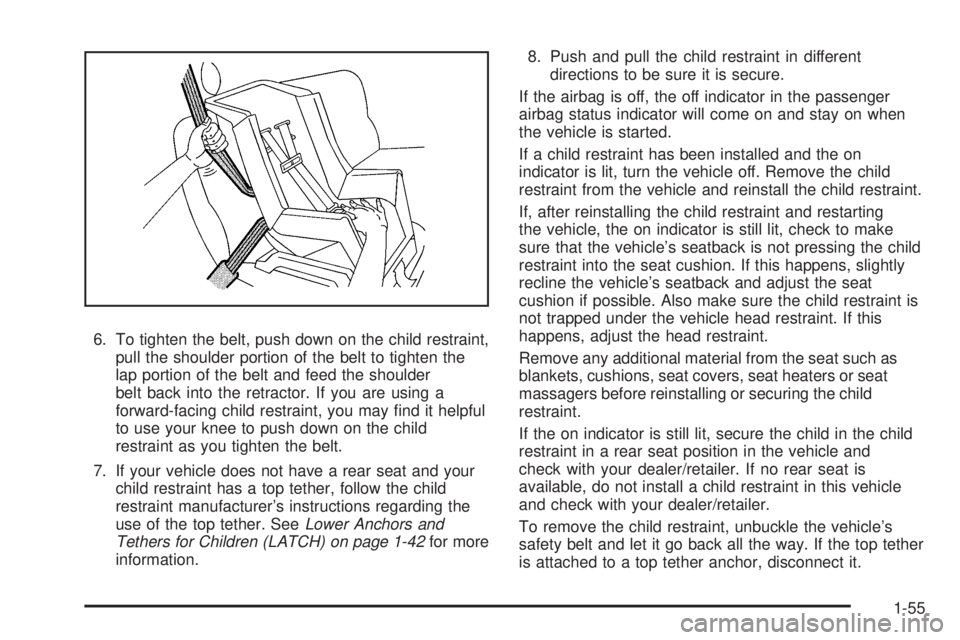
6. To tighten the belt, push down on the child restraint,
pull the shoulder portion of the belt to tighten the
lap portion of the belt and feed the shoulder
belt back into the retractor. If you are using a
forward-facing child restraint, you may nd it helpful
to use your knee to push down on the child
restraint as you tighten the belt.
7. If your vehicle does not have a rear seat and your
child restraint has a top tether, follow the child
restraint manufacturer’s instructions regarding the
use of the top tether. SeeLower Anchors and
Tethers for Children (LATCH) on page 1-42for more
information.8. Push and pull the child restraint in different
directions to be sure it is secure.
If the airbag is off, the off indicator in the passenger
airbag status indicator will come on and stay on when
the vehicle is started.
If a child restraint has been installed and the on
indicator is lit, turn the vehicle off. Remove the child
restraint from the vehicle and reinstall the child restraint.
If, after reinstalling the child restraint and restarting
the vehicle, the on indicator is still lit, check to make
sure that the vehicle’s seatback is not pressing the child
restraint into the seat cushion. If this happens, slightly
recline the vehicle’s seatback and adjust the seat
cushion if possible. Also make sure the child restraint is
not trapped under the vehicle head restraint. If this
happens, adjust the head restraint.
Remove any additional material from the seat such as
blankets, cushions, seat covers, seat heaters or seat
massagers before reinstalling or securing the child
restraint.
If the on indicator is still lit, secure the child in the child
restraint in a rear seat position in the vehicle and
check with your dealer/retailer. If no rear seat is
available, do not install a child restraint in this vehicle
and check with your dealer/retailer.
To remove the child restraint, unbuckle the vehicle’s
safety belt and let it go back all the way. If the top tether
is attached to a top tether anchor, disconnect it.
1-55
Page 60 of 434
Airbag System
Your vehicle has the following airbags:
A frontal airbag for the driver.
A frontal airbag for the right front passenger.
Your vehicle may have the following airbags:
A roof-rail airbag for the driver and the passenger
seated directly behind the driver.
A roof-rail airbag for the right front passenger and
the passenger seated directly behind that
passenger.
All of the airbags in your vehicle will have the word
AIRBAG embossed in the trim or on an attached label
near the deployment opening.
For frontal airbags, the word AIRBAG will appear on the
middle part of the steering wheel for the driver and
on the instrument panel for the right front passenger.
With roof-rail airbags, the word AIRBAG will appear
along the headliner or trim.
Even if you do not have a right front passenger seat in
your vehicle there is still an active frontal airbag in
the right side of the instrument panel. Do not place cargo
in front of this airbag.
{CAUTION:
Be sure that cargo is not near an airbag. In a
crash, an inating airbag might force that
object toward a person. This could cause
severe injury or even death. Secure objects
away from the area in which an airbag would
inate. For more information, seeWhere Are
the Airbags? on page 1-59andLoading Your
Vehicle on page 4-22.
Airbags are designed to supplement the protection
provided by safety belts. Even though today’s airbags
are also designed to help reduce the risk of injury
from the force of an inating bag, all airbags must inate
very quickly to do their job.
1-56
Page 62 of 434
{CAUTION:
Airbags inate with great force, faster than the
blink of an eye. Anyone who is up against, or
very close to, any airbag when it inates can
be seriously injured or killed. Do not sit
unnecessarily close to the airbag, as you
would be if you were sitting on the edge of
your seat or leaning forward. Safety belts help
keep you in position before and during a
crash. Always wear your safety belt, even with
airbags. The driver should sit as far back as
possible while still maintaining control of the
vehicle.
Occupants should not lean on or sleep against
the door or side windows in seating positions
with roof-rail airbags.
{CAUTION:
Airbags plus lap-shoulder belts offer the best
protection for adults, but not for young
children and infants. Neither the vehicle’s
safety belt system nor its airbag system is
designed for them. Young children and infants
need the protection that a child restraint
system can provide. Always secure children
properly in your vehicle. To read how, see
Older Children on page 1-31orInfants and
Young Children on page 1-34.
There is an airbag
readiness light on the
instrument panel cluster,
which shows the airbag
symbol.
The system checks the airbag electrical system for
malfunctions. The light tells you if there is an electrical
problem. SeeAirbag Readiness Light on page 3-29
for more information.
1-58
Page 64 of 434
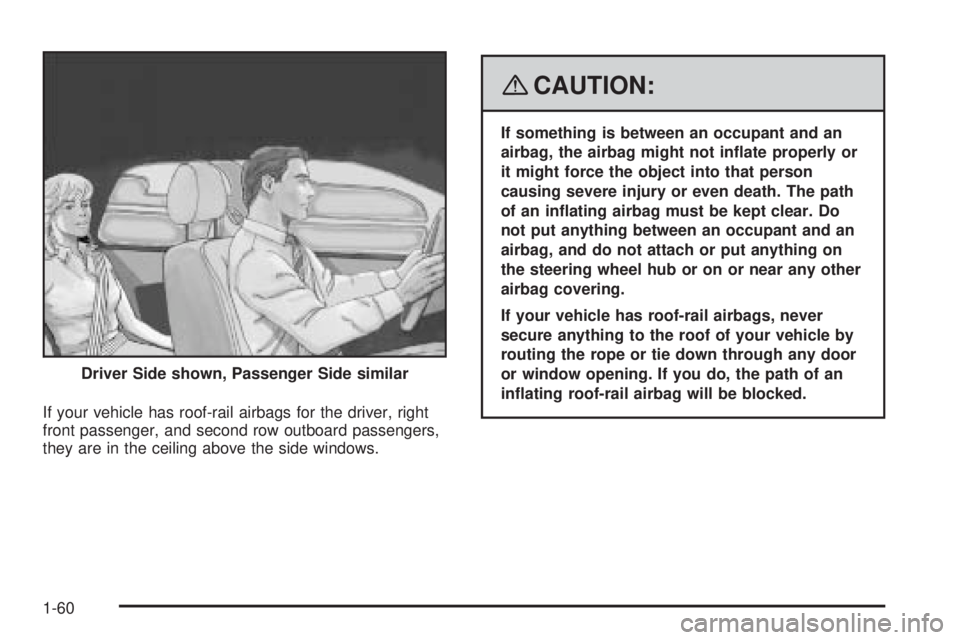
If your vehicle has roof-rail airbags for the driver, right
front passenger, and second row outboard passengers,
they are in the ceiling above the side windows.
{CAUTION:
If something is between an occupant and an
airbag, the airbag might not inate properly or
it might force the object into that person
causing severe injury or even death. The path
of an inating airbag must be kept clear. Do
not put anything between an occupant and an
airbag, and do not attach or put anything on
the steering wheel hub or on or near any other
airbag covering.
If your vehicle has roof-rail airbags, never
secure anything to the roof of your vehicle by
routing the rope or tie down through any door
or window opening. If you do, the path of an
inating roof-rail airbag will be blocked. Driver Side shown, Passenger Side similar
1-60
Page 69 of 434
The passenger sensing system works with sensors that
are part of the right front passenger’s seat. The sensors
are designed to detect the presence of a properly-seated
occupant and determine if the right front passenger’s
frontal airbag should be enabled (may inate) or not.
Accident statistics show that children are safer if they
are restrained in the rear rather than the front seat.
We recommend that children be secured in a rear seat,
including: an infant or a child riding in a rear-facing
child restraint; a child riding in a forward-facing child
seat; an older child riding in a booster seat; and children,
who are large enough, using safety belts.
A label on your sun visor says, “Never put a rear-facing
child seat in the front.” This is because the risk to the
rear-facing child is so great, if the airbag deploys.
{CAUTION:
A child in a rear-facing child restraint can be
seriously injured or killed if the right front
passenger’s airbag inates. This is because
the back of the rear-facing child restraint
would be very close to the inating airbag.
CAUTION: (Continued)
CAUTION: (Continued)
Even though the passenger sensing system is
designed to turn off the right front passenger’s
frontal airbag if the system detects a
rear-facing child restraint, no system is
fail-safe, and no one can guarantee that an
airbag will not deploy under some unusual
circumstance, even though it is turned off. We
recommend that rear-facing child restraints be
secured in a rear seat, even if the airbag is off.
If you secure a forward-facing child restraint in
the right front seat, always move the front
passenger seat as far back as it will go. It is
better to secure the child restraint in a rear seat.
If your vehicle does not have a rear seat that will
accommodate a rear-facing child restraint, we
recommend that rear-facing child restraints not be
transported in your vehicle, even if the airbag is off.
1-65
Page 70 of 434
The passenger sensing system is designed to turn off
the right front passenger’s frontal airbag if:
The right front passenger seat is unoccupied.
The system determines that an infant is present in
a rear-facing infant seat.
The system determines that a small child is present
in a child restraint.
The system determines that a small child is present
in a booster seat.
A right front passenger takes his/her weight off of
the seat for a period of time.
The right front passenger seat is occupied by a
smaller person, such as a child who has outgrown
child restraints.
Or, if there is a critical problem with the airbag
system or the passenger sensing system.When the passenger sensing system has turned off the
right front passenger’s frontal airbag, the off indicator
will light and stay lit to remind you that the airbag is off.
SeePassenger Airbag Status Indicator on page 3-30.
If a child restraint has been installed and the on indicator
is lit, turn the vehicle off. Remove the child restraint
from the vehicle and reinstall the child restraint following
the child restraint manufacturer’s directions and refer
toSecuring a Child Restraint in the Right Front
Seat Position on page 1-52.
If, after reinstalling the child restraint and restarting the
vehicle, the on indicator is still lit, check to make
sure that the vehicle’s seatback is not pressing the child
restraint into the seat cushion. If this happens, slightly
recline the vehicle’s seatback and adjust the seat
cushion if possible. Also make sure the child restraint is
not trapped under the vehicle head restraint. If this
happens, adjust the head restraint. SeeHead Restraints
on page 1-7.
1-66
Page 71 of 434
Remove any additional material from the seat such as
blankets, cushions, seat covers, seat heaters, or
seat massagers before reinstalling or securing the child
restraint.
If the on indicator is still lit, secure the child in the child
restraint in a rear seat position in the vehicle, and
check with your dealer/retailer. If no rear seat is
available, do not install a child restraint in this vehicle,
and check with your dealer/retailer.
The passenger sensing system is designed to enable
(may inate) the right front passenger’s frontal
airbag anytime the system senses that a person of adult
size is sitting properly in the right front passenger’s
seat. When the passenger sensing system has allowed
the airbag to be enabled, the on indicator will light
and stay lit to remind you that the airbag is active.For some children who have outgrown child restraints
and for very small adults, the passenger sensing system
may or may not turn off the right front passenger’s
frontal airbag, depending upon the person’s seating
posture and body build. Everyone in your vehicle who
has outgrown child restraints should wear a safety
belt properly — whether or not there is an airbag for
that person.
If a person of adult-size is sitting in the right front
passenger’s seat, but the off indicator is lit, it could be
because that person is not sitting properly in the seat. If
this happens, turn the vehicle off, remove any additional
material from the seat, such as blankets, cushions,
seat covers, seat heaters or seat massagers and ask
the person to place the seatback in the fully upright
position, then sit upright in the seat, centered on the seat
cushion, with the person’s legs comfortably extended.
Restart the vehicle and have the person remain in
this position for two to three minutes. This will allow the
system to detect that person and then enable the
right front passenger’s frontal airbag.
1-67
Page 74 of 434
Adding Equipment to Your
Airbag-Equipped Vehicle
Q:Is there anything I might add to or change
about the vehicle that could keep the airbags
from working properly?
A:Yes. If you add things that change your vehicle’s
frame, bumper system, height, front end or side
sheet metal, they may keep the airbag system from
working properly. Changing or moving any parts of
the front seats, safety belts, the airbag sensing and
diagnostic module, steering wheel, instrument panel,
roof-rail airbag modules, ceiling headliner or pillar
garnish trim, overhead console, front sensors, side
impact sensors, rollover sensor module, or airbag
wiring can affect the operation of the airbag system.
In addition, your vehicle has a passenger sensing
system for the right front passenger’s position,
which includes sensors that are part of the
passenger’s seat. The passenger sensing system
may not operate properly if the original seat
trim is replaced with non-GM covers, upholstery or
trim, or with GM covers, upholstery or trim
designed for a different vehicle. Any object, such as
an aftermarket seat heater or a comfort enhancing
pad or device, installed under or on top of theseat fabric, could also interfere with the operation of
the passenger sensing system. This could either
prevent proper deployment of the passenger
airbag(s) or prevent the passenger sensing system
from properly turning off the passenger airbag(s).
SeePassenger Sensing System on page 1-64.
If you have any questions about this, you should
contact Customer Assistance before you modify
your vehicle. The phone numbers and addresses for
Customer Assistance are in Step Two of the
Customer Satisfaction Procedure in this manual.
SeeCustomer Satisfaction Procedure on page 7-2.
If your vehicle has rollover roof-rail airbags, see
Different Size Tires and Wheels on page 5-72
for additional important information.
Q:Because I have a disability, I have to get my
vehicle modied. How can I nd out whether
this will affect my airbag system?
A:If you have questions, call Customer Assistance.
The phone numbers and addresses for Customer
Assistance are in Step Two of the Customer
Satisfaction Procedure in this manual. See
Customer Satisfaction Procedure on page 7-2.
In addition, your dealer/retailer and the service manual
have information about the location of the airbag sensors,
sensing and diagnostic module and airbag wiring.
1-70
Page 77 of 434
Keys...............................................................2-3
Remote Keyless Entry (RKE) System................2-4
Remote Keyless Entry (RKE) System
Operation...................................................2-5
Remote Vehicle Start......................................2-8
Doors and Locks............................................2-11
Door Locks..................................................2-11
Power Door Locks........................................2-11
Delayed Locking...........................................2-12
Programmable Automatic Door Locks..............2-12
Rear Door Security Locks..............................2-12
Lockout Protection........................................2-13
Liftgate........................................................2-13
Windows........................................................2-15
Power Windows............................................2-16
Sun Visors...................................................2-17
Theft-Deterrent Systems..................................2-17
Content Theft-Deterrent.................................2-18
PASS-Key
®III+............................................2-18
PASS-Key®III+ Operation..............................2-19Starting and Operating Your Vehicle................2-20
New Vehicle Break-In....................................2-20
Ignition Positions..........................................2-21
Retained Accessory Power (RAP)...................2-22
Starting the Engine.......................................2-22
Engine Coolant Heater..................................2-23
Automatic Transmission Operation
(3.4L V6 with 5-Speed)..............................2-25
Automatic Transmission Operation
(3.6L V6 with 6-Speed)..............................2-28
Parking Brake..............................................2-32
Shifting Into PARK (P)...................................2-33
Shifting Out of PARK (P)...............................2-35
Parking Over Things That Burn.......................2-35
Engine Exhaust............................................2-36
Running the Engine While Parked...................2-36
Mirrors...........................................................2-37
Manual Rearview Mirror.................................2-37
Manual Rearview Mirror with OnStar
®..............2-37
Automatic Dimming Rearview Mirror
with OnStar
®............................................2-38
Outside Power Mirrors...................................2-38
Outside Convex Mirrors.................................2-39
Section 2 Features and Controls
2-1