trailer PONTIAC TORRENT 2008 Owner's Manual
[x] Cancel search | Manufacturer: PONTIAC, Model Year: 2008, Model line: TORRENT, Model: PONTIAC TORRENT 2008Pages: 434, PDF Size: 2.51 MB
Page 281 of 434
You should keep a record with all parts receipts and list
the mileage and the date of any service work you
perform. SeeMaintenance Record on page 6-16.
Adding Equipment to the Outside of
Your Vehicle
Things you might add to the outside of your vehicle can
affect the airow around it. This can cause wind
noise and can affect fuel economy and windshield
washer performance. Check with your dealer/retailer
before adding equipment to the outside of your vehicle.
Fuel
Use of the recommended fuel is an important part of the
proper maintenance of your vehicle. To help keep the
engine clean and maintain optimum vehicle
performance, we recommend the use of gasoline
advertised as TOP TIER Detergent Gasoline.
The 8th digit of the Vehicle Identication Number (VIN)
shows the code letter or number that identies your
vehicle’s engine. The VIN is at the top left of the
instrument panel. SeeVehicle Identification Number
(VIN) on page 5-98.
Gasoline Octane
If your vehicle has the 3.4L V6 engine (VIN Code F),
use regular unleaded gasoline with a posted octane
rating of 87 or higher. If the octane rating is less than 87,
you might notice an audible knocking noise when you
drive, commonly referred to as spark knock. If this
occurs, use a gasoline rated at 87 octane or higher as
soon as possible. If you are using gasoline rated at
87 octane or higher and you hear heavy knocking, the
engine needs service.
If your vehicle has the 3.6L V6 engine (VIN Code 7), use
regular unleaded gasoline with a posted octane rating of
87 or higher. For best performance or trailer towing, you
could choose to use middle grade 89 octane unleaded
gasoline. If the octane rating is less than 87, you might
notice an audible knocking noise when you drive,
commonly referred to as spark knock. If this occurs, use a
gasoline rated at 87 octane or higher as soon as possible.
If you are using gasoline rated at 87 octane or higher and
you hear heavy knocking, the engine needs service.
5-5
Page 302 of 434
If No Steam Is Coming From Your
Engine
An overheat warning can indicate a serious problem.
If you get an engine overheat warning, but see or hear
no steam, the problem may not be too serious.
Sometimes the engine can get a little too hot when you:
Climb a long hill on a hot day.
Stop after high-speed driving.
Idle for long periods in traffic.
Tow a trailer.
If you get the overheat warning with no sign of steam,
try this for a minute or so:
1. If the air conditioner is on, turn it off.
2. Turn on your heater to full hot at the highest fan
speed and open the windows as necessary.
3. Try to minimize engine load. If you are in a traffic
jam, shift to NEUTRAL (N); otherwise, shift to the
highest gear while driving.
If you no longer have the overheat warning, you can
drive. Just to be safe, drive slower for about ten minutes.
If the warning does not come back on, you can drive
normally.
If the warning continues and you have not stopped, pull
over, stop, and park your vehicle right away.If there is still no sign of steam, you can idle the engine
for three minutes while you are parked. If you still
have the warning, turn off the engine and get everyone
out of the vehicle until it cools down. Also, see
“Overheated Engine Protection Operating Mode” later in
this section.
You may decide not to lift the hood but to get service
help right away.
Overheated Engine Protection
Operating Mode
This emergency operating mode lets your vehicle be
driven to a safe place in an emergency situation. If an
overheated engine condition exists, an overheat
protection mode which alternates ring groups of
cylinders helps prevent engine damage. In this mode,
there is a signicant loss in power and engine
performance. The temperature gage indicates an
overheat condition exists. Driving extended distances
and/or towing a trailer in the overheat protection mode
should be avoided.
Notice:After driving in the overheated engine
protection operating mode, to avoid engine damage,
allow the engine to cool before attempting any repair.
The engine oil will be severely degraded. Repair the
cause of coolant loss, change the oil and reset the oil
life system. SeeEngine Oil on page 5-15.
5-26
Page 380 of 434
Fuses Usage
32 Spare
33 Engine Control Module, Battery
34Transmission Control Module,
Battery
35 Trailer Park Lamp
36 Front Wiper
37Driver Side Trailer Stoplamp, Turn
Signal
38 Spare
39 Fuel Pump
40 Not Used
41 All-Wheel Drive
42 Regulated Voltage Control
43Passenger Side Trailer Stoplamp,
Turn Signal
44 Spare
45 Front, Rear Washer
48 Rear Defogger
49 Antilock Brake System Motor
50 Battery Main 2
52 Daytime Running LampsFuses Usage
53 Fog Lamps
54 Climate Control System Blower
57 Battery Main 1
63 Electric Power Steering
Relays Usage
31 Ignition Main
46 Air Conditioning Compressor Clutch
47 Powertrain
51 Spare
55 Crank
56 Fan 1
58Passenger Side Trailer Stoplamp,
Turn Signal
59Driver Side Trailer Stoplamp, Turn
Signal
60 Fan 3
61 Fan 2
62 Fuel Pump
5-104
Page 389 of 434
Maintenance Footnotes
(a)Visually inspect brake lines and hoses for proper
hook-up, binding, leaks, cracks, chafing, etc. Inspect
disc brake pads for wear and rotors for surface
condition. Inspect other brake parts, including calipers,
parking brake, etc. Check parking brake adjustment.
(b)Visually inspect front and rear suspension and
steering system for damaged, loose, or missing parts
or signs of wear. Visually check constant velocity joints,
rubber boots, and axle seals for leaks. With 3.4L V6
engine: Inspect electric power steering cables for proper
hook-up, binding, cracks, chafing, etc. With 3.6L V6
engine: Inspect hydraulic power steering lines and hoses
for proper hook-up, binding, leaks, cracks, chafing, etc.
(c)Visually inspect hoses and have them replaced if they
are cracked, swollen, or deteriorated. Inspect all pipes,
fittings and clamps; replace with genuine parts as
needed. To help ensure proper operation, a pressure test
of the cooling system and pressure cap and cleaning the
outside of the radiator and air conditioning condenser is
recommended at least once a year.
(d)Inspect wiper blades for wear, cracking, or
contamination. Clean the windshield and wiper blades,
if contaminated. Replace wiper blades that are worn
or damaged. See Windshield Wiper Blade Replacement
on page 5-51andWindshield and Wiper Blades on
page 5-94 for more information.(e)Make sure the safety belt reminder light and safety
belt assemblies are working properly. Look for any
other loose or damaged safety belt system parts. If you
see anything that might keep a safety belt system
from doing its job, have it repaired. Have any torn or
frayed safety belts replaced. Also see Checking
the Restraint Systems on page 1-71.
(f)Lubricate all key lock cylinders, hood latch
assemblies, secondary latches, pivots, spring anchor
and release pawl, hood and door hinges, rear folding
seats, and liftgate hinges. More frequent lubrication may
be required when exposed to a corrosive environment.
Applying silicone grease on weatherstrips with a
clean cloth will make them last longer, seal better, and
not stick or squeak.
(g)If you drive regularly under dusty conditions, the
filter may require replacement more often.
(h)Change automatic transmission fluid if the vehicle is
mainly driven under one or more of these conditions:
In heavy city traffic where the outside temperature
regularly reaches 90°F (32°C) or higher.
In hilly or mountainous terrain.
When doing frequent trailer towing.
Uses such as found in taxi, police, or delivery
service.
6-7
Page 432 of 434
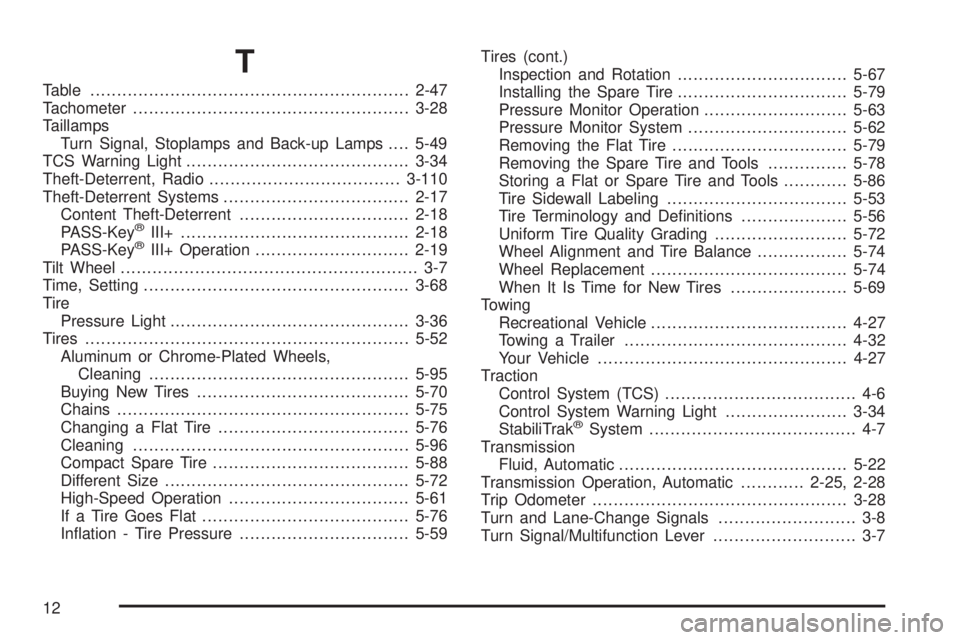
T
Table............................................................2-47
Tachometer....................................................3-28
Taillamps
Turn Signal, Stoplamps and Back-up Lamps....5-49
TCS Warning Light..........................................3-34
Theft-Deterrent, Radio....................................3-110
Theft-Deterrent Systems...................................2-17
Content Theft-Deterrent................................2-18
PASS-Key
®III+...........................................2-18
PASS-Key®III+ Operation.............................2-19
Tilt Wheel........................................................ 3-7
Time, Setting..................................................3-68
Tire
Pressure Light.............................................3-36
Tires.............................................................5-52
Aluminum or Chrome-Plated Wheels,
Cleaning.................................................5-95
Buying New Tires........................................5-70
Chains.......................................................5-75
Changing a Flat Tire....................................5-76
Cleaning....................................................5-96
Compact Spare Tire.....................................5-88
Different Size..............................................5-72
High-Speed Operation..................................5-61
If a Tire Goes Flat.......................................5-76
Ination - Tire Pressure................................5-59Tires (cont.)
Inspection and Rotation................................5-67
Installing the Spare Tire................................5-79
Pressure Monitor Operation...........................5-63
Pressure Monitor System..............................5-62
Removing the Flat Tire.................................5-79
Removing the Spare Tire and Tools...............5-78
Storing a Flat or Spare Tire and Tools............5-86
Tire Sidewall Labeling..................................5-53
Tire Terminology and Denitions....................5-56
Uniform Tire Quality Grading.........................5-72
Wheel Alignment and Tire Balance.................5-74
Wheel Replacement.....................................5-74
When It Is Time for New Tires......................5-69
Towing
Recreational Vehicle.....................................4-27
Towing a Trailer..........................................4-32
Your Vehicle...............................................4-27
Traction
Control System (TCS).................................... 4-6
Control System Warning Light.......................3-34
StabiliTrak
®System....................................... 4-7
Transmission
Fluid, Automatic...........................................5-22
Transmission Operation, Automatic............2-25, 2-28
Trip Odometer................................................3-28
Turn and Lane-Change Signals.......................... 3-8
Turn Signal/Multifunction Lever........................... 3-7
12