mirror PONTIAC TORRENT 2009 User Guide
[x] Cancel search | Manufacturer: PONTIAC, Model Year: 2009, Model line: TORRENT, Model: PONTIAC TORRENT 2009Pages: 436, PDF Size: 2.43 MB
Page 259 of 436
Before Leaving on a Long Trip
To prepare your vehicle for a long trip, consider having
it serviced by your dealer/retailer before departing.
Things to check on your own include:
Windshield Washer Fluid:Reservoir full? Windows
clean — inside and outside?
Wiper Blades:In good shape?
Fuel, Engine Oil, Other Fluids:All levels checked?
Lamps:Do they all work and are lenses clean?
Tires:Are treads good? Are tires inated to
recommended pressure?
Weather and Maps:Safe to travel? Have
up-to-date maps?
Highway Hypnosis
Always be alert and pay attention to your surroundings
while driving. If you become tired or sleepy, nd a
safe place to park your vehicle and rest.
Other driving tips include:
Keep the vehicle well ventilated.
Keep interior temperature cool.
Keep your eyes moving — scan the road ahead
and to the sides.
Check the rearview mirror and vehicle instruments
often.
4-15
Page 262 of 436
Blizzard Conditions
Being stuck in snow can be in a serious situation. Stay
with the vehicle unless there is help nearby. If possible,
use theRoadside Assistance Program on page 7-7.
To get help and keep everyone in the vehicle safe:
Turn on theHazard Warning Flashers on page 3-6.
Tie a red cloth to an outside mirror.
{CAUTION:
Snow can trap engine exhaust under the vehicle.
This may cause exhaust gases to get inside.
Engine exhaust contains carbon monoxide (CO)
which cannot be seen or smelled. It can cause
unconsciousness and even death.
If the vehicle is stuck in the snow:
Clear away snow from around the base of
your vehicle, especially any that is blocking
the exhaust pipe.
Check again from time to time to be sure
snow does not collect there.
CAUTION: (Continued)
CAUTION: (Continued)
Open a window about two inches (5 cm) on
the side of the vehicle that is away from the
wind to bring in fresh air.
Fully open the air outlets on or under the
instrument panel.
Adjust the Climate Control system to a setting
that circulates the air inside the vehicle and
set the fan speed to the highest setting.
See Climate Control System in the Index.
For more information about carbon monoxide, see
Engine Exhaust on page 2-35.
Snow can trap exhaust gases under your vehicle.
This can cause deadly CO (carbon monoxide) gas
to get inside. CO could overcome you and kill you.
You cannot see it or smell it, so you might not
know it is in your vehicle. Clear away snow from
around the base of your vehicle, especially any
that is blocking the exhaust.
Run the engine for short periods only as needed to
keep warm, but be careful.
To save fuel, run the engine for only short periods as
needed to warm the vehicle and then shut the engine off
and close the window most of the way to save heat.
4-18
Page 281 of 436
Driving with a Trailer
{CAUTION:
When towing a trailer, exhaust gases may collect
at the rear of the vehicle and enter if the liftgate,
trunk/hatch, or rear-most window is open.
Engine exhaust contains carbon monoxide (CO)
which cannot be seen or smelled. It can cause
unconsciousness and even death.
To maximize safety when towing a trailer:
Have the exhaust system inspected for
leaks and make necessary repairs before
starting a trip.
Never drive with the liftgate, trunk/hatch, or
rear-most window open.
Fully open the air outlets on or under the
instrument panel.
Adjust the Climate Control system to a setting
that brings in only outside air and set the fan
speed to the highest setting. See Climate
Control System in the Index.
For more information about carbon monoxide, see
Engine Exhaust on page 2-35.Towing a trailer requires a certain amount of experience.
Get to know the rig before setting out for the open
road. Get acquainted with the feel of handling and
braking with the added weight of the trailer. And always
keep in mind that the vehicle you are driving is now
longer and not as responsive as the vehicle is by itself.
Before starting, check all trailer hitch parts and
attachments, safety chains, electrical connectors, lamps,
tires and mirror adjustments. If the trailer has electric
brakes, start the vehicle and trailer moving and then
apply the trailer brake controller by hand to be sure the
brakes are working. This checks the electrical connection
at the same time.
During the trip, check occasionally to be sure that the
load is secure, and that the lamps and any trailer brakes
are still working.
4-37
Page 376 of 436
Instrument Panel Fuse Block
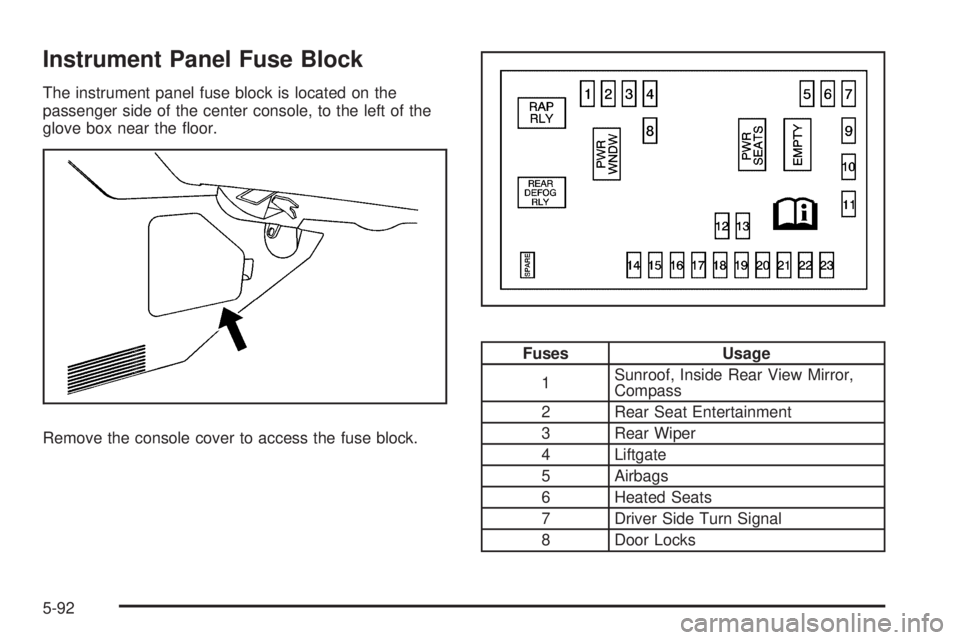
The instrument panel fuse block is located on the
passenger side of the center console, to the left of the
glove box near the oor.
Remove the console cover to access the fuse block.
Fuses Usage
1Sunroof, Inside Rear View Mirror,
Compass
2 Rear Seat Entertainment
3 Rear Wiper
4 Liftgate
5 Airbags
6 Heated Seats
7 Driver Side Turn Signal
8 Door Locks
5-92
Page 377 of 436
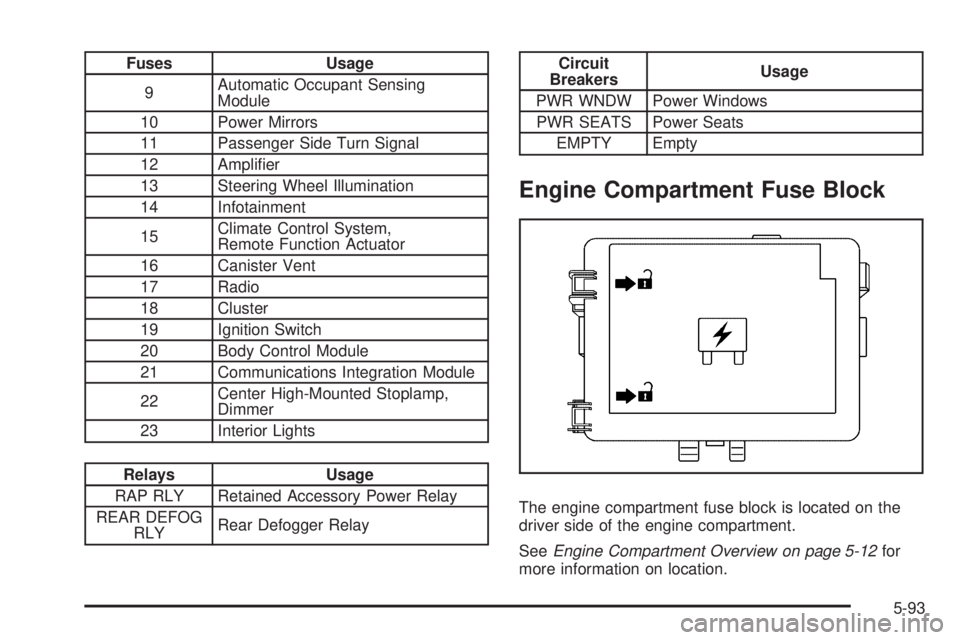
Fuses Usage
9Automatic Occupant Sensing
Module
10 Power Mirrors
11 Passenger Side Turn Signal
12 Amplier
13 Steering Wheel Illumination
14 Infotainment
15Climate Control System,
Remote Function Actuator
16 Canister Vent
17 Radio
18 Cluster
19 Ignition Switch
20 Body Control Module
21 Communications Integration Module
22Center High-Mounted Stoplamp,
Dimmer
23 Interior Lights
Relays Usage
RAP RLY Retained Accessory Power Relay
REAR DEFOG
RLYRear Defogger Relay
Circuit
BreakersUsage
PWR WNDW Power Windows
PWR SEATS Power Seats
EMPTY Empty
Engine Compartment Fuse Block
The engine compartment fuse block is located on the
driver side of the engine compartment.
SeeEngine Compartment Overview on page 5-12for
more information on location.
5-93
Page 431 of 436
Maintenance Schedule (cont.)
Recommended Fluids and Lubricants.............6-13
Scheduled Maintenance................................. 6-4
Using.......................................................... 6-2
Your Vehicle and the Environment................... 6-2
Malfunction Indicator Lamp...............................3-34
Manual Lumbar Controls.................................... 1-4
Manual Reclining Seatbacks............................... 1-5
Manual Seats................................................... 1-2
Map Lamps ....................................................3-16
Message
DIC Warnings and Messages........................3-49
Mirrors
Automatic Dimming Rearview........................2-37
Manual Rearview Mirror................................2-36
Outside Convex Mirrors................................2-38
Outside Power Mirrors..................................2-37
MP3 .....................................................3-87, 3-92
N
Navigation System, Privacy..............................7-19
Navigation/Radio System,
see Navigation Manual.................................3-98
Net
Convenience...............................................2-47
New Vehicle Break-In......................................2-19
O
Odometer......................................................3-26
Odometer, Trip...............................................3-26
Off-Road
Recovery....................................................4-11
Oil
Change Engine Oil Light...............................3-37
Engine.......................................................5-15
Engine Oil Life System.................................5-18
Pressure Light.............................................3-36
Older Children, Restraints................................1-31
Online Owner Center........................................ 7-5
OnStar, Privacy..............................................7-19
OnStar
®System, see OnStar®Manual...............2-38
Outlet Adjustment............................................3-23
Outlets
Accessory Power.........................................3-18
Outside
Convex Mirrors............................................2-38
Power Mirrors.............................................2-37
Overheated Engine Protection Operating Mode....5-29
Owner Checks and Services.............................6-10
Owners, Canadian............................................... ii
9
Page 432 of 436
P
Paint, Damage...............................................5-89
Park
Shifting Into................................................2-32
Shifting Out of............................................2-33
Parking
Over Things That Burn.................................2-34
Parking Brake................................................2-31
Passenger Airbag Status Indicator.....................3-29
Passenger Compartment Air Filter.....................3-23
Passenger Sensing System..............................1-63
Passing.........................................................4-12
PASS-Key
®III+ Electronic Immobilizer...............2-17
PASS-Key®III+ Electronic Immobilizer
Operation...................................................2-18
Perchlorate Materials Requirements, California...... 5-4
Phone
Bluetooth
®..................................................3-98
Power
Door Locks.................................................2-10
Reduced Engine Light..................................3-38
Retained Accessory (RAP)............................2-21
Seat ............................................................ 1-3
Steering Fluid.............................................5-30
Windows....................................................2-15
Pregnancy, Using Safety Belts..........................1-30Privacy..........................................................7-17
Navigation System.......................................7-19
OnStar.......................................................7-19
Radio Frequency Identication (RFID).............7-19
Program
Courtesy Transportation................................7-10
Programmable Automatic Door Locks.................2-11
Proposition 65 Warning, California....................... 5-4
R
Radio Frequency Identication (RFID), Privacy....7-19
Radio(s)........................................................3-67
Radios
Navigation/Radio System, see Navigation
Manual...................................................3-98
Reception.................................................3-119
Setting the Clock.........................................3-65
Theft-Deterrent..........................................3-118
Range Adjustment, Headlamps........................... 1-7
Rear Compartment Storage Panel/Cover............2-44
Rear Door Security Locks................................2-11
Rear Seat Armrest..........................................2-45
Rear Seat Entertainment System.....................3-109
Rear Window Washer/Wiper.............................3-10
Rearview Mirror, Automatic Dimming..................2-37
10
Page 433 of 436
Rearview Mirrors.............................................2-36
Reclining Seatbacks, Manual.............................. 1-5
Recommended Fluids and Lubricants.................6-13
Recreational Vehicle Towing.............................4-26
Reduced Engine Power Light............................3-38
Reimbursement Program, GM Mobility................. 7-7
Remote Keyless Entry (RKE) System.................. 2-4
Remote Keyless Entry (RKE) System, Operation . . . 2-5
Remote Vehicle Start........................................ 2-7
Removing the Flat Tire and Installing the
Spare Tire..................................................5-73
Removing the Spare Tire and Tools...................5-72
Replacement Bulbs.........................................5-46
Replacement Parts, Maintenance......................6-15
Reporting Safety Defects to General Motors.......7-16
Reporting Safety Defects to the
Canadian Government..................................7-16
Reporting Safety Defects to the
U.S. Government.........................................7-15
Restraint System Check
Checking the Restraint Systems....................1-70
Replacing Restraint System Parts
After a Crash..........................................1-71
Retained Accessory Power (RAP)......................2-21
Roadside Assistance Program............................ 7-7
Rocking Your Vehicle to Get it Out....................4-20
Roof
Sunroof......................................................2-47
Running the Vehicle While Parked.....................2-36S
Safety Belt Reminders.....................................3-27
Safety Belts
Care of ......................................................5-85
Extender....................................................1-30
How to Wear Safety Belts Properly................1-17
Lap-Shoulder Belt........................................1-25
Safety Belts Are for Everyone.......................1-12
Use During Pregnancy.................................1-30
Safety Defects
Reporting to Canadian Government................7-16
Reporting to General Motors.........................7-16
Reporting to the U.S. Government.................7-15
Safety Warnings and Symbols.............................. iii
Scheduled Maintenance..................................... 6-4
Additional Required Services........................... 6-7
Scheduling Appointments.................................7-10
Seatback, Folding Passenger............................. 1-8
Seats
Driver Seat Height Adjuster............................. 1-3
Heated Seats............................................... 1-4
Manual Lumbar............................................. 1-4
Manual Reclining Seatbacks........................... 1-5
Passenger Folding Seatback........................... 1-8
Power Seat.................................................. 1-3
Split Folding Rear Seat................................1-10
Securing a Child Restraint
Rear Seat Position......................................1-49
Right Front Seat Position..............................1-52
11