trailer PONTIAC TORRENT 2009 Owner's Manual
[x] Cancel search | Manufacturer: PONTIAC, Model Year: 2009, Model line: TORRENT, Model: PONTIAC TORRENT 2009Pages: 436, PDF Size: 2.43 MB
Page 283 of 436
Making Turns
Notice:Making very sharp turns while trailering
could cause the trailer to come in contact with the
vehicle. The vehicle could be damaged. Avoid
making very sharp turns while trailering.
When turning with a trailer, make wider turns than
normal. Do this so the trailer will not strike soft
shoulders, curbs, road signs, trees or other objects.
Avoid jerky or sudden maneuvers. Signal well in
advance.
Turn Signals When Towing a Trailer
The arrows on the instrument panel ash whenever
signaling a turn or lane change. Properly hooked up, the
trailer lamps also ash, telling other drivers the vehicle
is turning, changing lanes or stopping.
When towing a trailer, the arrows on the instrument
panel ash for turns even if the bulbs on the trailer
are burned out. For this reason you may think other
drivers are seeing the signal when they are not.
It is important to check occasionally to be sure the
trailer bulbs are still working.
Driving On Grades
Reduce speed and shift to a lower gearbeforestarting
down a long or steep downgrade. If the transmission is
not shifted down, the brakes might have to be used so
much that they would get hot and no longer work well.
On a long uphill grade, shift down and reduce the
vehicle’s speed to around 45 mph (70 km/h) to reduce
the possibility of the engine and the transmission
overheating.
Vehicles can tow in D (Drive). Shift the transmission to
a lower gear if the transmission shifts too often under
heavy loads and/or hilly conditions.
When towing at high altitude on steep uphill grades,
consider the following: Engine coolant will boil at a lower
temperature than at normal altitudes. If the engine is
turned off immediately after towing at high altitude on
steep uphill grades, the vehicle may show signs similar to
engine overheating. To avoid this, let the engine run while
parked, preferably on level ground, with the automatic
transmission in P (Park) for a few minutes before turning
the engine off. If the overheat warning comes on, see
Engine Overheating on page 5-28.
4-39
Page 284 of 436
Parking on Hills
{CAUTION:
Parking the vehicle on a hill with the trailer
attached can be dangerous. If something goes
wrong, the rig could start to move. People can be
injured, and both the vehicle and the trailer can be
damaged. When possible, always park the rig on a
at surface.
If parking the rig on a hill:
1. Press the brake pedal, but do not shift into P (Park)
yet. Turn the wheels into the curb if facing downhill
or into traffic if facing uphill.
2. Have someone place chocks under the trailer
wheels.
3. When the wheel chocks are in place, release the
regular brakes until the chocks absorb the load.
4. Reapply the brake pedal. Then apply the parking
brake and shift into P (Park).
5. Release the brake pedal.
Leaving After Parking on a Hill
1. Apply and hold the brake pedal while you:
Start the engine
Shift into a gear
Release the parking brake
2. Let up on the brake pedal.
3. Drive slowly until the trailer is clear of the chocks.
4. Stop and have someone pick up and store the
chocks.
Maintenance When Trailer Towing
The vehicle needs service more often when pulling a
trailer. See this manual’s Maintenance Schedule
or Index for more information. Things that are especially
important in trailer operation are automatic transmission
uid, engine oil, axle lubricant, belts, cooling system
and brake system. It is a good idea to inspect
these before and during the trip.
Check periodically to see that all hitch nuts and bolts
are tight.
Engine Cooling When Trailer Towing
The cooling system may temporarily overheat during
severe operating conditions. SeeEngine Overheating on
page 5-28.
4-40
Page 289 of 436
Keep a record with all parts receipts and list the
mileage and the date of any service work performed.
SeeMaintenance Record on page 6-17.
Adding Equipment to the Outside of
the Vehicle
Things added to the outside of the vehicle can affect the
airow around it. This can cause wind noise and can
affect fuel economy and windshield washer performance.
Check with your dealer/retailer before adding equipment
to the outside of the vehicle.
Fuel
Use of the recommended fuel is an important part of
the proper maintenance of this vehicle. To help keep the
engine clean and maintain optimum vehicle performance,
we recommend the use of gasoline advertised as
TOP TIER Detergent Gasoline.
The 8th digit of the Vehicle Identication Number (VIN)
shows the code letter or number that identies the
vehicle’s engine. The VIN is at the top left of the
instrument panel. SeeVehicle Identification
Number (VIN) on page 5-90.
Gasoline Octane
If the vehicle has the 3.4L V6 engine (VIN Code F), use
regular unleaded gasoline with a posted octane rating
of 87 or higher. If the octane rating is less than 87,
you might notice an audible knocking noise when you
drive, commonly referred to as spark knock. If this
occurs, use a gasoline rated at 87 octane or higher
as soon as possible. If you are using gasoline rated
at 87 octane or higher and you hear heavy knocking,
the engine needs service.
If the vehicle has the 3.6L V6 engine (VIN Code 7),
use regular unleaded gasoline with a posted octane
rating of 87 or higher. For best performance or trailer
towing, you could choose to use middle grade 89 octane
unleaded gasoline. If the octane rating is less than 87,
you might notice an audible knocking noise when you
drive, commonly referred to as spark knock. If this occurs,
use a gasoline rated at 87 octane or higher as soon as
possible. If you are using gasoline rated at 87 octane or
higher and you hear heavy knocking, the engine needs
service.
5-5
Page 313 of 436
If No Steam Is Coming From The
Engine Compartment
If an engine overheat warning is displayed but no
steam can be seen or heard, the problem may not
be too serious. Sometimes the engine can get a little
too hot when the vehicle:
Climbs a long hill on a hot day.
Stops after high-speed driving.
Idles for long periods in traffic.
Tows a trailer.
If the overheat warning is displayed with no sign
of steam:
1. Turn the air conditioner off.
2. Turn the heater on to the highest temperature and
to the highest fan speed. Open the windows as
necessary.
3. If in a traffic jam, try to minimize engine load.
Shift to N (Neutral); otherwise, shift to the
highest gear while driving.
If the temperature overheat gage is no longer in the
overheat zone or an overheat warning no longer displays,
the vehicle can be driven. Continue to drive the vehicle
slow for about 10 minutes. Keep a safe vehicle distance
from the car in front of you. If the warning does not come
back on, continue to drive normally.If the warning continues, pull over, stop, and park the
vehicle right away.
If there is no sign of steam, idle the engine for
three minutes while parked. If the warning is still
displayed, turn off the engine until it cools down.
Also, see “Overheated Engine Protection Operating
Mode” later in this section.
Overheated Engine Protection
Operating Mode
This emergency operating mode lets the vehicle
be driven to a safe place in an emergency situation.
If an overheated engine condition exists, an overheat
protection mode which alternates ring groups of
cylinders helps prevent engine damage. In this mode,
there is a signicant loss in power and engine
performance. The temperature gage indicates an
overheat condition exists. Driving extended distances
and/or towing a trailer in the overheat protection mode
should be avoided.
Notice:After driving in the overheated engine
protection operating mode, to avoid engine damage,
allow the engine to cool before attempting any repair.
The engine oil will be severely degraded. Repair the
cause of coolant loss, change the oil and reset the oil
life system. SeeEngine Oil on page 5-15.
5-29
Page 379 of 436
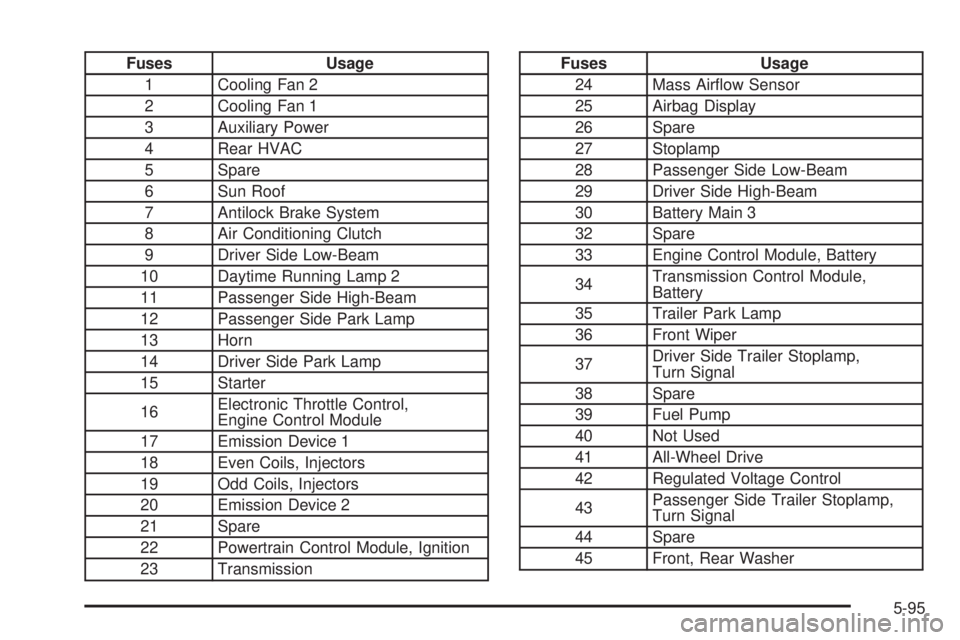
Fuses Usage
1 Cooling Fan 2
2 Cooling Fan 1
3 Auxiliary Power
4 Rear HVAC
5 Spare
6 Sun Roof
7 Antilock Brake System
8 Air Conditioning Clutch
9 Driver Side Low-Beam
10 Daytime Running Lamp 2
11 Passenger Side High-Beam
12 Passenger Side Park Lamp
13 Horn
14 Driver Side Park Lamp
15 Starter
16Electronic Throttle Control,
Engine Control Module
17 Emission Device 1
18 Even Coils, Injectors
19 Odd Coils, Injectors
20 Emission Device 2
21 Spare
22 Powertrain Control Module, Ignition
23 TransmissionFuses Usage
24 Mass Airow Sensor
25 Airbag Display
26 Spare
27 Stoplamp
28 Passenger Side Low-Beam
29 Driver Side High-Beam
30 Battery Main 3
32 Spare
33 Engine Control Module, Battery
34Transmission Control Module,
Battery
35 Trailer Park Lamp
36 Front Wiper
37Driver Side Trailer Stoplamp,
Turn Signal
38 Spare
39 Fuel Pump
40 Not Used
41 All-Wheel Drive
42 Regulated Voltage Control
43Passenger Side Trailer Stoplamp,
Turn Signal
44 Spare
45 Front, Rear Washer
5-95
Page 380 of 436
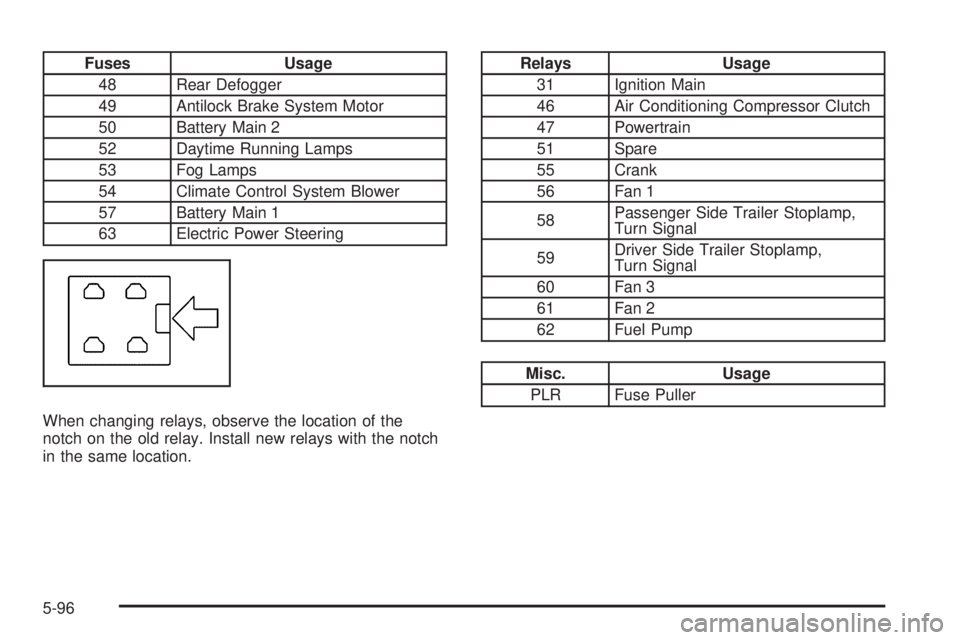
Fuses Usage
48 Rear Defogger
49 Antilock Brake System Motor
50 Battery Main 2
52 Daytime Running Lamps
53 Fog Lamps
54 Climate Control System Blower
57 Battery Main 1
63 Electric Power Steering
When changing relays, observe the location of the
notch on the old relay. Install new relays with the notch
in the same location.Relays Usage
31 Ignition Main
46 Air Conditioning Compressor Clutch
47 Powertrain
51 Spare
55 Crank
56 Fan 1
58Passenger Side Trailer Stoplamp,
Turn Signal
59Driver Side Trailer Stoplamp,
Turn Signal
60 Fan 3
61 Fan 2
62 Fuel Pump
Misc. Usage
PLR Fuse Puller
5-96
Page 391 of 436
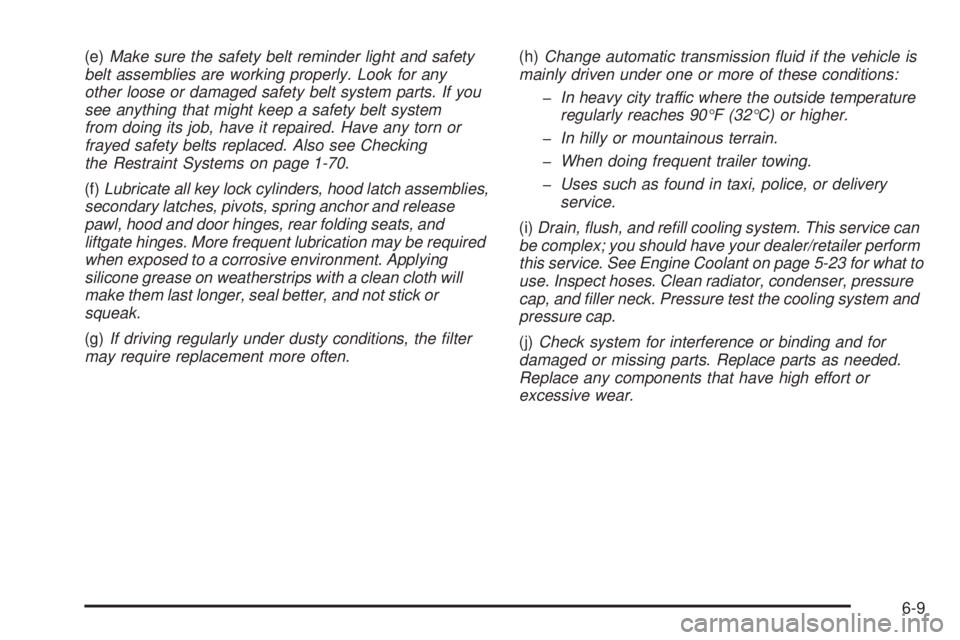
(e)Make sure the safety belt reminder light and safety
belt assemblies are working properly. Look for any
other loose or damaged safety belt system parts. If you
see anything that might keep a safety belt system
from doing its job, have it repaired. Have any torn or
frayed safety belts replaced. Also see Checking
the Restraint Systems on page 1-70.
(f)Lubricate all key lock cylinders, hood latch assemblies,
secondary latches, pivots, spring anchor and release
pawl, hood and door hinges, rear folding seats, and
liftgate hinges. More frequent lubrication may be required
when exposed to a corrosive environment. Applying
silicone grease on weatherstrips with a clean cloth will
make them last longer, seal better, and not stick or
squeak.
(g)If driving regularly under dusty conditions, the filter
may require replacement more often.(h)Change automatic transmission fluid if the vehicle is
mainly driven under one or more of these conditions:
In heavy city traffic where the outside temperature
regularly reaches 90°F (32°C) or higher.
In hilly or mountainous terrain.
When doing frequent trailer towing.
Uses such as found in taxi, police, or delivery
service.
(i)Drain, flush, and refill cooling system. This service can
be complex; you should have your dealer/retailer perform
this service. See Engine Coolant on page 5-23 for what to
use. Inspect hoses. Clean radiator, condenser, pressure
cap, and filler neck. Pressure test the cooling system and
pressure cap.
(j)Check system for interference or binding and for
damaged or missing parts. Replace parts as needed.
Replace any components that have high effort or
excessive wear.
6-9
Page 392 of 436
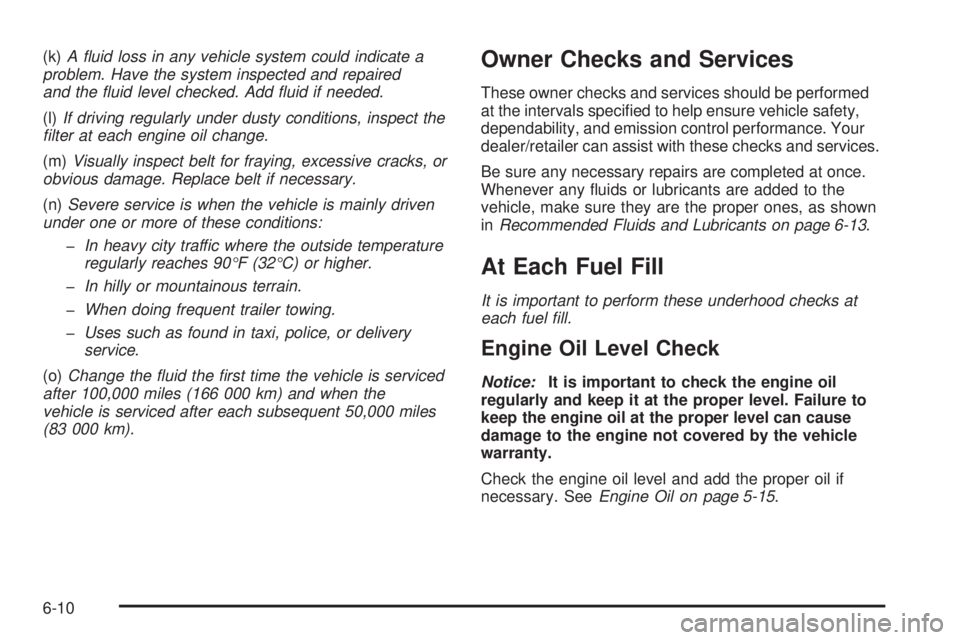
(k)A fluid loss in any vehicle system could indicate a
problem. Have the system inspected and repaired
and the fluid level checked. Add fluid if needed.
(l)If driving regularly under dusty conditions, inspect the
filter at each engine oil change.
(m)Visually inspect belt for fraying, excessive cracks, or
obvious damage. Replace belt if necessary.
(n)Severe service is when the vehicle is mainly driven
under one or more of these conditions:
In heavy city traffic where the outside temperature
regularly reaches 90°F (32°C) or higher.
In hilly or mountainous terrain.
When doing frequent trailer towing.
Uses such as found in taxi, police, or delivery
service.
(o)Change the fluid the first time the vehicle is serviced
after 100,000 miles (166 000 km) and when the
vehicle is serviced after each subsequent 50,000 miles
(83 000 km).Owner Checks and Services
These owner checks and services should be performed
at the intervals specied to help ensure vehicle safety,
dependability, and emission control performance. Your
dealer/retailer can assist with these checks and services.
Be sure any necessary repairs are completed at once.
Whenever any uids or lubricants are added to the
vehicle, make sure they are the proper ones, as shown
inRecommended Fluids and Lubricants on page 6-13.
At Each Fuel Fill
It is important to perform these underhood checks at
each fuel fill.
Engine Oil Level Check
Notice:It is important to check the engine oil
regularly and keep it at the proper level. Failure to
keep the engine oil at the proper level can cause
damage to the engine not covered by the vehicle
warranty.
Check the engine oil level and add the proper oil if
necessary. SeeEngine Oil on page 5-15.
6-10
Page 435 of 436
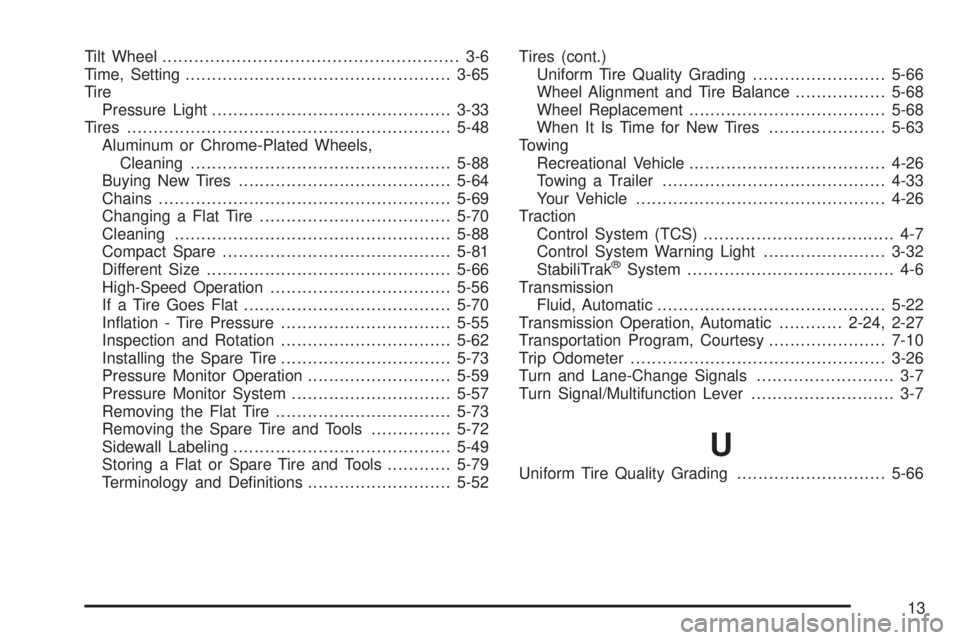
Tilt Wheel........................................................ 3-6
Time, Setting..................................................3-65
Tire
Pressure Light.............................................3-33
Tires.............................................................5-48
Aluminum or Chrome-Plated Wheels,
Cleaning.................................................5-88
Buying New Tires........................................5-64
Chains.......................................................5-69
Changing a Flat Tire....................................5-70
Cleaning....................................................5-88
Compact Spare...........................................5-81
Different Size..............................................5-66
High-Speed Operation..................................5-56
If a Tire Goes Flat.......................................5-70
Ination - Tire Pressure................................5-55
Inspection and Rotation................................5-62
Installing the Spare Tire................................5-73
Pressure Monitor Operation...........................5-59
Pressure Monitor System..............................5-57
Removing the Flat Tire.................................5-73
Removing the Spare Tire and Tools...............5-72
Sidewall Labeling.........................................5-49
Storing a Flat or Spare Tire and Tools............5-79
Terminology and Denitions...........................5-52Tires (cont.)
Uniform Tire Quality Grading.........................5-66
Wheel Alignment and Tire Balance.................5-68
Wheel Replacement.....................................5-68
When It Is Time for New Tires......................5-63
Towing
Recreational Vehicle.....................................4-26
Towing a Trailer..........................................4-33
Your Vehicle...............................................4-26
Traction
Control System (TCS).................................... 4-7
Control System Warning Light.......................3-32
StabiliTrak
®System....................................... 4-6
Transmission
Fluid, Automatic...........................................5-22
Transmission Operation, Automatic............2-24, 2-27
Transportation Program, Courtesy......................7-10
Trip Odometer................................................3-26
Turn and Lane-Change Signals.......................... 3-7
Turn Signal/Multifunction Lever........................... 3-7
U
Uniform Tire Quality Grading............................5-66
13