brake light PONTIAC VIBE 2004 User Guide
[x] Cancel search | Manufacturer: PONTIAC, Model Year: 2004, Model line: VIBE, Model: PONTIAC VIBE 2004Pages: 370, PDF Size: 2.68 MB
Page 178 of 370
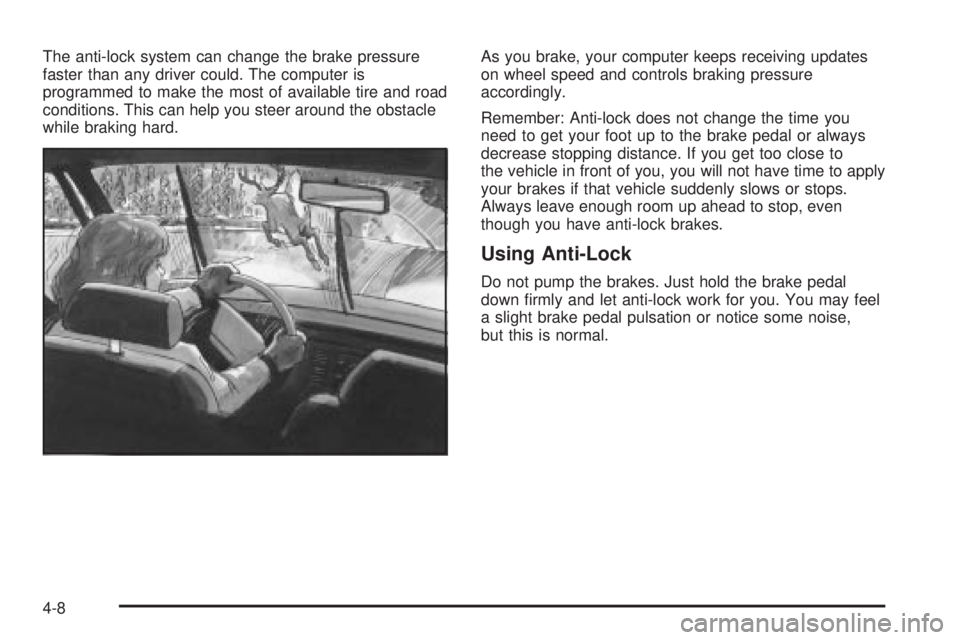
The anti-lock system can change the brake pressure
faster than any driver could. The computer is
programmed to make the most of available tire and road
conditions. This can help you steer around the obstacle
while braking hard.As you brake, your computer keeps receiving updates
on wheel speed and controls braking pressure
accordingly.
Remember: Anti-lock does not change the time you
need to get your foot up to the brake pedal or always
decrease stopping distance. If you get too close to
the vehicle in front of you, you will not have time to apply
your brakes if that vehicle suddenly slows or stops.
Always leave enough room up ahead to stop, even
though you have anti-lock brakes.
Using Anti-Lock
Do not pump the brakes. Just hold the brake pedal
down ®rmly and let anti-lock work for you. You may feel
a slight brake pedal pulsation or notice some noise,
but this is normal.
4-8
Page 179 of 370

Braking in Emergencies
At some time, nearly every driver gets into a situation
that requires hard braking.
If you have anti-lock, you can steer and brake at the
same time. However, if you do not have anti-lock, your
®rst reaction Ð to hit the brake pedal hard and hold
it down Ð may be the wrong thing to do. Your wheels
can stop rolling. Once they do, the vehicle can not
respond to your steering. Momentum will carry it
in whatever direction it was headed when the wheels
stopped rolling. That could be off the road, into the very
thing you were trying to avoid, or into traffic.
If you do not have anti-lock, use a ªsqueezeº braking
technique. This will give you maximum braking
while maintaining steering control. You can do this by
pushing on the brake pedal with steadily increasing
pressure.
In an emergency, you will probably want to squeeze the
brakes hard without locking the wheels. If you hear or
feel the wheels sliding, ease off the brake pedal.This will help you retain steering control. If you
dohave
anti-lock, it is different. See ªAnti-Lock Brake Systemº
in this section.
In many emergencies, steering can help you more than
even the very best braking.
All-Wheel Drive (AWD) System
If your vehicle has all-wheel drive (AWD), the AWD
system operates automatically without any action
required by the driver. If the front drive wheels begin to
slip, the rear wheels will automatically begin to drive
the vehicle as required. There may be a slight
engagement noise during hard use but this is normal.
Steering
Power Steering
If you lose power steering assist because the engine
stops or the system is not functioning, you can steer but
it will take much more effort.
4-9
Page 187 of 370

The heavier the rain, the harder it is to see. Even if your
windshield wiper blades are in good shape, a heavy
rain can make it harder to see road signs and
traffic signals, pavement markings, the edge of the road
and even people walking.
It's wise to keep your windshield wiping equipment in
good shape and keep your windshield washer tank ®lled
with washer ¯uid. Replace your windshield wiper
inserts when they show signs of streaking or missing
areas on the windshield, or when strips of rubber start to
separate from the inserts.Driving too fast through large water puddles or even
going through some car washes can cause problems,
too. The water may affect your brakes. Try to avoid
puddles. But if you can't, try to slow down before you
hit them.
{CAUTION:
Wet brakes can cause accidents. They will not
work as well in a quick stop and may cause
pulling to one side. You could lose control of
the vehicle.
After driving through a large puddle of water
or a car wash, apply your brake pedal lightly
until your brakes work normally.
4-17
Page 251 of 370

So, it is not a good idea to ªtop offº your brake ¯uid.
Adding brake ¯uid will not correct a leak. If you add ¯uid
when your linings are worn, then you will have too
much ¯uid when you get new brake linings. You should
add (or remove) brake ¯uid, as necessary, only when
work is done on the brake hydraulic system.
{CAUTION:
If you have too much brake ¯uid, it can spill on
the engine. The ¯uid will burn if the engine is
hot enough. You or others could be burned,
and your vehicle could be damaged. Add brake
¯uid only when work is done on the brake
hydraulic system.When your brake ¯uid falls to a low level, your brake
warning light will come on. SeeBrake System Warning
Light on page 3-31. United States
Canada
5-41
Page 253 of 370

Brake Wear
The GT series has four-wheel disc brakes. All other
models have front disc brakes and rear drum brakes.
Disc brake pads have built-in wear indicators that make
a high-pitched warning sound when the brake pads
are worn and new pads are needed. The sound
may come and go or be heard all the time your vehicle
is moving (except when you are pushing on the
brake pedal ®rmly).
{CAUTION:
The brake wear warning sound means that
soon your brakes will not work well. That
could lead to an accident. When you hear the
brake wear warning sound, have your vehicle
serviced.
Notice:Continuing to drive with worn-out brake
pads could result in costly brake repair.
Some driving conditions or climates may cause a brake
squeal when the brakes are ®rst applied or lightly
applied. This does not mean something is wrong with
your brakes.Properly torqued wheel nuts are necessary to help
prevent brake pulsation. When tires are rotated, inspect
brake pads for wear and evenly tighten wheel nuts in
the proper sequence to GM torque speci®cations.
If you have rear drum brakes, they do not have wear
indicators, but if you ever hear a rear brake rubbing
noise, have the rear brake linings inspected immediately.
Also, the rear brake drums should be removed and
inspected each time the tires are removed for rotation or
changing. When you have the front brake pads
replaced, have the rear brakes inspected, too.
Brake linings should always be replaced as complete
axle sets.
See
Brake System Inspection on page 6-25.
Brake Pedal Travel
See your dealer if the brake pedal does not return to
normal height, or if there is a rapid increase in
pedal travel. This could be a sign of brake trouble.
Brake Adjustment
Every time you make a moderate brake stop, your disc
brakes adjust for wear. If you rarely make a moderate
or heavier stop, then your brakes might not adjust
correctly. If you drive in that way, then Ð very
carefully Ð make a few moderate brake stops about
every 1,000 miles (1 600 km), so your brakes will
adjust properly.
5-43
Page 275 of 370

Tire Terminology and De®nitions
Air Pressure:The amount of air inside the tire pressing
outward on each square inch of the tire. Air pressure
is expressed in pounds per square inch (psi) or
kilopascal (kPa).
Accessory Weight:This means the combined weight
of optional accessories, for example, automatic
transmission, power steering, power brakes, power
windows, power seats, radio and air conditioning.
Aspect Ratio:The relationship of a tire's height to
its width.
Belt:A rubber coated layer of cords that is located
between the plies and the tread. Cords may be made
from steel or other reinforcing materials.
Bead:The tire bead contains steel wires that hold the
tire onto the rim.
Bias Ply Tire:A pneumatic tire in which the ply cords
that extend to the beads are laid at alternate angles
substantially less than 90 degrees to the centerline of
the tread.
Cold In¯ation Pressure:The amount of air pressure in
a tire, measured in pounds per square inch (psi) or
kilopascal (kPa), before a tire has built up heat
from driving. See
In¯ation -- Tire Pressure on page 5-67.Curb Weight:This means the weight of a motor
vehicle with standard and optional equipment including
the maximum capacity of fuel, oil and coolant, without
passengers and cargo.
DOT Markings:A code molded into the sidewall of a
tire signifying that the tire is in compliance with the
U.S. Department of Transportation motor vehicle safety
standards. The DOT code includes the Tire Identi®cation
Number (TIN), an alphanumeric designator which can
also identify the tire manufacturer, production plant,
brand and date of production.
GVWR:Gross Vehicle Weight Rating, see
Loading
Your Vehicle on page 4-32.
GAWR FRT:Gross Axle Weight Rating for the front
axle, see
Loading Your Vehicle on page 4-32.
GAWR RR:Gross Axle Weight Rating for the rear axle,
see
Loading Your Vehicle on page 4-32.
Intended Outboard Sidewall:The side of an
asymmetrical tire that must always face outward when
mounted on a vehicle.
Kilopascal (kPa):The metric unit for air pressure.
There are 6.9 kPa's to one psi.
Light Truck (LT-Metric) Tire:A tire used on light duty
trucks and some multipurpose passenger vehicles.
5-65
Page 309 of 370
Instrument Panel Fuse Block
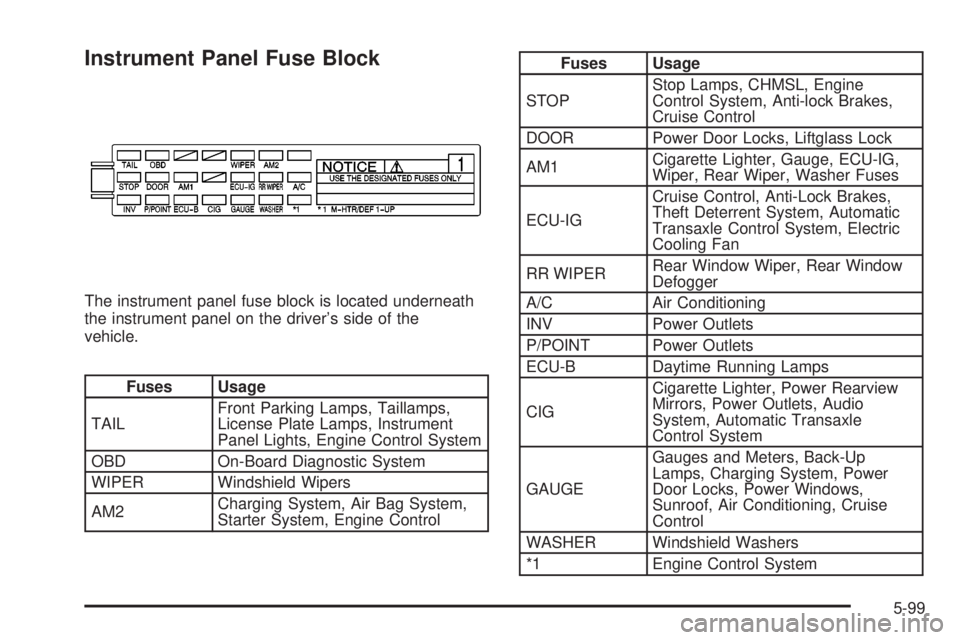
The instrument panel fuse block is located underneath
the instrument panel on the driver's side of the
vehicle.
Fuses Usage
TAILFront Parking Lamps, Taillamps,
License Plate Lamps, Instrument
Panel Lights, Engine Control System
OBD On-Board Diagnostic System
WIPER Windshield Wipers
AM2Charging System, Air Bag System,
Starter System, Engine Control
Fuses Usage
STOPStop Lamps, CHMSL, Engine
Control System, Anti-lock Brakes,
Cruise Control
DOOR Power Door Locks, Liftglass Lock
AM1Cigarette Lighter, Gauge, ECU-IG,
Wiper, Rear Wiper, Washer Fuses
ECU-IGCruise Control, Anti-Lock Brakes,
Theft Deterrent System, Automatic
Transaxle Control System, Electric
Cooling Fan
RR WIPERRear Window Wiper, Rear Window
Defogger
A/C Air Conditioning
INV Power Outlets
P/POINT Power Outlets
ECU-B Daytime Running Lamps
CIGCigarette Lighter, Power Rearview
Mirrors, Power Outlets, Audio
System, Automatic Transaxle
Control System
GAUGEGauges and Meters, Back-Up
Lamps, Charging System, Power
Door Locks, Power Windows,
Sunroof, Air Conditioning, Cruise
Control
WASHER Windshield Washers
*1 Engine Control System
5-99
Page 310 of 370
Engine Compartment Fuse Block
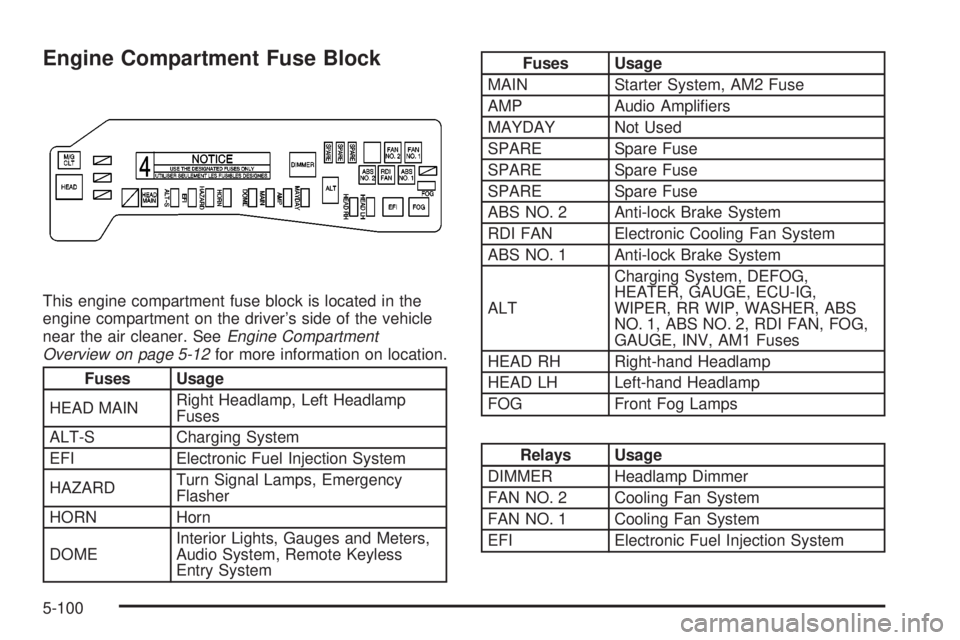
This engine compartment fuse block is located in the
engine compartment on the driver's side of the vehicle
near the air cleaner. See
Engine Compartment
Overview on page 5-12for more information on location.
Fuses Usage
HEAD MAINRight Headlamp, Left Headlamp
Fuses
ALT-S Charging System
EFI Electronic Fuel Injection System
HAZARDTurn Signal Lamps, Emergency
Flasher
HORN Horn
DOMEInterior Lights, Gauges and Meters,
Audio System, Remote Keyless
Entry System
Fuses Usage
MAIN Starter System, AM2 Fuse
AMP Audio Ampli®ers
MAYDAY Not Used
SPARE Spare Fuse
SPARE Spare Fuse
SPARE Spare Fuse
ABS NO. 2 Anti-lock Brake System
RDI FAN Electronic Cooling Fan System
ABS NO. 1 Anti-lock Brake System
ALTCharging System, DEFOG,
HEATER, GAUGE, ECU-IG,
WIPER, RR WIP, WASHER, ABS
NO. 1, ABS NO. 2, RDI FAN, FOG,
GAUGE, INV, AM1 Fuses
HEAD RH Right-hand Headlamp
HEAD LH Left-hand Headlamp
FOG Front Fog Lamps
Relays Usage
DIMMER Headlamp Dimmer
FAN NO. 2 Cooling Fan System
FAN NO. 1 Cooling Fan System
EFI Electronic Fuel Injection System
5-100
Page 357 of 370
A
Accessory Power Outlets.................................3-17
Adding Washer Fluid.......................................5-39
Additional Program Information........................... 7-9
Additives, Fuel................................................. 5-6
Add-On Electrical Equipment............................5-97
Adjusting the Speakers (Balance/Fade)......3-45, 3-54
Air Bag .........................................................3-30
Readiness Light..........................................3-30
Air Bag System, Supplemental Restraint
System (SRS).............................................1-47
Air Cleaner/Filter, Engine.................................5-21
All-Wheel Drive...............................................5-51
All-Wheel-Drive (AWD) System........................... 4-9
Aluminum Wheels...........................................5-94
AM ...............................................................3-63
Antenna, Fixed Mast.......................................3-64
Antenna, XMŸ Satellite Radio Antenna
System......................................................3-64
Anti-Lock Brake, System Warning Light..............3-32
Anti-lock Brake System..................................... 4-7
Appearance Care............................................5-89
Care of Safety Belts....................................5-92
Chemical Paint Spotting...............................5-95
Cleaning the Inside of Your Vehicle................5-89Appearance Care (cont.)
Cleaning the Outside of Your Vehicle..............5-92
Finish Damage............................................5-94
Sheet Metal Damage...................................5-94
Underbody Maintenance...............................5-95
Vehicle Care/Appearance Materials................5-95
Weatherstrips..............................................5-92
Arming the System.........................................2-14
Ashtrays........................................................3-19
Audio System(s).............................................3-41
Care of Your CD Player...............................3-64
Care of Your CDs........................................3-64
Fixed Mast Antenna.....................................3-64
Navigation/Radio System..............................3-63
Radio with CD............................................3-42
Radio with Six-Disc CD................................3-52
Setting the Time..........................................3-41
Understanding Radio Reception.....................3-63
XMŸ Satellite Radio Antenna System............3-64
Automatic Headlamp System............................3-13
Automatic Transaxle........................................2-18
Fluid..........................................................5-23
Operation...................................................2-20
Automatic Transaxle Shift Lock Control
System Check.............................................6-22
1
Page 358 of 370
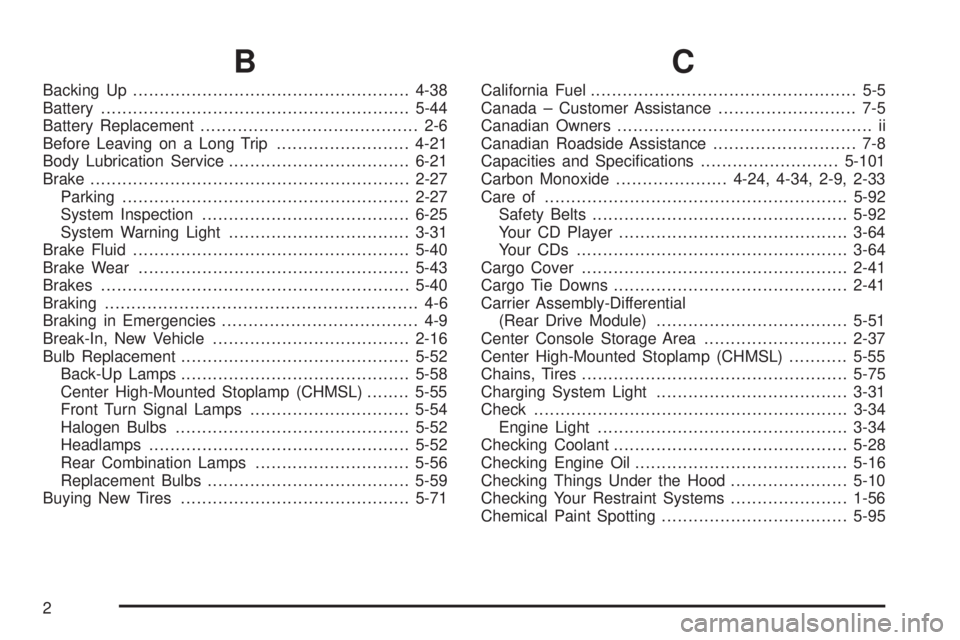
B
Backing Up....................................................4-38
Battery..........................................................5-44
Battery Replacement......................................... 2-6
Before Leaving on a Long Trip.........................4-21
Body Lubrication Service..................................6-21
Brake............................................................2-27
Parking......................................................2-27
System Inspection.......................................6-25
System Warning Light..................................3-31
Brake Fluid....................................................5-40
Brake Wear...................................................5-43
Brakes..........................................................5-40
Braking........................................................... 4-6
Braking in Emergencies..................................... 4-9
Break-In, New Vehicle.....................................2-16
Bulb Replacement...........................................5-52
Back-Up Lamps...........................................5-58
Center High-Mounted Stoplamp (CHMSL)........5-55
Front Turn Signal Lamps..............................5-54
Halogen Bulbs............................................5-52
Headlamps.................................................5-52
Rear Combination Lamps.............................5-56
Replacement Bulbs......................................5-59
Buying New Tires...........................................5-71
C
California Fuel.................................................. 5-5
Canada ± Customer Assistance.......................... 7-5
Canadian Owners................................................ ii
Canadian Roadside Assistance........................... 7-8
Capacities and Speci®cations..........................5-101
Carbon Monoxide.....................4-24, 4-34, 2-9, 2-33
Care of.........................................................5-92
Safety Belts................................................5-92
Your CD Player...........................................3-64
Your CDs ...................................................3-64
Cargo Cover..................................................2-41
Cargo Tie Downs............................................2-41
Carrier Assembly-Differential
(Rear Drive Module)....................................5-51
Center Console Storage Area...........................2-37
Center High-Mounted Stoplamp (CHMSL)...........5-55
Chains, Tires..................................................5-75
Charging System Light....................................3-31
Check...........................................................3-34
Engine Light...............................................3-34
Checking Coolant............................................5-28
Checking Engine Oil........................................5-16
Checking Things Under the Hood......................5-10
Checking Your Restraint Systems......................1-56
Chemical Paint Spotting...................................5-95
2