instrument panel PONTIAC VIBE 2004 User Guide
[x] Cancel search | Manufacturer: PONTIAC, Model Year: 2004, Model line: VIBE, Model: PONTIAC VIBE 2004Pages: 370, PDF Size: 2.68 MB
Page 74 of 370
Liftgate/Liftglass Release
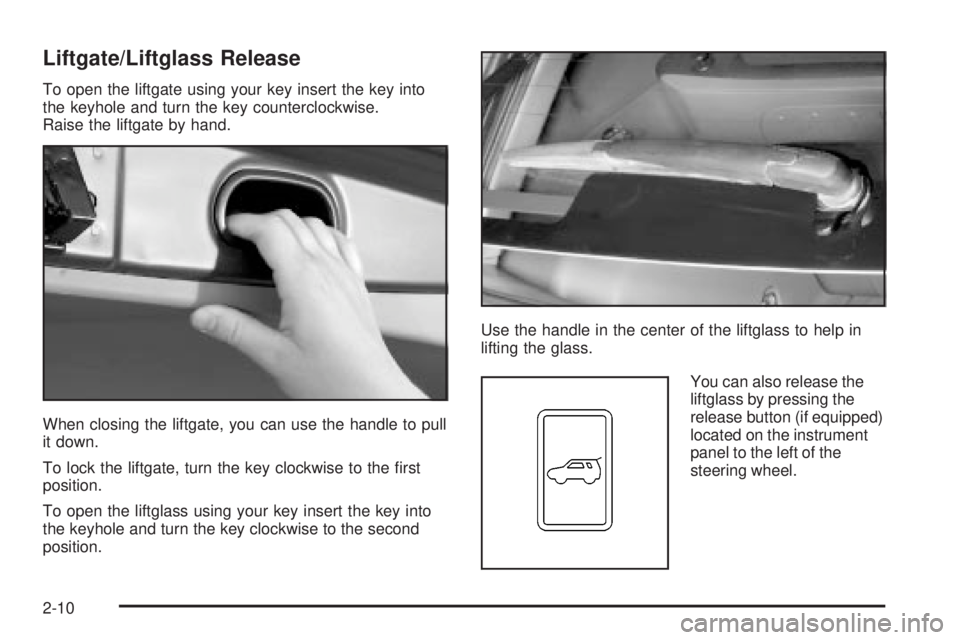
To open the liftgate using your key insert the key into
the keyhole and turn the key counterclockwise.
Raise the liftgate by hand.
When closing the liftgate, you can use the handle to pull
it down.
To lock the liftgate, turn the key clockwise to the ®rst
position.
To open the liftglass using your key insert the key into
the keyhole and turn the key clockwise to the second
position.Use the handle in the center of the liftglass to help in
lifting the glass.
You can also release the
liftglass by pressing the
release button (if equipped)
located on the instrument
panel to the left of the
steering wheel.
2-10
Page 78 of 370

Arming the System
To arm the system, do the following:
1. Turn the ignition key to the LOCK position and
remove it.
2. Have all passengers get out of the vehicle.
3. Close and lock all the side doors and liftgate with
the key or remote keyless entry transmitter.
The indicator light located
on the instrument panel to
the left of the steering
wheel will come on when
all the side doors and
liftgate are closed
and locked.
The system will be automatically set after 30 seconds.
When the system is set, the indicator light will start
¯ashing.4. After the indicator light starts ¯ashing, you may
leave the vehicle.
Do not leave anyone in the vehicle when you set
the system, because unlocking the vehicle from the
inside will activate the system.
Testing the Alarm
To test the alarm, do the following:
1. Open all the windows.
2. Set the system as described in the previous
procedure. The side doors and liftgate should
be locked with the key or remote keyless entry
transmitter. Be sure to wait until the indicator light
starts ¯ashing.
3. Unlock the driver's door from the inside. The
system should activate the alarm.
4. Stop the alarm as described in the disarming
procedure.
5. Repeat this operation for the other doors. Also
check that the system is activated when the
battery terminal is disconnected and then
reconnected.
If the system does not work properly, have it
checked by your dealer.
2-14
Page 86 of 370
SECOND (2):This position gives you more power than
DRIVE (D) but lower fuel economy. You can use
SECOND (2) on hills. It can help control your speed as
you go down steep mountain roads, but then you
would also want to use your brakes off and on.
LOW (L):This position gives you even more power
than SECOND (2) but lower fuel economy. You can use
it on very steep hills, or in deep snow or mud. If the
shift lever is put in LOW (L), the transaxle won't shift into
low gear until the vehicle is going slow enough.
Notice:If your front wheels won't turn, don't try to
drive. This might happen if you were stuck in
very deep sand or mud or were up against a solid
object. You could damage your transaxle. Also,
if you stop when going uphill, don't hold your
vehicle there with only the accelerator pedal. This
could overheat and damage the transaxle. Use your
brakes to hold your vehicle in position on a hill.
Overdrive Off
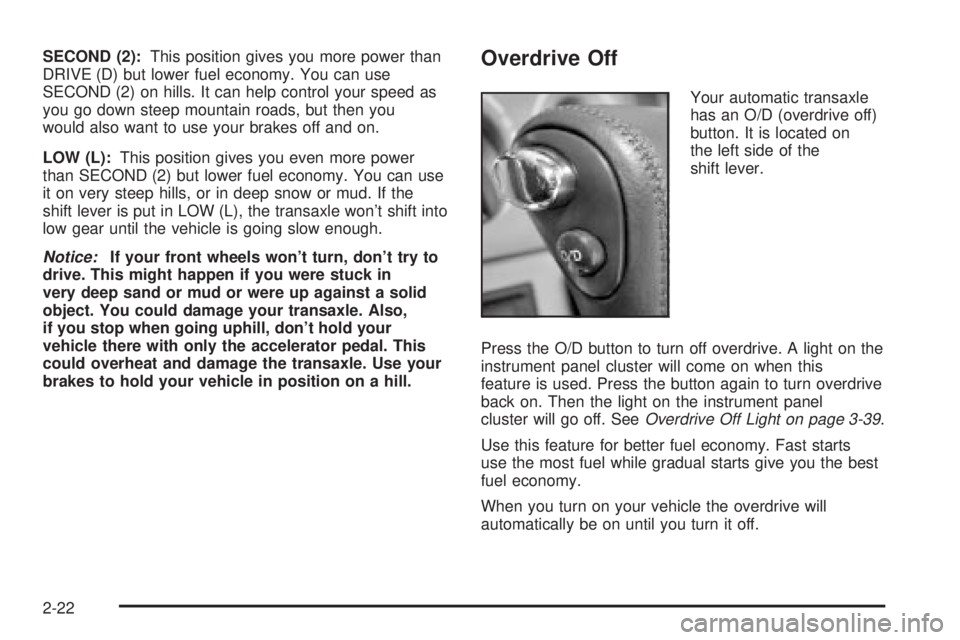
Your automatic transaxle
has an O/D (overdrive off)
button. It is located on
the left side of the
shift lever.
Press the O/D button to turn off overdrive. A light on the
instrument panel cluster will come on when this
feature is used. Press the button again to turn overdrive
back on. Then the light on the instrument panel
cluster will go off. See
Overdrive Off Light on page 3-39.
Use this feature for better fuel economy. Fast starts
use the most fuel while gradual starts give you the best
fuel economy.
When you turn on your vehicle the overdrive will
automatically be on until you turn it off.
2-22
Page 100 of 370
Outside Remote Control Mirrors
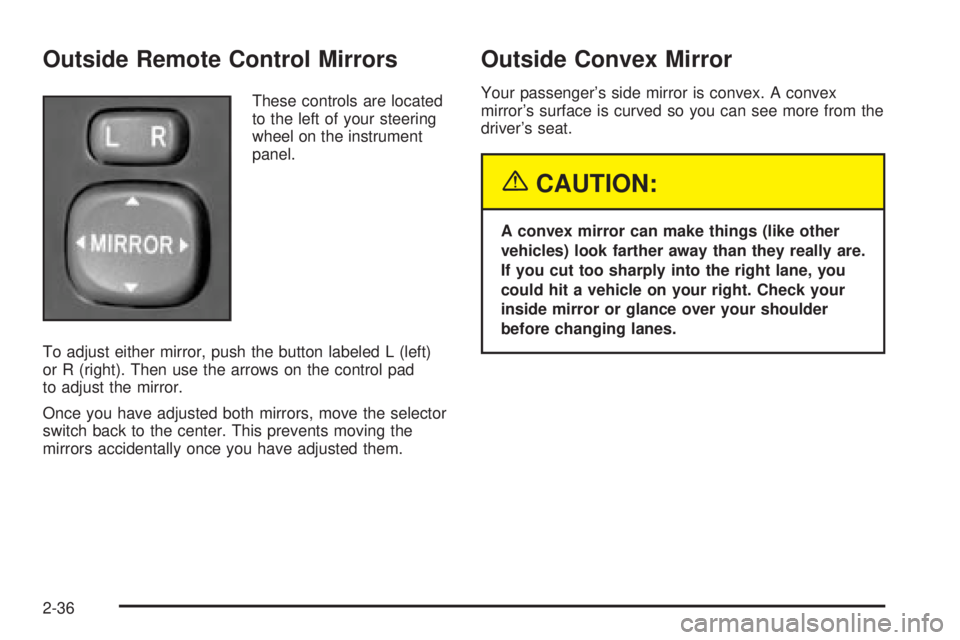
These controls are located
to the left of your steering
wheel on the instrument
panel.
To adjust either mirror, push the button labeled L (left)
or R (right). Then use the arrows on the control pad
to adjust the mirror.
Once you have adjusted both mirrors, move the selector
switch back to the center. This prevents moving the
mirrors accidentally once you have adjusted them.
Outside Convex Mirror
Your passenger's side mirror is convex. A convex
mirror's surface is curved so you can see more from the
driver's seat.
{CAUTION:
A convex mirror can make things (like other
vehicles) look farther away than they really are.
If you cut too sharply into the right lane, you
could hit a vehicle on your right. Check your
inside mirror or glance over your shoulder
before changing lanes.
2-36
Page 101 of 370
Storage Areas
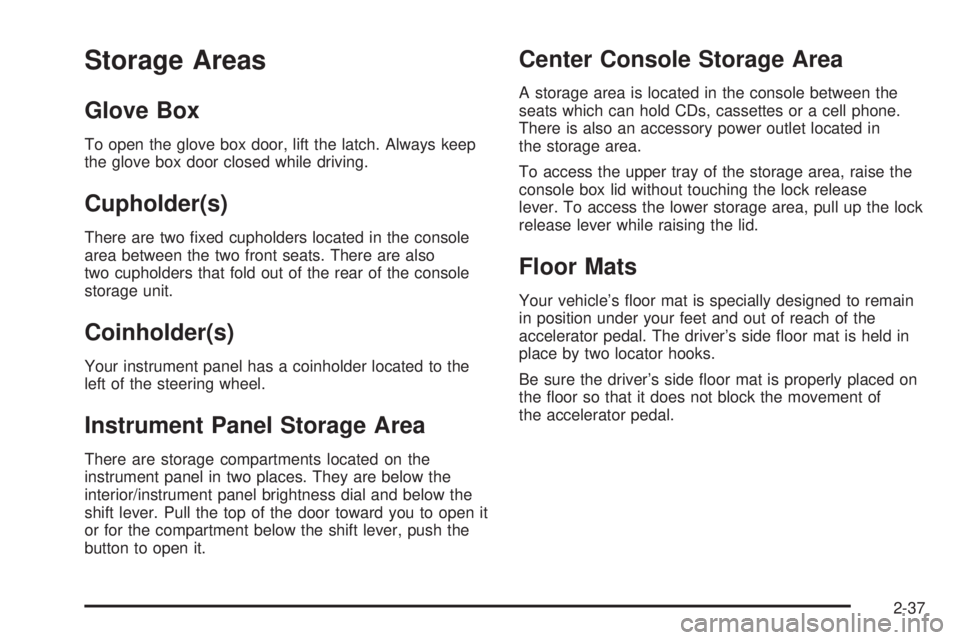
Glove Box
To open the glove box door, lift the latch. Always keep
the glove box door closed while driving.
Cupholder(s)
There are two ®xed cupholders located in the console
area between the two front seats. There are also
two cupholders that fold out of the rear of the console
storage unit.
Coinholder(s)
Your instrument panel has a coinholder located to the
left of the steering wheel.
Instrument Panel Storage Area
There are storage compartments located on the
instrument panel in two places. They are below the
interior/instrument panel brightness dial and below the
shift lever. Pull the top of the door toward you to open it
or for the compartment below the shift lever, push the
button to open it.
Center Console Storage Area
A storage area is located in the console between the
seats which can hold CDs, cassettes or a cell phone.
There is also an accessory power outlet located in
the storage area.
To access the upper tray of the storage area, raise the
console box lid without touching the lock release
lever. To access the lower storage area, pull up the lock
release lever while raising the lid.
Floor Mats
Your vehicle's ¯oor mat is specially designed to remain
in position under your feet and out of reach of the
accelerator pedal. The driver's side ¯oor mat is held in
place by two locator hooks.
Be sure the driver's side ¯oor mat is properly placed on
the ¯oor so that it does not block the movement of
the accelerator pedal.
2-37
Page 107 of 370
Instrument Panel Overview...............................3-2
Hazard Warning Flashers................................3-4
Other Warning Devices...................................3-4
Horn.............................................................3-5
Tilt Wheel.....................................................3-5
Turn Signal/Multifunction Lever.........................3-5
Exterior Lamps.............................................3-12
Interior Lamps..............................................3-14
Accessory Power Outlets...............................3-17
Power Outlet 115 Volt Alternating Current........3-18
Ashtrays and Cigarette Lighter........................3-19
Climate Controls............................................3-19
Climate Control System.................................3-19
Outlet Adjustment.........................................3-22
Passenger Compartment Air Filter...................3-23
Warning Lights, Gages and Indicators.............3-25
Instrument Panel Cluster................................3-26
Speedometer and Odometer...........................3-27
Tachometer.................................................3-28
Safety Belt Reminder Light.............................3-28
Air Bag Readiness Light................................3-30
Charging System Light..................................3-31Brake System Warning Light..........................3-31
Anti-Lock Brake System Warning Light.............3-32
Engine Coolant Temperature Gage..................3-33
Malfunction Indicator Lamp.............................3-34
Oil Pressure Light.........................................3-38
Cruise Control Light......................................3-39
Overdrive Off Light........................................3-39
Low Washer Fluid Warning Light.....................3-39
Door Ajar Light.............................................3-39
Fuel Gage...................................................3-40
Audio System(s).............................................3-41
Setting the Time...........................................3-41
Radio with CD..............................................3-42
Radio with Six-Disc CD.................................3-52
Navigation/Radio System...............................3-63
Understanding Radio Reception......................3-63
Care of Your CDs.........................................3-64
Care of Your CD Player................................3-64
Fixed Mast Antenna......................................3-64
XMŸ Satellite Radio Antenna System
(United States Only)..................................3-64
Section 3 Instrument Panel
3-1
Page 108 of 370
Instrument Panel Overview
3-2
Page 109 of 370

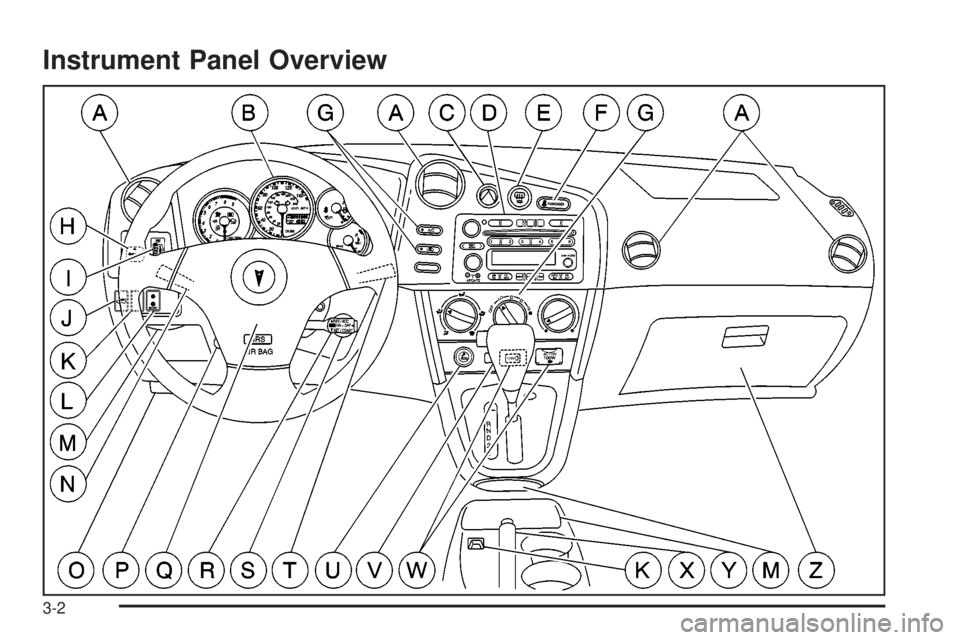
The main components of your instrument panel are the
following:
A. Air Outlets. See
Outlet Adjustment on page 3-22.
B. Instrument Panel Cluster. See
Instrument Panel
Cluster on page 3-26.
C. Hazard Warning Flasher Button. See
Hazard
Warning Flashers on page 3-4.
D. Audio System. See
Audio System(s) on page 3-41.
E. Rear Window Defogger Button. See ªRear Window
Defoggerº under
Climate Control System on
page 3-19.
F. Front Passenger Safety Belt Reminder Light. See
Safety Belt Reminder Light on page 3-28.
G. Climate Control System. See
Climate Control
System on page 3-19.
H. Power Remote Control Mirror Button. See
Outside
Remote Control Mirrors on page 2-36.
I. Instrument Panel Brightness Control. See
ªInstrument Panel Brightnessº under
Interior Lamps
on page 3-14.
J. Rear Liftglass Release Button. See
Liftgate/Liftglass
on page 2-9.
K. Coinholder. See
Coinholder(s) on page 2-37.
L. Content Theft-Deterrent Security Light. See
Content
Theft-Deterrent on page 2-13.M. Storage Compartment. See
Instrument Panel
Storage Area on page 2-37.
N. Turn Signal/Multifunction Lever. See
Turn
Signal/Multifunction Lever on page 3-5.
O. Hood Release. See
Hood Release on page 5-10.
P. Tilt Lever. See
Tilt Wheel on page 3-5.
Q. Horn. See
Horn on page 3-5.
R. Cruise Control Lever (Option). See ªCruise Controlº
under
Turn Signal/Multifunction Lever on page 3-5.
S. Ignition Switch. See
Ignition Positions on page 2-16.
T. Windshield Wiper Lever. See ªWindshield Wipersº
under
Turn Signal/Multifunction Lever on page 3-5.
U. Cigarette Lighter. See
Ashtrays and Cigarette Lighter
on page 3-19.
V. Shift Lever. See
Shifting Into Park (P) on page 2-28.
W. Power Outlet. See
Power Outlet 115 Volt Alternating
Current on page 3-18.
X. Parking Brake. See
Parking Brake on page 2-27.
Y. Center Console Storage Area. See
Center Console
Storage Area on page 2-37.
Z. Glove Box. See
Glove Box on page 2-37.
3-3
Page 110 of 370
Hazard Warning Flashers
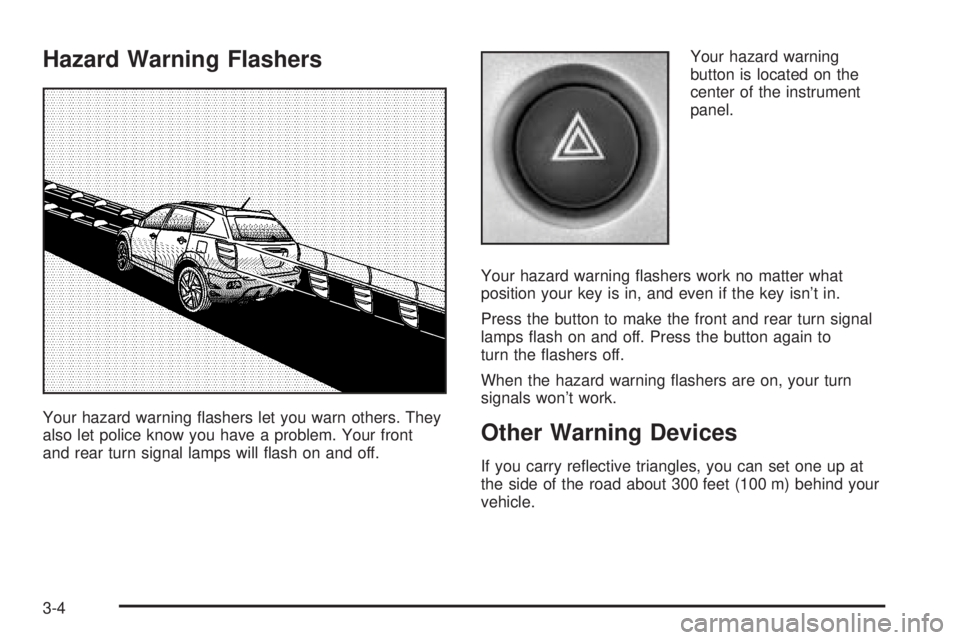
Your hazard warning ¯ashers let you warn others. They
also let police know you have a problem. Your front
and rear turn signal lamps will ¯ash on and off.Your hazard warning
button is located on the
center of the instrument
panel.
Your hazard warning ¯ashers work no matter what
position your key is in, and even if the key isn't in.
Press the button to make the front and rear turn signal
lamps ¯ash on and off. Press the button again to
turn the ¯ashers off.
When the hazard warning ¯ashers are on, your turn
signals won't work.Other Warning Devices
If you carry re¯ective triangles, you can set one up at
the side of the road about 300 feet (100 m) behind your
vehicle.
3-4
Page 112 of 370
Turn and Lane-Change Signals
The turn signal has an upward (for right) and a
downward (for left) position. These positions allow you
to signal a turn or a lane change.
To signal a turn, move the lever all the way up or down.
When the turn is ®nished, the lever will return
automatically.
To signal a lane change, raise or lower the lever until
the arrow starts to ¯ash. Hold it there until you complete
your lane change. The lever will return by itself when
you release it.
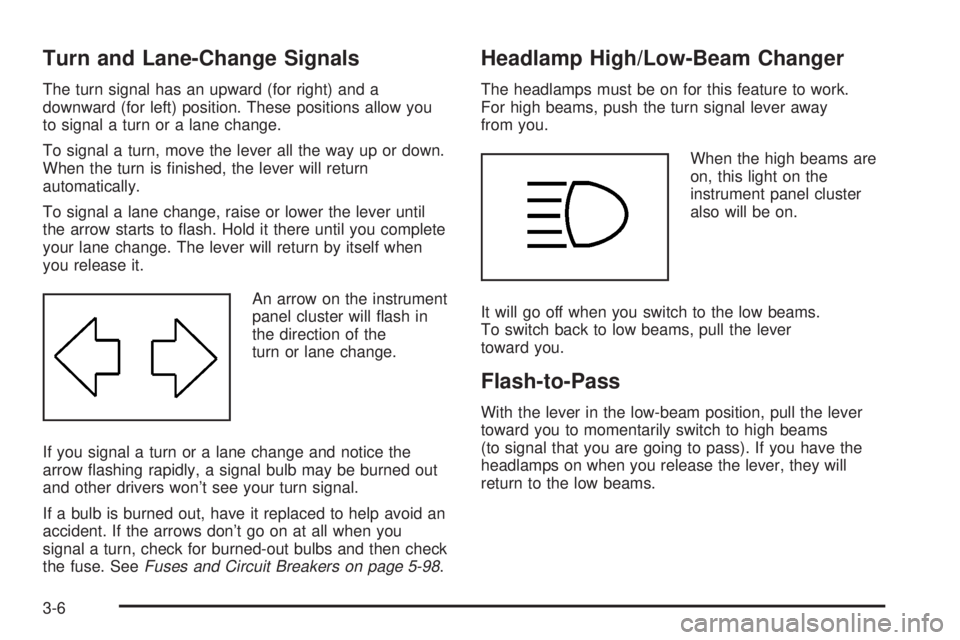
An arrow on the instrument
panel cluster will ¯ash in
the direction of the
turn or lane change.
If you signal a turn or a lane change and notice the
arrow ¯ashing rapidly, a signal bulb may be burned out
and other drivers won't see your turn signal.
If a bulb is burned out, have it replaced to help avoid an
accident. If the arrows don't go on at all when you
signal a turn, check for burned-out bulbs and then check
the fuse. See
Fuses and Circuit Breakers on page 5-98.
Headlamp High/Low-Beam Changer
The headlamps must be on for this feature to work.
For high beams, push the turn signal lever away
from you.
When the high beams are
on, this light on the
instrument panel cluster
also will be on.
It will go off when you switch to the low beams.
To switch back to low beams, pull the lever
toward you.
Flash-to-Pass
With the lever in the low-beam position, pull the lever
toward you to momentarily switch to high beams
(to signal that you are going to pass). If you have the
headlamps on when you release the lever, they will
return to the low beams.
3-6